

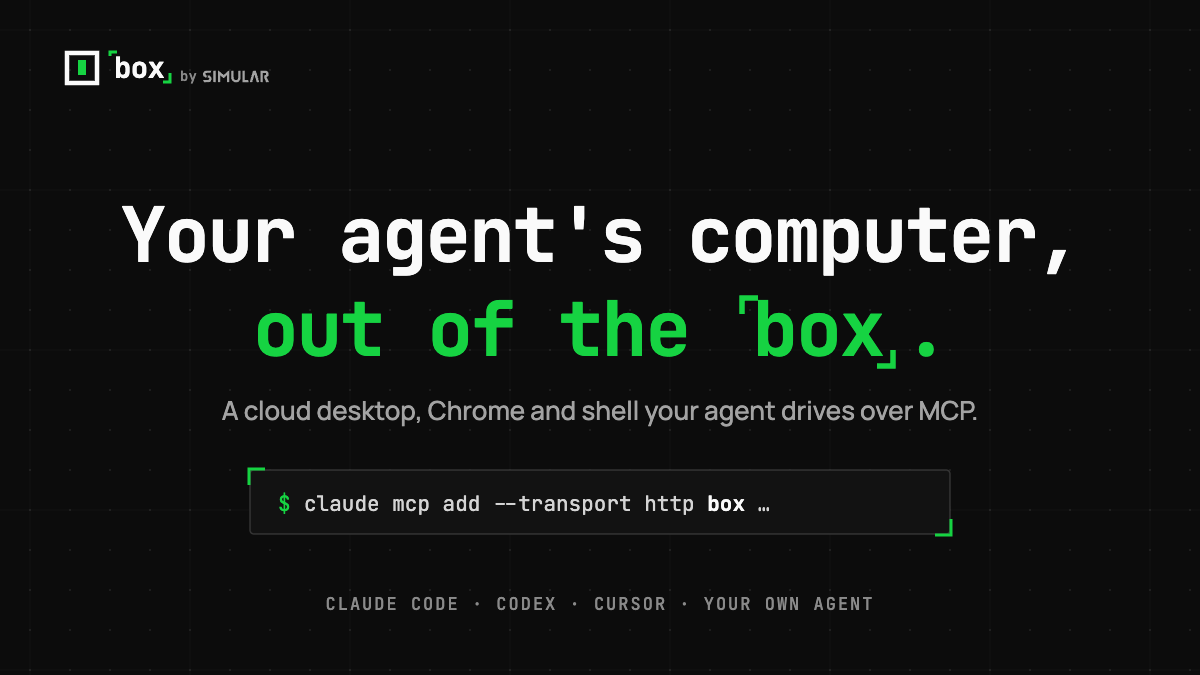
On November 12 (UTC), Simular, the computer-use agent startup backed by Felicis and NVIDIA, launched box: one cloud Ubuntu desktop per account with Chrome and a persistent shell, exposed as a single remote MCP server (https://mcp.box.simular.ai/mcp, Streamable HTTP, OAuth sign-in). Any MCP client can add it, including claude.ai, ChatGPT, Gemini, Claude Code, Codex, Cursor, OpenCode and VS Code, so different assistants can work on the same machine with shared logins and files. Users watch it live on the web or iPhone and take over to sign in or approve payments. The desktop itself is free; model calls use account credits. The box sleeps when idle, wakes in about a second, and is deleted after 14 straight days asleep. The launch video passed 810K views. Simular has not published a benchmark for its "fastest computer use" claim.
Key Takeaways
- ✓Setup: one remote MCP URL, mcp.box.simular.ai/mcp, with OAuth; Claude Code needs a single claude mcp add --transport http box command, and CI can use a personal cb_ key
- ✓The installer npx @simular-ai/[email protected] connect finds Claude Code, Codex, Cursor, OpenCode, Hermes, OpenClaw and VS Code on your machine and adds box; doctor and remove check and undo it
- ✓Billing: the desktop is free and model calls use account credits; it wakes in about 1 second and is deleted with its files after 14 straight days asleep
- ✓Secrets: API keys are stored encrypted and the AI only sees a stand-in; box swaps in the real key only on requests to the sites you list
- ✓The launch video drew about 815K views; the "fastest computer use" line is a vendor claim with no published OSWorld or other benchmark
Key Decision Metrics at a Glance
Heavy Claude Code use: compare subscription limits and API bills
Compare 40 dev plans & simulate token costs vs $20/mo subscriptions
Project Links & Resources
Direct AccessIn-Depth Technical Analysis
Background and pain points
Computer use is a battleground for every agent vendor this year, but deployment keeps hitting the same question: which computer does it run on? Driving the user's own machine fights them for the mouse and raises security concerns, while each vendor's cloud sandbox is isolated, so a page ChatGPT opened is out of Claude's reach. Simular, a computer-use agent startup backed by Felicis and NVIDIA, answered on November 12 with box: one always-available cloud computer per user that every AI can share.
Architecture highlights
box is a cloud Ubuntu desktop with Chrome and a persistent shell, exposed only as a single remote MCP server (Streamable HTTP with OAuth). Because it speaks standard MCP, claude.ai, ChatGPT, Gemini, Claude Code, Codex and Cursor can all connect, and logins and files stay on the machine, so a job Claude starts can be finished by ChatGPT. Users can watch the live screen on the web or iPhone and take over. A Secrets feature lets shell commands use API keys while the AI sees only a stand-in. The box sleeps when idle and wakes in about a second.
Benchmarks and data
CEO Ang Li, a former Google DeepMind research scientist, calls it "the world's fastest computer use in production," but Simular has not published OSWorld or any other benchmark, so treat that as a vendor claim. Verifiable numbers: the launch video has about 815K views, version 1.2.1 of the npm installer shipped on November 11, and the simular-ai/box-plugin repo is MIT licensed. The desktop is free and model calls use credits; the docs do not list prices.
Getting started
The quickest path is npx @simular-ai/[email protected] connect in a terminal, which configures the coding agents on your machine; or run claude mcp add --transport http box https://mcp.box.simular.ai/mcp in Claude Code and sign in with /mcp. Headless runs (codex exec, claude -p) must pre-approve box's tools, and CI should use a personal key kept in a secret store. A box asleep for 14 straight days is deleted, so back up anything important.
Benchmark side-by-side against alternatives, or calculate monthly token cost vs subscription break-even.
Discussion & Comments
0Sign in to join the discussion
Connect with AI developers to exchange benchmark insights.