AI Coding Live News

Ant Ling Launches Ling-3.2-flash: 560B/25B Native Multimodal MoE, 1M Context; Vendor Evals Beat Opus 5 on Several Vision Suites; Free for First Two Weeks

On November 5 Ant Group’s Ant Ling (@AntLingAGI) launched Ling-3.2-flash: a 560B-total / 25B-active native multimodal MoE with a 1M context window and native image, text and video input. The official changelog targets complex visual understanding, multimodal long-horizon agents, 3D understanding and interaction, and medical multimodal work; APIs are OpenAI- and Anthropic-compatible and free for the first two weeks. The launch post cites vendor evals versus Claude Opus 5 (max): OmniDocBench1.5 92.21 vs 90.56, ZEROBench(Sub) 43.71 vs 39.52, Vision2Web 85.86 vs 80.20. DesignArena placed it about #10 on Image-to-Frontend with Elo 1238.

Ant Ling Launches Ling-3.2-flash: 560B/25B Native Multimodal MoE, 1M Context; Vendor Evals Beat Opus 5 on Several Vision Suites; Free for First Two Weeks

Key Takeaways

  • Specs (official docs): 560B total / 25B active; 1M context; native image/text/video; four focuses: complex vision, multimodal long-horizon agents, 3D, medical multimodal
  • Availability: chat UI plus OpenAI/Anthropic-compatible APIs; changelog says free for first 2 weeks, then original pricing resumes
  • Vendor evals (official X): OmniDocBench1.5 92.21 vs Opus 5 90.56; ZEROBench(Sub) 43.71 vs 39.52; Vision2Web 85.86 vs 80.20
  • Third party: DesignArena Image-to-Frontend ~#10, Elo 1238; official price page stresses 2-week free promo and has not listed 3.2 USD rates yet
  • Hands-on: model id Ling-3.2-flash; use image_url / video_url blocks; weights not on Hugging Face (API-first)
Read full story
Linked Models & Agents:
⚡ Ling-3.2-flash⚡ Ling-3.1-flash⚡ Claude Opus 5🌐 Ant Ling🌐 Ant Group

vLLM and Ant Group Open-Source Humming: Up to 5x Kernel Acceleration and +43.3% MoE Throughput

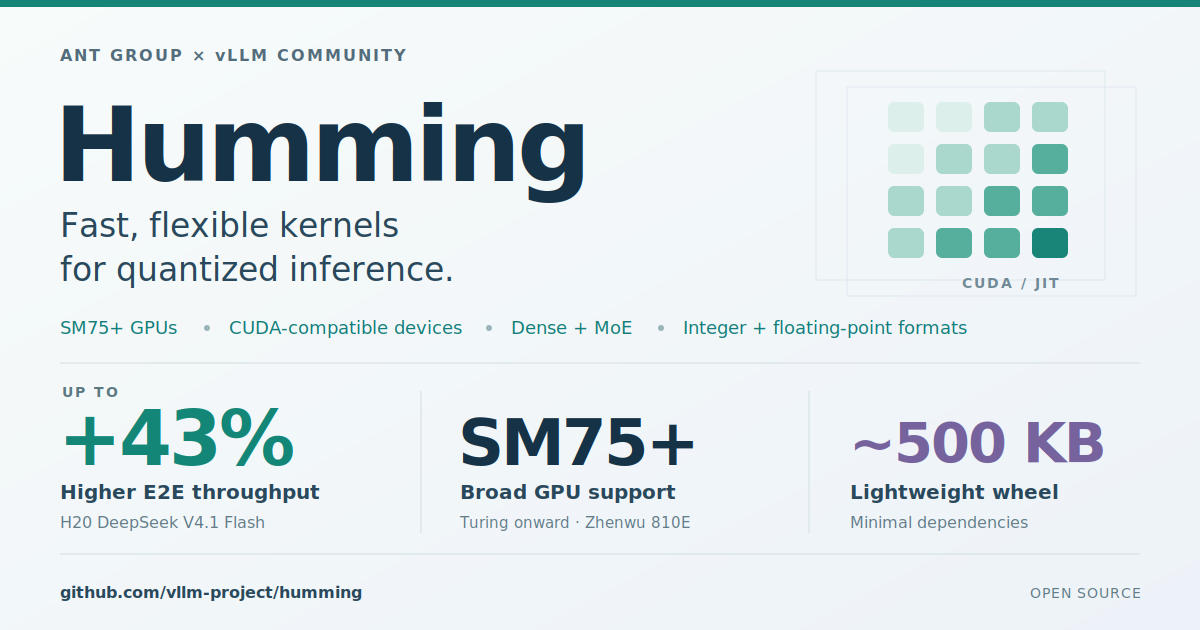
The vLLM project team and Ant Group officially open-sourced Humming (humming-kernels), a specialized high-performance kernel library designed for serving quantized MoE and dense LLMs at massive scale. Humming natively supports WnA16, W8A8, W4A8, and W4A4 across INT1–INT8 and FP4–FP8 formats, spanning NVIDIA architectures from Turing through Blackwell as well as T-Head Zhenwu 810E silicon. In production benchmarks, Humming kernels outpace cuBLAS by 3–4x at small batch sizes and surpass Marlin by 2x on H200 clusters. Serving DeepSeek-V4.1-Flash across 8x H20 GPUs, Humming drives a +43.3% throughput gain under 64 concurrent requests while reducing time-to-first-token (TTFT) by 32%, pre-integrated directly into vLLM v0.29.0+.

vLLM and Ant Group Open-Source Humming: Up to 5x Kernel Acceleration and +43.3% MoE Throughput

Key Takeaways

  • vLLM and Ant Group open-sourced Humming (humming-kernels), integrated out-of-the-box into vLLM v0.29.0+
  • Covers WnA16, W8A8, W4A8, and W4A4, compiling JIT kernels in just 1.82 seconds versus 23.35 seconds for CUTLASS
  • Serving DeepSeek-V4.1-Flash on 8x H20 GPUs yields a +43.3% throughput boost at 64 concurrency (442 to 634 tokens/sec)
  • Cuts time-to-first-token (TTFT) by 25% to 32% while delivering up to 5x kernel speedups on Blackwell B300 systems
Read full story

vLLM and Ant Group open-source Humming, one quantized-inference kernel library for many formats and every NVIDIA GPU since Turing, lifting DeepSeek-V4.1-Flash end-to-end throughput by 14-43%

On Oct 21 the vLLM community and Ant Group open-sourced Humming (Apache 2.0), a quantized-inference library that JIT-compiles GEMM kernels on demand. It supports every NVIDIA architecture from Turing on plus T-Head's Zhenwu 810E, and covers weight and activation combinations from INT1-INT8 and FP4-FP8 for dense and MoE workloads. In vLLM's microbenchmarks it runs 2-5x faster than vLLM Marlin, FlashInfer or DeepGEMM in some cases; on 8 H20 GPUs, switching DeepSeek-V4.1-Flash MoE from Marlin W4A16 to Humming W4A8 raised throughput 14-43%. vLLM 0.29.0 ships it built in.

vLLM and Ant Group open-source Humming, one quantized-inference kernel library for many formats and every NVIDIA GPU since Turing, lifting DeepSeek-V4.1-Flash end-to-end throughput by 14-43%

Key Takeaways

  • One JIT kernel framework instead of a hand-written kernel per format: WNA16, W8A8, W4A8, W4A4, INT1-INT8 and FP4-FP8 weights, dense and MoE
  • Hardware: every NVIDIA GPU from Turing (SM75) on, including Blackwell SM100/103/120/121, plus T-Head Zhenwu 810E
  • End to end: DeepSeek-V4.1-Flash on 8x H20 at TP=8, Humming W4A8 beats Marlin W4A16 by 14-43% in throughput and cuts mean TTFT 25-32%; at concurrency 64 output goes from 442 to 634 tok/s
  • Microbenchmarks run by the vLLM community: W4A8-MXFP4 on H200 is about 4.5x DeepGEMM W8A8, and the B300 MoE Grouped path is about 5x Marlin; one W4A16 kernel compiles in 1.82 s versus 23.35 s for CUTLASS
  • Use: pip install humming-kernels (about a 500 KB wheel); built into vLLM 0.29.0+, enable with --linear-backend humming --moe-backend humming
Read full story

Ant Group Open-Sources Ming-3.0-tts: 93.2% Pronunciation Accuracy Leading Global Open Speech Models

In the latest independent Text-to-Speech (TTS) evaluations published by Artificial Analysis, Ant Group's open-source Ming-3.0-tts achieved a 93.2% pronunciation accuracy score, ranking #1 among all 31 evaluated models (outperforming commercial leader ElevenLabs v4 at 91.7%). Offering both a dense 0.5B parameter variant and a 7.9B mixture-of-experts (MoE) model, it delivers voice cloning and preset voices with a Controlled Voice Elo score of 1,069 (#1 among open-weight models), fully released under the permissive MIT license.

Ant Group Open-Sources Ming-3.0-tts: 93.2% Pronunciation Accuracy Leading Global Open Speech Models

Key Takeaways

  • Ant Group open-sourced Ming-3.0-tts, achieving a chart-topping 93.2% pronunciation accuracy on Artificial Analysis speech benchmarks
  • Surpasses commercial leader ElevenLabs v4 (91.7%) and ranks #1 among open-weight models on the Controlled Voice leaderboard (1,069 Elo)
  • Provides both a lightweight 0.5B dense model for edge inference and a 7.9B MoE flagship with zero-shot voice cloning
  • Released under the permissive MIT license for unrestricted commercial deployment, hosted on Hugging Face
Read full story
Linked Models & Agents:
ADSponsored

Ant Group Open-Sources Mara Chain: Rethinking Failure as a Stepping Stone for Autonomous Agent System Evolution

Modern AI agent systems and autonomous frameworks rely heavily on greedy search or reinforcement learning for self-evolution (such as harness synthesis, workflow routing, and prompt optimization). However, in non-convex and deceptive optimization landscapes, greedy pruning prematurely discards mutations that temporarily underperform, stranding systems in local optima. Researchers from Ant Group Research, Peking University, and Beijing Academy of Artificial Intelligence (BAAI) unveil Mara Chain (arXiv:2609.35855), an evolutionary optimization framework that rethinks failures as essential stepping stones. Mara Chain operates via three interconnected mechanisms: a stepping-stone archive combining semantic embeddings and execution traces for novelty preservation, a hierarchical mutator driven by backward failure attribution, and a Pareto-optimal non-dominated sorting selection module. On the AppWorld benchmark, Mara Chain achieves up to a 20.5% performance improvement over leading baselines (GEPA, ACE, SkillOpt-Lite) while requiring 65.5% fewer rollouts. On TerminalBench 2.1, it outstrips AHE and Meta-Harness by 20.2 and 22.5 percentage points respectively. The team has open-sourced the implementation under the AntOmniEvo repository.

Key Takeaways

  • Ant Group, PKU, and BAAI unveil Mara Chain, rethinking failed mutations as stepping stones to bypass local optima in agent self-evolution
  • Outperforms GEPA and ACE by up to 20.5% on AppWorld with 65.5% fewer rollouts, and beats AHE by 20.2 percentage points on TerminalBench 2.1
  • Open-sources the complete AntOmniEvo framework with AST-aware stepping-stone buffering and hierarchical failure mutators
Read full story

InclusionAI Ling-3.1-flash: 560B/25B-active MoE; vendor SWE-Pro 65.39 & CyberGym 87.9; free on Vercel/OpenCode through Oct 13

On 2026-09-30 InclusionAI (Ant Group) announced Ling-3.1-flash: ~560B total / ~25B active MoE hybrid-reasoning model, designed for up to 1M context (trial/gateway routes often expose 256K–262K). Weights are not on Hugging Face yet. Vercel AI Gateway and OpenCode Zen list limited-time free access (~through 2026-10-13). Vendor-reported scores include SWE-Pro 65.39, Terminal-Bench 4.0 40.40, CyberGym 87.90—not independently reproduced.

InclusionAI Ling-3.1-flash: 560B/25B-active MoE; vendor SWE-Pro 65.39 & CyberGym 87.9; free on Vercel/OpenCode through Oct 13

Key Takeaways

  • Scale: ~560B total / 25B active (vs Ling-3.0-flash 124B/5.1B); design target 1M context; trial/gateway often 256K–262K
  • Architecture (vendor summary): 7×KDA : 1×Gated MLA; 512 routed experts pick 8 + 1 shared
  • Vendor benches (unreproduced): SWE-Pro 65.39, TB4.0 40.40, CyberGym 87.90, BrowseComp 91.67
  • Access: Vercel AI Gateway inclusionai/ling-3.1-flash(-free) via Novita free ~to Oct 13; OpenCode Zen ling-3.1-flash-free
  • Caveats: no public weights yet; free routes may use data to improve the model; some scores are environment-qualified
Read full story

PrismQuant: Optimal Null-Space Rotations for Grouped Quantizers Slashes Peak Memory by 56% with Only 0.22% Drop on 70B Models

Deploying 70B+ LLMs under tight memory constraints necessitates extreme 4-bit weight, activation, and KV-cache quantization (W4A4KV4). However, current methods predominantly focus on suppressing activation outliers, overlooking their geometric alignment with the quantizer grid. Researchers introduce PrismQuant, a quantizer-aware rotation framework that mathematically aligns the leading activation eigenspace with the constant group subspace of asymmetric grouped INT4 quantization. Formulated as a Ky Fan trace maximization problem, PrismQuant derives a closed-form, provably optimal rotation solution without requiring expensive gradient descent. Benchmarked across Llama, Qwen, and Mistral architectures up to 70B parameters and 30B MoE variants, PrismQuant sets new SOTA marks: on Llama-3.1-70B under W4A4KV4, it achieves 72.46% zero-shot accuracy—merely 0.22 percentage points below full FP16 precision. Deployment benchmarks demonstrate a 1.51x prefill speedup and 56.34% reduction in peak decoding VRAM with code open-sourced on GitHub.

PrismQuant: Optimal Null-Space Rotations for Grouped Quantizers Slashes Peak Memory by 56% with Only 0.22% Drop on 70B Models

Key Takeaways

  • Quantizer-Aware Geometric Alignment: Establishes that minimizing activation outlier magnitudes is secondary to aligning the leading activation eigenspace with the grouped quantizer's null-space.
  • Closed-Form Optimal Rotation: Solves Ky Fan trace maximization analytically, deriving gradient-free Householder rotations that can be computed in seconds without retraining.
  • Near-Lossless W4A4KV4 on 70B & 56% VRAM Drop: Reaches 72.46% zero-shot accuracy on Llama-3.1-70B (within 0.22% of FP16), delivers a 1.51x prefill speedup, and cuts peak decode VRAM by 56.34%.
Read full story
Linked Models & Agents: