AI Coding Live News

Anthropic: Claude Helps Map the First Prokaryotic Vault Particle Structure; Purification in ~90 Minutes, First Model in ~34 Hours

On November 4 Anthropic's biology team reported that Claude helped determine the first 3D vault structure from a prokaryotic/phage system (protein L05). Vendor-reported timing: ~90-minute purification and a first model in ~34 hours, plus an open discussion of mistakes and the multi-agent research workflow.

Anthropic: Claude Helps Map the First Prokaryotic Vault Particle Structure; Purification in ~90 Minutes, First Model in ~34 Hours

Key Takeaways

  • Official Anthropic research: Claude helped determine the first 3D prokaryotic/phage vault structure (protein L05)
  • Vendor-reported timing: purification cut from ~3 days to ~90 minutes; first model ready in ~34 hours
  • L05 forms a ~9.5 MDa shell of 96 chains with ~25% more volume than mammalian vaults
  • Anthropic also discloses failures: a medium additive cost ~2 weeks; an early cryo-EM map was mirrored
  • For developers: a concrete case of a science multi-agent harness with human oversight, not biology trivia
Read full story
Linked Models & Agents:
⚡ Anthropic Claude🤖 claude🌐 Anthropic

Claude Code Background Subagent Status Lines Now Written by Haiku 5.5: About 99% Cheaper per Update, About 6% More Prompts per Limit

On November 4 ClaudeDevs, Anthropic's official developer account, said the status line that a background subagent in Claude Code refreshes every 30 seconds used to re-read its whole conversation each time, and is now written by Haiku 5.5 from short notes, so each update costs about 99% less. Anthropic says sessions with background subagents used about 5% less of the limit, giving about 6% more prompts on the same limit. It is live for most Pro, Max and Ultra users and everyone on Team and Enterprise, on v2.1.316 or later.

Key Takeaways

  • A background subagent refreshes its status line every 30 seconds, and each refresh used to re-read the subagent's whole conversation
  • Haiku 5.5 now writes the status line from short notes, which Anthropic says makes each update about 99% cheaper
  • The subagent itself keeps its own model; only the status line is written by Haiku 5.5
  • Anthropic says sessions with background subagents used about 5% less of the limit, so the same limit gives about 6% more prompts
  • It is live for most Pro, Max and Ultra users and everyone on Team and Enterprise; update to v2.1.316 or later
Read full story

Cat Wu, Formerly on Claude Code at Anthropic, Announces She Is Joining OpenAI to Lead Product Management for Core Products

Cat Wu (@_catwu) announced on X on November 5 that she is joining OpenAI to lead product management for Core Products; her X bio says she previously worked on Claude Code at Anthropic. She said she will work with Tibo (@thsottiaux) and the PM team to build agents that have users' and teams' backs and keep them in control. The post drew about 6,900 likes, and Tibo posted a welcome. OpenAI has not published an official announcement.

Key Takeaways

  • Cat Wu announced on X herself that she is joining OpenAI to lead product management for Core Products
  • Her X bio says she previously worked on Claude Code at Anthropic, and before that at Dagster and Scale AI
  • She named Tibo (@thsottiaux, bio: Codex & ChatGPT @OpenAI) as a collaborator, with a focus on agents that keep users in control
  • Tibo welcomed her with a "Welcome Cat" post; her announcement drew about 6,900 likes and nearly 900 replies
  • OpenAI has not issued an official announcement, and which products Core Products covers was not specified
Read full story

AMD Q3 2026: Data Center Revenue Up 97% to $8.5B, First Helios Racks Running for Anthropic and OpenAI, Q4 Guide About $17B

AMD reported Q3 2026 results on November 3. Total revenue was $13.377B, up 45% year over year, and the Data Center segment hit a record $8.546B, up 97% year over year and 27% sequentially, driven by EPYC server CPUs and the newly launched Instinct MI450 Series GPUs. AMD says Anthropic, Meta, Microsoft, OpenAI and Oracle Cloud Infrastructure are running models and workloads on the first Helios rack-scale systems. It guided Q4 revenue to about $17B, plus or minus 3%, roughly 66% year-over-year growth at the midpoint.

Key Takeaways

  • Data Center revenue was $8.546B, up 97% year over year and 27% sequentially, about 64% of total revenue versus roughly 47% a year ago; segment operating income was $2.882B at a 34% margin
  • The first Helios racks (Instinct MI450 Series GPUs plus 6th Gen EPYC) are running models for Anthropic, Meta, Microsoft, OpenAI and Oracle Cloud, and MI455X began volume shipments this quarter
  • Total revenue was $13.377B (+45%), with 56% non-GAAP gross margin and $2.09 non-GAAP EPS; GAAP net income of $2.428B includes a $1.097B fair-value change on customer warrants
  • Q4 guidance is about $17B plus or minus 3%, roughly +66% year over year and +27% sequentially at the midpoint, with about 55% non-GAAP gross margin
  • AMD also released ROCm 10 with ROCm.AI, introduced the Helion reference architecture for rack-scale agentic systems, and announced agreements to acquire World Labs and Taalas
Read full story
ADSponsored

Anthropic Amended S-1: $17.0B Q3 Revenue, Compute at 58% of Revenue, and About $895.4B in Committed Compute and Infrastructure Spend

Amendment No. 1 to the S-1 that Anthropic filed with the SEC on November 2 adds its first Q3 2026 numbers. Quarterly revenue was $16.956B, up 1,127% year over year and about 47% above Q2 revenue of $11.555B. Compute and infrastructure expense was $9.863B, or 58% of revenue versus 48% in Q2, including $5.0B of pricier short-term compute. Q3 swung to a $567M operating loss from $974M of operating income in Q2; a $21.9B fair-value charge on convertible notes and similar instruments drove a $23.29B net loss. Anthropic also discloses about $895.4B of purchase commitments and leases, substantially all for compute and infrastructure.

Key Takeaways

  • Q3 revenue was $16.956B, up 1,127% year over year and about 47% over Q2 revenue of $11.555B; nine-month revenue reached $33.2B
  • Compute and infrastructure expense hit $9.863B, rising to 58% of revenue from 48% in Q2, including $5.0B of short-term compute that costs far more than multi-year capacity
  • Q3 operating loss was $567M versus $974M of operating income in Q2; the $23.29B net loss is driven mainly by a $21.9B fair-value change on convertible notes and similar instruments
  • Committed compute and infrastructure spend is about $895.4B: roughly $447.5B expected before the end of 2030 and about $69.8B due in the next 12 months
  • Anthropic says it does not expect revenue to keep growing at comparable rates; headcount is about 5,300 and more than 1,900 customers pay $1M or more on a TTM basis
Read full story
Linked Models & Agents:

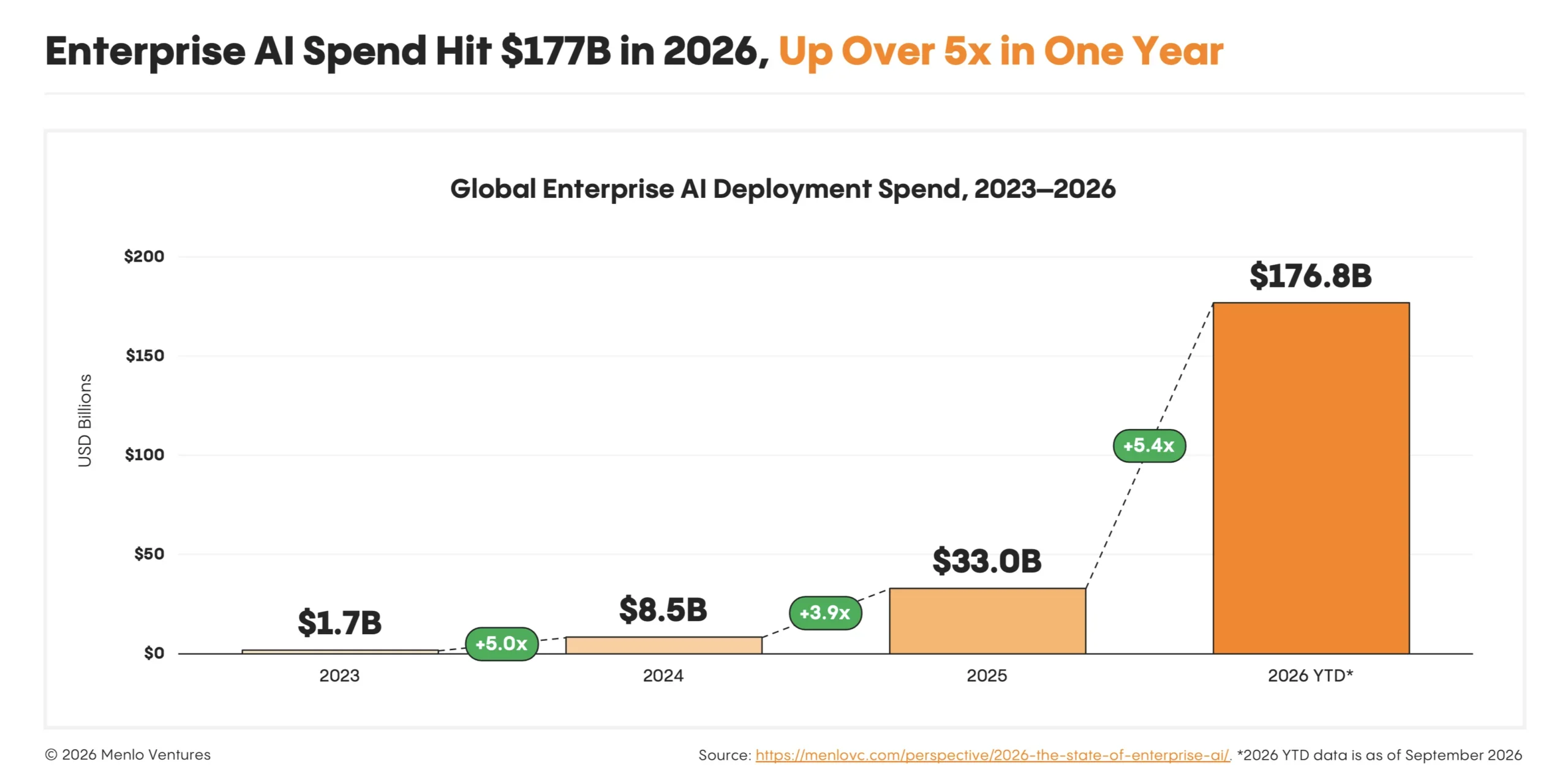
Menlo Ventures 2026 State of Enterprise AI: Enterprise AI Spend Hits $176.8B, Up 5.4x, as Anthropic Takes 55% of Enterprise API Spend

On November 3, Menlo Ventures released its fourth annual enterprise AI report. It estimates enterprise spending on using AI reached $176.8B by September 2026, up 5.4x from $33B in 2025. In enterprise LLM API spend, Anthropic rose from 40% to 55%, OpenAI from 27% to 31%, and Google fell from 21% to 9%. Coding is the largest app category at $34.0B. Figures come from a survey of about 400 US enterprise AI decision-makers plus third-party data, so they are estimates; Menlo is an Anthropic investor.

Menlo Ventures 2026 State of Enterprise AI: Enterprise AI Spend Hits $176.8B, Up 5.4x, as Anthropic Takes 55% of Enterprise API Spend

Key Takeaways

  • Enterprise AI deployment spend: $1.7B (2023) to $8.5B (2024) to $33B (2025) to $176.8B by Sep 2026, up 5.4x vs 3.9x last year (Menlo estimate)
  • Enterprise LLM API spend share: Anthropic 55% (from 40%), OpenAI 31% (from 27%), Google 9% (from 21%); open-source models are about 19% of usage but only 4% of spend
  • App-layer spend is about $77.3B: coding $34.0B and chatbots/productivity $25.0B make up 76%; Claude Code and Codex account for $24.0B (70%) of coding spend
  • On OpenRouter, agents generate 80% of tokens (about 130.9T per week), roughly 7x human usage, and have grown 37x since overtaking human traffic in February
  • 55% of incremental AI spend comes from net-new budgets and 22% from existing software budgets; the share of enterprises paying for AI rose only from 55% to 65%
Read full story

Flower Labs Releases Endeavor 1.1: Multimodal, EU-Only Inference and Private Deployment With Readable Thinking Traces, Claims Parity With OpenAI and Anthropic

Flower Labs, the company behind the Flower federated learning framework, released Endeavor 1.1 on November 3, its third model this year after the UK sovereign 7B model Lizzy in April and Endeavor 1.0 in September. The update adds image input, an optional EU-only GPU inference tier, and Flower-managed, private-cloud or on-premises deployment, and promises readable thinking traces plus ownership of outputs that customers may use to train their own models. Vendor-reported scores are GPQA 94.4, HumanEval 99.9, AIME 2026 99.9 and MMMU-Pro 81.1, but the comparison uses GPT-5.6 Sol and Claude Fable 5 rather than either lab's newest models, and access is request-only for now.

Flower Labs Releases Endeavor 1.1: Multimodal, EU-Only Inference and Private Deployment With Readable Thinking Traces, Claims Parity With OpenAI and Anthropic

Key Takeaways

  • Vendor-reported: GPQA rose from 92.0 in 1.0 to 94.4 (about 30% fewer errors), HumanEval from 98.2 to 99.9; IFEval is 94.5 and MMMU-Pro 81.1.
  • In the vendor table, GPT-5.6 Sol scores GPQA 94.1, IFEval 95.9 and MMMU-Pro 83.0, and Claude Fable 5 scores GPQA 92.6; Endeavor does not lead on IFEval or MMMU-Pro.
  • New EU-only GPU inference with SLAs, with UK, Middle East, Asia and Africa regions planned.
  • The pitch is control: raw thinking traces, ownership of outputs and traces, and the right to fine-tune or train your own models on them.
  • Flower says the model builds on mature open-weight models via continual pre-training, targeted post-training and model integration, without naming the base or parameter count; access is request-only.
Read full story
Linked Models & Agents:
⚡ Endeavor 1.1⚡ Endeavor 1.0⚡ GPT-5.6 Sol⚡ Claude Fable 5⚡ Kimi K3⚡ Nemotron 3 Ultra🌐 Flower Labs

X Discussion: Addy Osmani of Claude Code Warns of "Cognitive Surrender" and Urges Developers to Keep Critical Thinking When Agents Do the Work

Addy Osmani (@addyosmani), whose X bio lists Claude Code at Anthropic, posted a long article on X on November 3 titled "Critical thinking when agents do the work." He describes a spectrum of working with AI: cognitive offloading (delegating a task but owning the result), deferral (the tool output becomes your new input), and "cognitive surrender" (the AI output quietly becomes your own and you feel no need to check it), a term he credits to Steven Shaw and Gideon Nave at Wharton. He offers self-check questions and verification habits. Within about three hours the post drew roughly 1,400 likes, 2,400 bookmarks and more than 72,000 views and reached X trending. These are the author's views, not an Anthropic announcement.

Key Takeaways

  • The spectrum: cognitive offloading (delegate but keep ownership, which the author says he does all day), deferral (the output stops being a hypothesis), and cognitive surrender (no more checking; it becomes your conclusion). Read the X article.
  • His argument: as models improve there are fewer obvious errors, so well-written, mostly correct output no longer demands a second look, and even with many agents running you still have only one pair of eyes on the results.
  • Self-check questions: write down your hypothesis before asking; know whether the AI is helping you think or thinking for you; ask what would make it wrong and test it; have several models argue the other side; ask whether you would bet on it in front of the person who maintains it.
  • Verification habits: define "verified" up front (a passing test, a screenshot, a log); a green check proves one property, so ask what it did not prove; have Claude Code critique its work with a fresh-context subagent, and finish by asking "Did I miss anything?"
  • Delegate fully where being wrong is cheap, but keep the reasoning for decisions whose consequences land on others, such as what to build and whether it is safe to ship.
Read full story
Linked Models & Agents:

Anthropic Open-Sources FlashProve: zkSNARK Proofs That a Reply Came From the Committed Model, About 110 Tokens/s for 400B Llama 4 Maverick on One H100

Anthropic's Frontier Red Team published a research post on November 2 and open-sourced FlashProve under Apache 2.0. A model provider commits to hidden weights once, then attaches a zero-knowledge proof to each reply, so a user without the weights can check on an ordinary CPU that the reply really came from that model. That targets routing services that quietly swap in cheaper models and tampered token streams. Anthropic reports about 110 tokens/s on one H100 for Llama 4 Maverick (400B MoE, 4-bit), proofs of about 19 MB per 1,024-token request, and roughly 70-95x the GPU time of vLLM inference. It is an unmaintained research prototype limited to 1,024-token contexts and greedy decoding of an integer version of the model. Anthropic engineer Steve Weis shared the release on X.

Anthropic Open-Sources FlashProve: zkSNARK Proofs That a Reply Came From the Committed Model, About 110 Tokens/s for 400B Llama 4 Maverick on One H100

Key Takeaways

  • Anthropic-reported: on Llama 4 Maverick (400B MoE, 4-bit) one H100 proves about 110 tokens/s (prefill, 24 requests per batch), with proofs of about 19 MB per 1,024-token request.
  • It is costly: roughly 70-95x the GPU time of vLLM inference; the performance page lists about 270 GB of host memory for serving and about 39 minutes to commit to a set of weights.
  • Verification needs no GPU: the C++ verifier checks a proof in about 21 seconds on one thread, and a slower Lean verifier plus Lean 4 proofs of the security theorem are included.
  • Against prior work: VerInf proved the same model at about 0.02 tokens/s; the commercial Attestable reached 53-77 tokens/s on Gemma 4 31B but has no open-source release.
  • Limits: v0.16.0 is an unmaintained research prototype with 1,024-token contexts, greedy decoding of an integer model only, and no architecture hiding.
Read full story
Linked Models & Agents:

X Discussion: roon Says "Sparks" of an AI Ability Mean It Is Months to Years From Superhuman, and "You Are Almost Always Underhyping"

roon (@tszzl), a well-known AI account with about 500,000 followers, posted on November 2: "when you see “sparks” of any ability in ai models that means you’re months-years from it being superhuman at it. today grade school math, tomorrow navier stokes. it is hard to overhype these results. you are almost always underhyping no matter what." Within about five hours it drew nearly 2,000 likes and 59,000 views. Adam Karvonen, a researcher at Truthful AI and former Anthropic Fellow, pushed back that the domains where models are superhuman are verifiable, easy to simulate and fast to get feedback on, and that research taste, robotics or running companies may not move as fast. This is a debate between personal views, not any company's official position.

Key Takeaways

  • roon's exact claim: "sparks" of an ability mean a model is months to years from being superhuman at it, "today grade school math, tomorrow navier stokes," and "you are almost always underhyping."
  • "Sparks" echoes the MIT CSAIL blog post "Sparks of Weight-Space Programming" that circulated the same day; in a reply roon called that paper "signs of life" pointing toward AI designing neural network behaviors directly.
  • Adam Karvonen's pushback: the domains where models are superhuman are verifiable, easy to simulate, fast-feedback and error-tolerant, and research taste, robotics or running companies may not move as fast.
  • Supporters such as Derya Unutmaz (about 344,000 followers) say people dismiss AI as hype when the opposite is true; others say extrapolating exponential curves is unreliable.
  • These are personal views with no new benchmarks or data, and they do not represent OpenAI or any other company.
Read full story
Linked Models & Agents:
ADSponsored

Anthropic Launches Message Threads in Public Beta on the Messages API: Server-Side Conversations Cut Claude Code TTFT About 35% on 500K-1M Token Requests

On November 2 (US time) Anthropic put message threads into public beta on the Messages API (beta header message-threads-2026-08-12). The API keeps the conversation on the server: the first request sends the full conversation and creates a thread, and each later request sends only new messages plus the previous response id. Anthropic says threads are on by default for most Claude Code users, cutting median time to first token by about 35% on 500K-1M token requests, while the median long-conversation request shrank from about 800 KB to 1.8 KB. Threads expire after 5 idle minutes; pricing and rate limits are unchanged.

Anthropic Launches Message Threads in Public Beta on the Messages API: Server-Side Conversations Cut Claude Code TTFT About 35% on 500K-1M Token Requests

Key Takeaways

  • Per Anthropic, median time to first token on 500K-1M token Claude Code requests is about 35% lower.
  • The median long-conversation request fell from about 800 KB to about 1.8 KB, since each turn uploads only new messages plus previous_message_id.
  • A thread expires 5 minutes after its last request and is deleted within 1 hour; an expired thread returns 404 thread_not_found and must be replayed in full.
  • Pricing and rate limits are unchanged; Message Batches, token counting and on-demand compaction are unsupported, and threads are not ZDR or HIPAA eligible.
  • Available on the Claude API, Claude Platform on AWS, Google Cloud (Anthropic managed) and Microsoft Foundry, with a thread helper in the SDKs.
Read full story
Linked Models & Agents:

X Discussion: Former Claude Code Member Thariq Says the $200 Plans Are Enough and "This Is the Most Expensive Intelligence Will Ever Be"

Thariq (@trq212), whose X bio reads "formerly Claude Code @anthropicai", posted on November 2: "one week in my takeaway is that you don't need unlimited tokens to do great work, the $200 plans are amazing and this is the most expensive intelligence will ever be." Within about seven hours the post drew more than 5,500 likes, 240,000 views and 350+ replies. Supporters say flat-rate plans are enough for most developers; critics point out the tension between "no unlimited tokens" and recommending the top tier, and some worry prices will rise once subsidies end. This is a personal view, not an Anthropic statement.

Key Takeaways

  • Thariq's exact claim: you don't need unlimited tokens to do great work, the $200 plans are "amazing", and "this is the most expensive intelligence will ever be."
  • In replies he added that he has been using the plans on weekends for a while and has "never hit a real limit."
  • Claude's official pricing page lists Max at $100/month (5x Pro usage) and Ultra at $200/month (10x Pro usage, no 5-hour limit, $200/month in API credits).
  • Pushback centers on two points: the tension between "no unlimited tokens" and recommending the most expensive tier, and whether current prices depend on subsidies that may end.
  • This is a personal view from a former Anthropic team member, not an official Anthropic position, and it comes with no usage data.
Read full story

Anthropic's Amended S-1 Says Future Models May Imminently Meet Its RSP Threshold for Dramatically Accelerated AI Progress

On November 2 Anthropic filed Amendment No. 1 to its S-1 with the SEC, adding a risk disclosure: based on internal estimates and expectations about future models, not current ones, the company may imminently meet its Responsible Scaling Policy definition of dramatically accelerated progress attributable to AI. No current model has been designated as exceeding the threshold. Anthropic says it is evaluating the implications of meeting the AI R&D capability threshold, is considering RSP updates that would require human review and approval of certain R&D decisions, and does not expect to safely let Claude fully autonomously design and build successive frontier models without meaningful human supervision.

Key Takeaways

  • Filing: Anthropic, PBC's Amendment No. 1 to Form S-1, filed November 2, 2026 (SEC filing), Registration No. 333-299633.
  • Key line: based on internal estimates for future models, the company may imminently meet the RSP definition of dramatically accelerated progress attributable to AI; no current model has been designated as exceeding it.
  • Proposed measures: possible RSP updates requiring human review and approval of certain R&D decisions; Anthropic also says it recently delayed pre-training a new frontier base model by more than a month to strengthen safeguards such as preventing weight exfiltration.
  • Same filing (company figures): over 90% of contributions to Anthropic's codebase in September 2026 were written by Claude, and revenue for the three months ended September 30, 2026 was $17.0 billion.
Read full story
Linked Models & Agents:

X Discussion: Jason Calacanis Says Under $40K a Year in AI Subscriptions Delivers $2M+ in Value and Has Automated at Least Seven Full-Time Jobs

Angel investor and This Week in Startups host Jason Calacanis posted on X on November 2 that he spends under $40K a year on tokens and subscriptions from Anthropic, Lovable, Grok Bot, ElevenLabs and other AI products, yet gets more than $2M in value at LAUNCH and This Week in Startups. He said they have automated at least seven full-time jobs and become 100% faster at the average task, and that the last 90 days changed more than the previous two years. Within about 9 hours the post drew about 2,200 likes and 230K views, with debate centered on AI ROI and job replacement. All figures are his own claims and have not been independently verified.

Key Takeaways

  • This is Calacanis's personal post, not official data or an announcement from any AI company; the $40K, $2M, seven jobs and 100% faster figures are self-reported with no public breakdown.
  • The original post (2026-11-02 05:27 UTC) had about 2,201 likes, 106 reposts, 244 replies, 42 quotes, 230K views and 715 bookmarks at fetch time.
  • Tools he named include Anthropic, Lovable, Grok Bot and ElevenLabs plus a long tail of other products; he also said anyone who has not used the last 90 days of products for at least 30 hours a week has no idea how profound this software is.
  • Supporters: entrepreneur Steven Cohn (@spcohn) quoted it saying his team has seen the same level of ROI; Farzad (@farzyness), with about 400K followers, quoted it saying "The ROI for AI is mind-boggling," drawing about 157 likes.
  • Skeptics: one user mocked posting "we automated seven full-time jobs" with a siren emoji like a product launch, noting that 30 hours a week of usage is itself like a new full-time job.
Read full story

Meituan ships LongCat-2.5, a 1.6T-parameter (about 48B active) native multimodal agentic model, with API pricing of $0.30/$1.20 per 1M tokens

On Nov 2 Meituan's LongCat team listed LongCat-2.5 in its API platform change log as the full release of September 25's LongCat-2.5-Preview. The official technical blog says it has 1.6 trillion total parameters with about 48 billion activated per token, builds on LongCat-2.0 with stronger native visual understanding and agentic coding, and was trained and served with W4A4 inference on domestic AI accelerators. Vendor-reported scores include 88.4 on Terminal Bench v2.1, 38.5 on Terminal Bench v4.0, 91.9 on BrowseComp and 83.1 on MCP Atlas. The API speaks both OpenAI and Anthropic formats with a 1M-token context and up to 128K output tokens, at a limited-time price of $0.30 per 1M uncached input tokens, $0.006 cached input and $1.20 output.

Meituan ships LongCat-2.5, a 1.6T-parameter (about 48B active) native multimodal agentic model, with API pricing of $0.30/$1.20 per 1M tokens

Key Takeaways

  • Scale: a 1.6-trillion-parameter MoE with about 48B active per token, a 1M-token context and up to 128K output tokens (official blog, API docs)
  • Code agents (vendor-reported): Terminal Bench v2.1 88.4 (Claude Opus 5 89.1, GPT-5.6-Sol 88.8), Terminal Bench v4.0 38.5 (GPT-5.6-Sol 37.3, Claude Opus 5 53.9), DeepSWE v1.1 64.6
  • General agents (vendor-reported): BrowseComp 91.9, MCP Atlas 83.1, AutomationBench v1.0.6 51.8, HLE with tools 63.1; AutomationBench jumps from 15.8 on LongCat-2.0
  • Pricing: limited-time $0.30 per 1M uncached input tokens, $0.006 cached input and $1.20 output (pricing page)
  • Engineering: W4A4 inference raises prefill throughput 43.3% and decode throughput 42.77% over a W8A8 baseline; FSDP gives 86% higher per-device throughput than DDP in long-sequence SFT
Read full story