AI Coding Live News

HF's Joël Niklaus Ships Harness Leaderboard: 28,849 Trials Across 9 Coding Agent Harnesses; Author Reports mini-swe-agent ~51.4% Average

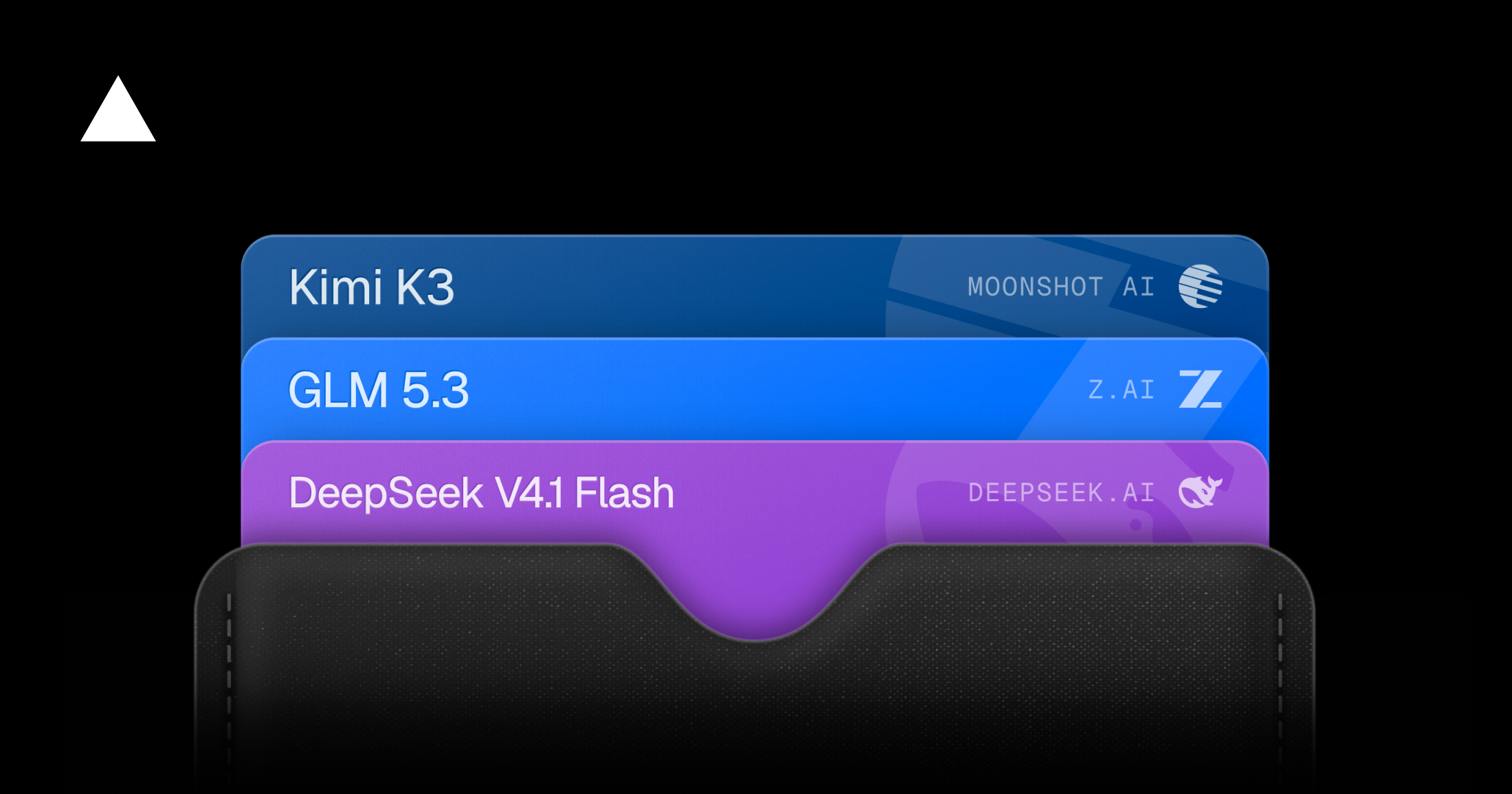
On 2026-11-05, Hugging Face Harness Optimization researcher Joël Niklaus (@joelniklaus) released the Harness Leaderboard: same model, provider, and reasoning effort with only the harness swapped, covering GLM-5.3-Flash, DeepSeek-V4.1-Flash, and Flint on Terminal-Bench 2.1 and DeepSWE—28,849 trials and about $4,746 of inference. Author-reported averages: mini-swe-agent ~51.4% resolve rate; Pi ~49.4% at about $0.29 per solved task. This is an individual research leaderboard, not a Hugging Face company product announcement.

HF's Joël Niklaus Ships Harness Leaderboard: 28,849 Trials Across 9 Coding Agent Harnesses; Author Reports mini-swe-agent ~51.4% Average

Key Takeaways

  • Source: personal post by HF Harness Optimization researcher Joël Niklaus on 2026-11-05T16:04:08Z—not a company announcement
  • Scale (author): 9 harnesses on open models, 28,849 trials, ~$4,746 inference spend
  • Method: pin model/provider/reasoning effort; 3 attempts per task; Terminal-Bench 2.1 and DeepSWE
  • Results (author): averaged mini-swe-agent ~51.4%, openclaw ~27.3%; Pi ~49.4% at ~$0.29 per solved task
  • Use: public HF Space leaderboard + trajectories; Harness Lens documents prompts/tools for each harness
Read full story

Vercel Token Pass Credit Applies Automatically on AI Gateway via API Key, OIDC, or fx Login

On 2026-11-06 Vercel updated Token Pass so featured-model usage through AI Gateway draws credit automatically with a standard API key, OIDC token, or fx login. When credit runs out, those auth modes fall back to team AI Gateway credits; dedicated Token Pass keys still stop until the next billing period.

Vercel Token Pass Credit Applies Automatically on AI Gateway via API Key, OIDC, or fx Login

Key Takeaways

  • Official: Vercel changelog 2026-11-06 — Token Pass credit now applies automatically across AI Gateway
  • Behavior: standard API key, OIDC, or fx login can draw Token Pass credit; dedicated key optional
  • Fallback: when credit ends, standard key/OIDC use team AI Gateway credits; dedicated Token Pass keys still stop until next period
  • Product terms: ~$30/month for ~$80 featured open-weight credit on Pro; Token Pass path stays ZDR
  • Guidance: early Token Pass key users should switch to standard key/OIDC to enable fallback
Read full story

Dwarkesh Ships Clocktower Bench: 386 Blood on the Clocktower Games; GPT-6 Astra Elo 1859, ~82% Win Rate vs Opus 5.5

On 2026-11-05 Dwarkesh Patel released Clocktower Bench: ~$20k API for 386 social-deception games, open harness. Author board: GPT-6 Astra Elo 1859, ~82% win rate vs Opus 5.5.

Dwarkesh Ships Clocktower Bench: 386 Blood on the Clocktower Games; GPT-6 Astra Elo 1859, ~82% Win Rate vs Opus 5.5

Key Takeaways

  • Author: Dwarkesh Patel (@dwarkesh_sp) on 2026-11-05; clocktowerbench.com + Substack
  • Scale: ~$20k API, 386 rated games
  • Top: GPT-6 Astra Elo 1859; ~82% win rate vs Opus 5.5; ~+430 Elo vs Opus 4.6
  • Open source: github.com/dwarkeshsp/clocktower; HF dwarkesh/clocktower-games; human play
  • Social-deception eval is not a general IQ board; script/role variance applies
Read full story

Hugging Face Ships Ultimate MoE Training Handbook: ~500k–800k GPU-Hours Distilled into a Megatron-LM Guide

On 2026-11-05 Hugging Face released the free Ultimate MoE Training Handbook. Co-founder Thomas Wolf cited ~800k GPU-hours, ~70k words and 55 interactive figures; author Nouamane Tazi separately cited ~500k GPU-hours. The Megatron-LM guide covers routing, expert sizing, communication and debugging via the official Space.

Hugging Face Ships Ultimate MoE Training Handbook: ~500k–800k GPU-Hours Distilled into a Megatron-LM Guide

Key Takeaways

  • Official: Hugging Face Space “The Ultimate MoE Training Handbook” (2026-11-05)
  • Thomas Wolf (HF co-founder) on X: ~800k GPU-hours, ~70k words, 55 interactive figures
  • Author Nouamane Tazi separately cited ~500k GPU-hours; prefer the Space body over a reconciled figure
  • Covers Megatron-LM: routing, expert sizing, all-to-all, aux vs loss-free bias, upcycling and serving
  • Free and open; small teams can follow the runbook flag-by-flag against logs
Read full story
Linked Models & Agents:
⚡ DeepSeek-V4 (Next-Gen MoE)⚡ Nemotron 3 Super⚡ Nemotron 3 Ultra🌐 Hugging Face🌐 NVIDIA
ADSponsored

Nous Research Ships Hermes Agent v0.23.0 “The Hearth”: Browser Webapp Desktop, Unified Gateway Sessions, Plugin Catalog Past 1,050

On 2026-11-05 Nous Research released Hermes Agent v0.23.0 (The Hearth). Your gateway can serve the full Desktop in a browser; CLI/TUI/Desktop/editors/bots/cron share one session authority; the plugin catalog grew from ~600 to 1,050+; plus conversation rewind, inline terminal images, and paid-MCP spend limits. Official: ~1,950 merged PRs and 666 contributors.

Nous Research Ships Hermes Agent v0.23.0 “The Hearth”: Browser Webapp Desktop, Unified Gateway Sessions, Plugin Catalog Past 1,050

Key Takeaways

  • Official GitHub release: Hermes Agent v0.23.0 (2026-11-05), codename The Hearth
  • Webapp: gateway serves full Desktop in a browser (off by default; webapp.enabled)
  • Unified sessions: one gateway owns chats so surfaces stop double-writing
  • Plugin catalog ~600→1,050+ with a Verified tier; paid MCP tools can declare cost + chat spend caps
  • Since v0.22.0 (vendor): ~10,080 commits / ~1,950 PRs / 666 contributors
Read full story
Linked Models & Agents:

Cursor Launches Live Apps: Cloud Agents Build, Add Postgres, Cursor SSO and Hosting, Run Security Checks, Then Share a Link

On November 5 Cursor shipped Build Live Apps: describe a tool to a cloud agent and Cursor builds the web app, adds Postgres if needed, sets up Cursor SSO auth and hosting, runs deterministic and agentic security checks, then publishes to a domain you choose with a shareable link for people, groups or the whole team. Works with Origin and GitHub repos on all paid plans with cloud agents enabled.

Cursor Launches Live Apps: Cloud Agents Build, Add Postgres, Cursor SSO and Hosting, Run Security Checks, Then Share a Link

Key Takeaways

  • Flow: start a cloud agent and say you want an app; Cursor handles scaffolding, Postgres if needed, Cursor SSO auth and hosting
  • Publish: pick a unique domain for a live link; repos on Cursor Origin and GitHub, GitLab and others "coming soon"
  • Safety: deterministic and agentic checks (secrets in files, exposed credentials) run first; nothing goes live until checks pass and you publish
  • Controls: admins see every app and secret, add review rules, approve blocked publishes and unpublish any app
  • Sharing & plans: behind Cursor sign-in for people, groups or the team, public sharing on individual plans; all paid plans with cloud agents
Read full story

FrontierPhysics Launches: 56 End-to-End Physics Tasks by 42 Physicists; Claude Opus 5.5 Tops ~27.4% Pass; Failures Center on Rigorous Reasoning

On November 5, the BenchFlow team publicly launched FrontierPhysics (arXiv:2611.06910): 56 end-to-end physics-research tasks authored by 42 physicists from their own work across nine domains. Agents must do literature review, planning, research/experiments, deterministic artifacts, and a manuscript. Across 22 models in 26 configurations, no setup passed more than 46 of 168 rollouts; the best reported Pass@1 is about 27.4% for Claude Opus 5.5 in Claude Code. Expert trajectory review finds the main gaps are rigorous reasoning and expert intuition, not missing physics facts. Artificial Analysis said it will partner to host the evaluation.

FrontierPhysics Launches: 56 End-to-End Physics Tasks by 42 Physicists; Claude Opus 5.5 Tops ~27.4% Pass; Failures Center on Rigorous Reasoning

Key Takeaways

  • Scale: 56 tasks by 42 authors at 26 institutions across 9 physics domains; 56 accepted from 182 submissions; 18 based on published papers (including 4 Nature)
  • Grading: deterministic verifiers plus expert rubrics (blockers/non-blockers); a pass needs all verifiers and blockers
  • Results: 22 models / 26 configs; no configuration passed more than 46 of 168 rollouts; best Pass@1 ~27.4% for Claude Opus 5.5 in Claude Code (paper)
  • Failures: rigorous reasoning ~48%, expert intuition ~34%, literature synthesis ~27%; missing physics knowledge is not the main cause (manual audit of GPT-6 Astra)
  • Ecosystem: run via BenchFlow; Artificial Analysis will partner to host; paper arXiv:2611.06910
Read full story

OpenAI Launches GPT-6 Cyber: ExploitGym 48.5%, Out-of-Scope Rate Down to 0.07%, Daybreak Red Select Access, Critical Preparedness

On November 5 OpenAI launched GPT-6 Cyber for authorized security research: ExploitGym rose from GPT-5.6 Cyber's 32.1% to 48.5% (about 51% relative), out-of-scope exploitation fell to 0.07% without deployment prompts and 0% with them. The model helped find 81 novel high-severity Firefox bugs and develop exploits for 948 Linux privilege-escalation cases, and OpenAI raised its Preparedness Framework cyber rating from High to Critical. It is initially available via API and Codex to select Daybreak Red customers, with expansion to all Red customers planned.

OpenAI Launches GPT-6 Cyber: ExploitGym 48.5%, Out-of-Scope Rate Down to 0.07%, Daybreak Red Select Access, Critical Preparedness

Key Takeaways

  • ExploitGym 48.5% vs GPT-5.6 Cyber 32.1% (~51% relative gain; vendor figures)
  • Scope alignment: 99.93% avoided out-of-scope services without deployment prompts; 100% with them
  • Real-world: 81 novel high-severity Firefox vulns; 1,724 Linux vulns reproduced, 948 exploits developed
  • Preparedness raised to Critical; RemoteExploitBench 95% completion (Astra refused 100%)
  • Select Daybreak Red via API/Codex first; Daybreak Blue alpha for Astra defensive use expanding
Read full story
Linked Models & Agents:

Baidu Opens ERNIE-5.5-Flash-Base: 280B-A14B MoE, 33.5T Pretrain, Vendor-Reported MMLU 93.3

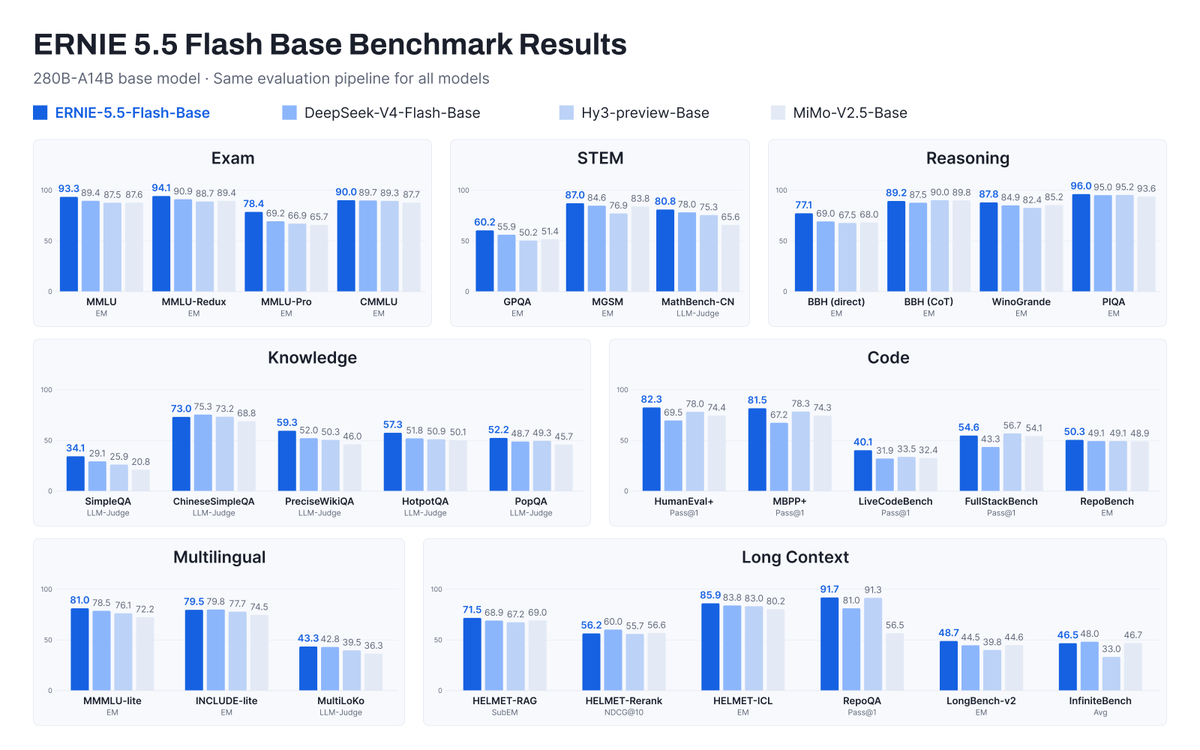
On November 5 Baidu (official blog + @BaiduResearch) open-sourced ERNIE-5.5-Flash-Base: a text-only MoE base checkpoint at end of pre-training (no mid/post-training), 280B total / 14B active per token, 33.5T pretrain tokens, up to 128K train context and 1M for fine-tune/inference. FP8 and BF16 weights are on Hugging Face and ModelScope. Under Baidu's unified eval pipeline vs similar bases: MMLU 93.3, HumanEval+ 82.3, LiveCodeBench 40.1 (vendor-reported). Post-trained ERNIE 5.5 Flash "will follow". License is custom (excludes EU/UK/South Korea; commercial use above $50M related revenue needs prior written authorization).

Baidu Opens ERNIE-5.5-Flash-Base: 280B-A14B MoE, 33.5T Pretrain, Vendor-Reported MMLU 93.3

Key Takeaways

  • Nov 5 open base at end of pre-training: 280B total / 14B active — not a chat/instruct model
  • 33.5T pretrain tokens; up to 128K train context, 1M for fine-tune and inference
  • Vendor unified eval: MMLU 93.3, HumanEval+ 82.3, LiveCodeBench 40.1 vs similar bases
  • Architecture: 37 HCA + 6 MLA-DSA layers; Multi-Router Latent MoE (512 routed top-10 + 1 shared)
  • Custom license (not Apache): excludes EU/UK/South Korea; >$50M related revenue needs Baidu written authorization
Read full story
Linked Models & Agents:
⚡ Ernie 5.5 Flash Base🌐 Baidu (百度文心)

Axion 1.0 Open Agent Foundation Model: Two SFT Stages Plus RL, 35B-A3B Reproduction Checkpoint Under Apache 2.0, Full Recipe Released

arXiv paper 2611.03233 by Yuqi Jia, Yunjie Tian and five co-authors introduces Axion 1.0, an agent foundation model that is open beyond its weights. It uses just two lightweight SFT stages plus reinforcement learning, with no dedicated mid-training, DPO or on-policy distillation, and about 18K SFT trajectories in total. Training code is hosted under the bytedance GitHub organization, and the training data and an Axion 1.0-35B reproduction checkpoint (Qwen3.6-35B-A3B base, 35B total / 3B active, Apache 2.0) are on Hugging Face; weights for the paper's 122B model are listed as coming soon.

Axion 1.0 Open Agent Foundation Model: Two SFT Stages Plus RL, 35B-A3B Reproduction Checkpoint Under Apache 2.0, Full Recipe Released

Key Takeaways

  • A minimal recipe: SFT stage one for self-contained scientific reasoning, stage two for tool use and information seeking, then RL for long-horizon interaction, with 18,363 SFT trajectories and 484 RL tasks
  • The release covers data construction, generation, filtering, verification, prompts and training code (GitHub), not just weights
  • The 35B reproduction checkpoint scores 52.8 on HLE, 60.4 on SEAL-0, 85.0 on FrontierScience Olympiad and 55.0 on FrontierScience Research (HF model card)
  • The paper's 122B model reports 59.0 on HLE with restricted website access and 66.7 on FrontierScience Research; 122B weights are not out yet
  • All scores are self-reported; the HF card lists Claude Opus 5 at 63.6 on HLE, so Axion still trails the strongest closed models
Read full story
Linked Models & Agents:
⚡ Axion 1.0-35B⚡ Axion 1.0-122B⚡ Qwen3.6-35B-A3B🌐 ByteDance🌐 Hugging Face
ADSponsored

X Discussion: Addy Osmani of Claude Code Warns of "Cognitive Surrender" and Urges Developers to Keep Critical Thinking When Agents Do the Work

Addy Osmani (@addyosmani), whose X bio lists Claude Code at Anthropic, posted a long article on X on November 3 titled "Critical thinking when agents do the work." He describes a spectrum of working with AI: cognitive offloading (delegating a task but owning the result), deferral (the tool output becomes your new input), and "cognitive surrender" (the AI output quietly becomes your own and you feel no need to check it), a term he credits to Steven Shaw and Gideon Nave at Wharton. He offers self-check questions and verification habits. Within about three hours the post drew roughly 1,400 likes, 2,400 bookmarks and more than 72,000 views and reached X trending. These are the author's views, not an Anthropic announcement.

Key Takeaways

  • The spectrum: cognitive offloading (delegate but keep ownership, which the author says he does all day), deferral (the output stops being a hypothesis), and cognitive surrender (no more checking; it becomes your conclusion). Read the X article.
  • His argument: as models improve there are fewer obvious errors, so well-written, mostly correct output no longer demands a second look, and even with many agents running you still have only one pair of eyes on the results.
  • Self-check questions: write down your hypothesis before asking; know whether the AI is helping you think or thinking for you; ask what would make it wrong and test it; have several models argue the other side; ask whether you would bet on it in front of the person who maintains it.
  • Verification habits: define "verified" up front (a passing test, a screenshot, a log); a green check proves one property, so ask what it did not prove; have Claude Code critique its work with a fresh-context subagent, and finish by asking "Did I miss anything?"
  • Delegate fully where being wrong is cheap, but keep the reasoning for decisions whose consequences land on others, such as what to build and whether it is safe to ship.
Read full story
Linked Models & Agents:

X Discussion: levelsio Used Claude Code to Decompile the Battlefield 1942 Demo and Put It in the Browser With Multiplayer, Citing About 1M Output Tokens

Indie developer Pieter Levels (@levelsio) said on X on November 2 that he used Claude Code to decompile the engine of the free Battlefield 1942 demo, port it to C, compile it to WebAssembly and host it at bf1942.pieter.com, where it runs in the browser with online co-op on the Tobruk map. He said the job took about 1 million output tokens, roughly $100 at API prices, while he pays for a $100-a-month Claude subscription. His two main posts drew about 2,200 likes and 340,000 views and reached X trending. These are the author's own claims and community discussion, not independently verified.

X Discussion: levelsio Used Claude Code to Decompile the Battlefield 1942 Demo and Put It in the Browser With Multiplayer, Citing About 1M Output Tokens

Key Takeaways

  • Author's account: Claude Code decompiled the Battlefield 1942 demo engine, which was ported to C and compiled to WebAssembly to run in the browser.
  • The live build at bf1942.pieter.com opens directly, is labeled non-commercial and unofficial, and offers online co-op on Tobruk with no install.
  • Cost: about 1 million output tokens by the author's count, roughly $100 at API prices; he actually pays for a $100-a-month Claude subscription.
  • He said it was much harder than his earlier Quake and DOOM ports, whose engine source code id Software released long ago.
  • Reach: the first post had about 1,100 likes and 230,000 views, the launch post about 1,100 likes and 107,000 views; testers are already reporting bugs.
Read full story
Linked Models & Agents:

X Discussion: MIT Team Says GPT-6 Astra Can Read and Write Neural Network Weights, Editing 0.016% of Qwen3.5-0.8B to Lift MATH-500 From 7.9% to 48.1%

On November 2, MIT CSAIL PhD student Rikiya Takehi posted "Weight-Space Programming" on X: a team (Takehi, Jayden Teoh, Alex Zhang, Omar Khattab) had GPT-6 Astra read and edit neural network weights directly, with no gradients or training. Their blog says Astra changed only 131,072 weights (0.016%) of Qwen3.5-0.8B, fixed its thinking loops and raised MATH-500 from 7.9% to 48.1%. The post drew about 24K likes and 1.77M views, and Ethan Mollick quoted it saying it is a big deal pending replication. All results are self-reported by the authors and not yet independently reproduced.

X Discussion: MIT Team Says GPT-6 Astra Can Read and Write Neural Network Weights, Editing 0.016% of Qwen3.5-0.8B to Lift MATH-500 From 7.9% to 48.1%

Key Takeaways

  • The original post (2026-11-02 17:51 UTC) had about 24,320 likes, 2,697 reposts, 2,284 quotes, 1.77M views and 15K bookmarks at fetch time; Wharton professor Ethan Mollick quoted it saying it is a pretty big deal pending replication (about 880 likes).
  • Experiment 8 (authors' figures): with a 50 forward-pass budget, Astra edited 131,072 weights (0.016%) of Qwen3.5-0.8B, raising MATH-500 from 7.9% to 48.1% and IFEval from 21.0% to 62.3%, while answers hitting the token limit fell from 93.0% to 33.1%.
  • Experiment 5 (authors' figures): with no data, gradients or tools, Astra wrote MinAtar policy networks in one shot that scored 517.4 on Breakout versus 15.8 for PPO at 100M steps and 25.3 at 500M steps; on Seaquest it scored 53.1, below the 88.9 of 500M-step PPO.
  • Limits the authors report: on Gemma 3 270M, which rarely loops, Astra's edits moved MATH-500 by no more than about a point; they conclude weight edits can remove an obstacle hiding an ability but cannot add one the model lacks.
  • Full experiment logs are public at RikiyaT/lm_understand-logs; so far there is only a blog post, with no peer-reviewed paper and no third-party replication.
Read full story
Linked Models & Agents:

LeCun and Balestriero turn the Platonic Representation Hypothesis into a theorem: a 109M text JEPA aligns with vision models better than 72B LLMs

On October 29, Randall Balestriero and Yann LeCun posted "Proving and Improving the Platonic Representation Hypothesis with JEPAs" (arXiv 2610.39302), affiliated with Brown University, NYU and AMI Labs. The paper proves that JEPAs trained separately on different modalities learn the same representation up to one rotation whenever their positive pairs are two observations of one scene ("good views"), and argues that next-token prediction is a JEPA with "bad views", which is why language models only align with vision through scale. The authors report that good views need 42x fewer training samples than next-token prediction to reach the same alignment, and that a 109M text JEPA scores 0.184 alignment with DINOv2 versus 0.154 for Qwen2.5-72B (author-reported). Code and a live demo are public; Balestriero's announcement post has about 1,054 likes and 72K views.

LeCun and Balestriero turn the Platonic Representation Hypothesis into a theorem: a 109M text JEPA aligns with vision models better than 72B LLMs

Key Takeaways

  • Paper: arXiv 2610.39302, submitted 2026-10-29 by Randall Balestriero and Yann LeCun (Brown University / NYU / AMI Labs)
  • On the PRH benchmark, the 109M text JEPA scores 0.184 alignment with DINOv2, versus 0.154 for Qwen2.5-72B and 0.151 for Llama-3-70B; with the CLIP image encoder it reaches 0.23 against a previous best of 0.21 (author-reported)
  • Good views reach the same alignment with 42x fewer training samples than next-token prediction; the authors pre-registered predictions from their alignment scaling law, trained 85 new runs, and the law was as accurate as rerunning with another seed
  • A single rotation turns separately trained encoders into an image captioner with CIDEr 0.838 on COCO; on a pair-free benchmark it hits 64% top-5 on ImageNet-100 versus at most 56% for language models up to 8B
  • Code (galilai-group/prh-proof) and a live demo are public; Balestriero's announcement post has about 1,054 likes and 180 reposts
Read full story
Linked Models & Agents:

Google DeepMind expands Gemini-built PlanAssist to 15 English councils after pilots cut planning assessment time by up to 58%

On October 31, Google DeepMind said PlanAssist, a Gemini-built planning tool developed with the UK government, Google Cloud and Faculty, will be made available to 12 more local planning authorities in England, bringing the total to 15 for a 12-month Beta on live applications. In early pilots at Barnet, Camden and Dorset, DeepMind says the average officer time on householder assessment tasks fell by 58%, and more than 70% of the drafted reports were approved with no edits. Planning officers keep the final decision.

Google DeepMind expands Gemini-built PlanAssist to 15 English councils after pilots cut planning assessment time by up to 58%

Key Takeaways

  • Scale: from 3 pilot councils to 15; the 12 new ones join in three cohorts for a 12-month Beta (DeepMind blog)
  • Efficiency: average officer time on householder assessment tasks fell 58% in pilots (vendor-reported; DeepMind's X post says "up to 58%")
  • Quality: more than 70% of AI-drafted reports were approved by officers with no edits (vendor-reported)
  • The UK government says, together with new rules, routine householder processing can halve from eight weeks to four, and it aims to offer the tool to every council in England in 2027 (GOV.UK)
Read full story