AI Coding Live News

Artificial Analysis: Tencent Hy4 Scores 35 on Intelligence Index v5, Ranked No.2 Among China Labs, 31% on FrontierCode 2.0

Independent evaluator Artificial Analysis published Tencent Hunyuan Hy4 results on the Intelligence Index v5 on November 5 (08:28 UTC): a composite score of 35, tying Grok 4.7 (xhigh) and one point behind Claude Haiku 5.5 (max). Among China-based labs it ranks second only to Kimi K3.1 Pro (46). On agentic coding it scores 31% on FrontierCode 2.0 and 37% on Terminal-Bench 4.0; cost per Intelligence Index task is about $0.78, roughly one-tenth of same-score Grok 4.7.

Artificial Analysis: Tencent Hy4 Scores 35 on Intelligence Index v5, Ranked No.2 Among China Labs, 31% on FrontierCode 2.0

Key Takeaways

  • Intelligence Index v5 composite 35: ties Grok 4.7 (xhigh), one point behind Haiku 5.5 (max, 36); No.2 China-lab model behind Kimi K3.1 Pro (46)
  • FrontierCode 2.0 at 31% (leads China labs; DeepSeek V4.1 Flash 1017 max 28%, Kimi K3.1 Pro 25%); Terminal-Bench 4.0 at 37%
  • AA-Omniscience v1.1 accuracy 50% but hallucination rate 89% (Kimi K3.1 Pro hallucination 37%); HLE-Diamond 33%
  • About $0.78 per Intelligence Index task: ~10x cheaper than same-score Grok 4.7, ~13x cheaper than Qwen3.8 Max (34), nearly 2x Haiku 5.5
  • Pricing about $0.834/$2.501 per 1M input/output tokens, cache reads $0.042; 1M context; text and image input
Read full story

Notion: MCP Shared Brain Lets ChatGPT, Claude, Muse and Bot Share Memories and Skills, With Official Agent Setup Prompts

On November 4 NotionHQ announced that via Notion MCP, ChatGPT, Claude, Muse and Bot can read and write the same Memories and Skills—one shared brain across agents. Official setup prompts (v0.0.6, Oct 30), help docs and a Nov 3 MCP use-cases blog corroborate the product push.

Notion: MCP Shared Brain Lets ChatGPT, Claude, Muse and Bot Share Memories and Skills, With Official Agent Setup Prompts

Key Takeaways

  • NotionHQ post (Nov 4, 19:14 UTC) had about 3,271 likes, 225 reposts, 4,560 bookmarks and ~589K views when fetched
  • Product claim: ChatGPT / Claude / Muse / Bot share Memories and Skills in Notion so switching agents does not reset context
  • Official setup prompt v0.0.6 (2026-10-30): walks agents through an Agent Operating Guide and custom-instruction paste for ChatGPT / Claude
  • Help center: Notion MCP works with Claude, Cursor, ChatGPT Pro and more; Enterprise can approve a whitelist and govern connections
  • Vendor blog (Nov 3): five team stories of MCP workflows as reusable SOPs; Skills via MCP are listed as coming soon
Read full story

Anthropic: Claude Helps Map the First Prokaryotic Vault Particle Structure; Purification in ~90 Minutes, First Model in ~34 Hours

On November 4 Anthropic's biology team reported that Claude helped determine the first 3D vault structure from a prokaryotic/phage system (protein L05). Vendor-reported timing: ~90-minute purification and a first model in ~34 hours, plus an open discussion of mistakes and the multi-agent research workflow.

Anthropic: Claude Helps Map the First Prokaryotic Vault Particle Structure; Purification in ~90 Minutes, First Model in ~34 Hours

Key Takeaways

  • Official Anthropic research: Claude helped determine the first 3D prokaryotic/phage vault structure (protein L05)
  • Vendor-reported timing: purification cut from ~3 days to ~90 minutes; first model ready in ~34 hours
  • L05 forms a ~9.5 MDa shell of 96 chains with ~25% more volume than mammalian vaults
  • Anthropic also discloses failures: a medium additive cost ~2 weeks; an early cryo-EM map was mirrored
  • For developers: a concrete case of a science multi-agent harness with human oversight, not biology trivia
Read full story
Linked Models & Agents:
⚡ Anthropic Claude🤖 claude🌐 Anthropic

Claude Code Background Subagent Status Lines Now Written by Haiku 5.5: About 99% Cheaper per Update, About 6% More Prompts per Limit

On November 4 ClaudeDevs, Anthropic's official developer account, said the status line that a background subagent in Claude Code refreshes every 30 seconds used to re-read its whole conversation each time, and is now written by Haiku 5.5 from short notes, so each update costs about 99% less. Anthropic says sessions with background subagents used about 5% less of the limit, giving about 6% more prompts on the same limit. It is live for most Pro, Max and Ultra users and everyone on Team and Enterprise, on v2.1.316 or later.

Key Takeaways

  • A background subagent refreshes its status line every 30 seconds, and each refresh used to re-read the subagent's whole conversation
  • Haiku 5.5 now writes the status line from short notes, which Anthropic says makes each update about 99% cheaper
  • The subagent itself keeps its own model; only the status line is written by Haiku 5.5
  • Anthropic says sessions with background subagents used about 5% less of the limit, so the same limit gives about 6% more prompts
  • It is live for most Pro, Max and Ultra users and everyone on Team and Enterprise; update to v2.1.316 or later
Read full story
ADSponsored

Cat Wu, Formerly on Claude Code at Anthropic, Announces She Is Joining OpenAI to Lead Product Management for Core Products

Cat Wu (@_catwu) announced on X on November 5 that she is joining OpenAI to lead product management for Core Products; her X bio says she previously worked on Claude Code at Anthropic. She said she will work with Tibo (@thsottiaux) and the PM team to build agents that have users' and teams' backs and keep them in control. The post drew about 6,900 likes, and Tibo posted a welcome. OpenAI has not published an official announcement.

Key Takeaways

  • Cat Wu announced on X herself that she is joining OpenAI to lead product management for Core Products
  • Her X bio says she previously worked on Claude Code at Anthropic, and before that at Dagster and Scale AI
  • She named Tibo (@thsottiaux, bio: Codex & ChatGPT @OpenAI) as a collaborator, with a focus on agents that keep users in control
  • Tibo welcomed her with a "Welcome Cat" post; her announcement drew about 6,900 likes and nearly 900 replies
  • OpenAI has not issued an official announcement, and which products Core Products covers was not specified
Read full story

Artificial Analysis Makes Time per Task Its Headline Performance Metric: GPT-6 Astra Finishes a Max-Effort Task in About 17 Minutes, Ahead of Opus 5.5 and Gemini 4 Carbon

Independent benchmarker Artificial Analysis announced on X on November 4 (17:34 UTC) a new version of its API performance benchmarking: the headline metric moves from output speed to Time per Task, the time to finish one Intelligence Index task (output tokens per task divided by end-to-end output speed). It covers about 1,000 serverless endpoints, measures speed from sending the request to the final token, and adds multi-turn agentic coding and knowledge-work workloads. Per its data, GPT-6 Astra at max effort runs at 51 tokens/s yet finishes a task in about 17 minutes, against about 26 for Claude Opus 5.5 (max) and about 29 for Gemini 4 Carbon (high).

Key Takeaways

  • Time per Task equals output tokens per Intelligence Index task divided by end-to-end output speed, so a model that is fast per token but verbose can finish later than a slower model that uses fewer tokens.
  • End-to-end output speed runs from sending the request to the final token, including the wait before the first token (prefill and hidden reasoning); output tokens now come from each provider's API-reported counts instead of the o200k_base tokenizer.
  • GPT-6 Astra (max) runs at 51 tokens/s with about 50k output tokens per task and takes about 17 minutes; Claude Opus 5.5 (max, 111 tokens/s) takes about 26 minutes and Gemini 4 Carbon (high, 71 tokens/s) about 29, using roughly 120k to 170k tokens per task.
  • At each lab's API default effort (medium for all three), GPT-6 Astra, GPT-6.1 Sol and Opus 5.5 cut Time per Task by about 3 to 5x and Cost per Task by about 2 to 4x, scoring about 5 to 11 points lower; Opus 5.5 drops from about 26 minutes and $10.04 to about 6.8 minutes and $2.45.
  • The official methodology page lists this as version 3.0.0 (October 30), with runs now every 6 hours and a new endpoint error rate metric.
Read full story

RoboColosseum Opens Real-Robot Evaluation: 100+ Robots at 124 Sites, Claude Opus 5.5 and GPT-6 Astra Rival Specialized VLA Policies Zero-Shot

Hugging Face, BitRobot, the Singapore Embodied AI Centre, NUS and others launched RoboColosseum on November 4, a distributed real-robot evaluation framework covering four embodiments: SO-101, Franka, Bimanual-YAM and the Unitree G1 humanoid. The first study ran 5,699 blinded pairwise comparisons at 124 sites across 5 VLA policies and 3 frontier models. Claude Opus 5.5 and GPT-6 Astra beat their VLA counterparts on average task progress by 12.1 and 11.0 points, while Grok 4.7 trailed by 7.5. All rollouts are open on Hugging Face, and the project pledges 10,000 free evaluation hours to academic labs.

RoboColosseum Opens Real-Robot Evaluation: 100+ Robots at 124 Sites, Claude Opus 5.5 and GPT-6 Astra Rival Specialized VLA Policies Zero-Shot

Key Takeaways

  • Two tracks: the Open Track runs blinded zero-shot pairwise comparisons, and the Fine-tune Track gives each VLA the same 100 demonstrations per task across 20 tasks.
  • The VLAs tested are GR00T N1.7, pi0.5, MolmoAct2, G0.5 and LingBot-VLA v2; the frontier models are GPT-6 Astra, Claude Opus 5.5 and Grok 4.7.
  • After fine-tuning, GR00T N1.7 leads on SO-101 and pi0.5 leads on Franka and Bimanual-YAM; on the G1 humanoid no policy completes any task, with average progress of 13.3% to 23.2%.
  • Rankings agree only weakly across robots (Kendall W = 0.24), and zero-shot rankings poorly predict rankings after fine-tuning.
Read full story

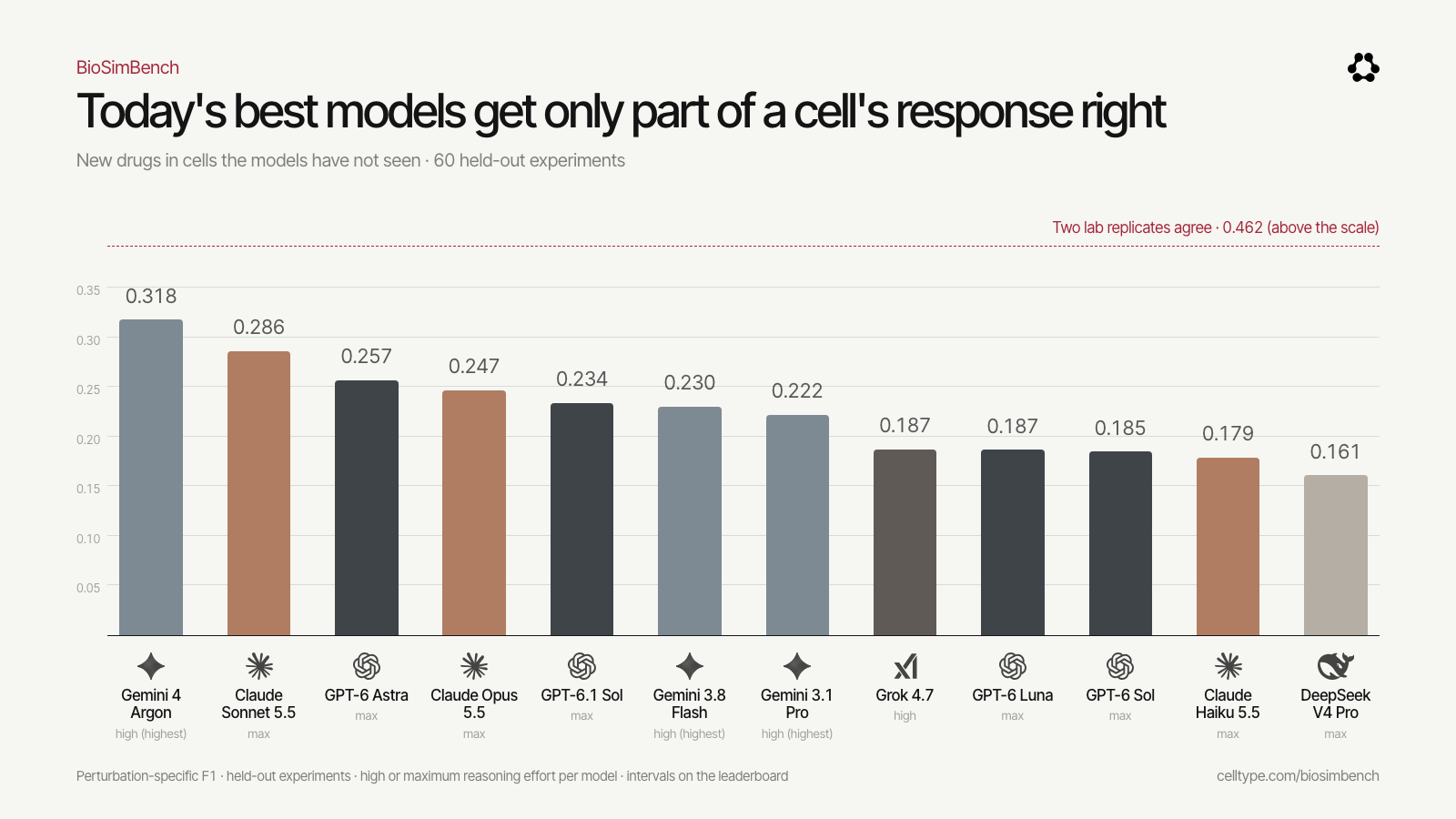
CellType Launches BioSimBench: Frontier LLMs Get Only Part of Cell Responses Right, Gemini 4 Argon Leads and CellType 27B Beats Them on Every Track

CellType, a YC W26 startup, released BioSimBench 1.0 on November 4. It uses real lab experiments to test whether language models can predict which genes go up or down after a cell is hit by a drug, a gene knockdown or an immune signal. Among 12 frontier models, Gemini 4 Argon ranks first with an overall score of 0.184, ahead of Claude Sonnet 5.5 (0.160) and GPT-6 Astra (0.159), while two lab replicates agree at 0.462. A 27B model CellType trained in its BioSimGym RL environments beats the best frontier model on all four prediction tracks.

CellType Launches BioSimBench: Frontier LLMs Get Only Part of Cell Responses Right, Gemini 4 Argon Leads and CellType 27B Beats Them on Every Track

Key Takeaways

  • BioSimBench 1.0 has five tracks: new drugs and cell contexts, gene knockdown, drug response, immune signals, and a tool-using research agent; test answers are kept private.
  • The 12 frontier models score between 0.110 and 0.184 overall, with Gemini 4 Argon first and DeepSeek V4 Pro last; two lab replicates agree at 0.462, so the gap is still large.
  • CellType 27B scores 0.366 on new drugs and cell contexts and 0.203 on drug response, about double the best frontier score of 0.103.
  • Data processing uses NVIDIA RAPIDS-singlecell, at least 4x faster for the whole pipeline; models were trained with NeMo RL and BioSimGym follows NeMo RL environment interfaces.
Read full story

Fireworks Forge Launches: Ultra-fast Inference Preview Hits 1,500 Tokens/s, Half-Price Background Mode, Nexus Desktop for Codex and Claude Desktop, Sovereign Private Preview

At its first Forge conference on November 3, open-model inference platform Fireworks launched a batch of products. Ultra-fast, powered by NVIDIA Blackwell, is in public preview at up to 1,500 tokens per second on DeepSeek V4.1 Flash, cutting a 30-turn agent task from 1 minute to 8 seconds. Background Mode runs deferrable work at half price, alongside multi-day prompt caching and higher rate limits. Nexus Desktop brings open-model routing into the Codex app, Claude Desktop and OpenCode, with Pro plans from $8 per month. Fireworks also announced No Eval, serverless LoRA inference, the Fireworks Sovereign private preview and a 60+ partner Frontier Ecosystem.

Fireworks Forge Launches: Ultra-fast Inference Preview Hits 1,500 Tokens/s, Half-Price Background Mode, Nexus Desktop for Codex and Claude Desktop, Sovereign Private Preview

Key Takeaways

  • Ultra-fast public preview: on NVIDIA Blackwell, up to 1,500 tokens per second on DeepSeek V4.1 Flash; in Fireworks' benchmark a 30-turn agent task fell from 1 minute to 8 seconds (Fireworks blog)
  • Cost options: Background Mode runs deferrable work at half price; multi-day prompt caching cuts the cost of resuming long context; higher serverless rate limits and Elastic Burst are generally available
  • Nexus Desktop launches: personalized routing across open and closed models inside the Codex app, Claude Desktop and OpenCode; Pro from $8 per month, Teams from $10 per seat per month
  • Training: No Eval (private preview) turns production traces into task evals; serverless LoRA inference (public preview) starts with GLM 5.3 Flash at per-token pricing with no idle charge; free training on Muse Glimmer 30B through November 30
  • Enterprise: Fireworks Sovereign (private preview) runs the inference engine in a customer's own cloud or data center; Fireworks says it already manages over 25,000 GPUs in customer environments; plus a 60+ partner Frontier Ecosystem
Read full story

Artificial Analysis Upgrades Its Six Capability Indexes to v2.0, Weighting Non-Hallucination and Agentic Tool Use; Claude Opus 5.5 Leads All Six

Independent evaluator Artificial Analysis announced on X on November 4 that its six Capability Indexes (Finance & Accounting, Strategy & Ops, Legal, Healthcare & Medical, Engineering, Economics) are now v2.0, aligned with Intelligence Index v5.0 evaluations and weighting Non-Hallucination and Agentic Tool Use more heavily. Across the indexes, HLE becomes HLE-Diamond, AA-Omniscience moves to v1.1 and GDPval-AA is removed; Engineering gains a new Science capability. Per Artificial Analysis, Claude Opus 5.5 (max) leads all six, with GPT-6 Astra (max) second in Finance & Accounting, Legal and Engineering. Among open-weights models, Kimi K3.1 Pro (weights not yet released) leads all six at #5 to #8.

Artificial Analysis Upgrades Its Six Capability Indexes to v2.0, Weighting Non-Hallucination and Agentic Tool Use; Claude Opus 5.5 Leads All Six

Key Takeaways

  • The six indexes map O*NET occupation tasks to representative benchmarks, weighted by how often each capability appears in that occupation (methodology page)
  • Common changes: HLE becomes HLE-Diamond, AA-Omniscience moves to v1.1, and GDPval-AA is dropped from Agentic Knowledge Work (now AA-Briefcase v1.1)
  • Non-Hallucination weight rises to 15% in Finance & Accounting and Legal; Agentic Tool Use (AutomationBench-AA) is 35% of Strategy & Ops, its largest component
  • Engineering adds Science (20%, CritPt v2 Hard Subset plus Terminal-Bench-Science 0.1) and FrontierCode 2.0 under Agentic Coding; Economics swaps AA-LCR for GDP.pdf
  • Results per Artificial Analysis: Claude Opus 5.5 (max) is #1 in all six; among open weights, Kimi K3.1 Pro leads all six, MiniMax-M3.1-Flash leads Strategy & Ops (#10) and DeepSeek V4.1 Flash 1017 (max) leads Healthcare & Medical (#12)
Read full story
ADSponsored

Epic Confirms Unreal Engine 5.9: Preview Next Week With Improved AI Workflows and Web Back as a Target Platform

On November 3, the official Unreal Engine account said UE 5.9 is happening, with a Preview build next week that includes improved AI workflows, web as a target platform, and rendering and animation updates; changes are already landing in the 5.9 branch on GitHub, with more details to come. This reverses Epic's June State of Unreal stance that 5.8 was the last planned major UE5 release, with 5.9 kept only as an option. UE 5.8 shipped the Experimental Unreal MCP plugin, which lets MCP clients such as Claude Code and Cursor drive the editor; the 5.9 AI workflow changes likely build on it, but Epic has not published a feature list yet.

Key Takeaways

  • Timing: the official post went out at 13:05 UTC on November 3 and says the 5.9 Preview arrives next week; the exact date and the final release date are not announced
  • Scope (per Epic): improved AI workflows, web as a target platform, and rendering and animation updates; changes are already landing in the 5.9 branch on GitHub
  • Context: in June, State of Unreal called 5.8 the last planned major UE5 release; UE6 targets Early Access at the end of 2027, with the full release 12 to 18 months later
  • AI groundwork: the Experimental Unreal MCP plugin in 5.8 embeds an MCP server in the editor at http://127.0.0.1:8000/mcp by default, loopback only and with no authentication
  • Reach: about 2,552 likes, 251 reposts, 114 quotes and 215K views at fetch time
Read full story

Flower Labs Releases Endeavor 1.1: Multimodal, EU-Only Inference and Private Deployment With Readable Thinking Traces, Claims Parity With OpenAI and Anthropic

Flower Labs, the company behind the Flower federated learning framework, released Endeavor 1.1 on November 3, its third model this year after the UK sovereign 7B model Lizzy in April and Endeavor 1.0 in September. The update adds image input, an optional EU-only GPU inference tier, and Flower-managed, private-cloud or on-premises deployment, and promises readable thinking traces plus ownership of outputs that customers may use to train their own models. Vendor-reported scores are GPQA 94.4, HumanEval 99.9, AIME 2026 99.9 and MMMU-Pro 81.1, but the comparison uses GPT-5.6 Sol and Claude Fable 5 rather than either lab's newest models, and access is request-only for now.

Flower Labs Releases Endeavor 1.1: Multimodal, EU-Only Inference and Private Deployment With Readable Thinking Traces, Claims Parity With OpenAI and Anthropic

Key Takeaways

  • Vendor-reported: GPQA rose from 92.0 in 1.0 to 94.4 (about 30% fewer errors), HumanEval from 98.2 to 99.9; IFEval is 94.5 and MMMU-Pro 81.1.
  • In the vendor table, GPT-5.6 Sol scores GPQA 94.1, IFEval 95.9 and MMMU-Pro 83.0, and Claude Fable 5 scores GPQA 92.6; Endeavor does not lead on IFEval or MMMU-Pro.
  • New EU-only GPU inference with SLAs, with UK, Middle East, Asia and Africa regions planned.
  • The pitch is control: raw thinking traces, ownership of outputs and traces, and the right to fine-tune or train your own models on them.
  • Flower says the model builds on mature open-weight models via continual pre-training, targeted post-training and model integration, without naming the base or parameter count; access is request-only.
Read full story
Linked Models & Agents:
⚡ Endeavor 1.1⚡ Endeavor 1.0⚡ GPT-5.6 Sol⚡ Claude Fable 5⚡ Kimi K3⚡ Nemotron 3 Ultra🌐 Flower Labs

X Discussion: Addy Osmani of Claude Code Warns of "Cognitive Surrender" and Urges Developers to Keep Critical Thinking When Agents Do the Work

Addy Osmani (@addyosmani), whose X bio lists Claude Code at Anthropic, posted a long article on X on November 3 titled "Critical thinking when agents do the work." He describes a spectrum of working with AI: cognitive offloading (delegating a task but owning the result), deferral (the tool output becomes your new input), and "cognitive surrender" (the AI output quietly becomes your own and you feel no need to check it), a term he credits to Steven Shaw and Gideon Nave at Wharton. He offers self-check questions and verification habits. Within about three hours the post drew roughly 1,400 likes, 2,400 bookmarks and more than 72,000 views and reached X trending. These are the author's views, not an Anthropic announcement.

Key Takeaways

  • The spectrum: cognitive offloading (delegate but keep ownership, which the author says he does all day), deferral (the output stops being a hypothesis), and cognitive surrender (no more checking; it becomes your conclusion). Read the X article.
  • His argument: as models improve there are fewer obvious errors, so well-written, mostly correct output no longer demands a second look, and even with many agents running you still have only one pair of eyes on the results.
  • Self-check questions: write down your hypothesis before asking; know whether the AI is helping you think or thinking for you; ask what would make it wrong and test it; have several models argue the other side; ask whether you would bet on it in front of the person who maintains it.
  • Verification habits: define "verified" up front (a passing test, a screenshot, a log); a green check proves one property, so ask what it did not prove; have Claude Code critique its work with a fresh-context subagent, and finish by asking "Did I miss anything?"
  • Delegate fully where being wrong is cheap, but keep the reasoning for decisions whose consequences land on others, such as what to build and whether it is safe to ship.
Read full story
Linked Models & Agents:

X Discussion: levelsio Used Claude Code to Decompile the Battlefield 1942 Demo and Put It in the Browser With Multiplayer, Citing About 1M Output Tokens

Indie developer Pieter Levels (@levelsio) said on X on November 2 that he used Claude Code to decompile the engine of the free Battlefield 1942 demo, port it to C, compile it to WebAssembly and host it at bf1942.pieter.com, where it runs in the browser with online co-op on the Tobruk map. He said the job took about 1 million output tokens, roughly $100 at API prices, while he pays for a $100-a-month Claude subscription. His two main posts drew about 2,200 likes and 340,000 views and reached X trending. These are the author's own claims and community discussion, not independently verified.

X Discussion: levelsio Used Claude Code to Decompile the Battlefield 1942 Demo and Put It in the Browser With Multiplayer, Citing About 1M Output Tokens

Key Takeaways

  • Author's account: Claude Code decompiled the Battlefield 1942 demo engine, which was ported to C and compiled to WebAssembly to run in the browser.
  • The live build at bf1942.pieter.com opens directly, is labeled non-commercial and unofficial, and offers online co-op on Tobruk with no install.
  • Cost: about 1 million output tokens by the author's count, roughly $100 at API prices; he actually pays for a $100-a-month Claude subscription.
  • He said it was much harder than his earlier Quake and DOOM ports, whose engine source code id Software released long ago.
  • Reach: the first post had about 1,100 likes and 230,000 views, the launch post about 1,100 likes and 107,000 views; testers are already reporting bugs.
Read full story
Linked Models & Agents:

Anthropic Launches Message Threads in Public Beta on the Messages API: Server-Side Conversations Cut Claude Code TTFT About 35% on 500K-1M Token Requests

On November 2 (US time) Anthropic put message threads into public beta on the Messages API (beta header message-threads-2026-08-12). The API keeps the conversation on the server: the first request sends the full conversation and creates a thread, and each later request sends only new messages plus the previous response id. Anthropic says threads are on by default for most Claude Code users, cutting median time to first token by about 35% on 500K-1M token requests, while the median long-conversation request shrank from about 800 KB to 1.8 KB. Threads expire after 5 idle minutes; pricing and rate limits are unchanged.

Anthropic Launches Message Threads in Public Beta on the Messages API: Server-Side Conversations Cut Claude Code TTFT About 35% on 500K-1M Token Requests

Key Takeaways

  • Per Anthropic, median time to first token on 500K-1M token Claude Code requests is about 35% lower.
  • The median long-conversation request fell from about 800 KB to about 1.8 KB, since each turn uploads only new messages plus previous_message_id.
  • A thread expires 5 minutes after its last request and is deleted within 1 hour; an expired thread returns 404 thread_not_found and must be replayed in full.
  • Pricing and rate limits are unchanged; Message Batches, token counting and on-demand compaction are unsupported, and threads are not ZDR or HIPAA eligible.
  • Available on the Claude API, Claude Platform on AWS, Google Cloud (Anthropic managed) and Microsoft Foundry, with a thread helper in the SDKs.
Read full story
Linked Models & Agents: