AI Coding Live News

Empirical Benchmark Unmasks Sub-Agent Concurrency: SWE-bench Success Drops 24% as Token Costs Surge up to 3.3x

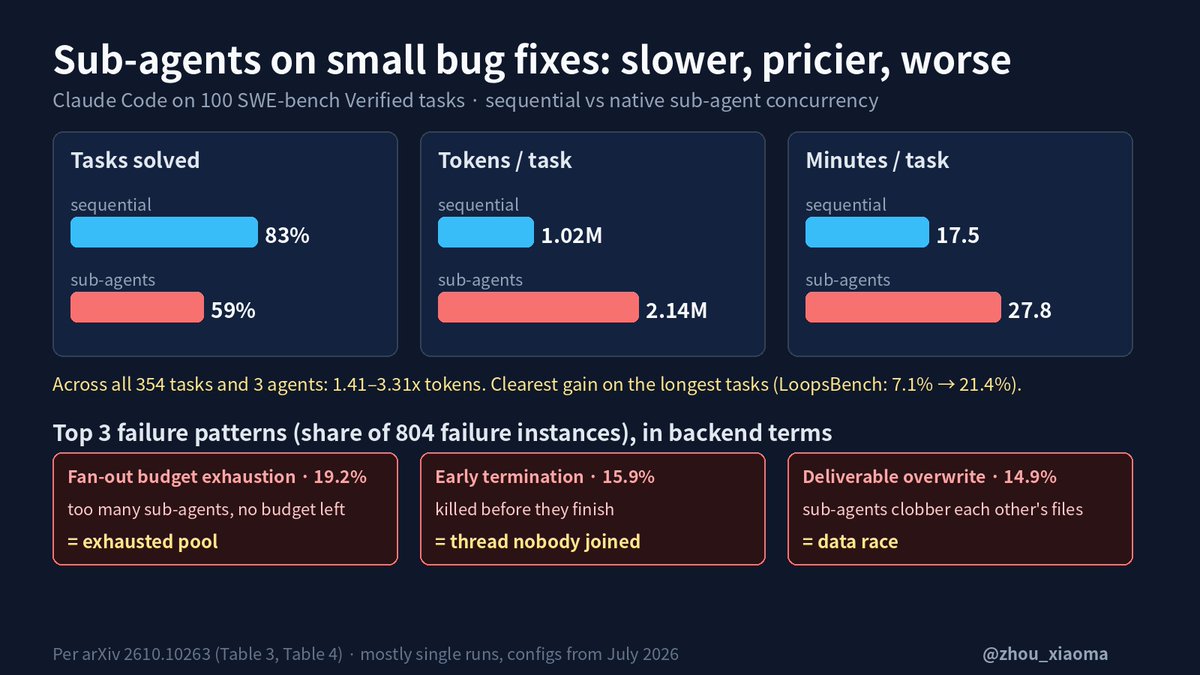
A comprehensive empirical study evaluated native sub-agent concurrency across 2,124 runs on Claude Code, Codex, and Kimi Code (354 tasks, ~$20.8K API cost). On 100 standard SWE-bench Verified tasks, enabling sub-agents caused Claude Code's solve rate to collapse from 83% to 59% (with latency increasing from 17.5 to 27.8 minutes) and Kimi Code from 77% to 59%, while token consumption inflated by 1.41x to 3.31x. The study revealed severe failure modes including budget-exhausting fan-outs, orphaned child processes, and concurrent delivery race conditions.
Empirical Benchmark Unmasks Sub-Agent Concurrency: SWE-bench Success Drops 24% as Token Costs Surge up to 3.3x

Key Takeaways

  • A $20,800 empirical study across 2,124 runs revealed the real costs of native sub-agent concurrency in Claude Code, Codex, and Kimi Code
  • On SWE-bench Verified, sub-agent concurrency dropped Claude Code's solve rate from 83% to 59% and Kimi Code from 77% to 59%
  • Token consumption inflated by 1.41x-3.31x while execution times lengthened, caused by thread race conditions and budget exhaustion
  • Delivered gains only on massive multi-file projects (LoopsBench: 7.1% to 21.4%); authors recommend sequential execution as the default
Read full story
Linked Models & Agents:

Modal will run agent Sandboxes on NVIDIA Vera CPUs: up to 2x the throughput of comparable x86 under heavy load

Modal said in an October 19 blog post that it will add NVIDIA's Arm-based Vera CPU to power Modal Sandboxes, its first step beyond an all-x86 fleet. Using Agentless Agent Bench, a 50-task suite built from Terminal-Bench, Modal measured up to 2x the task throughput of a comparable x86 GNR machine under heavy concurrency, with per-task latency equal or lower (vendor figures). On an idle host running tasks serially, Vera's edge was small. The capacity targets background coding agents and reinforcement learning rollouts.

Modal will run agent Sandboxes on NVIDIA Vera CPUs: up to 2x the throughput of comparable x86 under heavy load

Key Takeaways

  • Throughput: under heavy concurrency Vera reached up to 2x the task throughput of a comparable x86 GNR machine, with per-task latency equal or lower (Modal early tests, vendor figures).
  • Benchmark: Agentless Agent Bench uses 50 Terminal-Bench oracle solutions and verifiers with network calls removed, isolating CPU work such as compilation, grep, git and device emulation.
  • Idle serial runs: across the 50 tasks Vera was often but not always faster, and not by a large margin; the gap opens under contention.
  • Why: Modal credits Vera's high memory bandwidth for packing more containers per core without throttling; x86 alternatives plateaued earlier as CPU counts rose.
  • Rollout: this is Modal's first Arm support and needs infrastructure and image-build changes; no launch date or pricing was announced.
Read full story
m
mofcom.gov.cnSource·
👀119
🔥82

China proposes export controls on 23 AI technologies: weights of 2T-parameter or global top-10 models restricted, open source and API services exempt

On Oct 16 China's commerce and science ministries proposed adding 40 technologies, 23 of them in AI, to the export ban and restriction catalogue. The draft restricts core technology of models with at least 10^26 training FLOPs, at least 2 trillion parameters, or a global top-10 ranking, and sets step, concurrency and tool-count thresholds for agents. Open-sourced technology is exempt, and API or SaaS services are not treated as technology exports. Temporary pre-export registration took effect the same day; comments close Nov 15.

Key Takeaways

  • 23 AI items out of 40 proposed technologies (14 prohibited, 26 restricted across AI, biomedicine and photovoltaics); comments open Oct 16 to Nov 15, 2026
  • Restricted model thresholds (any one): at least 10^26 training FLOPs, at least 2 trillion parameters, or a global top-10 ranking; covers weights, checkpoints, source code, architecture and training or inference acceleration
  • Agent thresholds include 20 or more sub-task steps with at least 90% average success, 60 or more concurrent agents, or 200 or more integrated tools
  • Open-sourced or published technology is exempt; serving via API, app or web, SaaS, or lightweight on-device deployment is not a technology export, while overseas on-premise deployment is
  • Temporary pre-export registration has applied since Oct 16, including deals already underway
Read full story
Linked Models & Agents:

SparseEngine: Harbin Institute of Technology Open-Sources Sparse-First Inference Engine Delivering 2.5x Faster Decoding Than vLLM for Long-Horizon Agents

Long-horizon LLM agents accumulate expanding interaction histories that saturate GPU KV-cache memory and choke self-attention throughput. While sparse attention algorithms mitigate these bottlenecks mathematically, existing production serving engines (e.g. vLLM) are tightly coupled to dense tensor layouts, preventing heterogeneous sparse mechanisms from sharing infrastructure. Researchers from Harbin Institute of Technology (HIT) release SparseEngine (arXiv:2609.39068), an open-source, sparse-first inference engine built from the ground up for long-horizon agent workloads. SparseEngine establishes a shared lifecycle contract enabling 15 diverse sparse attention methods across four distinct families to control their custom KV representations while unifying memory management. It introduces Chain Cache to resume stateful KV-evicted contexts across multi-turn requests and Controllable Prefix-Cache Pruning to discard stale history without disrupting prefix matching. Empirical evaluations on long-horizon agent benchmarks show that SparseEngine delivers over 10x higher throughput under KV eviction, over 2.5x faster decoding throughput than vLLM at matched concurrency, and more than 2x end-to-end task speedups with zero degradation in model reasoning accuracy.

Key Takeaways

  • Harbin Institute of Technology open-sources SparseEngine, a sparse-first inference engine natively supporting 15 sparse attention algorithms
  • Introduces Chain Cache and Controllable Prefix-Cache Pruning to preserve prefix-cache benefits across multi-turn sparse agent sessions
  • Delivers 2.5x faster decoding than vLLM, lifts throughput by 10x under KV eviction, and halves end-to-end agent task latency
Read full story
ADSponsored

WEFT: Whole-System Evolution for Tool-Use Post-Training Scales Agentic Interaction with MegaMCP State Isolation

Recent attempts to scale tool-use post-training for autonomous agents have focused primarily on synthesizing standalone execution environments. However, environments constitute merely one component of a holistic agentic interaction system comprising environments, tasks, harnesses, and evaluators; scaling environments in isolation yields inconsistent training signals. Researchers from Fudan University introduce WEFT (arXiv:2609.36887), a whole-system evolution framework for tool-use post-training. WEFT coordinates environment breadth, task complexity, and interaction diversity, applying execution-driven self-evolution to attribute failures and iteratively revise flawed components. To ensure optimization stability and concurrency reliability, WEFT introduces prefix-preserving sampling, atomic-turn credit assignment, and MegaMCP—a Model Context Protocol infrastructure providing isolated, recoverable state management across concurrent rollouts. WEFT-8B and WEFT-14B outperform matched environment-scaling baselines across BFCL V4, tau^2-Bench, and Claw-Eval, with WEFT-14B beating Agent-World-14B by 6.41, 2.23, and 12.27 percentage points, while WEFT-35B-A3B excels on long-horizon benchmarks like Toolathlon-Verified.

WEFT: Whole-System Evolution for Tool-Use Post-Training Scales Agentic Interaction with MegaMCP State Isolation

Key Takeaways

  • Pioneers WEFT, co-evolving environments, tasks, harnesses, and evaluators to overcome the limits of isolated environment synthesis
  • Integrates prefix-preserving sampling, atomic-turn credit assignment, and MegaMCP isolation for resilient tool-use post-training
  • WEFT-14B surges past Agent-World-14B by 6.41 pp on BFCL V4, 2.23 pp on tau^2-Bench, and 12.27 pp on Claw-Eval
Read full story
Linked Models & Agents:

Huawei Cloud Unveils Agentic Hybrid Cloud Architecture and Upgrades AgentArts Platform

At HUAWEI CONNECT 2026, Huawei Cloud launched its Agentic Hybrid Cloud architecture, introducing the AI Cluster Service (AICS) and Agentic Model-as-a-Service. The upgraded AgentArts orchestrator provides deterministic concurrency and secure data isolation across 100+ enterprise customers.

Key Takeaways

  • Launches AI Cluster Service (AICS) purpose-built for massive agentic concurrency
  • AgentArts platform delivers enterprise low-code agent DAG orchestration and sandboxing
  • Accelerates enterprise transition toward autonomous agent-driven production workflows
Read full story
Linked Models & Agents:

Bench v2.1.0: constitution + three-stage edit review for Claude Code, installer/CLI, 1036 tests

Dana (@MatureIntellect) shipped Bench v2.1.0: Claude Code runs under a written constitution with three-stage edit review and a tamper-evident ledger. v2.1 adds prompt caching, per-stage model control, installer/CLI, concurrency locks, weekly cost/latency reports, and 1,036 passing tests.

Key Takeaways

  • Release: Bench v2.1.0 (benchgov.com).
  • Governance: constitution + three-stage edit review + tamper-evident ledger.
  • Eng: installer/CLI, prompt caching, concurrency locks, 1036 tests, cost/latency reports.
Read full story
Linked Models & Agents:

Sortie: Apache-2.0 orchestrator that turns GitHub/GitLab/Linear/Jira tickets into isolated coding-agent sessions via WORKFLOW.md

Dan Kornas (@DanKornas) launched Apache-2.0 open-source Sortie: define tracker, coding agent, and concurrency in WORKFLOW.md beside the repo, then schedule GitHub/GitLab/Gitea/Linear/Jira issues into isolated workspaces. Adapters cover Claude Code, Copilot, OpenCode, Codex, and Kiro, with SQLite run history, retry queues, and stall detection.

Key Takeaways

  • Ship: Apache-2.0 open-source sortie-ai/sortie ticket-to-agent orchestrator.
  • Config: single WORKFLOW.md for trackers, concurrency, and isolated workspaces.
  • Adapters: Claude Code / Copilot / OpenCode / Codex / Kiro with SQLite state and stall detection.
Read full story

LightSeek open-sources Kimi K3 draft trio: EAGLE-3, DFlash2, DSpark via TorchSpec + vLLM

LightSeek Foundation released a Kimi K3 draft-model collection (EAGLE-3, DFlash2, DSpark) trained with TorchSpec on 40 NVIDIA GB200 GPUs, with open data recipes. Their blog reports acceptance length across 10 benchmarks and SPEED-Bench end-to-end throughput; DFlash2 averages ~4.02 accepted tokens and leads EAGLE-3 at lower concurrency.

Key Takeaways

  • Three draft architectures for Kimi K3 speculative decoding: EAGLE-3, DFlash2, DSpark.
  • Trained on 40×GB200 with TorchSpec; data recipes plus Docker/CI shared.
  • On HumanEval, DFlash2 acceptance length ~5.08 vs EAGLE-3 ~3.29.
Read full story
Linked Models & Agents:

Claude Code weekly limits become +25% permanent on Sept 14, a 17% cut versus today's promo

ClaudeDevs announced that standard Claude Code weekly usage limits will rise permanently by 25% on September 14, 2026 for Pro, Max, Team, and seat-based Enterprise plans. Until that date, the current 50% promotional increase remains in effect. Anthropic also stated the new permanent baseline is about a 17% reduction versus the allowance developers are using today. The company said it is working on product changes that should make remaining quota feel more productive, with better visibility and control over usage. For teams running long-horizon coding agents, the practical implication is a two-step calendar: keep the promo window for large refactors and eval loops through mid-September, then resize concurrency, /loop jobs, and default effort levels to the tighter permanent cap. Heavy Claude Code users should treat the dashboard, not older Help Center copy, as the live schedule.

Key Takeaways

  • Permanent +25% weekly limits start September 14 for Pro, Max, Team, and seat-based Enterprise.
  • The current +50% promo holds until then, making the new standard about 17% lower than today.
  • Resize long-horizon agent jobs and concurrency before the promotional allowance ends.
Read full story
ADSponsored

Milvus Ships Official Plugin for DeepSeek Harness for Read-Only Vector Retrieval

Milvus released an official integration plugin for DeepSeek Harness 0.1, providing high-concurrency hybrid vector retrieval and secure read-only context injection for open-source autonomous agents.

Key Takeaways

  • Seamless compatibility with DeepSeek Harness 0.1 to provide out-of-the-box vector knowledge retrieval;
  • Strict read-only security guards protect enterprise vector collections from unintended agent modifications;
  • Integrates smoothly with Milvus 3.0 StructArray for multi-vector contextual retrieval in agent loops.
Read full story
Linked Models & Agents:

Chroma Releases Fission Concurrency Protocol for Multi-Agent Swarm Memory Consistency

Chroma published Fission, a concurrency-control protocol engineered for multi-agent swarms updating shared Foundation memory concurrently without write collisions or Git-style merge locks.

Key Takeaways

  • Tailored specifically for multi-agent swarm environments requiring high-frequency shared memory mutations;
  • Addresses architectural limitations of Git-style branching by implementing lightweight decentralized locks;
  • Core infrastructure building block supporting Chroma Foundation's self-improving memory ecosystem.
Read full story
Linked Models & Agents: