AI Coding Live News

Perplexity Cuts Agent API Effort-Level Costs and Adds Ultra: Medium Nearly 90% Cheaper; Ultra ~85.9% WANDR

On November 5 Perplexity Developers (@perplexitydevs) said every Agent API effort level now costs less per query with equal or better research quality, and added an ultra tier for broad long-running research. Vendor figures: medium rose from ~55% to ~77% on BrowseComp/DSQA with nearly 90% lower cost; xhigh held ~76.5% WANDR at ~25% of August 2026 cost; ultra runs three parallel researchers plus a consolidator at ~85.9% WANDR and about $21.71/task.

Perplexity Cuts Agent API Effort-Level Costs and Adds Ultra: Medium Nearly 90% Cheaper; Ultra ~85.9% WANDR

Key Takeaways

  • Official (@perplexitydevs + blog): every effort level cheaper with equal/better quality; new ultra
  • Vendor: medium BrowseComp/DSQA ~55%→~77% with nearly 90% lower cost
  • Vendor: xhigh WANDR ~76.5% at ~25% of August 2026 cost
  • ultra: 3 parallel research agents + consolidator; WANDR ~85.9% at ~$21.71/task on Claude Opus 5.5
  • Use effort="ultra" or pin [email protected]; background mode for long runs
Read full story

Cognition Ships Devin Review 2.0: ~82% Cheaper (~5x) Since August, Median Latency ~94s; Auto-Review, Autofix, Ultra & Custom Reviewers

On November 5, Cognition launched Devin Review 2.0. Since August, per-PR review cost fell about 82%, with a typical review at about $0.25–$0.75 and median latency about 94 seconds (down from about 139). It adds automatic review rules, incremental re-reviews, configurable per-PR spend limits, and tighter Devin Autofix loops. New controls include Devin Review Ultra and Custom Reviewers (beta).

Cognition Ships Devin Review 2.0: ~82% Cheaper (~5x) Since August, Median Latency ~94s; Auto-Review, Autofix, Ultra & Custom Reviewers

Key Takeaways

  • Cost: ~82% cheaper per PR since August (~5x); typical ~$0.25–$0.75; ~$2.25 average per fixed bug across customers (vendor)
  • Quality & speed: bugs found per PR rose 1.22→1.32 on average; median latency ~94s (~1.5x faster vs ~139s)
  • Incremental reviews: default re-reviews only changed parts; ~80% of PRs cost under $1 including all pushes; configurable per-PR spend cap
  • Loop: with Devin, findings can be fixed, dismissed, or escalated; Autofix available in Devin Cloud and Desktop
  • Controls: Devin Review Ultra for higher-effort reviews; Custom Reviewers (beta) run specialized checks from your instructions
Read full story

OpenAI Publishes National Community Compact: Pays Full Campus Power Costs, No NDAs With Officials, Public Impact Reporting

On November 5 OpenAI published a National Community Compact for U.S. compute campuses it owns and operates: no NDAs with public officials except narrow security carve-outs, public construction and impact reporting (noise, water, energy), Ratepayer Protection Pledge to pay full electricity and incremental grid costs with stranded-asset assurances, Grid Protector peak curtailment (up to 1,000 MW in Effingham, Georgia), and community investments already listed at $80M in Effingham and $40M in Pike County, Ohio. A PDF of the Compact is on openai.com.

OpenAI Publishes National Community Compact: Pays Full Campus Power Costs, No NDAs With Officials, Public Impact Reporting

Key Takeaways

  • On November 5 OpenAI published a National Community Compact as the baseline for campuses it owns and operates
  • It pledges no NDAs with public officials (narrow carve-outs) and public reporting on noise, water, energy and sustainability
  • Ratepayer Protection Pledge: OpenAI pays full campus power and incremental grid costs, with assurances against stranded assets
  • Grid Protector continues: up to 1,000 MW peak demand response at Effingham, Georgia
  • Community investments cited: $80M Effingham and $40M Pike County; each campus still gets a local Compact
Read full story
Linked Models & Agents:

Artificial Analysis: Tencent Hy4 Scores 35 on Intelligence Index v5, Ranked No.2 Among China Labs, 31% on FrontierCode 2.0

Independent evaluator Artificial Analysis published Tencent Hunyuan Hy4 results on the Intelligence Index v5 on November 5 (08:28 UTC): a composite score of 35, tying Grok 4.7 (xhigh) and one point behind Claude Haiku 5.5 (max). Among China-based labs it ranks second only to Kimi K3.1 Pro (46). On agentic coding it scores 31% on FrontierCode 2.0 and 37% on Terminal-Bench 4.0; cost per Intelligence Index task is about $0.78, roughly one-tenth of same-score Grok 4.7.

Artificial Analysis: Tencent Hy4 Scores 35 on Intelligence Index v5, Ranked No.2 Among China Labs, 31% on FrontierCode 2.0

Key Takeaways

  • Intelligence Index v5 composite 35: ties Grok 4.7 (xhigh), one point behind Haiku 5.5 (max, 36); No.2 China-lab model behind Kimi K3.1 Pro (46)
  • FrontierCode 2.0 at 31% (leads China labs; DeepSeek V4.1 Flash 1017 max 28%, Kimi K3.1 Pro 25%); Terminal-Bench 4.0 at 37%
  • AA-Omniscience v1.1 accuracy 50% but hallucination rate 89% (Kimi K3.1 Pro hallucination 37%); HLE-Diamond 33%
  • About $0.78 per Intelligence Index task: ~10x cheaper than same-score Grok 4.7, ~13x cheaper than Qwen3.8 Max (34), nearly 2x Haiku 5.5
  • Pricing about $0.834/$2.501 per 1M input/output tokens, cache reads $0.042; 1M context; text and image input
Read full story
ADSponsored

Claude Code Background Subagent Status Lines Now Written by Haiku 5.5: About 99% Cheaper per Update, About 6% More Prompts per Limit

On November 4 ClaudeDevs, Anthropic's official developer account, said the status line that a background subagent in Claude Code refreshes every 30 seconds used to re-read its whole conversation each time, and is now written by Haiku 5.5 from short notes, so each update costs about 99% less. Anthropic says sessions with background subagents used about 5% less of the limit, giving about 6% more prompts on the same limit. It is live for most Pro, Max and Ultra users and everyone on Team and Enterprise, on v2.1.316 or later.

Key Takeaways

  • A background subagent refreshes its status line every 30 seconds, and each refresh used to re-read the subagent's whole conversation
  • Haiku 5.5 now writes the status line from short notes, which Anthropic says makes each update about 99% cheaper
  • The subagent itself keeps its own model; only the status line is written by Haiku 5.5
  • Anthropic says sessions with background subagents used about 5% less of the limit, so the same limit gives about 6% more prompts
  • It is live for most Pro, Max and Ultra users and everyone on Team and Enterprise; update to v2.1.316 or later
Read full story

OpenAI Details Autonomous Vulnerability Pipeline: An Upcoming Cyber Model Produced Exploits and Patches for 948 Linux Kernel Privilege Escalation Bugs for $1.2M in API Costs

On November 4 OpenAI published "A thousand fewer paths to root." Its autonomous pipeline for vulnerability discovery, validation, exploitation and patching scanned the Linux kernel in mid-October with an upcoming cyber model, reproduced 1,724 vulnerabilities and produced exploits and patches for 948 distinct local privilege escalation (LPE) bugs. The run cost $1,213,430 in API credits, about $1,279 per LPE, and hundreds of reports and patches have already gone to maintainers.

OpenAI Details Autonomous Vulnerability Pipeline: An Upcoming Cyber Model Produced Exploits and Patches for 948 Linux Kernel Privilege Escalation Bugs for $1.2M in API Costs

Key Takeaways

  • Five-stage pipeline: discovery, dynamic validation, exploitability assessment, patch generation, human review
  • Of 2,308 candidate findings, 1,724 were reproduced, yielding 291 info-leak PoCs and 948 distinct LPEs
  • Total cost $1,213,430; historical Pwn2Own and TyphoonPWN bounties imply a hypothetical $18.9M to $66.3M value
  • The newer model found more than 5x the novel LPEs of a July GPT-5.6 Sol run (166)
  • The agents used at least 10 novel Linux exploitation techniques, withheld for safety reasons
Read full story
Linked Models & Agents:

Ricursive Open-Sources Ripple-65B Preview: A 65B Dense Model Pretrained From Scratch, TerminalBench 2.1 80.5, Apache 2.0

Ricursive Intelligence released its first model, Ripple-65B Preview, on November 4 (18:24 UTC), open-sourcing the instruction-tuned model (BF16 and NVFP4) and a base model on Hugging Face under Apache 2.0. The official model card describes a 65B dense Transformer pretrained on 12T tokens with up to 1M context, and self-reports TerminalBench 2.1 80.5, SWE-bench Pro v2.0 Hard 79.1 and DeepSWE 1.1 44.3, ahead of much larger US open-weight models on agentic coding. It fits on local hardware such as the DGX Spark. CEO Anna Goldie says it cost about a tenth of the prior comparable state of the art.

Ricursive Open-Sources Ripple-65B Preview: A 65B Dense Model Pretrained From Scratch, TerminalBench 2.1 80.5, Apache 2.0

Key Takeaways

  • Ripple-65B Preview is a 65B dense model with a thin-and-deep shape (80 layers, d_model 5120), moving from an Olmo 3 baseline to a Gemma 3N-like architecture.
  • It was pretrained on 12T tokens at 8K sequence length, then went through mid-training, long-context training, SFT and mixed-domain RL, with up to 1M context.
  • Self-reported TerminalBench 2.1 is 80.5, above Reflection Beam 501B (80.1) and Muse Spark Open 816B (76.4), but SWE-bench Verified 76.5 and DeepSWE 1.1 44.3 show it does not lead everywhere.
  • Ricursive says the core team grew from one to five people and code compute efficiency improved 16x versus the Olmo 3 ladder; it reaches about 250 tok/s on 2x B200.
  • Hugging Face hosts BF16, NVFP4, base and DFlash2 speculative-decoding checkpoints, all under Apache 2.0.
Read full story
Linked Models & Agents:
⚡ Ripple-65B Preview⚡ Reflection Beam 501B⚡ Muse Spark Open⚡ Nemotron 3 Ultra🌐 Ricursive Intelligence🌐 NVIDIA

OpenAI Launches Grid Protectors Program: Future Compute Campuses Will Cut Power When Grids Are Strained, Starting With Up to 1,000 MW in Georgia

On November 2, OpenAI announced the Grid Protectors Program on its official blog: working with utilities and regulators so its future self-built compute campuses (its new term for data centers) cut electricity use when the grid is strained, while paying the full infrastructure and electric-service costs. The pilot is the planned campus in Effingham County, Georgia (Project Camellia), which Georgia Power says needs about 3,200 MW and commits up to 1,000 MW of flexible demand response, equal per OpenAI to the average use of roughly 700,000 households. The campus is still in development.

OpenAI Launches Grid Protectors Program: Future Compute Campuses Will Cut Power When Grids Are Strained, Starting With Up to 1,000 MW in Georgia

Key Takeaways

  • The Effingham campus (Project Camellia) needs about 3,200 MW, and Georgia Power can cut up to 1,000 MW of supply to it during peaks under a 25-year agreement (Georgia Power figures).
  • OpenAI says 1,000 MW equals the average demand of roughly 700,000 households, more than Washington, D.C., and Boston combined.
  • Georgia Power projects about $950 million a year in customer savings from 2029 from its large-load portfolio including this project, at least $15 a month for a typical home.
  • OpenAI commits to paying the full grid infrastructure and electric-service costs; terms for other campuses will be shared once finalized.
  • OpenAI cites a projection that U.S. data center capacity will exceed 100 GW by 2030.
Read full story
Linked Models & Agents:

X Discussion: Elon Musk Says Grok Bot Serving Costs Were Unsustainably High Relative to Revenue; Replit CEO Amjad Masad Warns Subsidized AI Subscriptions Face a Rug Pull

After users on X complained that their Grok Bot usage ran out early this cycle, Elon Musk replied that "the cost of serving Grok Bot was unsustainably high relative to revenue", a reply with about 13K likes and 5.5M views. Replit CEO Amjad Masad then quoted the news, saying people enjoying subsidized AI subscriptions should "get ready to get rug pulled", sparking a debate over whether flat-rate AI plans can last. This is an X discussion with personal views; xAI has not published a formal pricing or limit announcement.

Key Takeaways

  • Trigger: user @DogecoinNorway said their Grok Bot usage hit 100% with 4 days left until reset, a post with about 1.24M views.
  • Musk replied that the cost of serving Grok Bot was unsustainably high relative to revenue, with about 13.2K likes, 5.51M views and 1,900+ quotes.
  • Amjad Masad (Replit CEO) quoted it, warning subsidized AI subscriptions are about to get rug pulled, with about 2,347 likes and 146K views; in replies he said Replit never subsidized.
  • xAI has not published a formal limit or pricing change; rely on official notices for specifics.
Read full story

X discussion: Scott Alexander's "Against SURA" criticizes the "stop unilaterally and raise awareness" line, as AI safety is accused of acting like a mass political movement

On October 31, Scott Alexander published "Against SURA" on LessWrong. He uses SURA (Stop Unilaterally + Raise Awareness) for the view that AI companies, their employees and countries should halt AI work on their own and focus on raising awareness, and argues it would hand the lead to companies that do not prioritize alignment and cost the US its bargaining chip with China. He cites AI Futures Project members' survival estimates for scenarios without a global pause, mostly in the 25%-50% range, to push back on 90%+ doom estimates. Blogger jessicat quoted it and said parts of AI safety now behave like a mass political movement with bad epistemics (about 359 likes, 63K views); Bloomberg Odd Lots co-host Joe Weisenthal summed it up as people competing to out-doom each other (about 287 likes, 38K views). This is an opinion debate, not a policy announcement from any organization.

X discussion: Scott Alexander's "Against SURA" criticizes the "stop unilaterally and raise awareness" line, as AI safety is accused of acting like a mass political movement

Key Takeaways

  • Source: Scott Alexander's "Against SURA" on LessWrong, posted 2026-10-31 19:32 UTC; SURA stands for Stop Unilaterally + Raise Awareness
  • AI Futures Project members' survival estimates for three no-global-pause scenarios (C+ / C / D), as cited: Daniel Kokotajlo 40%/20%/10%, Ryan Greenblatt 60%/63%/55%, Eli Lifland 50%/45%/32%, Thomas Larsen 45%/35%/20%, Romeo Dean 40%/35%/20%; the AI forecaster FutureSearch gave 44%
  • He says that if the US unilaterally passed Sanders' "Ban Artificial Superintelligence Act" (endorsed by MIRI), the AI forecaster he asked put the chance of China agreeing to a pause within a year at only 7%, up from 1%
  • jessicat's quote post (Oct 31, 23:01 UTC) has about 359 likes, 28 reposts and 63K views; Joe Weisenthal's quote (Nov 1, 14:57 UTC) has about 287 likes, 33 replies and 38K views
  • Note: the "10-40%" in Weisenthal's post is his paraphrase; the estimates in the essay's table range from 10% to 63%
Read full story
Linked Models & Agents:
ADSponsored
T
Tsinghua University & Z.AI (HarnessPro, arXiv 2610.26770)arxiv.org·
👀27
🔥80

Tsinghua and Z.AI open-source HarnessPro: agents rewrite their own harness, reaching 80.8% on Terminal-Bench 2 at 34% lower cost per task

HarnessPro (arXiv 2610.26770, submitted Oct 19 and revised Oct 20), from Tsinghua University, Z.AI (Zhipu) and collaborators, is a label-free way to improve an agent harness: specialized agents diagnose execution traces, rewrite instructions and runtime policies, score candidates with LLM-generated tests, and keep Lite, Medium and Heavy harnesses along the performance-cost frontier. Per the paper, with GPT-5.5 and Codex the Heavy mode reaches 80.8% on Terminal-Bench 2, 4.5 points above the prior RHO method, while cost per task drops from $1.09 to $0.72. The code is MIT-licensed and drew wider media coverage this week, including from Pandaily.

Tsinghua and Z.AI open-source HarnessPro: agents rewrite their own harness, reaching 80.8% on Terminal-Bench 2 at 34% lower cost per task

Key Takeaways

  • Terminal-Bench 2 (GPT-5.5 with Codex, mean of 3 runs): Heavy reaches 80.8% at $0.72 per task, versus RHO at 76.3% and $1.09, a 33.9% cost cut (paper figures, arXiv)
  • Averaged over three benchmarks: +2.0 points pass rate and -26.1% cost per task versus RHO, across Terminal-Bench 2, SWE-Bench Pro and ProgramBench
  • Holds across models: with GLM-5.2 and Claude Code on Terminal-Bench 2, Heavy hits 81.4% at $0.62, versus vanilla at 74.6% and $0.92 and RHO at 78.0% and $1.00
  • Budget modes: Medium matches RHO at 76.3% on Terminal-Bench 2 for only $0.56 per task; Lite gets 72.9% at $0.43
  • Cheap to train: only 10 training tasks per benchmark and 3 to 4 evolution epochs, tested on 59, 100 and 100 held-out tasks; the three harness tiers are MIT-licensed on GitHub
Read full story

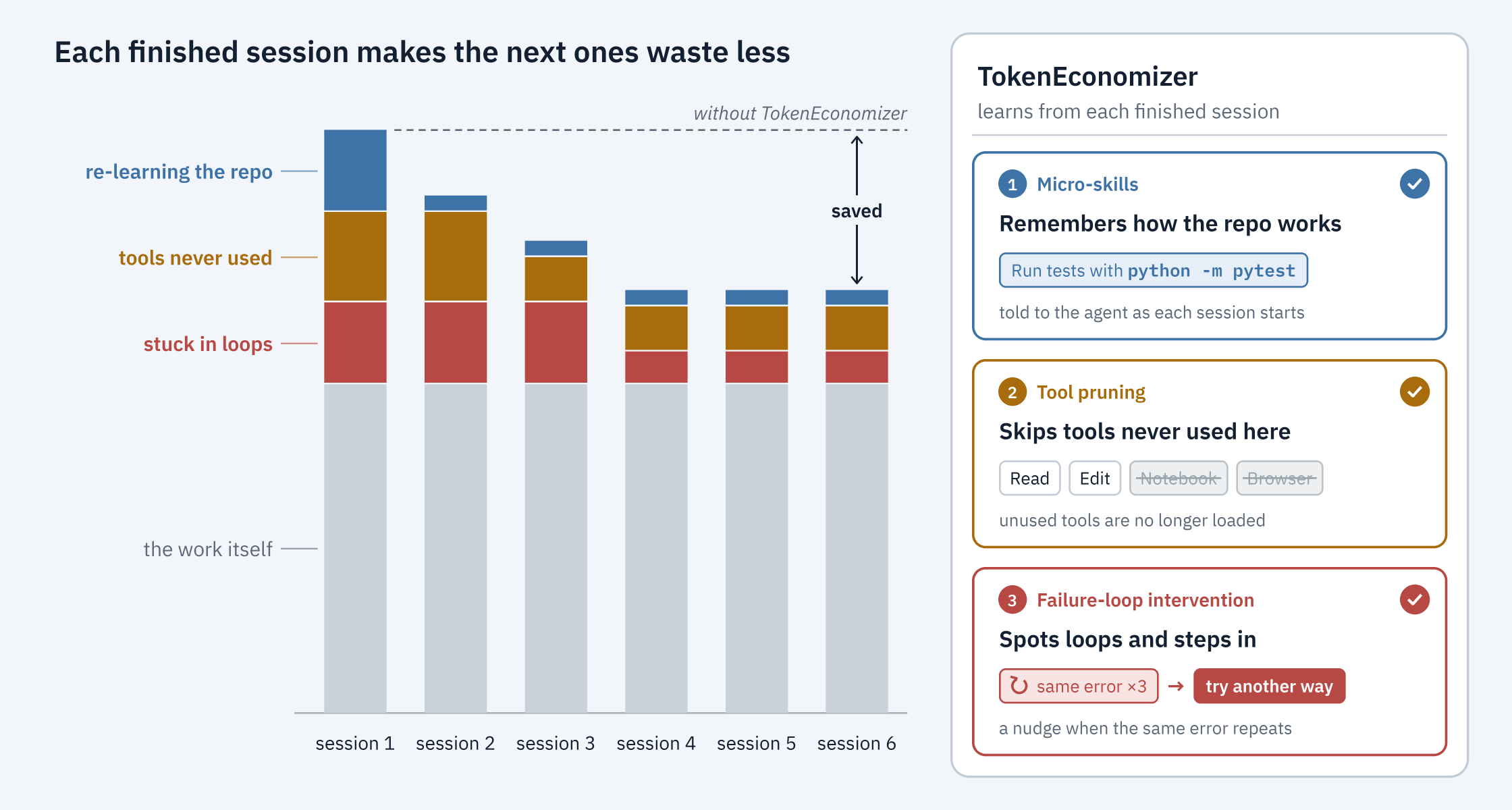
Microsoft Research and UC Berkeley open-source TokenEconomizer, a plugin that cuts Claude Code and Codex costs by 18.4–30.9% on SWE-Bench without changing the agent

Microsoft Research, Microsoft Security and UC Berkeley open-sourced TokenEconomizer on GitHub (Apache 2.0, v0.1.0 released October 26), a plugin for Claude Code, Codex, GitHub Copilot CLI and Pi, with experimental opencode support. It learns from earlier sessions in the same repository: micro-skills remember repo facts, tool pruning drops tool definitions that go unused, and a loop guard nudges an agent that is stuck. The paper reports 18.4–30.9% lower mean cost across five agent and model combinations on 277 SWE-Bench tasks (paper figures).

Microsoft Research and UC Berkeley open-source TokenEconomizer, a plugin that cuts Claude Code and Codex costs by 18.4–30.9% on SWE-Bench without changing the agent

Key Takeaways

  • Cost: on 277 SWE-Bench tasks across 6 repositories and 5 agent and model combinations, mean cost fell 18.4–30.9%, and all 30 repository-by-combination cells got cheaper (paper figures, including the plugin's own model calls)
  • Success rate: Pass@1 rose in 4 of 5 combinations, e.g. Copilot CLI with Sonnet 5 cost 18.4% less with Pass@1 +2.6, while Claude Code with Opus 4.8 cost 30.9% less with Pass@1 -1.0
  • Three mechanisms: micro-skills (repo facts stated only after three sessions confirm them), tool pruning (by default a tool unused over 10 prompts across 2 sessions is left out), and a failure-loop guard (one redirect when a judge is at least 0.7 confident, never stopping a turn itself)
  • Generalization: 16–21% lower cost on Web-Bench and 6–20% lower on two security-auditing benchmarks where every task is a new repository
  • Deployment: Apache 2.0, Python 3.10+, no API key of its own, and learned experience stays local in ~/.tokeneconomizer
Read full story

Claude API launches the Usage and Cost Analytics API in beta and raises the request size limit to 128 MB

Per the official Claude API release notes, on Oct 29 Anthropic launched the Usage and Cost Analytics API in beta, with two endpoints, /v1/organizations/analytics/usage and /analytics/cost, that filter and group token usage and cost by model, workspace, API key, and the user or service account behind each request, with 1-minute, 1-hour, or 1-day buckets. The older Usage and Cost API is now legacy but still supported. On Oct 28 the maximum request size for the Messages and Token Counting APIs on the first-party Claude API rose from 32 MB to 128 MB.

Key Takeaways

  • The new API needs the analytics-usage-cost-2026-08-24 beta header; one endpoint returns token and request counts, the other cost in USD (per the official docs)
  • group_by takes up to 5 dimensions, time buckets can be 1m, 1h, or 1d, and each filter accepts up to 100 values
  • Claude Console and Claude Enterprise organizations share the same endpoints and fields; it also works on Claude Platform on AWS and Claude Models on Google Cloud (Anthropic managed)
  • The old Usage and Cost API and four Enterprise Analytics usage and cost report endpoints are now legacy but still supported, with migration guides
  • Since Oct 28 the Messages and Token Counting APIs accept requests up to 128 MB instead of 32 MB (4x), on the first-party Claude API only
Read full story

Epoch AI: open-weight GLM 5.3 autonomously exploited the patch gap in six Firefox releases for about $1,000 each

Epoch AI reported on Oct 29 that, in a deliberately basic setup emulating an unsophisticated attacker, Z.ai's open-weight GLM 5.3 read security fixes that were public but not yet shipped and autonomously built exploit chains for all six Firefox releases from Sep 17 to Oct 26, letting a single webpage visit read local files. Marginal cost was about $1,000 per version and the fastest run took 12 hours. Mozilla patched a previously undisclosed bug the model also used in Firefox 159.0 on Oct 27.

Epoch AI: open-weight GLM 5.3 autonomously exploited the patch gap in six Firefox releases for about $1,000 each

Key Takeaways

  • 6 of 6: every Firefox release from Sep 17 to Oct 26 was compromised using only information public at each release (Epoch report)
  • About $1,000 marginal cost per version, with a 48-hour budget and the fastest run at 12 hours; total Firefox research spend exceeded $100,000 including setup
  • The model also rediscovered an unpublished bug on each attempt, which Mozilla fixed in Firefox 159.0 on Oct 27
  • No refusals or safeguards triggered through first-party or third-party APIs
  • Roughly $100,000 of attempts against Chrome failed so far, which Epoch says is not strong evidence Chrome is safe
Read full story

Amp launches macOS Satellites beta: agents boot a cloud Mac with Xcode in ~30 seconds to build, test and run iOS and Mac apps, from $2/hour

On Oct 29 Amp shipped macOS Satellites: threads keep running on a Linux orb, and when work needs macOS Amp boots a fresh cloud Mac with Xcode and simulators, uses it only to build, run and test, and returns screenshots, logs and screen recordings to the thread. mac.medium costs $2/hour and mac.large $4/hour; the beta is waitlisted. CEO Quinn Slack says agents need a Mac only about 35% of the time even for macOS-heavy work.

Amp launches macOS Satellites beta: agents boot a cloud Mac with Xcode in ~30 seconds to build, test and run iOS and Mac apps, from $2/hour

Key Takeaways

  • Amp says the cloud Mac is ready in about 30 seconds with Xcode, iOS simulators and Homebrew preinstalled
  • Two sizes: mac.medium (6 CPUs, 14 GB) at $2/hour and mac.large (12 CPUs, 28 GB) at $4/hour, drawn first from plan orb usage, then Amp credits
  • A Mac stays up 20 minutes after use so follow-ups reuse its build cache, then it is deleted and nothing is saved
  • CEO Quinn Slack posted on X that even macOS-heavy agent work needs a Mac only ~35% of the time (company figure)
  • Beta only: join the waitlist under Settings > Experimental Features
Read full story
Linked Models & Agents: