AI Coding Live News

Scope Ships Hosted-DB Agent Signup Benchmark: 18 Products, 1,035 Sessions; Prisma Postgres ~88.3%, Seven at Zero

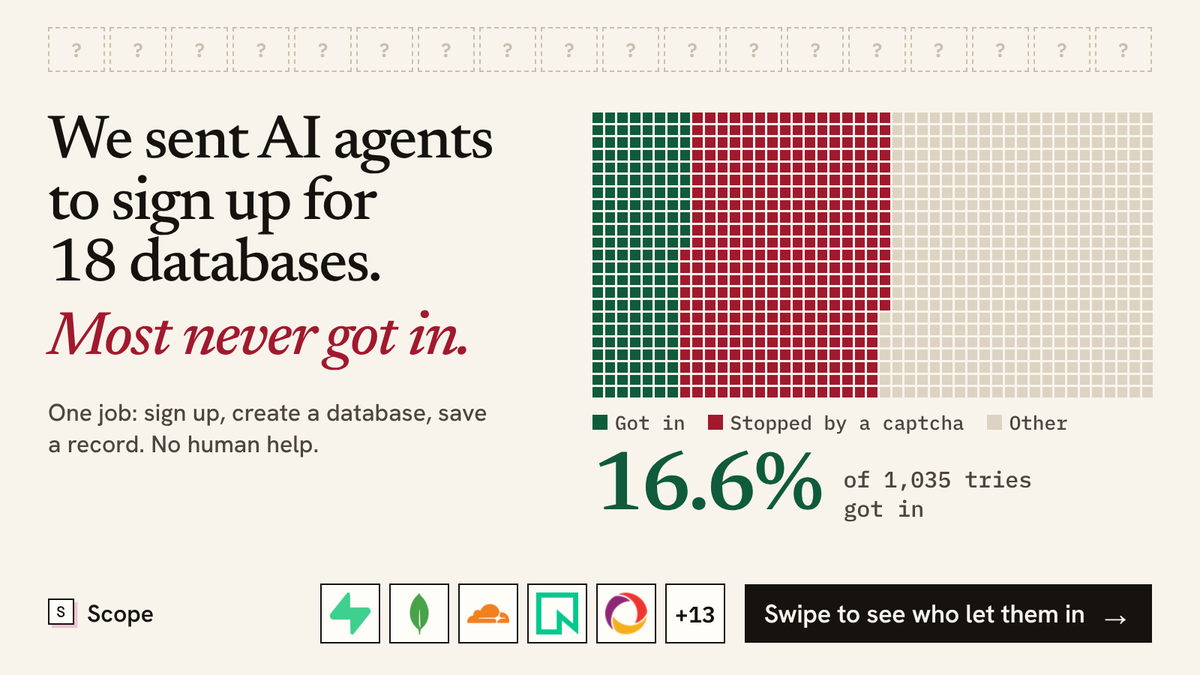
On 2026-11-06, Scope (YC P26) founder Anand Paj (@anandPa94) released the first hosted-database agent signup benchmark. Agents start with no account, provision the named DB, write a record, and hand back credentials across 20 Claude Code/Codex/Cursor configs and 1,035 sessions. Official leaderboard: Prisma Postgres ~88.3%, Upstash ~63.3%, Neon/Nile ~43.3%; CAPTCHAs stopped 373 sessions; 7 of 18 products had zero successes.
Scope Ships Hosted-DB Agent Signup Benchmark: 18 Products, 1,035 Sessions; Prisma Postgres ~88.3%, Seven at Zero

Key Takeaways

  • Source: Scope founder Anand Paj (@anandPa94) X post 2026-11-06 + official board tryscope.com/leaderboard/databases (vendor/evaluator)
  • Scale: 18 hosted DBs × 20 agent configs = 1,035 sessions; only ~16.6% reached a first working result overall
  • Leaders: Prisma Postgres ~88.3% (53/58), Upstash ~63.3%, Neon/Nile ~43.3%, ClickHouse Cloud ~38.3%
  • Friction: CAPTCHAs stopped 373 sessions, bot blocks 105; 7/18 products had zero successes; 50 of 172 wins needed no account
  • Takeaway: for agent-facing devtools, signup→write→hand-back-credentials is now part of the conversion funnel
Read full story

OpenAI Solves Legacy Software Migration: MultiLangBench Lifts COBOL Pass Rate to 97.9%, Modernizing Enterprise Stacks

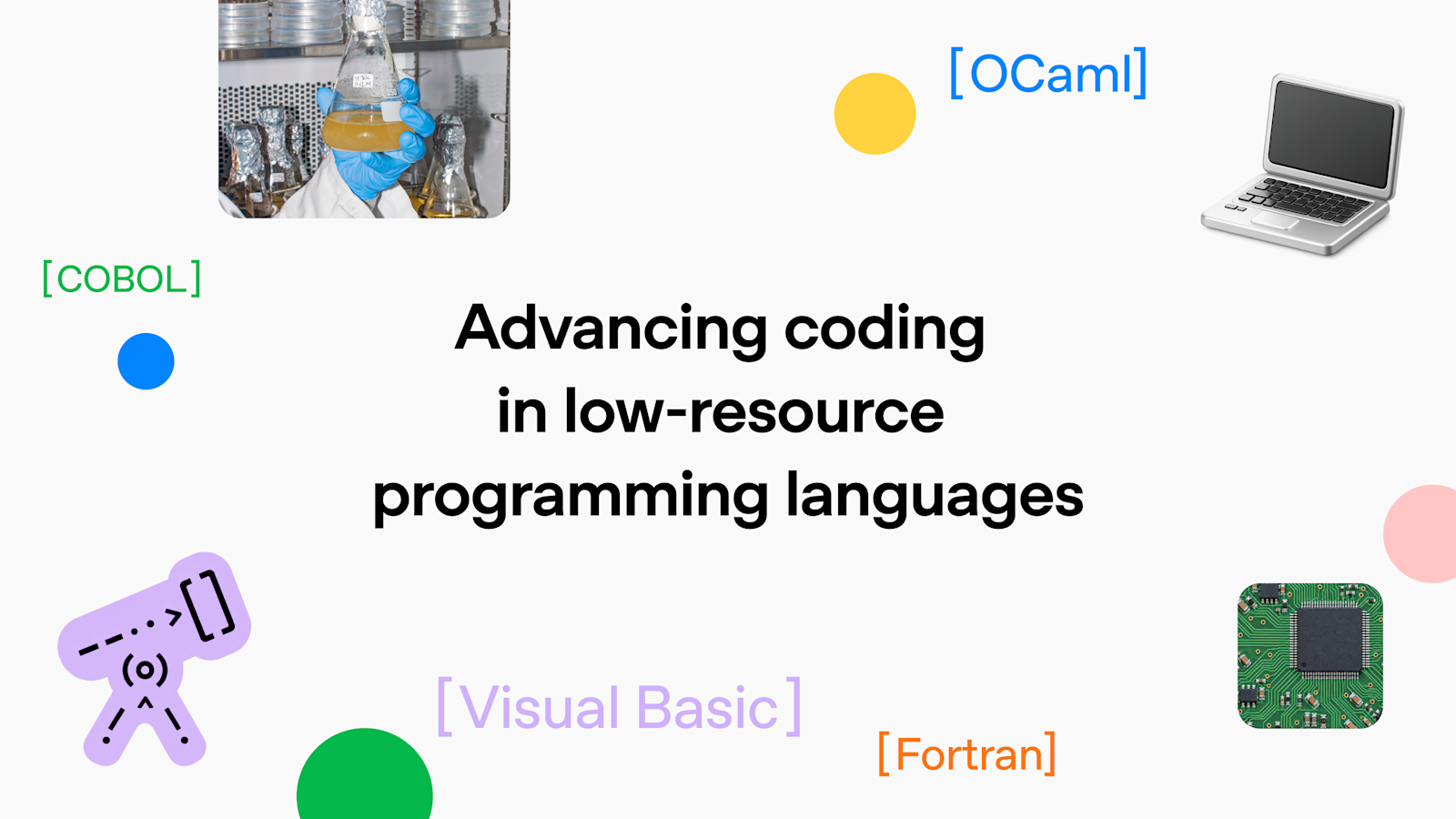
OpenAI officially announced breakthroughs in building and migrating software written in low-resource and legacy languages (COBOL, Fortran, Visual Basic, OCaml), introducing the MultiLangBench evaluation suite. Tackling the trillions of dollars in critical banking and enterprise mainframe infrastructure, the benchmark challenges models to synthesize a SQLite-compatible database engine across 20 distinct languages. GPT-6 Astra boosted average test pass rates from 26.8% to 87.4%, with COBOL soaring from 10.9% to 72.1%. In enterprise COBOL migration tasks, GPT-6.1 Sol achieved a 97.9% success rate while cutting inference costs by 39%.

OpenAI Solves Legacy Software Migration: MultiLangBench Lifts COBOL Pass Rate to 97.9%, Modernizing Enterprise Stacks

Key Takeaways

  • OpenAI unveiled breakthroughs in low-resource and legacy languages with MultiLangBench, challenging models to implement database engines across 20 languages
  • GPT-6 Astra raised the average pass rate from 26.8% to 87.4% (clearing >83% in 19 languages), with COBOL hitting 72.1% and Fortran 83.5%
  • In enterprise COBOL migration benchmarks, GPT-6.1 Sol scored 97.9% (vs 5.4% for GPT-5.6 Sol) while reducing execution costs by 39%
  • OpenAI confirmed open-sourcing the MultiLangBench test suite on GitHub to accelerate automated modernization of mainframe software
Read full story
Linked Models & Agents:

Technical University of Munich Introduces TabWM: Relational World Modeling for Enterprise Database Decision Agents

Researchers from the Technical University of Munich (TUM) introduced TabWM (Tabular World Model) and the WorldRel benchmark generator in arXiv:2610.16763. Moving beyond traditional relational learning that only performs static prediction on database rows, TabWM formulates operational database environments as relational world models capable of simulating state transitions and downstream consequences under arbitrary business actions, unlocking offline reinforcement learning for enterprise decision agents.

Technical University of Munich Introduces TabWM: Relational World Modeling for Enterprise Database Decision Agents

Key Takeaways

  • Technical University of Munich introduced TabWM and WorldRel (arXiv:2610.16763), formalizing relational databases as dynamic world models
  • Expands relational learning beyond static predictions to counterfactual simulations of state deltas under business actions
  • Achieves >0.84 correlation on state transition prediction from only 10-20 observed traces, improving decision-making utility by 28.4%
  • Provides enterprise teams with a differentiable simulation sandbox to train autonomous database and ERP agents via offline RL
Read full story
Linked Models & Agents:

OpenAI open-sources MultiLangBench and reports low-resource language gains: GPT-6 Astra averages 87.4% building SQLite across 20 languages, GPT-6.1 Sol reaches up to 97.9% on COBOL migration

On October 19 OpenAI said its latest models are much better at low-resource languages such as COBOL, Fortran, Visual Basic and OCaml, and open-sourced MultiLangBench, which asks a model to build a SQLite-compatible database engine from scratch in each of 20 languages. GPT-6 Astra averages an 87.4% test pass rate (GPT-5.6 Sol: 26.8%), above 83% in 19 of 20 languages, with COBOL hardest at 72.1%. On a separate COBOL migration eval requiring byte-for-byte output parity after porting to C++, Java, Kotlin, Python or Rust, GPT-6.1 Sol scores 86.6% at low effort (GPT-5.6 Sol: 5.4%) and 97.9% at higher effort. All figures are OpenAI's own.

OpenAI open-sources MultiLangBench and reports low-resource language gains: GPT-6 Astra averages 87.4% building SQLite across 20 languages, GPT-6.1 Sol reaches up to 97.9% on COBOL migration

Key Takeaways

  • MultiLangBench: GPT-6 Astra (max) averages 87.4% across 20 languages vs 26.8% for GPT-5.6 Sol, above 83% in 19 of them (OpenAI-reported).
  • Per language: COBOL 10.9% to 72.1%, OCaml 25.6% to 85.8%, Fortran 21.4% to 83.5%, Visual Basic 27.5% to 89.4%.
  • Budget tier: GPT-6 Luna averages 40.3% at about $0.77 per sample vs $3.48 for GPT-5.6 Sol, roughly 78% cheaper.
  • COBOL migration: GPT-6.1 Sol scores 86.6% at low effort (GPT-5.6 Sol 5.4%) at about 61% of the API cost; 97.9% at higher effort, near saturation.
  • The eval setup, test suite and per-language results are on GitHub openai/multilangbench; the COBOL migration eval is not public.
Read full story
ADSponsored

Nanjing University LAMDA Unveils AgenticBBO-Bench: Benchmarking LLM Agents for Black-Box Optimization, Outperforming Top Numerical Solvers

Black-box optimization (BBO) poses foundational computational hurdles across chip design, database parameter tuning, hyperparameter optimization, and molecular engineering where objective function evaluations are prohibitively expensive and gradients are unavailable. Traditional Bayesian optimization and evolutionary algorithms rely strictly on numerical samples while discarding rich task semantics, whereas direct LLM prompting struggles with numerical precision and hallucinations. Researchers from Nanjing University's National Key Laboratory for Novel Software Technology (LAMDA Group) introduce AgenticBBO-Bench (arXiv:2610.12183), the first unified cross-domain benchmark for evaluating LLM agents in black-box optimization. Spanning synthetic functions, hyperparameter tuning, database configuration, chip layout, and molecular design under a standardized finite-budget protocol, Agentic BBO achieves superior family-averaged scores over direct LLM methods across all five domains and outperforms the strongest numerical optimizers in four. Evaluating seven frontier LLMs within the Codex agent harness establishes the Pareto frontier of performance and inference cost, with the benchmark and harness fully open-sourced.

Key Takeaways

  • Nanjing University LAMDA releases AgenticBBO-Bench, benchmarking LLM agents across chip design, DB tuning, and molecular optimization
  • Agentic BBO outperforms direct LLM prompting across all 5 domains and beats leading numerical optimizers in 4 out of 5 areas
  • Maps Pareto frontier of frontier models within Codex harness, cutting required optimization steps by over 38% under finite budgets
Read full story

UndoBench: Decoupling Nominal Task Competence from Fault Recovery in Tool-Using AI Agents via Counterfactual Mutation Paired Trials

Tool-using AI agents are rapidly assuming mission-critical automation responsibilities across enterprise software ecosystems. However, standard agent benchmarks focus exclusively on nominal, forward task completion—conflating initial planning competency with operational resilience and fault recovery. In real-world enterprise environments where network drops, idempotency failures, and partial commits are commonplace, unguided LLM retries routinely cause devastating side effects such as duplicate payments or corrupted databases. Researchers introduce UndoBench (arXiv:2610.05622), a comprehensive evaluation suite spanning 36 enterprise workflows and 36 production fault scenarios across 8 enterprise verticals. Utilizing counterfactual paired trials alongside wire-level effect-history and state oracles, UndoBench decouples task competence from recovery capability. Experiments reveal a severe vulnerability gap: while nominal task competence achieves 83.54%, conditional recovery success rates (CRSR) collapse to 46.72%, with naive retry producing duplicated external mutations in 53.33% of trials. The code is available at GitHub (tradertanmay/undobench).

Key Takeaways

  • Introduces UndoBench, the first enterprise fault recovery and undo benchmark for tool-using AI agents across 8 domains and 36 fault scenarios
  • Decouples nominal task competence from fault recovery: nominal task completion hits 83.54% while conditional recovery plunges to 46.72%, with naive retries causing duplicate mutations in 53.33% of trials
  • Pinpoints phase-dependent execution vulnerabilities, urging agent frameworks to move from naive retry loops to deterministic compensation transactions
Read full story

SEAD: State-Based Security Framework for Tool-Using Agents Intercepts 92.7% of Harmful Paths, Slashing Attack Success from 48% to 4%

As language-model agents gain write access to operating systems, cloud APIs, and databases, an insidious attack vector emerges: actions that appear innocuous in isolation can cause catastrophic damage when executed after earlier actions alter system permissions, configuration files, or database records. Researchers introduce SEAD, a unified state-based control framework for analyzing attacks and defenses in tool-using agents. The attacker module, DART, decomposes malicious goals into locally benign steps guided by execution feedback, improving attack success rates by 18.8 to 35.9 percentage points. To counter this, the defender module, SAGE, dynamically dispatches safe read-only queries to verify system state before authorizing actions. SAGE preserves 95.79% of benign workflows while intercepting 92.73% of harmful trajectories, reducing live executable attack success from 48.0% down to 4.0%. Code and benchmarks are open-sourced on GitHub.

SEAD: State-Based Security Framework for Tool-Using Agents Intercepts 92.7% of Harmful Paths, Slashing Attack Success from 48% to 4%

Key Takeaways

  • State-Based Security Formulation: Formalizes agent safety as partially observed state control, recognizing that previous actions alter system states to make subsequent benign-looking actions lethal.
  • DART Adversarial Trajectory Search: Decomposes malicious objectives into locally plausible steps, leveraging real execution feedback to boost attack success by 18.8–35.9 percentage points across four major models.
  • SAGE Proactive Read-Only Defense: Investigates critical system states via safe queries prior to action approval, preserving 95.79% of benign tasks while crushing live attack success from 48.0% to 4.0%.
Read full story

UIUC Introduces ANTMAN: Adaptive Need Tracking for Multi-Agent Navigation, Restricting Coordination Growth to 1.23x Across 16x Contexts

Information-seeking multi-agent systems increasingly traverse vast corpora spanning thousands of documents, expansive code repositories, and heterogeneous databases. However, most existing frameworks partition computation around static data slices, causing multi-agent coordination overhead to scale combinatorially with how data is segmented rather than what the user query actually requires. UIUC researchers introduce ANTMAN (Adaptive Need Tracking for Multi-Agent Navigation), an adaptive coordination framework treating evolving unresolved information needs as the atomic unit of runtime dispatch. ANTMAN maintains a revisable Need Graph tracking requirements, accumulated evidence, prior retrieval attempts, and progress, adaptively controlling worker selection, routing, and task-local recovery. Under a 16x expansion in searchable context, baseline partition methods suffer a >15x surge in coordination costs, whereas ANTMAN expands active coordination by only 1.23x while preserving high response fidelity.

UIUC Introduces ANTMAN: Adaptive Need Tracking for Multi-Agent Navigation, Restricting Coordination Growth to 1.23x Across 16x Contexts

Key Takeaways

  • Need-Driven Multi-Agent Scheduling: Replaces rigid dataset partitioning with a dynamic Need Graph that tracks evolving informational deficits, eliminating coordination blowups over massive data spaces.
  • 1.23x Coordination Growth under 16x Context Scaling: As searchable corpus size expands 16-fold, traditional partition baselines experience a >15x explosion in coordination exchanges, while ANTMAN grows by only 1.23x.
  • Cost-Efficient Delegation to Smaller Workers: Decoupling high-level coordination from underlying substrate search enables seamless delegation to smaller, economical worker models without degrading synthesis accuracy.
Read full story

Client SQL launches scoped PostgreSQL access for coding agents with human-reviewed writes

@hithere_devs and @AyanMn18 launched Client SQL (clientsql.com), a PostgreSQL control plane for Codex, Claude Code, and Cursor: per-person and per-agent scopes, agent grants cannot exceed the human owner, writes and schema changes need an independent human reviewer, plus audit trails and per-client revocation. The hosted product is still a pilot; the site advises starting with a disposable or staging database.

Key Takeaways

  • Codex, Claude Code, and Cursor connect over HTTP MCP with person-owned tokens, not database passwords.
  • Agent grants cannot exceed the human owner; production writes require an independent human reviewer.
  • Adds SQL review, commit-bound migrations, audit trails, and per-client revocation; hosted rollout is still a pilot.
Read full story

Navop open-sources a native all-in-one workspace with ACP for Codex, Claude Code, and OpenCode

@DanKornas introduced feigeCode/navop, a native desktop workspace that keeps database workbenches, SSH/local terminals, SFTP, and remote desktop in one app. AI features cover SQL help, terminal assistance, and an Agent Hub; builders can attach Codex, Claude Code, and OpenCode over ACP and optionally expose host tools via MCP. The repository had about 1.4k GitHub stars at verification.

Key Takeaways

  • Native all-in-one workspace for databases, SSH/terminals, SFTP, and remote desktop.
  • ACP hooks for Codex, Claude Code, and OpenCode plus an Agent Hub for terminals, project files, and Git diffs.
  • Optional local MCP tool exposure; feigeCode/navop had about 1.4k stars at verification.
Read full story
ADSponsored

Databricks Unity Gateway on Neon: claimed fastest AI Gateway for Kimi K3

Databricks engineer Yuchen Jin says Databricks Unity Gateway is coming to developers on Neon (@neondatabase) and calls it the fastest AI Gateway for Kimi K3, noting Databricks inference is moving quickly. For teams building agents/apps on Neon that need low-latency Moonshot Kimi K3 access, this is a new managed gateway path.

Key Takeaways

  • Unity Gateway is being brought to Neon developers and called the fastest AI Gateway for Kimi K3.
  • Targets teams building agents/apps on Neon that need low-latency Kimi K3 inference.
  • Source: @Yuchenj_UW on 2026-09-19; notes Databricks inference velocity.
Read full story

LangChain & TypeSafe AI Release Jev: Deterministic Guardrail for Dangerous Tool Calls

LangChain and TypeSafe AI released Jev, a specialized system model designed to classify and guardrail dangerous tool calls. Jev intercepts raw shell commands, database drops, and cloud API triggers with deterministic type validation to prevent catastrophic AI agent errors.

Key Takeaways

  • Inserts a millisecond-level typed safety middleware between agents and OS kernels
  • Enforces deterministic policy checks for shell execution, SQL drops, and IAM tokens
  • Compatible out of the box with LangChain, LlamaIndex, and custom agent runtimes
Read full story
Linked Models & Agents:

JetBrains 2026.2.2 Ships AI Agent Setup Widget with Deep Model Context Protocol Support

JetBrains released Rider and ReSharper 2026.2.2 featuring a dedicated AI Agent Setup widget. Developers can visually discover, configure, and authenticate MCP-compliant external tools, databases, and agent skills directly within the IDE.

Key Takeaways

  • Out-of-the-box AI Agent Setup widget embedded in Rider and ReSharper
  • Native Model Context Protocol (MCP) support for seamless tool and agent linking
  • Granular permission management and audit logging for enterprise codebases
Read full story
Linked Models & Agents:

Perplexity used hundreds of AI coding agents to build CobbleDB for its search stack

Perplexity says two engineers worked with hundreds of AI coding agents to build CobbleDB, a custom Rust database replacing DynamoDB reads in its search stack. The case shows coding agents contributing at real infrastructure scale while keeping production execution outside the agents’ permissions.

Key Takeaways

  • Two engineers coordinated hundreds of AI coding agents to build the custom Rust CobbleDB database
  • CobbleDB replaces DynamoDB read paths in Perplexity’s search stack
  • Agents built the system but were not allowed to run the database, separating coding from production authority
Read full story
Linked Models & Agents:

Keewano Launches KeewanoDB with a $12M Seed for Machine Reasoning

Keewano launched KeewanoDB alongside a $12M seed round. The database is designed for machine reasoning by preserving ordered event context for users, devices, and agents, so agents can read coherent history instead of reconstructing it from conventional tables.

Key Takeaways

  • KeewanoDB treats ordered event context as a first-class data structure for agents
  • Keewano announced a $12M seed round led by Hetz Ventures
  • Sequence-aware storage aims to reduce the engineering cost of reconstructing agent state and context
Read full story
Linked Models & Agents: