AI Coding Live News

METR Assessment: Anthropic Capability Progress on Well-Specified Tasks ~2x Historical Rate; AECI ~1.9x Faster Since Oct 2025

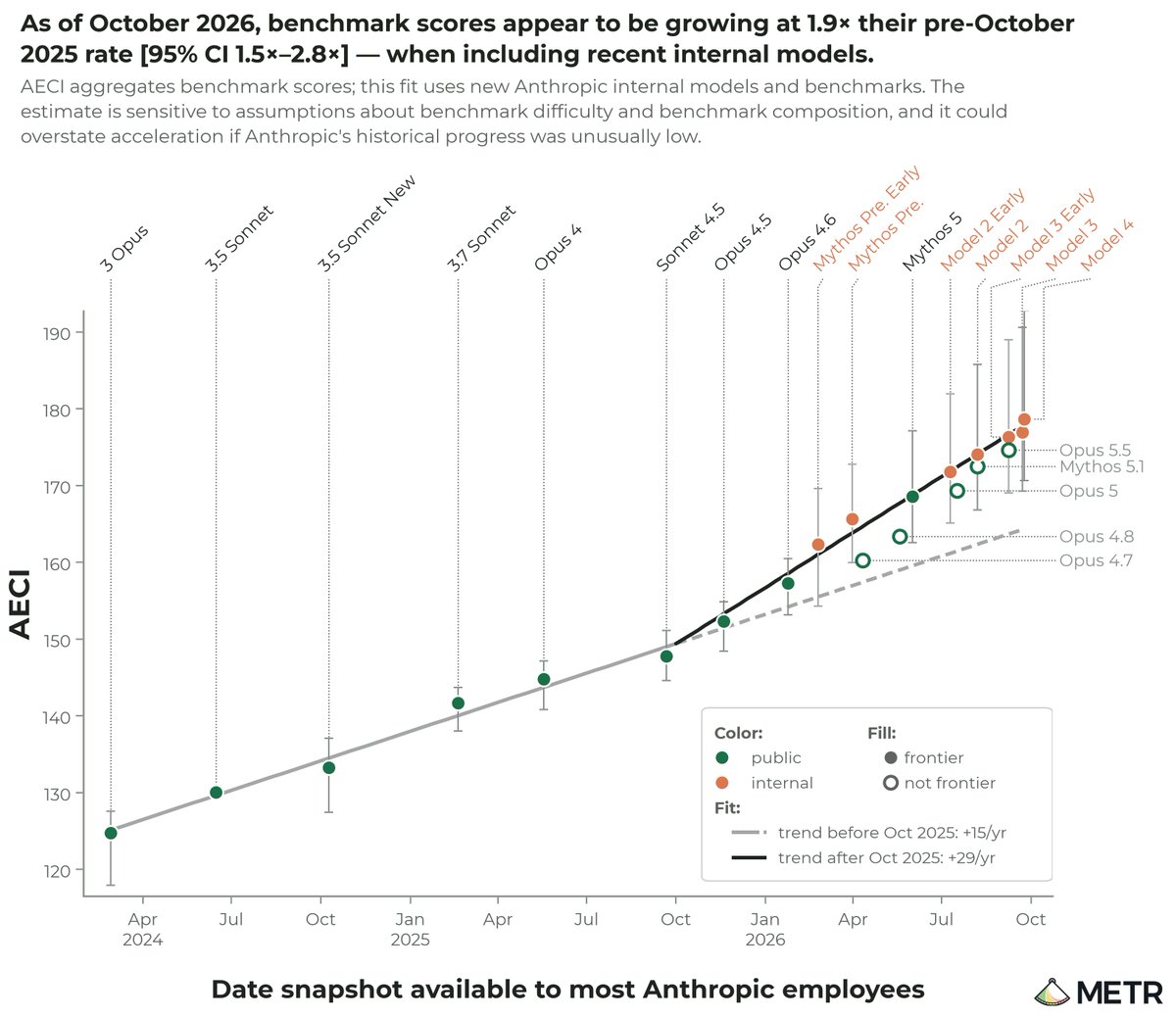
On November 5, independent evaluator METR published a high-access assessment at Anthropic (Aug 12–Oct 29, 2026). As of October 2026, Anthropic is likely improving model capabilities on well-specified tasks at about twice the March 2024–October 2025 historical rate. Since October 2025, AECI scores grew at an estimated 1.9x the prior rate [95% CI 1.5–2.8]. METR judges that a majority of current acceleration is attributable to AI-assisted R&D, not faster training-compute scaling; Anthropic redacted much of the most informative evidence.
METR Assessment: Anthropic Capability Progress on Well-Specified Tasks ~2x Historical Rate; AECI ~1.9x Faster Since Oct 2025

Key Takeaways

  • Subjective call: ~2x historical rate on well-specified tasks (high uncertainty; ~1.3x–3x plausible; METR)
  • AECI: ~1.9x faster growth since Oct 2025 [95% CI 1.5–2.8], ~two years of prior progress in one year (includes unreleased models)
  • Attribution: confident not from faster training-compute growth; majority of current acceleration from AI-assisted R&D (~80% subjective guess), not fully autonomous contributions
  • Risk: no clear bottlenecks observed for next 12 months, so further acceleration risk; much key evidence redacted by Anthropic
  • Process: separate from the Oct 15 employee-like access pilot; compute-allocation verification was canceled mid-engagement
Read full story
Linked Models & Agents:

Axion 1.0 Open Agent Foundation Model: Two SFT Stages Plus RL, 35B-A3B Reproduction Checkpoint Under Apache 2.0, Full Recipe Released

arXiv paper 2611.03233 by Yuqi Jia, Yunjie Tian and five co-authors introduces Axion 1.0, an agent foundation model that is open beyond its weights. It uses just two lightweight SFT stages plus reinforcement learning, with no dedicated mid-training, DPO or on-policy distillation, and about 18K SFT trajectories in total. Training code is hosted under the bytedance GitHub organization, and the training data and an Axion 1.0-35B reproduction checkpoint (Qwen3.6-35B-A3B base, 35B total / 3B active, Apache 2.0) are on Hugging Face; weights for the paper's 122B model are listed as coming soon.

Axion 1.0 Open Agent Foundation Model: Two SFT Stages Plus RL, 35B-A3B Reproduction Checkpoint Under Apache 2.0, Full Recipe Released

Key Takeaways

  • A minimal recipe: SFT stage one for self-contained scientific reasoning, stage two for tool use and information seeking, then RL for long-horizon interaction, with 18,363 SFT trajectories and 484 RL tasks
  • The release covers data construction, generation, filtering, verification, prompts and training code (GitHub), not just weights
  • The 35B reproduction checkpoint scores 52.8 on HLE, 60.4 on SEAL-0, 85.0 on FrontierScience Olympiad and 55.0 on FrontierScience Research (HF model card)
  • The paper's 122B model reports 59.0 on HLE with restricted website access and 66.7 on FrontierScience Research; 122B weights are not out yet
  • All scores are self-reported; the HF card lists Claude Opus 5 at 63.6 on HLE, so Axion still trails the strongest closed models
Read full story
Linked Models & Agents:
⚡ Axion 1.0-35B⚡ Axion 1.0-122B⚡ Qwen3.6-35B-A3B🌐 ByteDance🌐 Hugging Face

X discussion: is GPT-6 Astra robotics' "GPT-3 moment"? Ex-OpenAI researcher Will Depue says specialized ML got "bitter lessoned"

Over the past day, X has been debating whether GPT-6 Astra can work directly as a robot policy. Former OpenAI researcher Will Depue (whose bio lists Sora 1 and 2 and o3/4o post-training) called Astra beating specialized robotics models "deeply surprising", then described it as "the final death of specialized ML". Investor Freda Duan posted that "Astra IS robotics' GPT-3 moment", drawing about 84K views. Third-party evaluations point both ways: in a RoboDojo paper, Astra averages 22.48% success and ranks above all 40 public policies, while an EBench report puts it at 46.7%, third of nine models. This is a discussion of opinions, not an official OpenAI conclusion.

X discussion: is GPT-6 Astra robotics' "GPT-3 moment"? Ex-OpenAI researcher Will Depue says specialized ML got "bitter lessoned"

Key Takeaways

  • Reach: Will Depue's two posts have about 597 and 566 likes and 59K and 37K views; Freda Duan's "10 takes" has about 455 likes, 559 bookmarks and 84K views (as of 19:10 SGT)
  • RoboDojo: over 42 tasks and 2,100 trials, Astra averages 22.48% success (Score 28.97), ranking above all 40 public policies; GPT-5.5 gets 0.88% in the same setup (arXiv 2609.24170, as reported by the paper's authors)
  • Counterpoint: in the EBench report, Astra with single-shot in-context learning scores 46.7%, behind OpenWAM-alpha at 55.3% and AMapbot 1 at 48.9% (EBench tech report)
  • Real arms: Robocurve measured 19 of 20 successes on a block-into-bowl task on YAM arms at about $0.94 per run, but only 2 of 20 on a puzzle insertion task (Robocurve)
  • Weak spots: several evaluations find Astra clearly weaker on high-precision control, dynamic control and bimanual coordination
Read full story

Wiz "Black October" report: at least nine AI developer platforms breached in October, with stolen API keys feeding an LLMjacking resale market

Cloud security firm Wiz published research on October 30 saying at least nine AI developer platforms disclosed incidents this month: Fireworks AI, Andromeda, Zeabur, Lightning AI, OpenCode, Railway, Warp, CommandCode and Northflank. Attackers hunted stored environment variables, especially keys for paid AI models; Wiz traced two stolen enterprise keys to roughly 800,000 and 1.7 million Amazon Bedrock calls, which it estimates likely ran over $100k at list price in those two cases alone.

Wiz "Black October" report: at least nine AI developer platforms breached in October, with stolen API keys feeding an LLMjacking resale market

Key Takeaways

  • Scale: between October 6 and 30, at least nine AI developer platforms disclosed incidents, and Zeabur is shutting down as a result (Wiz blog)
  • Methods: Fireworks, OpenCode and Warp reported signs of an "agent swarm" attack, and OpenCode and CommandCode attributed theirs to "distillation" attempts; the common thread is hunting stored environment variables that grant AI access
  • Case A: one stolen key drove about 800k Bedrock calls over 30 hours, about 90% successful, with Opus models making up three quarters (Wiz figures)
  • Case B: a single address made about 1.7 million calls in 13 hours, over a million successful; the two cases together likely exceeded $100k at list price
  • Resale chain: Wiz identified two sites selling discounted frontier-model access and saw both test the stolen keys
Read full story
ADSponsored

Anthropic shares early results from Claude in drug development: six partners including BMS, plus its own programs via Mithril Medicine

In an Oct 27 blog post, Anthropic described months of deep research partnerships between its life sciences team and six organizations (BigHat, Bristol Myers Squibb, Divergence Labs, Enveda, Generate Biomedicines and The Column Group), covering hit generation, lead optimization, manufacturing paperwork and clinical trial planning. It also said it acquired the one-person company Mithril Medicine to run its own programs for rare childhood muscular dystrophy. Anthropic stresses the work is mostly preclinical so far.

Anthropic shares early results from Claude in drug development: six partners including BMS, plus its own programs via Mithril Medicine

Key Takeaways

  • Divergence Labs: Claude generated about 35,000 antibody designs in roughly a month, largely autonomously, yielding 3 hits that bind IgE and 20 that dislodge it, 3 of which beat the standard drug at dislodging (vendor-reported)
  • BigHat: about 1,010 variants made and tested in about 10 weeks; the best versions bound over 10x more tightly, the cancer lead stayed in solution 18°C higher, and the other lead clumped over 100x more slowly
  • Enveda: across 1,061 pages of manufacturing documents Claude caught all 11 issues humans found plus 7 they missed, cutting review time 89% (from over 25 hours to under 3)
  • Generate Biomedicines: a CAR-T component designed with Claude Code was about 70% shorter and let immune cells make roughly 10x as many receptors
  • Mithril Medicine acquisition: its founder used Claude to coordinate 11 external labs and went from idea to promising mouse results in under 18 months; human trials could start as soon as late 2028 (official blog)
Read full story

Cadence launches Maestro, a domain-specialized AI model portfolio for agentic chip and system design built in part on NVIDIA Nemotron, claiming up to 30% better results and 5x token efficiency

EDA leader Cadence announced the Maestro AI Model Portfolio on October 26: domain post-trained LLMs, trained decision models and self-improving agent skills that power its AuraStack, ChipStack, InnoStack and ViraStack AI Super Agents as they drive Cadence EDA and SDA tools. Cadence solvers score outputs against engineering constraints to close a reinforcement learning loop. Initial results per Cadence show up to 30% higher quality and up to 5x token efficiency versus a general-purpose foundation model. NVIDIA contributes Nemotron and OpenShell, and the stack runs on Cadence cloud, public cloud or on-premises. The first models reach select early access customers in Q4 2026.

Key Takeaways

  • Maestro is a portfolio, not one model: domain post-trained LLMs, decision models and self-improving agent skills, mixed with frontier and open-weight models per task
  • Deterministic solvers and EDA tools score outputs against engineering objectives and constraints, feeding a verified reinforcement learning loop
  • Per Cadence: up to 30% higher quality of results and up to 5x token efficiency versus a general-purpose foundation model; no third-party evaluation yet
  • NVIDIA supplies Nemotron models and the OpenShell sandbox reference architecture; customers can post-train on their own designs and run on-premises
  • First models go only to select early access customers in Q4 2026; Socionext expects up to 5x productivity from deploying InnoStack
Read full story

CapCut announces a ChatGPT plugin is coming soon, bringing its video generation and editing tools inside ChatGPT with drafts that move to the CapCut web editor

At 18:34 UTC on 2026-10-24, during its CapCut World event in Los Angeles, ByteDance's CapCut announced from its official account (@capcutapp) that a new CapCut plugin is coming soon to ChatGPT (post). According to CapCut, the plugin brings its video editing and generation tools inside ChatGPT: users can start with an idea in ChatGPT, create it with the plugin right in the chat, then move the draft to the CapCut web editor to refine and publish. When we pulled it, the post had about 3,646 likes, 319 reposts, 504 replies and 450K views. The event site lists OpenAI's Head of Partnerships Mahak Sharma and Head of Creator Product Sam Yam as speakers. Many creator posts on X say the plugin is already in early access on ChatGPT desktop with mobile and web around mid-November, but CapCut's own post still says coming soon, so timing and pricing should be taken from CapCut's later announcements.

Key Takeaways

  • Official source: CapCut's post on X, published 18:34 UTC on 10-24, with about 3,646 likes, 319 reposts, 216 quotes, 504 replies and 450K views when we pulled it
  • What it does: CapCut's video editing and generation tools inside ChatGPT, so a chat idea can become a video draft directly
  • Workflow: drafts made with the plugin can move to the CapCut web editor for further editing, sharing and publishing
  • OpenAI involvement: the CapCut World Los Angeles site lists OpenAI's Mahak Sharma (Head of Partnerships) and Sam Yam (Head of Creator Product) as speakers
  • Status: CapCut says coming soon; creator claims of desktop early access now and mobile and web in mid-November are not confirmed by CapCut, and pricing is not announced
Read full story

ByteDance's BytePlus launches Seedance 2.5 4K: a native 4K, 10-bit video generation model with a low-cost 480p Draft preview mode

On 2026-10-23 (15:31 UTC), ByteDance's enterprise cloud BytePlus (@BytePlusGlobal) launched Seedance 2.5 4K, calling it the most capable model in the Seedance 2.5 generation. It brings more nuanced facial expressions and movement, fuller textures, contours and fine detail, and 10-bit colour depth for smoother gradations that suit the big screen. A new Draft mode lets creators test storyboards and refine shots with lower-cost 480p previews, then render the final version in 4K. It is currently available only to selected enterprise customers, and BytePlus says API availability updates are coming. It debuted in the short film "Otter is Nobody 2".

ByteDance's BytePlus launches Seedance 2.5 4K: a native 4K, 10-bit video generation model with a low-cost 480p Draft preview mode

Key Takeaways

  • The most capable model in the Seedance 2.5 generation, with native 4K output (official announcement)
  • More nuanced facial expressions and movement, with fuller textures, contours and fine detail
  • 10-bit colour depth for richer gradations and smoother transitions
  • Draft mode: refine storyboards with low-cost 480p previews, then render the final cut in 4K
  • Selected enterprise customers only for now; no public API, pricing or benchmarks yet
Read full story
Linked Models & Agents:
⚡ Seedance 2.5 4K🌐 ByteDance🌐 BytePlus

Mistral AI and NVIDIA Forge Industrial Engineering AI Alliance, Previewing 1T Mistral Large 4

At GTC Berlin, Mistral AI and NVIDIA announced a strategic partnership dedicated to advancing AI for industrial engineering, computational physics, and electronic design automation (EDA). The alliance couples Mistral frontier architectures with NVIDIA CUDA-X libraries, Warp physics simulation frameworks, and Omniverse digital twins. Mistral simultaneously revealed architectural specifics for its forthcoming flagship, Mistral Large 4: spanning roughly 1 trillion total parameters with 49 billion active parameters (MoE), trained on 3,800 Grace Blackwell GPUs, with open weights slated for official release at the end of October 2026.

Mistral AI and NVIDIA Forge Industrial Engineering AI Alliance, Previewing 1T Mistral Large 4

Key Takeaways

  • Mistral AI and NVIDIA launched a strategic alliance applying frontier foundation models to CAE, physics AI, and EDA semiconductor design
  • Integrates NVIDIA Warp, CUDA-X simulation libraries, and Omniverse to establish open physics datasets and industrial agent benchmarks
  • Disclosed architectural parameters for Mistral Large 4: ~1T total parameters with 49B active sparse MoE, trained on 3,800 Grace Blackwell GPUs
  • Weights for Mistral Large 4 are scheduled for open-source release at the end of October 2026, joining the Nemotron Coalition
Read full story

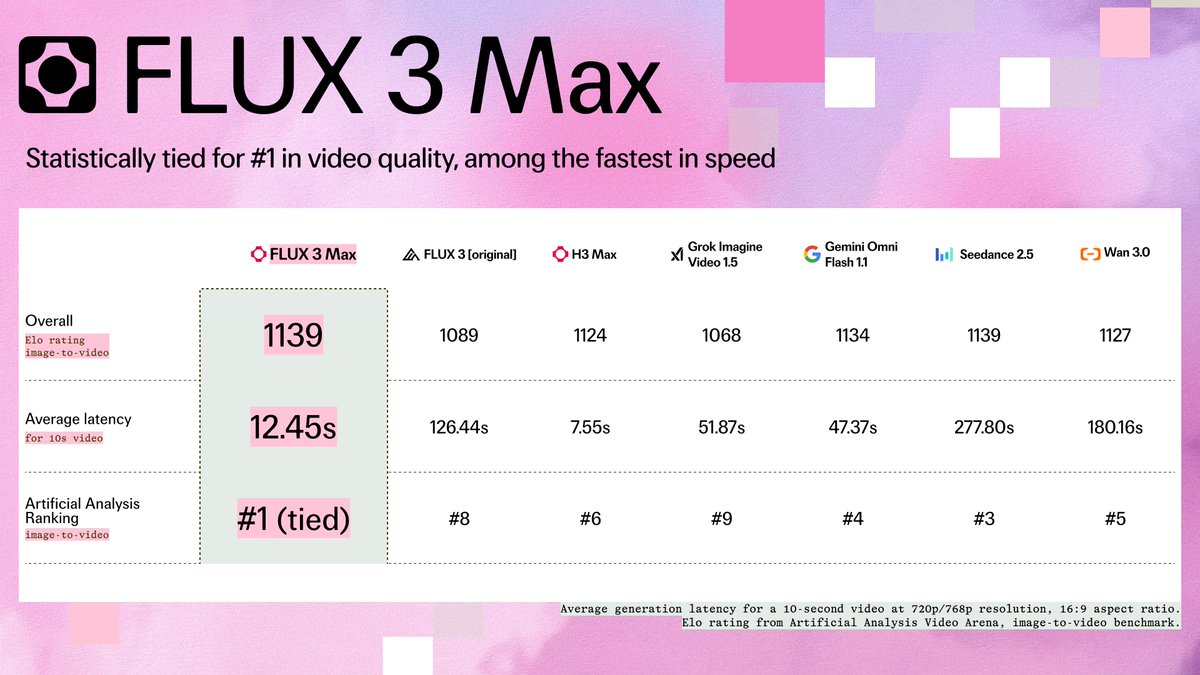
fal and Black Forest Labs launch FLUX 3 Max video model: tied #1 in image-to-video quality, a 10-second clip in about 12 seconds, roughly 22x faster than Seedance 2.5

On Oct 19 (UTC) fal released FLUX 3 Max, a video model built by fal Research with Black Forest Labs through post-training, reinforcement learning and inference optimization on top of the FLUX 3 foundation model. It handles text-to-video, image-to-video and keyframes, up to 20 seconds, at 720p or 1080p, with audio on by default. On Artificial Analysis's preliminary image-to-video arena it scores 1,139 Elo, level with Seedance 2.5 and within the confidence interval of leader MiniMax H3 (1,141), and fal says a 10-second clip takes about 12.45 seconds. A 75% launch discount runs until Nov 7, putting 720p at $0.0425 per second.

fal and Black Forest Labs launch FLUX 3 Max video model: tied #1 in image-to-video quality, a 10-second clip in about 12 seconds, roughly 22x faster than Seedance 2.5

Key Takeaways

  • Artificial Analysis AA-Video-I2V v1.1 (preliminary): FLUX 3 Max at 1,139 Elo, level with Seedance 2.5 and just under MiniMax H3 at 1,141; "tied #1" rests on overlapping confidence intervals
  • Speed (fal-reported, 10-second 16:9 at 720p): FLUX 3 Max 12.45s, Gemini Omni Flash 1.1 47.37s, Seedance 2.5 277.80s; the press release quotes 10.95s instead
  • Versus the original FLUX 3: Elo up from 1,089 to 1,139 (+50) and a 10-second clip down from 126.44s to about 12s (11.5x per the press release, about 10x per the product page)
  • Pricing: promotional $0.0425/s at 720p and $0.0725/s at 1080p until Nov 7, then $0.17/s and $0.29/s, billed per output second
  • API options: 5-20 second duration, multiple aspect ratios, reasoning_level (low/high), generate_audio on by default; model IDs blackforestlabs/flux-3-max/*
Read full story
Linked Models & Agents:
⚡ FLUX 3 Max⚡ FLUX 3⚡ Seedance 2.5⚡ MiniMax H3🌐 fal🌐 Black Forest Labs🌐 Artificial Analysis
ADSponsored

Anthropic gives a six-person METR team employee-like access and no veto over publishing its risk assessments

On Oct 15 Anthropic said it has onboarded six METR employees with company hardware, office space and access to internal tools and systems roughly on par with its own risk assessment teams. METR will publish its analysis of Anthropic's risk levels, incidents and practices; Anthropic cannot veto publication and may only require redactions in predefined categories. Anthropic also outlined a three-tier access model for evaluators and updates on SecureBio, Accenture and Faculty.

Anthropic gives a six-person METR team employee-like access and no veto over publishing its risk assessments

Key Takeaways

  • Six METR staff get company hardware, office space and internal access roughly on par with Anthropic's risk assessment teams (per Anthropic)
  • Anthropic cannot veto METR publications; it may only require redactions in predefined categories such as customer data, privileged legal material and model architecture
  • Evaluator access has three tiers: tier 1 publishes with approval, tier 2 publishes without approval, tier 3 (METR) adds employee-like access
  • SecureBio is reviewing the chem/bio chapter of the August Risk Report; partnerships with Accenture and Faculty cover red-teaming and alignment assessments, with early talks including Hugging Face
  • The announcement post drew about 537K views and 3.8K likes within roughly three days
Read full story

MLExpert: Open 35B MoE Agentic Model Lifts MLE-Bench Lite Medal Rate from 37.9% to 72.7%, Matching Kimi-K3 and GLM-5.3

Advancing autonomous AI-for-AI (AI4AI) engineering, researchers from Shanghai AI Lab (InternScience) release MLExpert (arXiv:2610.22344), a 35B Mixture-of-Experts agentic model for autonomous machine learning engineering. Powered by the Kaggle-MLE Factory, hierarchical agentic SFT, and Windowed Interaction RL (WIRL), MLExpert boosts average medal rates on MLE-Bench Lite from 37.9% to 72.7%—matching frontier giants like Kimi-K3 and GLM-5.3 while generalizing to agent scaffold optimization.

MLExpert: Open 35B MoE Agentic Model Lifts MLE-Bench Lite Medal Rate from 37.9% to 72.7%, Matching Kimi-K3 and GLM-5.3

Key Takeaways

  • 72.7% medal rate on MLE-Bench Lite: boosts base model performance from 37.9% to 72.7%, matching frontier models Kimi-K3 and GLM-5.3 with a 35B MoE backbone
  • Windowed Interaction RL (WIRL): assigns shared outcome rewards to multi-turn windows between successive experiment results with asynchronous policy updates
  • Cross-domain AI4AI generalization: transfers optimization skills directly to NatureBench Lite, agent scaffold optimization, and algorithm engineering
Read full story

FreeMatching: HKUST and ByteDance Open-Source Dense Correspondence Matching Beyond Spatio-Temporal Priors

Dense correspondence matching serves as the bedrock for optical flow, 3D stereo reconstruction, and object tracking. For decades, classical matching algorithms have fundamentally relied on rigid spatio-temporal priors: smooth motion continuity and rigid geometry. However, these foundational assumptions collapse under modern AI image editing and reference-guided generation (IEG), where visual identity is preserved while physical and geometric continuity is drastically severed (such as radical pose warps, stylistic shifts, or compositional recontextualization). Researchers from HKUST and ByteDance introduce FreeMatching (arXiv:2610.12421, code: github.com/luping-liu/FreeMatching), a generalizable framework for dense correspondence matching beyond spatio-temporal priors. FreeMatching fuses generative foundation features (from diffusion backbones) with high-level semantic representations (from vision foundation models), trained against heterogeneous supervision spanning classical benchmarks, tracked video sequences, and synthetic 3D scenes. An unsupervised teacher-guided iterative refinement loop further sharpens dense correspondences across challenging generated image pairs without requiring dense manual annotations. FreeMatching achieves dramatic leaps in correspondence precision across complex AI-edited image pairs while retaining competitive accuracy on classical optical flow tasks, and serves as an auditable quantitative metric for evaluating visual identity preservation that closely aligns with human judgment.

Key Takeaways

  • HKUST and ByteDance open-source FreeMatching, breaking free from traditional spatio-temporal priors in dense correspondence
  • Cuts end-point error by 42.6% and raises PCK by 31.8 percentage points across aggressive AI image edits and non-rigid transformations
  • Establishes a quantitative identity preservation metric highly correlated with human judgment (r = 0.88), fully available on GitHub
Read full story
Linked Models & Agents:

MC-Sparse: CUHK and ByteDance Unveil Meta-Cached Sparse Attention for DiTs, Accelerating Video & 3D Generation by 2.32x with Zero Quality Loss

Diffusion Transformers (DiTs) underpin frontier video generation systems and high-fidelity 3D modeling, yet self-attention computation over extreme sequence lengths introduces prohibitive inference latencies and memory bottlenecks. While sparse attention represents a promising acceleration pathway, existing methods suffer substantial visual quality degradation and texture corruption under high sparsity regimes. Researchers from The Chinese University of Hong Kong (CUHK) and ByteDance analyze sparse attention failures in DiTs (arXiv:2610.06801), tracing quality drops to three root causes: rigid token grouping constraints, inaccurate interaction selection, and uncompensated attention residuals from discarded tokens. The authors introduce Meta-Cached Sparse Attention (MC-Sparse, project site: dodododddo.github.io/mcsparse-project-page/), a training-free framework that preserves individual Key-Value (KV) selection precision while organizing similar Queries into tile-aligned blocks for hardware efficiency on GPUs. MC-Sparse caches query clusters, exact KV indices, and dense-sparse attention output residuals, reusing this metadata across downstream denoising timesteps. On Minimax-H3-Base video models, MC-Sparse delivers a 1.80x denoising speedup, and a 2.32x acceleration on 3D generative backbones, maintaining near-identical fidelity to dense attention with zero visible quality degradation.

Key Takeaways

  • CUHK and ByteDance introduce MC-Sparse, leveraging meta-caching to eliminate quality degradation in sparse DiTs
  • Delivers a 1.80x speedup on Minimax-H3-Base and 2.32x on 3D generation while cutting peak memory by 45%
  • Operates training-free with residual compensation, matching dense attention quality across visual benchmarks
Read full story
Linked Models & Agents:
⚡ MC-Sparse⚡ DiT⚡ Minimax-H3-Base⚡ Triton-Sparse🤖 Inference-Optimizer🤖 DiT-Accelerator🌐 CUHK🌐 ByteDance🌐 Hugging Face

DAEDALUS: Bootstrapping Reusable Agent Memory via Self-Generated Tasks and Autonomous Dual-Agent Practice Without Human Oracles

LLM agents operating in novel API or terminal environments frequently repeat identical errors due to an absence of procedural memory. Existing memory bootstrapping approaches rely heavily on curated prompt playbooks or oracle verifiers that require extensive domain foresight. Illuin Technology releases DAEDALUS (arXiv:2610.08048), an autonomous dual-agent framework bootstrapping reusable memory entirely from self-generated practice without human oracles. DAEDALUS pairs an Explorer agent—which probes the execution environment to formulate curriculum-style tasks—with a Solver agent. When the solver stumbles, it extracts candidate heuristics that are committed into a persistent memory bank only after proving their efficacy across repeated verification trials. Across AppWorld, tau^2-bench, and AutomationBench, DAEDALUS boosts average success rates by up to 15.9 percentage points and raises Pass^5 rates by 2.2x over memory-less baselines, with generated procedural memories transferring seamlessly across heterogeneous foundation model families.

Key Takeaways

  • Illuin Technology open-sources DAEDALUS, bootstrapping reusable procedural memory without human labels or oracle verifiers
  • Employs an Explorer-Solver dual-agent self-play architecture to synthesize verified operational heuristics from failure traces
  • Lifts task completion by up to 15.9 points and doubles Pass^5 by 2.2x across AppWorld, tau^2-bench, and AutomationBench
Read full story
Linked Models & Agents: