
AI Coding Live News

SenseTime Ships SenseNova 6.8 Flash: An Office Agent Model With Long-Term Memory and Proactive Interaction That Builds Animated Slides, Motion Posters and Editable Blender 3D Projects

On the evening of November 2, SenseTime released the official version of SenseNova 6.8 Flash, a multimodal agent model with two main upgrades. First, long-term memory and proactive interaction: it keeps user goals and constraints across tasks and sessions and flags affected items when information changes. Second, design generation across Web, SVG, Three.js, Blender, animated PPT and motion posters, with Figma integration. It is live in SenseNova Studio, the Raccoon assistant and the SenseNova Token Plan; the official X account says the Token Plan offers a free trial of 1,500 API requests every 5 hours. SenseTime says it beats some international frontier models on agent collaboration, data analysis and presentation generation, but the announcement lists no specific scores.

SenseTime Ships SenseNova 6.8 Flash: An Office Agent Model With Long-Term Memory and Proactive Interaction That Builds Animated Slides, Motion Posters and Editable Blender 3D Projects

Key Takeaways

  • The official release landed on the evening of November 2, positioned as a multimodal agent model for office collaboration and design delivery
  • Long-term memory plus proactive interaction: it remembers goals, constraints and preferences across sessions and suggests changes when related information shifts (demos ran on an internal Raccoon build)
  • Design output spans Web, SVG, Three.js, Blender, animated PPT and motion posters, producing editable PPTX files and Blender projects, with Figma integration
  • Available in SenseNova Studio, the Raccoon assistant and the SenseNova Token Plan; the official X post cites 1,500 free API requests every 5 hours
  • SenseTime only says it beats some international frontier models on agent collaboration, data analysis and presentation generation; no scores were published and there is no independent evaluation yet
Read full story
Linked Models & Agents:
⚡ SenseNova 6.8 Flash⚡ SenseNova Loop-9B-Preview🤖 Raccoon🌐 SenseTime

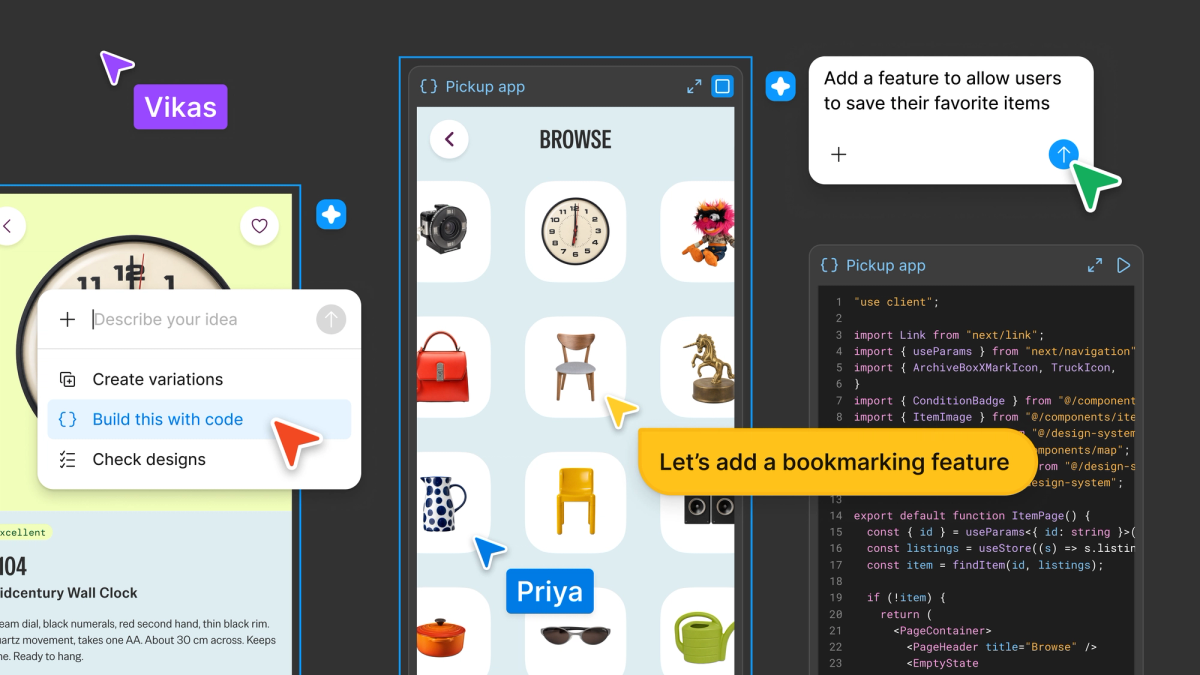
Figma Config India: Code Layers and Specs enter open beta, and agents can read and write specs and code layers through the Figma MCP server

At Config India on 2026-10-15 Figma launched agent-oriented features: Code Layers (running code on the canvas) in open beta on all plans, Specs (collaborative Markdown spec containers) in open beta on paid plans, Guidelines in open beta and Code Sources in closed beta. The Figma MCP server can now generate code layers and read/write Specs, with 20 new MCP partner integrations including OpenCode and JetBrains Junie.

Figma Config India: Code Layers and Specs enter open beta, and agents can read and write specs and code layers through the Figma MCP server

Key Takeaways

  • Code Layers: open beta on all plans, created from designs, local folders, GitHub, MCP or Chrome-extension page capture; uses AI credits, free on paid plans through 2026-11-04
  • Specs: open beta on Professional/Organization/Enterprise across web, desktop and mobile; pasting a Spec link into a coding agent carries Markdown, frame references, code layers and Code Connect snippets
  • MCP: the figma-spec skill lets agents read, create and update Specs; use_figma canvas writes remain a free beta with up to 20 KB output per call
  • Design systems: Guidelines open beta and Code Sources closed beta (import from a GitHub repo or npm package) on paid plans; Payload lands in Figma Make, with downloads up 6x in 12 months per Figma
  • Ecosystem: 20 new MCP partner integrations including OpenCode, Dia, JetBrains Junie and Meta Muse; the Figma agent is generally available
Read full story

Fireworks opens Training API and Fireworks Lab for serverless or dedicated RL at scale

Fireworks announced general availability of its Training API and Fireworks Lab, aiming to make model specialization accessible beyond labs that already own training clusters. The API lets teams connect a custom Python training loop to Fireworks-managed distributed training and rollout infrastructure, keeping control of loss, reward, data, and environment. Compute is split into Serverless mode for fast experiments and Dedicated mode when scale, control, and GPU economics matter. The stack is built for reinforcement learning as a single train-sample-serve-retrain loop, with three hard requirements: rollout throughput, weight sync so fresh weights land on the rollout deployment every step, and correctness so trainer and inference engine agree on the same model. Fireworks Lab additionally embeds forward-deployed researchers and engineers to co-design or build a model. Named customers include Cursor, Harvey, Figma, Vercel, Cognition, Factory, and Heidi.

Key Takeaways

  • The Training API attaches a custom Python loop to managed distributed training and rollout, with Serverless and Dedicated compute.
  • The RL loop is optimized for rollout throughput, per-step weight sync, and trainer-inference model agreement.
  • Fireworks Lab embeds researchers with customers including Cursor, Harvey, Figma, Vercel, Cognition, and Factory.
Read full story