AI Coding Live News

HF's Joël Niklaus Ships Harness Leaderboard: 28,849 Trials Across 9 Coding Agent Harnesses; Author Reports mini-swe-agent ~51.4% Average

On 2026-11-05, Hugging Face Harness Optimization researcher Joël Niklaus (@joelniklaus) released the Harness Leaderboard: same model, provider, and reasoning effort with only the harness swapped, covering GLM-5.3-Flash, DeepSeek-V4.1-Flash, and Flint on Terminal-Bench 2.1 and DeepSWE—28,849 trials and about $4,746 of inference. Author-reported averages: mini-swe-agent ~51.4% resolve rate; Pi ~49.4% at about $0.29 per solved task. This is an individual research leaderboard, not a Hugging Face company product announcement.

HF's Joël Niklaus Ships Harness Leaderboard: 28,849 Trials Across 9 Coding Agent Harnesses; Author Reports mini-swe-agent ~51.4% Average

Key Takeaways

  • Source: personal post by HF Harness Optimization researcher Joël Niklaus on 2026-11-05T16:04:08Z—not a company announcement
  • Scale (author): 9 harnesses on open models, 28,849 trials, ~$4,746 inference spend
  • Method: pin model/provider/reasoning effort; 3 attempts per task; Terminal-Bench 2.1 and DeepSWE
  • Results (author): averaged mini-swe-agent ~51.4%, openclaw ~27.3%; Pi ~49.4% at ~$0.29 per solved task
  • Use: public HF Space leaderboard + trajectories; Harness Lens documents prompts/tools for each harness
Read full story

Artificial Analysis Ships Endpoint Accuracy Index v1.1: Nearly 1 in 4 of 100+ Serverless Endpoints Score Below Reference

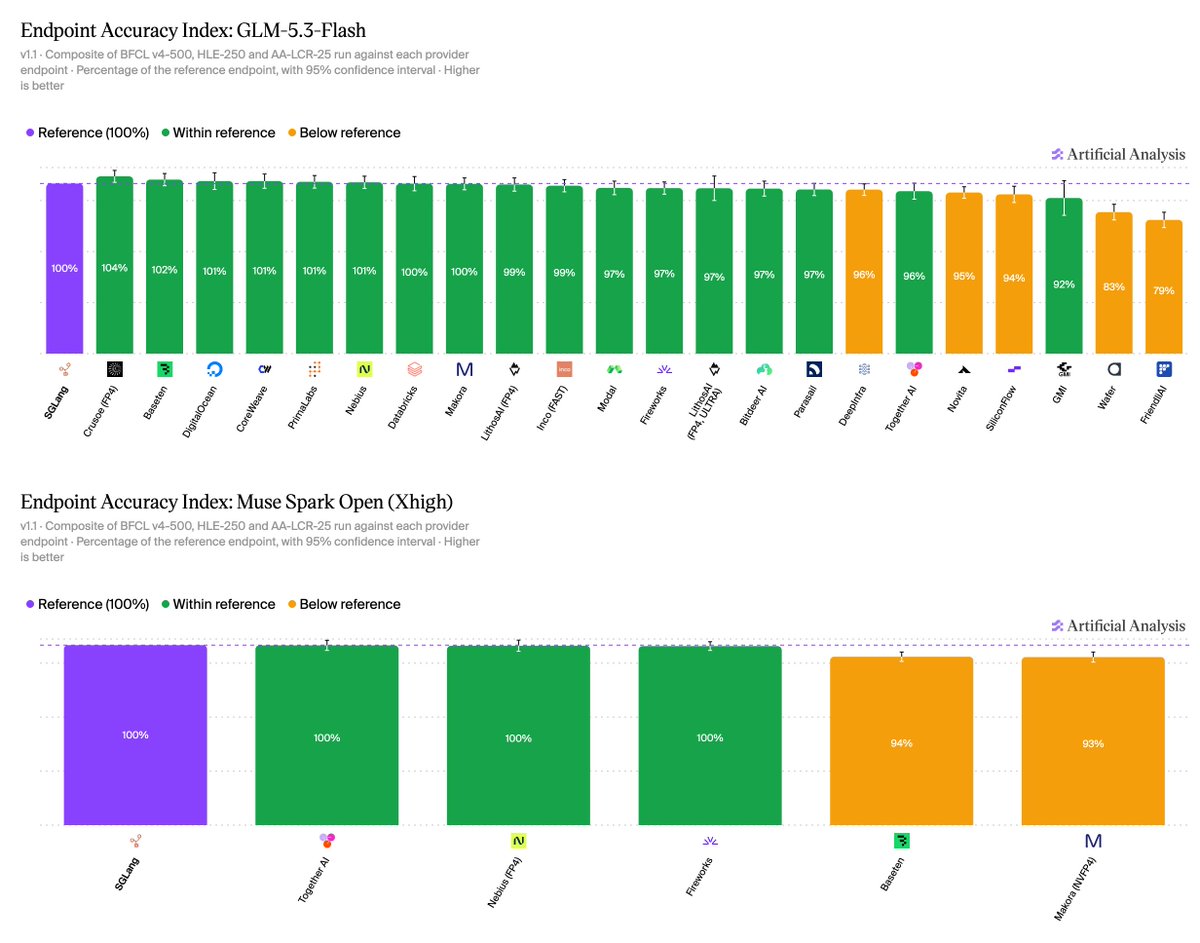
On 2026-11-06 Artificial Analysis launched Endpoint Accuracy Index v1.1: each serverless endpoint is scored as a percentage of a self-hosted official-weights reference across equally weighted BFCL-500, HLE-250, and AA-LCR-25. Vendor claim: nearly 1 in 4 of 100+ benchmarked endpoints score below the reference. AA-LCR-25 moved to v1.1 with repeats raised from 10 to 25 (average 95% CI ~±4.7 to ±2.6), and coverage expanded to six open-weights models including GLM-5.3 Flash and Muse Spark Open.

Artificial Analysis Ships Endpoint Accuracy Index v1.1: Nearly 1 in 4 of 100+ Serverless Endpoints Score Below Reference

Key Takeaways

  • Official: @ArtificialAnlys 2026-11-06 02:44 UTC; changelog 05 Nov 2026; methodology Endpoint Accuracy Index v1.1
  • Vendor claim: nearly 1 in 4 of 100+ serverless endpoints score below the self-hosted reference; providers often quantize, custom-kernel, tune stacks, or cap outputs
  • Equal-weight suite: BFCL v4-500 (3 repeats), HLE-250 (10), AA-LCR-25 (25); 95% CIs vs reference with significance flags
  • GLM-5.3 Flash: 16 of 22 endpoints statistically in line, one ~104.2; ~32K output caps scored ~22%/29% on HLE-250 vs 55% reference
  • Muse Spark Open: 3 of 5 endpoints ~99.5–99.9 (incl. FP4); two mainly lose on tool calling (BFCL-500 ~50%/51% vs 59%)
Read full story

Hyperstition Open-Sources Hyperkernel: Recursive Megakernel Generator; Vendor Claims Beat NVIDIA-Published vLLM on DeepSeek v4.1 Flash Latency

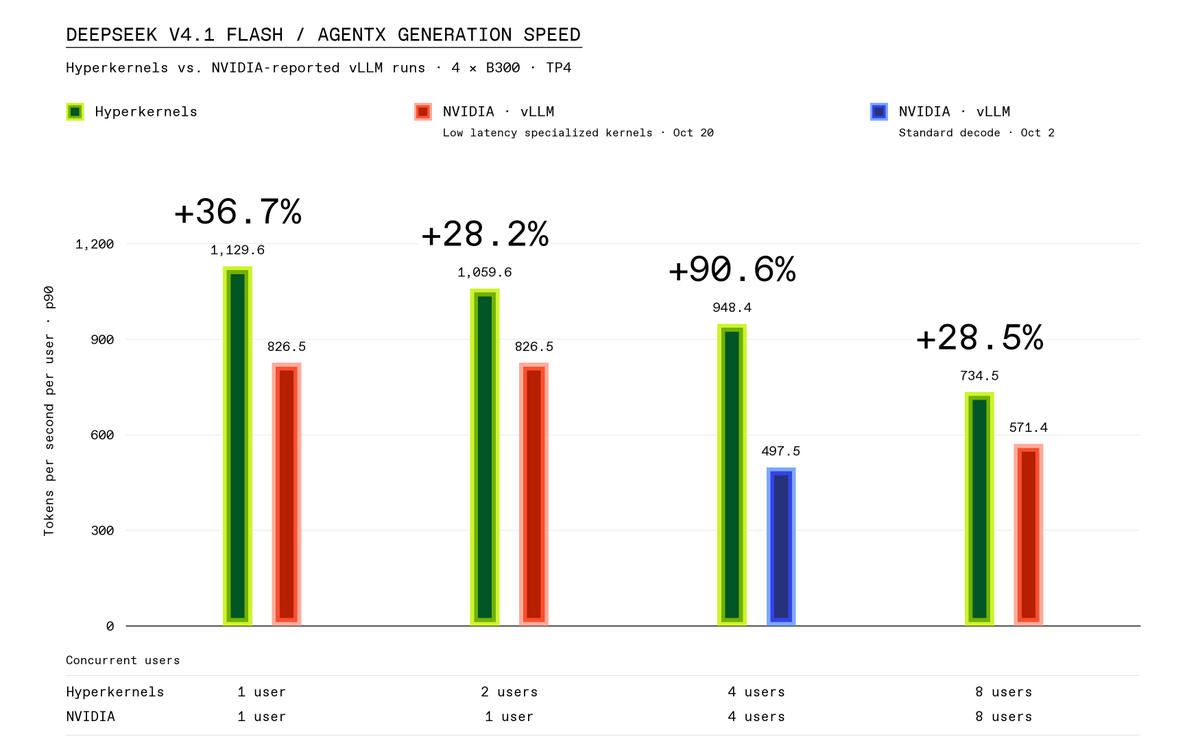
On 2026-11-05 Hyperstition open-sourced Hyperkernel’s first generated megakernels (Hyperserve), with vendor-reported gains versus NVIDIA-published vLLM baselines; Alpha, B300-oriented.

Hyperstition Open-Sources Hyperkernel: Recursive Megakernel Generator; Vendor Claims Beat NVIDIA-Published vLLM on DeepSeek v4.1 Flash Latency

Key Takeaways

  • Official: @hyperstition_cc on 2026-11-05; GitHub Hyperstitioncc/Hyperkernel (MIT, Alpha)
  • Vendor claim: DeepSeek v4.1 Flash ~36.7% higher per-user gen at C1 vs NVIDIA-published vLLM; ~90.6% at C4 vs AgentX
  • π₀-FAST ~94 vs ~243 ms; Matrix-Game ~37.4 vs ~11.6 FPS (~3.2×)
  • CLI: hyperserve llm|drive|dna|world; BYO weights, B300/R580+
  • Not independent reruns; full stack + Kimi/GLM serving planned in weeks
Read full story
Linked Models & Agents:

Ant Ling Launches Ling-3.2-flash: 560B/25B Native Multimodal MoE, 1M Context; Vendor Evals Beat Opus 5 on Several Vision Suites; Free for First Two Weeks

On November 5 Ant Group’s Ant Ling (@AntLingAGI) launched Ling-3.2-flash: a 560B-total / 25B-active native multimodal MoE with a 1M context window and native image, text and video input. The official changelog targets complex visual understanding, multimodal long-horizon agents, 3D understanding and interaction, and medical multimodal work; APIs are OpenAI- and Anthropic-compatible and free for the first two weeks. The launch post cites vendor evals versus Claude Opus 5 (max): OmniDocBench1.5 92.21 vs 90.56, ZEROBench(Sub) 43.71 vs 39.52, Vision2Web 85.86 vs 80.20. DesignArena placed it about #10 on Image-to-Frontend with Elo 1238.

Ant Ling Launches Ling-3.2-flash: 560B/25B Native Multimodal MoE, 1M Context; Vendor Evals Beat Opus 5 on Several Vision Suites; Free for First Two Weeks

Key Takeaways

  • Specs (official docs): 560B total / 25B active; 1M context; native image/text/video; four focuses: complex vision, multimodal long-horizon agents, 3D, medical multimodal
  • Availability: chat UI plus OpenAI/Anthropic-compatible APIs; changelog says free for first 2 weeks, then original pricing resumes
  • Vendor evals (official X): OmniDocBench1.5 92.21 vs Opus 5 90.56; ZEROBench(Sub) 43.71 vs 39.52; Vision2Web 85.86 vs 80.20
  • Third party: DesignArena Image-to-Frontend ~#10, Elo 1238; official price page stresses 2-week free promo and has not listed 3.2 USD rates yet
  • Hands-on: model id Ling-3.2-flash; use image_url / video_url blocks; weights not on Hugging Face (API-first)
Read full story
Linked Models & Agents:
⚡ Ling-3.2-flash⚡ Ling-3.1-flash⚡ Claude Opus 5🌐 Ant Ling🌐 Ant Group
ADSponsored

Gemini Omni 1.2 Flash GA: Up to 15s Clips, ~30% Lower Output Price, About $0.07/s at 720p; 1.1 Routes to 1.2 on Dec 3

On November 5 Google made Gemini Omni 1.2 Flash (gemini-omni-1.2-flash) generally available in AI Studio and the Gemini API: video generate/edit length rises to 15 seconds, vendor pricing cuts video output about 30% (~$12 per 1M tokens, roughly $0.07/s at 720p), with stronger multi-reference consistency and more natural speech. The changelog states that from December 3, 2026, requests to gemini-omni-1.1-flash will automatically route to 1.2 at 1.2 rates.

Gemini Omni 1.2 Flash GA: Up to 15s Clips, ~30% Lower Output Price, About $0.07/s at 720p; 1.1 Routes to 1.2 on Dec 3

Key Takeaways

  • Model id gemini-omni-1.2-flash live in AI Studio and Gemini API (changelog Nov 5)
  • Clips 3–15s at 360p/720p/1080p/4K; vendor notes consistency across up to 6 reference images
  • Vendor pricing: ~30% lower video output; ~$0.07/s at 720p (~$1.04 for 15s)
  • From 2026-12-03, gemini-omni-1.1-flash auto-routes to 1.2 at 1.2 rates
  • Consumers: Flow, Google Vids, and Gemini App support up to 15s clips and multi-turn edits
Read full story
Linked Models & Agents:
⚡ gemini-omni-1.2-flash⚡ gemini-omni-1.1-flash🌐 Google DeepMind

Gemini API Computer Use Tool Goes GA: Browser, Mobile and Desktop Agents Production-Ready, No Breaking Changes from Preview

The Gemini API changelog shows the Computer Use tool reached general availability on October 30 across both the Interactions and GenerateContent APIs; @GoogleAIStudio announced on November 4 that there are no breaking changes from preview and it is production-ready for browser, mobile and desktop control agents. Official docs list supported models: Gemini 4 Argon, the recommended Gemini 3.8 Flash, Gemini 3.5 Flash-Lite and Gemini 3 Flash Preview. Actions carry an intent field, responses may include a safety_decision requiring user confirmation, and opt-in screenshot prompt-injection detection is available.

Key Takeaways

  • Computer Use is GA on both the Interactions and GenerateContent APIs as of October 30
  • Google says there are no breaking changes from preview, so existing code carries over
  • Three environments: browser, mobile and desktop; Gemini 3.8 Flash is the recommended model
  • Every action includes an intent field; safety_decision can require user confirmation or block
  • Opt-in screenshot prompt-injection detection (Gemini 3.5 Flash-Lite and later, off by default)
Read full story

Baidu Opens ERNIE-5.5-Flash-Base: 280B-A14B MoE, 33.5T Pretrain, Vendor-Reported MMLU 93.3

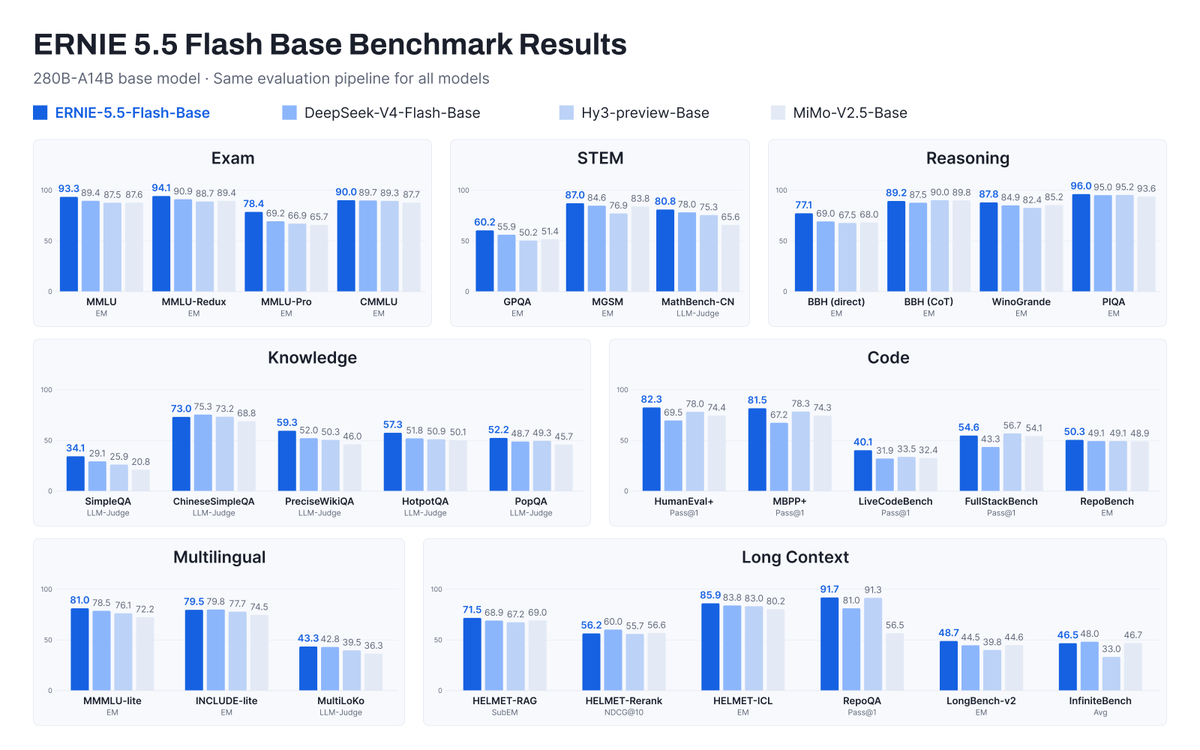
On November 5 Baidu (official blog + @BaiduResearch) open-sourced ERNIE-5.5-Flash-Base: a text-only MoE base checkpoint at end of pre-training (no mid/post-training), 280B total / 14B active per token, 33.5T pretrain tokens, up to 128K train context and 1M for fine-tune/inference. FP8 and BF16 weights are on Hugging Face and ModelScope. Under Baidu's unified eval pipeline vs similar bases: MMLU 93.3, HumanEval+ 82.3, LiveCodeBench 40.1 (vendor-reported). Post-trained ERNIE 5.5 Flash "will follow". License is custom (excludes EU/UK/South Korea; commercial use above $50M related revenue needs prior written authorization).

Baidu Opens ERNIE-5.5-Flash-Base: 280B-A14B MoE, 33.5T Pretrain, Vendor-Reported MMLU 93.3

Key Takeaways

  • Nov 5 open base at end of pre-training: 280B total / 14B active — not a chat/instruct model
  • 33.5T pretrain tokens; up to 128K train context, 1M for fine-tune and inference
  • Vendor unified eval: MMLU 93.3, HumanEval+ 82.3, LiveCodeBench 40.1 vs similar bases
  • Architecture: 37 HCA + 6 MLA-DSA layers; Multi-Router Latent MoE (512 routed top-10 + 1 shared)
  • Custom license (not Apache): excludes EU/UK/South Korea; >$50M related revenue needs Baidu written authorization
Read full story
Linked Models & Agents:
⚡ Ernie 5.5 Flash Base🌐 Baidu (百度文心)

Together AI Launches Together Compiler: Agents Continually Optimize Production Inference, Up to 2.6x Higher TPS

On November 4 Together AI launched Together Compiler (TKCC), which pairs a swarm of AI agents with a persistent inference engine to keep rewriting inference kernels for real traffic, models and hardware, as part of what it calls Polymorphic Inference. The company says that within 24 hours it reached up to 2.6x higher TPS on models such as Kimi K3, GLM 5.3, MiniMax M3.1-Flash and DeepSeek v4.1-Flash, up to 50% faster on customer workloads, and it already serves trillions of tokens a day in production.

Key Takeaways

  • Together Compiler recasts inference optimization from a classic compiler problem into an agentic search: agents propose kernel changes, a persistent engine checks speed and correctness, and only verified changes reach production
  • Together says that within 24 hours it reached up to 2.6x higher TPS on Kimi K3, GLM 5.3, MiniMax M3.1-Flash and DeepSeek v4.1-Flash, and up to 50% faster on customer workloads
  • On InferenceX low-latency batch size 1 it reports 1,111 TPS on MiniMax M3.1-Flash and 1,205 TPS on DeepSeek v4.1-Flash (company-reported); SemiAnalysis said it validated one of the results
  • The persistent engine hot-reloads candidate forward passes, cutting time to serving to 9 seconds versus 467 seconds for restarting an engine, with 252x higher experiment throughput than baseline agentic optimization systems
  • It already serves trillions of tokens a day in Together's production stack, where 40+ models are now optimized by agents
Read full story

Gemini 3.8 TTS Adds Voice Remixing: Edit Prebuilt or Designed Voices With Natural-Language Instructions Into New Reusable Voice IDs

The official Gemini API changelog released Voice remixing on November 4. Starting from a prebuilt voice, an Extended Voice Library voice or a Voice Design persona, developers describe changes such as accent, pitch, pacing or age in natural language, and POST /v1beta/voices returns a new standalone voice_ ID usable with Gemini 3.8 Flash TTS and Flash-Lite TTS. It is also available interactively in Google AI Studio.

Key Takeaways

  • New Voice remixing feature: apply relative natural-language edits to an existing voice to create a new standalone voice
  • Uses POST /v1beta/voices (type=prompted, store=true, plus a new prompted.base_voice field) and returns a voice_ ID with a 24kHz WAV preview
  • Base voices can be any of 30 prebuilt voices, an Extended Voice Library voice, or a stored custom voice_ voice in the project
  • The resulting voice_ ID works with gemini-3.8-flash-tts and gemini-3.8-flash-lite-tts and can itself be remixed again
  • The original voice is never modified, and deleting it does not affect voices remixed from it
Read full story
Linked Models & Agents:
⚡ Gemini 3.8 Flash TTS⚡ Gemini 3.8 Flash-Lite TTS🌐 Google🌐 Google DeepMind

Cognition Launches SWE-2 Flash: A Fast Coding Model Built on Inkling-Small, 200 tok/s at One-Fifth the Price of SWE-2

Cognition released SWE-2 Flash on November 4 (19:55 UTC). Its official blog says the model is built on Thinking Machines' Inkling-Small (276B total, 12B active parameters) and, for the first time, adds a large mid-training stage before reinforcement learning, lifting FrontierCode 2.0 from 3.2% to 24.0% and Terminal-Bench 4.0 from 0.9% to 20.0%. Cognition says it beats every American open-weight model. It generates about 200 tokens per second at one-fifth the price and 3x the speed of SWE-2, and is free for Pro, Max and Teams users in Devin Desktop and CLI until the end of November. Weights are not public; a secure sharing program for partners and researchers is planned.

Cognition Launches SWE-2 Flash: A Fast Coding Model Built on Inkling-Small, 200 tok/s at One-Fifth the Price of SWE-2

Key Takeaways

  • SWE-2 Flash is built on Thinking Machines' Inkling-Small, with 276B total and 12B active parameters, about one-tenth the size of SWE-2 (2.8T-A104B).
  • Training adds a three-stage mid-training run on a few trillion tokens of scientific articles, blogs, code and other sources, followed by large-scale RL with higher-quality and more diverse tasks.
  • Official scores: FrontierCode 2.0 24.0 (SWE-2 scores 23.8), DeepSWE 1.1 60.1, Terminal-Bench 2.1 89.2, SWE-Bench Pro v2 Hard 89.9 and Terminal-Bench 4.0 20.0.
  • It runs at about 200 tokens per second versus about 60 for SWE-2, at one-fifth the price, and is free for Pro, Max and Teams users in Devin Desktop and CLI through November.
  • Citing cyber risk, the weights are not openly released; Cognition says details of a secure weight-access program will follow in the coming weeks.
Read full story
Linked Models & Agents:
⚡ SWE-2 Flash⚡ SWE-2⚡ Inkling-Small🤖 Devin🌐 Cognition🌐 Thinking Machines
ADSponsored

Kling 4.0 Flash Is Fully Available With an API: 3-20 Second 720P Videos via Text, Image and Omni Reference Generation

Kling AI announced on November 4 that Kling 4.0 Flash is open to all users on the website and via API, and is also reachable through MCP, CLI and AI plugins, including Photoshop, Premiere Pro and After Effects. The official API changelog says the Flash API generates 3 to 20 second videos at 720P, supports text-to-video, image-to-video and Omni reference-to-video, accepts up to 15 inputs per task and bills by total duration.

Kling 4.0 Flash Is Fully Available With an API: 3-20 Second 720P Videos via Text, Image and Omni Reference Generation

Key Takeaways

  • Flash had been in early access for Ultra yearly subscribers since September 28; it is now open to all users and the API.
  • The API paths are kling-4.0-flash under /text-to-video, /image-to-video and /omni-video; image-to-video takes a single first-frame image.
  • Prompts can be up to 26,000 English characters, with up to 10 reference images and 5 reference videos, plus 21:9 and adaptive aspect ratios.
  • Billing is by the total duration of input and output video; unit prices are on the official pricing page and were not stated in the announcement.
Read full story
Linked Models & Agents:
⚡ Kling 4.0 Flash⚡ Kling 4.0🌐 Kling AI🌐 Kuaishou🌐 Adobe

SenseTime Ships SenseNova 6.8 Flash: An Office Agent Model With Long-Term Memory and Proactive Interaction That Builds Animated Slides, Motion Posters and Editable Blender 3D Projects

On the evening of November 2, SenseTime released the official version of SenseNova 6.8 Flash, a multimodal agent model with two main upgrades. First, long-term memory and proactive interaction: it keeps user goals and constraints across tasks and sessions and flags affected items when information changes. Second, design generation across Web, SVG, Three.js, Blender, animated PPT and motion posters, with Figma integration. It is live in SenseNova Studio, the Raccoon assistant and the SenseNova Token Plan; the official X account says the Token Plan offers a free trial of 1,500 API requests every 5 hours. SenseTime says it beats some international frontier models on agent collaboration, data analysis and presentation generation, but the announcement lists no specific scores.

SenseTime Ships SenseNova 6.8 Flash: An Office Agent Model With Long-Term Memory and Proactive Interaction That Builds Animated Slides, Motion Posters and Editable Blender 3D Projects

Key Takeaways

  • The official release landed on the evening of November 2, positioned as a multimodal agent model for office collaboration and design delivery
  • Long-term memory plus proactive interaction: it remembers goals, constraints and preferences across sessions and suggests changes when related information shifts (demos ran on an internal Raccoon build)
  • Design output spans Web, SVG, Three.js, Blender, animated PPT and motion posters, producing editable PPTX files and Blender projects, with Figma integration
  • Available in SenseNova Studio, the Raccoon assistant and the SenseNova Token Plan; the official X post cites 1,500 free API requests every 5 hours
  • SenseTime only says it beats some international frontier models on agent collaboration, data analysis and presentation generation; no scores were published and there is no independent evaluation yet
Read full story
Linked Models & Agents:
⚡ SenseNova 6.8 Flash⚡ SenseNova Loop-9B-Preview🤖 Raccoon🌐 SenseTime

Fireworks Forge Launches: Ultra-fast Inference Preview Hits 1,500 Tokens/s, Half-Price Background Mode, Nexus Desktop for Codex and Claude Desktop, Sovereign Private Preview

At its first Forge conference on November 3, open-model inference platform Fireworks launched a batch of products. Ultra-fast, powered by NVIDIA Blackwell, is in public preview at up to 1,500 tokens per second on DeepSeek V4.1 Flash, cutting a 30-turn agent task from 1 minute to 8 seconds. Background Mode runs deferrable work at half price, alongside multi-day prompt caching and higher rate limits. Nexus Desktop brings open-model routing into the Codex app, Claude Desktop and OpenCode, with Pro plans from $8 per month. Fireworks also announced No Eval, serverless LoRA inference, the Fireworks Sovereign private preview and a 60+ partner Frontier Ecosystem.

Fireworks Forge Launches: Ultra-fast Inference Preview Hits 1,500 Tokens/s, Half-Price Background Mode, Nexus Desktop for Codex and Claude Desktop, Sovereign Private Preview

Key Takeaways

  • Ultra-fast public preview: on NVIDIA Blackwell, up to 1,500 tokens per second on DeepSeek V4.1 Flash; in Fireworks' benchmark a 30-turn agent task fell from 1 minute to 8 seconds (Fireworks blog)
  • Cost options: Background Mode runs deferrable work at half price; multi-day prompt caching cuts the cost of resuming long context; higher serverless rate limits and Elastic Burst are generally available
  • Nexus Desktop launches: personalized routing across open and closed models inside the Codex app, Claude Desktop and OpenCode; Pro from $8 per month, Teams from $10 per seat per month
  • Training: No Eval (private preview) turns production traces into task evals; serverless LoRA inference (public preview) starts with GLM 5.3 Flash at per-token pricing with no idle charge; free training on Muse Glimmer 30B through November 30
  • Enterprise: Fireworks Sovereign (private preview) runs the inference engine in a customer's own cloud or data center; Fireworks says it already manages over 25,000 GPUs in customer environments; plus a 60+ partner Frontier Ecosystem
Read full story

Tencent Releases Hy4: First Hy Model With Vision and Computer Use, Live on Tencent Cloud and OpenRouter, Open Weights Planned

On November 4, Tencent Hy published Hy4 on its official site. Versus Augusts Hy4 preview, Tencent says it scaled up pre-training and post-training, added vision for the first time, added computer use across CLI and GUI, and trained specifically on Blender, CAD and engines like Unreal, Unity and Godot. Hy4 is live on Tencent Cloud and OpenRouter (tencent/hy4, 1M context) at the same API price as the preview. Weights and a system card are promised soon, and a cheaper Hy4 flash is coming.

Key Takeaways

  • Official blog: Introducing Hy4, dated 2026-11-04; the Tencent Hy transparency center also lists V1.0 Hy4
  • Two firsts: vision (fine-grained image detail, complex charts, math visual reasoning) and computer use (CLI plus GUI, with targeted training on Blender, CAD and long cross-app workflows)
  • Tencent's own evals: on 579 real finance tasks rated by 213 finance professionals Hy4 scores 3.04, first among open-weight models (DeepSeek-V4.1-Flash-1017 2.97, Kimi K3.1 Pro 2.68, GLM-5.3 2.68); GameDev +19.1%, GameLogic +9.8%; internal search hallucination rate 15.76% to 5.45%
  • Same API price as the preview: $0.042 cached input, $0.834 input, $2.501 output per million tokens; the OpenRouter page currently shows 50% off ($0.417/$1.251), 1,048,576 context and up to 65,536 output tokens
  • Weights are not out yet: Tencent says it will open-source them with a full system card, working with vLLM and SGLang; Hy4 flash is due soon
Read full story
Linked Models & Agents:
⚡ Hy4⚡ Hy4 preview⚡ Hy4 flash🤖 CodeBuddy🤖 WorkBuddy🌐 Tencent

Gemini API Deprecates Gemini 2.5 Pro and 2.5 Flash: From December 1, Requests Auto-Route to 3.8 Flash and 3.5 Flash-Lite at the New Models' Rates

In its November 2 Gemini API changelog, Google deprecated gemini-2.5-pro and gemini-2.5-flash and removed both from the Google AI Studio model picker. From December 1, 2026, requests to gemini-2.5-pro will automatically route to gemini-3.8-flash and requests to gemini-2.5-flash to gemini-3.5-flash-lite, billed at the new models' rates. Google flags breaking API changes: stricter function calling and thought_signature validation, thinking_level replacing thinking_budget, and removal of sampling parameters such as temperature and of prefilled model turns. The model string stays valid but behavior can change, so developers should switch model strings and rerun tests before December 1.

Key Takeaways

  • Deadline: from December 1, 2026, gemini-2.5-pro routes to gemini-3.8-flash and gemini-2.5-flash routes to gemini-3.5-flash-lite; API access to 2.5 Pro is already limited to existing users who actively used it.
  • Price change (official price list, per 1M tokens): 2.5 Pro is $1.25 input / $10.00 output for prompts up to 200k; 3.8 Flash is an introductory $0.75 / $3.75 through 2026, rising to $1.50 / $7.50 on January 1, 2027.
  • 2.5 Flash and 3.5 Flash-Lite both cost $0.30 input / $2.50 output for text, while audio input drops from $1.00 to $0.30.
  • The migration guide says to replace thinking_budget with thinking_level (3.8 Flash has no minimal level), drop temperature/top_p/top_k, candidate_count and prefilled model turns, and include call_id and name in every FunctionResponse.
  • It follows the October deprecation of 3.7 Flash, another case of an old model string silently routing to a newer model; 2.5 Pro users will actually land on a Flash-tier model.
Read full story