AI Coding Live News

Hugging Face Ships Ultimate MoE Training Handbook: ~500k–800k GPU-Hours Distilled into a Megatron-LM Guide

On 2026-11-05 Hugging Face released the free Ultimate MoE Training Handbook. Co-founder Thomas Wolf cited ~800k GPU-hours, ~70k words and 55 interactive figures; author Nouamane Tazi separately cited ~500k GPU-hours. The Megatron-LM guide covers routing, expert sizing, communication and debugging via the official Space.

Hugging Face Ships Ultimate MoE Training Handbook: ~500k–800k GPU-Hours Distilled into a Megatron-LM Guide

Key Takeaways

  • Official: Hugging Face Space “The Ultimate MoE Training Handbook” (2026-11-05)
  • Thomas Wolf (HF co-founder) on X: ~800k GPU-hours, ~70k words, 55 interactive figures
  • Author Nouamane Tazi separately cited ~500k GPU-hours; prefer the Space body over a reconciled figure
  • Covers Megatron-LM: routing, expert sizing, all-to-all, aux vs loss-free bias, upcycling and serving
  • Free and open; small teams can follow the runbook flag-by-flag against logs
Read full story
Linked Models & Agents:
⚡ DeepSeek-V4 (Next-Gen MoE)⚡ Nemotron 3 Super⚡ Nemotron 3 Ultra🌐 Hugging Face🌐 NVIDIA

Ant Ling Launches Ling-3.2-flash: 560B/25B Native Multimodal MoE, 1M Context; Vendor Evals Beat Opus 5 on Several Vision Suites; Free for First Two Weeks

On November 5 Ant Group’s Ant Ling (@AntLingAGI) launched Ling-3.2-flash: a 560B-total / 25B-active native multimodal MoE with a 1M context window and native image, text and video input. The official changelog targets complex visual understanding, multimodal long-horizon agents, 3D understanding and interaction, and medical multimodal work; APIs are OpenAI- and Anthropic-compatible and free for the first two weeks. The launch post cites vendor evals versus Claude Opus 5 (max): OmniDocBench1.5 92.21 vs 90.56, ZEROBench(Sub) 43.71 vs 39.52, Vision2Web 85.86 vs 80.20. DesignArena placed it about #10 on Image-to-Frontend with Elo 1238.

Ant Ling Launches Ling-3.2-flash: 560B/25B Native Multimodal MoE, 1M Context; Vendor Evals Beat Opus 5 on Several Vision Suites; Free for First Two Weeks

Key Takeaways

  • Specs (official docs): 560B total / 25B active; 1M context; native image/text/video; four focuses: complex vision, multimodal long-horizon agents, 3D, medical multimodal
  • Availability: chat UI plus OpenAI/Anthropic-compatible APIs; changelog says free for first 2 weeks, then original pricing resumes
  • Vendor evals (official X): OmniDocBench1.5 92.21 vs Opus 5 90.56; ZEROBench(Sub) 43.71 vs 39.52; Vision2Web 85.86 vs 80.20
  • Third party: DesignArena Image-to-Frontend ~#10, Elo 1238; official price page stresses 2-week free promo and has not listed 3.2 USD rates yet
  • Hands-on: model id Ling-3.2-flash; use image_url / video_url blocks; weights not on Hugging Face (API-first)
Read full story
Linked Models & Agents:
⚡ Ling-3.2-flash⚡ Ling-3.1-flash⚡ Claude Opus 5🌐 Ant Ling🌐 Ant Group

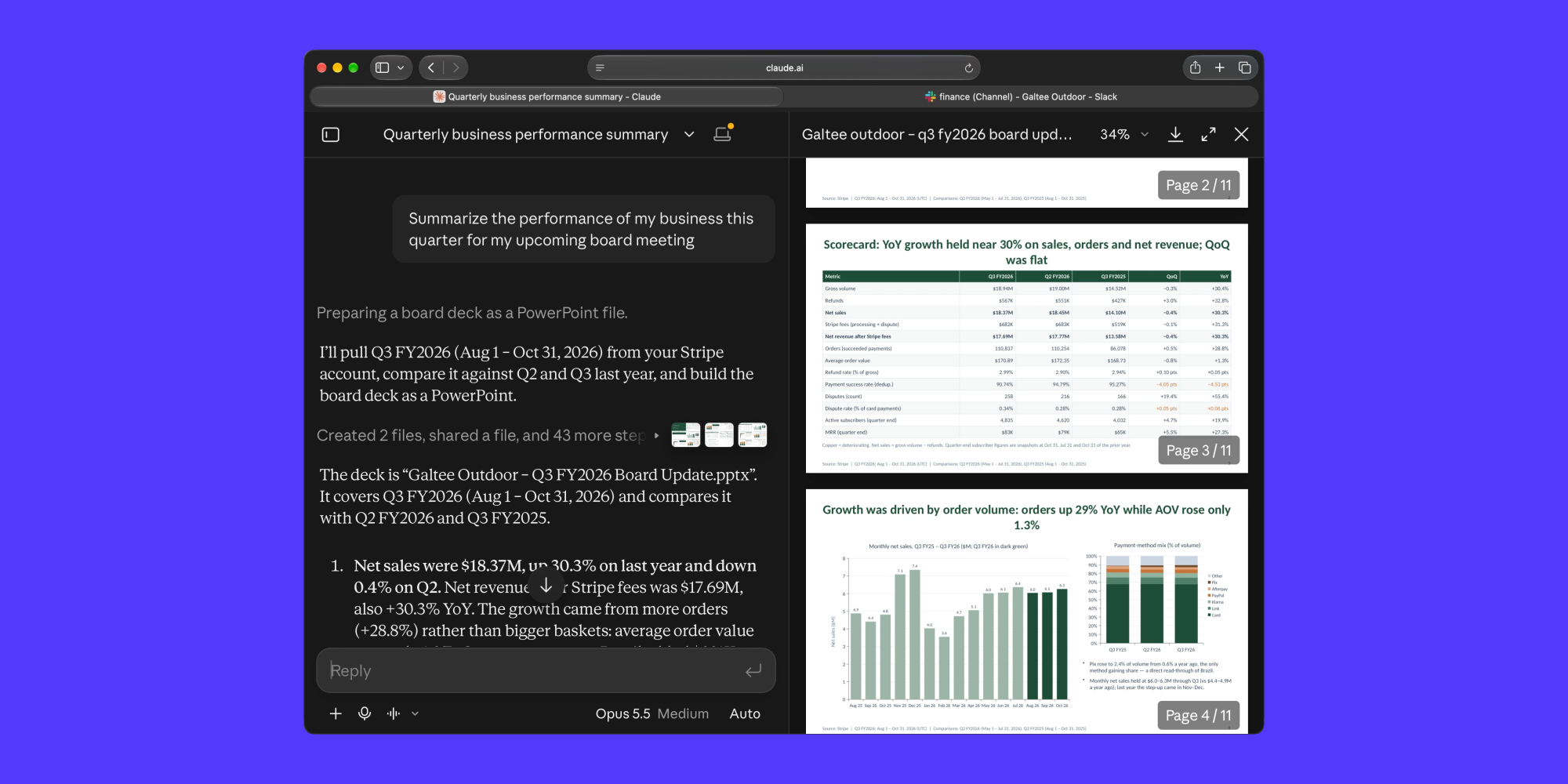
Stripe Opens Agent Data Analysis to All Users via MCP, Queries and Reports APIs; Queries Free Through Jan 31, 2027

On November 5 Stripe made agent access to Stripe analytics available to all users via the Stripe MCP or the Queries and Reports APIs directly. Compatible agents such as Claude and Cursor can answer natural-language questions about MRR, churn, fraud and reconciliation. The Reports API ships a modeled schema of 300+ tables with built-in guidance; Queries API is free through January 31, 2027 then usage-based, while Reports API stays free. Every analysis exposes the underlying SQL for verification.

Stripe Opens Agent Data Analysis to All Users via MCP, Queries and Reports APIs; Queries Free Through Jan 31, 2027

Key Takeaways

  • Availability: all Stripe users; connect via Stripe MCP or Queries/Reports APIs to Claude, Cursor and other compatible agents
  • Capabilities: natural-language MRR, expansion/contraction/churn, fraud, reconciliation and payments performance; can combine with tools like PostHog
  • Data model: Reports API includes 300+ modeled tables with usage guidance; every analysis exposes editable underlying SQL
  • Pricing (vendor): Queries API free through Jan 31, 2027 then per-credit with no monthly fee; Reports API remains free
  • Safety: read-only Data Metrics/Queries/Reports; do not paste secret keys into chat—use agent API keys or OAuth
Read full story

Claude Launches Personal Finance Beta in the US: Read-Only Bank Linking via Plaid, Up to 16 Banks and 24 Months of Transactions

On November 5 Anthropic announced a US beta of Personal Finance in Claude via @claudeai. Users link bank, card, loan and investment accounts through Plaid, see balances, cash flow, subscriptions and bills on one page, and ask questions in plain language. The official help article says access is read-only, so Claude cannot move, manage or invest money. It is limited to US Pro, Max and Ultra personal plans (not Free, Team or Enterprise) and is rolling out gradually.

Claude Launches Personal Finance Beta in the US: Read-Only Bank Linking via Plaid, Up to 16 Banks and 24 Months of Transactions

Key Takeaways

  • Read-only: balances, credit limits and up to 24 months of transactions; no money movement (vendor statement)
  • Up to 16 linked banks, US banks only; sign-in via Plaid so Claude never sees bank passwords
  • Pro, Max and Ultra personal plans only, on web, Desktop, iOS and Android, rolling out gradually
  • Chats inside the Personal Finance hub are not used for training; chats using account data are kept out of memory
  • Linked accounts cannot yet be used in Cowork, scheduled tasks or Claude Code
Read full story
ADSponsored

Google Antigravity v2.29 Brings Remote Agents and a Gemini Live Voice Mode: Agent Sessions Run in a Google-Managed Cloud and Keep Working After You Close Your Laptop, Rolling Out to AI Pro and Ultra

Ivan Leo, who works on developer experience at Google DeepMind, shared the official docs for Antigravity's new Remote Agents feature on X on November 4. Per the docs, Remote Agents run agent sessions and tools in an isolated, Google-managed remote environment, so tasks keep going when you close your laptop or browser or switch between desktop and mobile. Sessions start from the Antigravity App, the Antigravity CLI (1.4.12+, agy --remote-agent) or the web at antigravity.google.com, and remote projects can attach GitHub repositories, Google Drive files and uploads. It is rolling out gradually to Google AI Pro and Ultra subscribers on personal accounts; it is not available on the free plan, AI Plus or business accounts. The official changelog shows this ships in Antigravity v2.29.0 (November 3), which also starts rolling out a voice mode powered by Gemini Live for handing requests to the agent by voice, redesigns the Automations page into Scheduled, Always on and Paused lists, and adds a native Jupyter notebook viewer.

Key Takeaways

  • Remote Agents run in an isolated Google-managed environment with no local machine required; Remote Control instead connects to your own computer or server, and the web sidebar switches between them.
  • Three entry points: a New Remote Project in the Antigravity App, agy --remote-agent in CLI 1.4.12+, or antigravity.google.com in any browser, including mobile.
  • Remote projects can attach GitHub repositories (cloned automatically), Google Drive files and uploads (8 MiB per file, 100 MiB per project, 2 GiB per account).
  • CLI remote sessions default to the always-proceed (turbo) permission preset, so commands run without approval; locally installed MCP servers, plugins and skills are not available remotely yet.
  • Also in v2.29.0 (November 3): a Gemini Live voice mode rolling out gradually, a redesigned Automations page, and native rendering of .ipynb notebooks.
Read full story

Cognition Launches SWE-2 Flash: A Fast Coding Model Built on Inkling-Small, 200 tok/s at One-Fifth the Price of SWE-2

Cognition released SWE-2 Flash on November 4 (19:55 UTC). Its official blog says the model is built on Thinking Machines' Inkling-Small (276B total, 12B active parameters) and, for the first time, adds a large mid-training stage before reinforcement learning, lifting FrontierCode 2.0 from 3.2% to 24.0% and Terminal-Bench 4.0 from 0.9% to 20.0%. Cognition says it beats every American open-weight model. It generates about 200 tokens per second at one-fifth the price and 3x the speed of SWE-2, and is free for Pro, Max and Teams users in Devin Desktop and CLI until the end of November. Weights are not public; a secure sharing program for partners and researchers is planned.

Cognition Launches SWE-2 Flash: A Fast Coding Model Built on Inkling-Small, 200 tok/s at One-Fifth the Price of SWE-2

Key Takeaways

  • SWE-2 Flash is built on Thinking Machines' Inkling-Small, with 276B total and 12B active parameters, about one-tenth the size of SWE-2 (2.8T-A104B).
  • Training adds a three-stage mid-training run on a few trillion tokens of scientific articles, blogs, code and other sources, followed by large-scale RL with higher-quality and more diverse tasks.
  • Official scores: FrontierCode 2.0 24.0 (SWE-2 scores 23.8), DeepSWE 1.1 60.1, Terminal-Bench 2.1 89.2, SWE-Bench Pro v2 Hard 89.9 and Terminal-Bench 4.0 20.0.
  • It runs at about 200 tokens per second versus about 60 for SWE-2, at one-fifth the price, and is free for Pro, Max and Teams users in Devin Desktop and CLI through November.
  • Citing cyber risk, the weights are not openly released; Cognition says details of a secure weight-access program will follow in the coming weeks.
Read full story
Linked Models & Agents:
⚡ SWE-2 Flash⚡ SWE-2⚡ Inkling-Small🤖 Devin🌐 Cognition🌐 Thinking Machines

Conductor Is Joining Meta: The Multi-Agent Coding Tool Team Moves to MSL, Conductor Cloud Shuts Down on November 20

Charlie Holtz of Conductor announced on X on November 4 (18:18 UTC) that Conductor is joining Meta, where the team will build "the next interface" with Nat Friedman and Alexandr Wang at Meta Superintelligence Labs (MSL). The official announcement sets a timeline: from November 4 there are no new sign-ups and Pro features are free for existing users; on November 13 Conductor Cloud goes read-only and active subscribers get refunds; on November 20 Cloud shuts down and cloud data deletion begins; the local app keeps getting new models and critical fixes until early 2027. Terms were not disclosed.

Conductor Is Joining Meta: The Multi-Agent Coding Tool Team Moves to MSL, Conductor Cloud Shuts Down on November 20

Key Takeaways

  • Conductor launched in July 2025 as a tool for running a team of coding agents at once (it runs first-party agents such as Claude Code, Codex, Cursor and OpenCode under the hood), and its site claims 100k+ builders.
  • The team joins Meta Superintelligence Labs to work with Nat Friedman and Alexandr Wang; the official word on the new product is only "early next year", with no details.
  • Key dates: sign-ups and downloads stop on Nov 4, Cloud goes read-only with refunds on Nov 13, Cloud shuts down and data deletion starts on Nov 20, and the local app is maintained until early 2027.
  • To migrate, right-click a cloud workspace and choose Transfer to local, or export everything via Settings, Account, Export data.
  • Terms were not disclosed; on the same day HumanLayer announced it is joining Factory, a sign the coding-agent tooling market is consolidating quickly.
Read full story

RoboColosseum Opens Real-Robot Evaluation: 100+ Robots at 124 Sites, Claude Opus 5.5 and GPT-6 Astra Rival Specialized VLA Policies Zero-Shot

Hugging Face, BitRobot, the Singapore Embodied AI Centre, NUS and others launched RoboColosseum on November 4, a distributed real-robot evaluation framework covering four embodiments: SO-101, Franka, Bimanual-YAM and the Unitree G1 humanoid. The first study ran 5,699 blinded pairwise comparisons at 124 sites across 5 VLA policies and 3 frontier models. Claude Opus 5.5 and GPT-6 Astra beat their VLA counterparts on average task progress by 12.1 and 11.0 points, while Grok 4.7 trailed by 7.5. All rollouts are open on Hugging Face, and the project pledges 10,000 free evaluation hours to academic labs.

RoboColosseum Opens Real-Robot Evaluation: 100+ Robots at 124 Sites, Claude Opus 5.5 and GPT-6 Astra Rival Specialized VLA Policies Zero-Shot

Key Takeaways

  • Two tracks: the Open Track runs blinded zero-shot pairwise comparisons, and the Fine-tune Track gives each VLA the same 100 demonstrations per task across 20 tasks.
  • The VLAs tested are GR00T N1.7, pi0.5, MolmoAct2, G0.5 and LingBot-VLA v2; the frontier models are GPT-6 Astra, Claude Opus 5.5 and Grok 4.7.
  • After fine-tuning, GR00T N1.7 leads on SO-101 and pi0.5 leads on Franka and Bimanual-YAM; on the G1 humanoid no policy completes any task, with average progress of 13.3% to 23.2%.
  • Rankings agree only weakly across robots (Kendall W = 0.24), and zero-shot rankings poorly predict rankings after fine-tuning.
Read full story

Moonshot Releases Kimi K3.1 Pro Open Weights on Hugging Face: 2.8T-Parameter, 104B-Active MoE in MXFP4 at About 1.56TB, Custom License Limits Large Model-as-a-Service Use

The official Kimi account @Kimi_Moonshot announced the Kimi K3.1 Pro model weights at 16:00 UTC on November 4; the moonshotai/Kimi-K3.1-Pro repository is public and not gated. The model card describes a natively multimodal MoE with 2.8T total and 104B active parameters and a 1M-token context, shipped as MXFP4 weights from quantization-aware training, about 1.56TB in total; vLLM, SGLang and TokenSpeed are the recommended engines. The license allows free use and modification, but Model-as-a-Service businesses with over $20M in annual revenue need a separate agreement.

Moonshot Releases Kimi K3.1 Pro Open Weights on Hugging Face: 2.8T-Parameter, 104B-Active MoE in MXFP4 at About 1.56TB, Custom License Limits Large Model-as-a-Service Use

Key Takeaways

  • Architecture: 93 layers (1 dense), 69 KDA plus 24 Gated DSA attention layers, 896 experts with 16 selected per token plus 2 shared experts, and a 401M MoonViT-V2 vision encoder.
  • Compared with K3, the full-attention Gated MLA layers are replaced with Gated DeepSeek Sparse Attention for more efficient long-context modeling.
  • Vendor-reported scores on the model card: Terminal-Bench 4.0 65.7 (Opus 5.5 66.4), SWE Marathon v1.1 51.7 (Opus 5.5 46.3), HLE-Full with tools 70.0 and BrowseComp 92.1; ProgramBench 31.5 trails Opus 5.5 at 65.0.
  • License: a Model-as-a-Service business with over $20M revenue in any 12 months needs a separate agreement with Moonshot, and products above 100M monthly users or $20M monthly revenue must prominently display "Kimi K3.1-Pro"; internal use is exempt from both.
Read full story

SenseTime Ships SenseNova 6.8 Flash: An Office Agent Model With Long-Term Memory and Proactive Interaction That Builds Animated Slides, Motion Posters and Editable Blender 3D Projects

On the evening of November 2, SenseTime released the official version of SenseNova 6.8 Flash, a multimodal agent model with two main upgrades. First, long-term memory and proactive interaction: it keeps user goals and constraints across tasks and sessions and flags affected items when information changes. Second, design generation across Web, SVG, Three.js, Blender, animated PPT and motion posters, with Figma integration. It is live in SenseNova Studio, the Raccoon assistant and the SenseNova Token Plan; the official X account says the Token Plan offers a free trial of 1,500 API requests every 5 hours. SenseTime says it beats some international frontier models on agent collaboration, data analysis and presentation generation, but the announcement lists no specific scores.

SenseTime Ships SenseNova 6.8 Flash: An Office Agent Model With Long-Term Memory and Proactive Interaction That Builds Animated Slides, Motion Posters and Editable Blender 3D Projects

Key Takeaways

  • The official release landed on the evening of November 2, positioned as a multimodal agent model for office collaboration and design delivery
  • Long-term memory plus proactive interaction: it remembers goals, constraints and preferences across sessions and suggests changes when related information shifts (demos ran on an internal Raccoon build)
  • Design output spans Web, SVG, Three.js, Blender, animated PPT and motion posters, producing editable PPTX files and Blender projects, with Figma integration
  • Available in SenseNova Studio, the Raccoon assistant and the SenseNova Token Plan; the official X post cites 1,500 free API requests every 5 hours
  • SenseTime only says it beats some international frontier models on agent collaboration, data analysis and presentation generation; no scores were published and there is no independent evaluation yet
Read full story
Linked Models & Agents:
⚡ SenseNova 6.8 Flash⚡ SenseNova Loop-9B-Preview🤖 Raccoon🌐 SenseTime
ADSponsored

Vercel Security Review Enters Public Beta: Vulnerability Review on Every GitHub Push, One-Click Fixes with Vercel Agent

On November 3 (US Pacific time), Vercel launched Security Review in public beta. It is a new Vercel Agent capability alongside Code Review and Investigation: once enabled, every push to connected GitHub repositories triggers a diff-only vulnerability review that finishes in seconds. Findings land in the Security dashboard, PR comments and the CLI, and can be fixed with one click by Vercel Agent or pulled into your own coding agent via vercel security vulnerabilities. It is available to Pro and Enterprise teams, and reviews are free until November 10.

Vercel Security Review Enters Public Beta: Vulnerability Review on Every GitHub Push, One-Click Fixes with Vercel Agent

Key Takeaways

  • Trigger: every GitHub push (including direct pushes to production) is reviewed automatically; only the diff is scanned, which Vercel says finishes in seconds, so it can run on every preview and production deployment
  • Beyond pattern matching: the agent traces how changed code is reached, checks existing protections and rechecks each finding, which Vercel says catches logic flaws such as missing authorization checks
  • Teams can write security policies in plain language, scoped to projects or the whole team, and manage them with vercel security policy
  • Pricing: Vercel Agent rate, model tokens at provider cost with no markup, plus $0.25 per million tokens; reviews are free until November 10, 2026, while Agent fixes are billed
  • Availability: public beta for Pro and Enterprise teams; Vercel has not published detection-rate or false-positive benchmarks
Read full story

X Discussion: levelsio Used Claude Code to Decompile the Battlefield 1942 Demo and Put It in the Browser With Multiplayer, Citing About 1M Output Tokens

Indie developer Pieter Levels (@levelsio) said on X on November 2 that he used Claude Code to decompile the engine of the free Battlefield 1942 demo, port it to C, compile it to WebAssembly and host it at bf1942.pieter.com, where it runs in the browser with online co-op on the Tobruk map. He said the job took about 1 million output tokens, roughly $100 at API prices, while he pays for a $100-a-month Claude subscription. His two main posts drew about 2,200 likes and 340,000 views and reached X trending. These are the author's own claims and community discussion, not independently verified.

X Discussion: levelsio Used Claude Code to Decompile the Battlefield 1942 Demo and Put It in the Browser With Multiplayer, Citing About 1M Output Tokens

Key Takeaways

  • Author's account: Claude Code decompiled the Battlefield 1942 demo engine, which was ported to C and compiled to WebAssembly to run in the browser.
  • The live build at bf1942.pieter.com opens directly, is labeled non-commercial and unofficial, and offers online co-op on Tobruk with no install.
  • Cost: about 1 million output tokens by the author's count, roughly $100 at API prices; he actually pays for a $100-a-month Claude subscription.
  • He said it was much harder than his earlier Quake and DOOM ports, whose engine source code id Software released long ago.
  • Reach: the first post had about 1,100 likes and 230,000 views, the launch post about 1,100 likes and 107,000 views; testers are already reporting bugs.
Read full story
Linked Models & Agents:

X discussion: Pieter Levels posts a 13-minute video on "what is left when AI can build everything", saying his businesses are shrinking, the sense of achievement is gone, and moats shift to community and content

Indie developer Pieter Levels (@levelsio) posted a roughly 13.5-minute walk-and-talk video on X on November 1, following up his October 11 "software is dead" post. He says AI has finally hit programmers themselves, and the identity and sense of achievement that came from building paid products is fading; his own businesses and many friends' are flat or shrinking, and competition has exploded because anyone can now ship a landing page or app. He sees the remaining moats as community, audience, content and slower-moving enterprise B2B, and has already made Nomad List free as nomads.com. The post had about 2,478 likes and 205K views. These are personal views, not industry data.

X discussion: Pieter Levels posts a 13-minute video on "what is left when AI can build everything", saying his businesses are shrinking, the sense of achievement is gone, and moats shift to community and content

Key Takeaways

  • Original post: @levelsio video, Nov 1, 10:44 UTC, about 2,478 likes, 2,441 bookmarks, 204 replies and 205K views at fetch time
  • It quotes his October 11 "Software is dead" post (about 5,747 likes, 1.94M views); the video expands on what is left to do when AI can build everything
  • His GTA cheat-code analogy: every new model makes building faster and easier, but "where's the achievement?"; he says he is not pessimistic, just looking for a new source of achievement
  • His own observations: his and many friends' businesses are flat or shrinking, the ones still growing often rely on AI or VC sponsorships, and big labs building legal and medical products will absorb many small businesses
  • Nomad List is now free as nomads.com; he says sign-ups went from about 200 when paid to about 3,000 (period not stated), with revenue now from sponsorship and a $1 anti-spam membership
Read full story

X discussion: Stripe CEO Patrick Collison adds an agent-powered "improvements" box to his vibecoded apps and calls it liquid software

A widely discussed idea on X: on Oct 31 Stripe CEO Patrick Collison (@patrickc) posted that he is building an "improvements" feature into all of his personal vibecoded applications, a freeform text input hooked up to an agent that implements whatever is submitted. He says another person who uses one of the apps has already implemented 150 improvements in a few days, and he floats the name "liquid software" for the pattern. He is also candid that he does not know whether it scales: whether it becomes unmaintainable, how collaborative software works this way, and whether it can be secure and reliable. The post drew about 2,130 likes, 1,900 bookmarks and 147K views. This is a write-up of a personal opinion and the discussion around it, not an official Stripe product announcement.

X discussion: Stripe CEO Patrick Collison adds an agent-powered "improvements" box to his vibecoded apps and calls it liquid software

Key Takeaways

  • Buzz: about 2,133 likes, 1,896 bookmarks, 217 replies, 76 quotes and 147K views (public X metrics as of Nov 1, 12:15 SGT)
  • Pattern: every personal app gets a freeform text box wired to an agent that yolo implements whatever is submitted, which makes sanding a small rough edge almost free
  • Data point: Collison says another person using one of his apps implemented 150 improvements in a few days (self-reported; the app itself is not public)
  • His own open questions: does it become unmaintainable, can model gains outpace feature appetite, how does collaborative software work, and can it be secure and reliable
  • Debate: supporters say it will become standard and could even ship bespoke per-user features behind flags; skeptics note conflicts start once a second user asks for the opposite change, and maintenance and security remain unsolved; Collison himself compares it to the user-modifiable visions of Lisp machines, Smalltalk and HyperCard
Read full story
Linked Models & Agents:
T
Tsinghua University & Z.AI (HarnessPro, arXiv 2610.26770)arxiv.org·
👀27
🔥80

Tsinghua and Z.AI open-source HarnessPro: agents rewrite their own harness, reaching 80.8% on Terminal-Bench 2 at 34% lower cost per task

HarnessPro (arXiv 2610.26770, submitted Oct 19 and revised Oct 20), from Tsinghua University, Z.AI (Zhipu) and collaborators, is a label-free way to improve an agent harness: specialized agents diagnose execution traces, rewrite instructions and runtime policies, score candidates with LLM-generated tests, and keep Lite, Medium and Heavy harnesses along the performance-cost frontier. Per the paper, with GPT-5.5 and Codex the Heavy mode reaches 80.8% on Terminal-Bench 2, 4.5 points above the prior RHO method, while cost per task drops from $1.09 to $0.72. The code is MIT-licensed and drew wider media coverage this week, including from Pandaily.

Tsinghua and Z.AI open-source HarnessPro: agents rewrite their own harness, reaching 80.8% on Terminal-Bench 2 at 34% lower cost per task

Key Takeaways

  • Terminal-Bench 2 (GPT-5.5 with Codex, mean of 3 runs): Heavy reaches 80.8% at $0.72 per task, versus RHO at 76.3% and $1.09, a 33.9% cost cut (paper figures, arXiv)
  • Averaged over three benchmarks: +2.0 points pass rate and -26.1% cost per task versus RHO, across Terminal-Bench 2, SWE-Bench Pro and ProgramBench
  • Holds across models: with GLM-5.2 and Claude Code on Terminal-Bench 2, Heavy hits 81.4% at $0.62, versus vanilla at 74.6% and $0.92 and RHO at 78.0% and $1.00
  • Budget modes: Medium matches RHO at 76.3% on Terminal-Bench 2 for only $0.56 per task; Lite gets 72.9% at $0.43
  • Cheap to train: only 10 training tasks per benchmark and 3 to 4 evolution epochs, tested on 59, 100 and 100 held-out tasks; the three harness tiers are MIT-licensed on GitHub
Read full story