AI Coding Live News

Meta Rolls Out Muse Realtime Avatar in the US Muse App: Speech-Driven Expression and Gesture at ~870ms First-Byte Latency

On November 5 Meta AI (@AIatMeta) said Muse Realtime Avatar, previewed at Connect, is rolling out in the US Muse app, turning Muse Realtime Voice into interactive live avatars. The research blog describes an audio-driven Diffusion Transformer that shares the speech-token stream with voice for lip-sync and expression; a single GB200 session streams 448×768 at 25 fps with about 870 ms from end of user turn to first synchronized audio-video byte, with Meta Video Seal invisible watermarking. Muse is for users 18+; no global schedule or developer API was announced.

Meta Rolls Out Muse Realtime Avatar in the US Muse App: Speech-Driven Expression and Gesture at ~870ms First-Byte Latency

Key Takeaways

  • US Muse app rollout of Realtime Avatar after the Connect preview (@AIatMeta)
  • Shared speech VQ tokens drive audio decode and avatar video; causal chunks with self-forcing distillation cut ~120 teacher NFEs to 2 student NFEs (~60x)
  • Vendor perf: 448×768@25fps, ~870ms first-byte latency; ~8x serving capacity vs BF16 baseline, up to 12 concurrent sessions on one GB200
  • Vendor preference study favored Muse over Runway Characters and HeyGen LiveAvatar on overall and most axes
  • Safety: Video Seal invisible watermark; blog demos are not the full in-app avatar set; no public developer API stated
Read full story
Linked Models & Agents:
⚡ Muse Spark⚡ Muse Presence🤖 Muse🌐 Meta

Block unveils Dessa: a full-duplex speech model trained from scratch only on human conversation audio, running locally on a MacBook Pro M4 Max

On 2026-10-23 (16:53 UTC) the official @blocks account unveiled Dessa, and Jack Dorsey called it the most authentic full-duplex speech model ever built. The official page block.xyz/dessa says Dessa is a true speech-to-speech model trained only on recordings of human conversation, with no text and no pretrained models. It is full-duplex, so it listens and talks at the same time, cuts in and backchannels naturally, runs faster than real time, and runs locally on a MacBook Pro M4 Max or better. Block says it was trained on a single NVIDIA GB200 NVL72 and learned language from hundreds of times fewer words than LLMs. There is no public API or weights yet; a small group of AI safety researchers is getting early access.

Block unveils Dessa: a full-duplex speech model trained from scratch only on human conversation audio, running locally on a MacBook Pro M4 Max

Key Takeaways

  • Trained only on human conversation audio, from scratch, with no text and no pretrained models (official page)
  • Full-duplex speech-to-speech: listens while talking, cuts in and backchannels, and natively hears and expresses emotion, sarcasm and laughter
  • Inference runs faster than real time and runs locally on a MacBook Pro M4 Max or better
  • Block says training used a single NVIDIA GB200 NVL72 and needed hundreds of times fewer words than LLMs
  • No public API, weights or third-party benchmarks yet; early access is limited to a small group of AI safety researchers
Read full story
Linked Models & Agents:
⚡ Dessa🌐 Block

vLLM Narrows Gap with DeepInfer to 6% on NVIDIA GB200, Reaching 1M Tokens/s per GPU on GB300

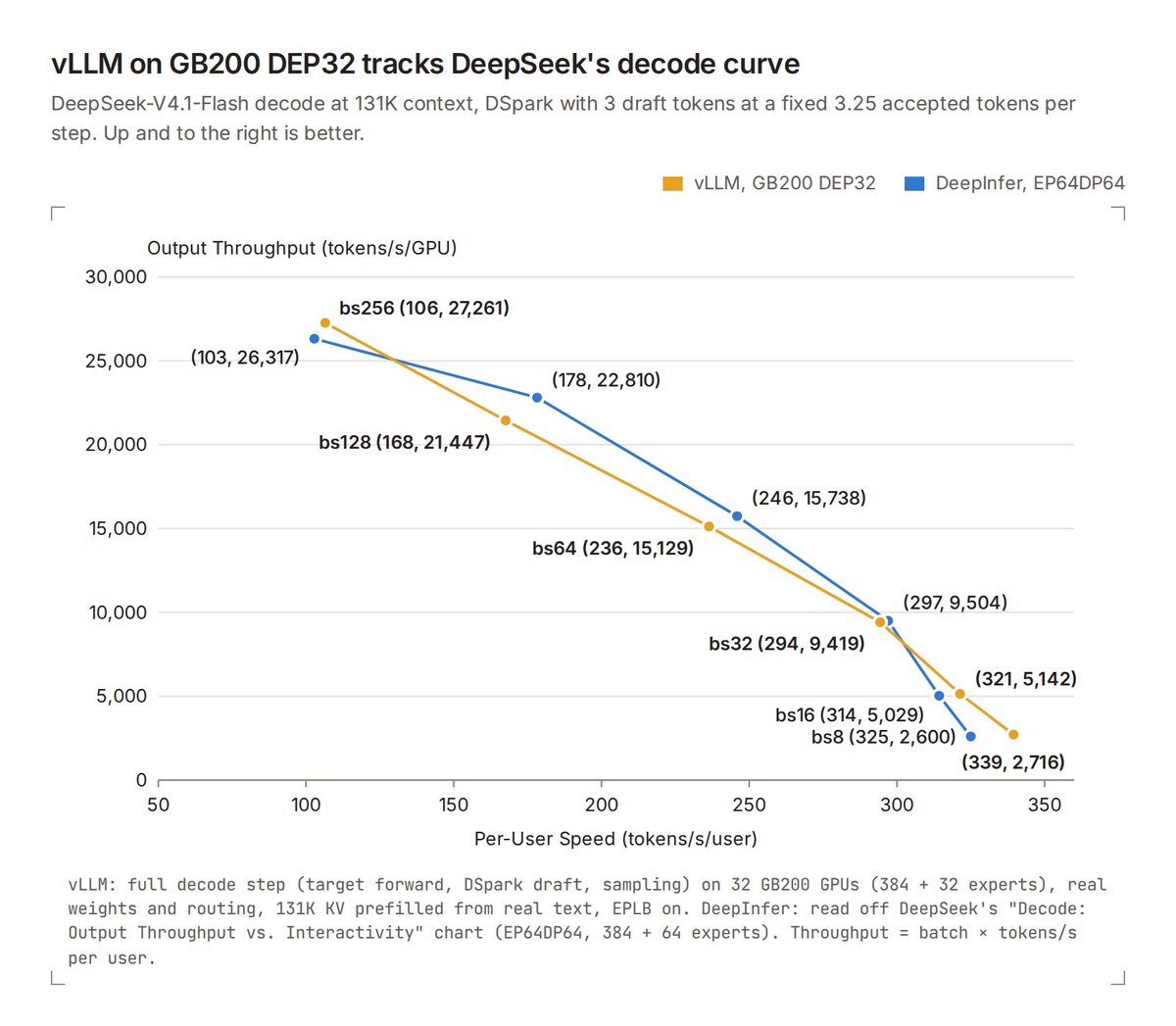
Hours after DeepSeek open-sourced DeepInfer, the vLLM project team released official benchmark parity data serving DeepSeek-V4.1-Flash. Utilizing DeepSeek's identical decoding setup (131K context window, nextn=3 speculative decoding), vLLM closed its throughput performance delta to within 6% of DeepInfer across batch sizes 8 through 256 on NVIDIA GB200 systems. On GB300 hardware, vLLM attained up to 1,000,000 tokens/second per GPU and 826 tokens/second per user, generating $38.96 in hourly GPU revenue at DeepSeek off-peak rates. vLLM simultaneously shipped day-0 runtime support for FastH3-Omni and Spark-X2.6-4B.

vLLM Narrows Gap with DeepInfer to 6% on NVIDIA GB200, Reaching 1M Tokens/s per GPU on GB300

Key Takeaways

  • vLLM published direct benchmark comparisons, demonstrating that its serving throughput on NVIDIA GB200 is within 6% of DeepInfer
  • Achieves unprecedented scaling on NVIDIA GB300: up to 1,000,000 tokens/second per GPU and 826 tokens/second per active user stream
  • Generates up to $38.96 per GPU-hour in revenue when mapped to DeepSeek's production off-peak API pricing schedule
  • Delivers immediate Day-0 support for the FastH3-Omni video model and the 1M-token Apache 2.0 model Spark-X2.6-4B
Read full story
Linked Models & Agents:

Hao AI Lab open-sources FastH3 Omni: MiniMax H3 distilled to 8 steps for reference-guided video and audio, with 5.6-11.9x lower end-to-end latency

On Oct 20, the FastVideo team at UCSD's Hao AI Lab open-sourced FastH3 Omni, a distilled version of MiniMax H3's reference-to-video-and-audio (Ref2VA) model that generates video with synchronized stereo audio from text plus up to nine images, video clips and voice references. Sampling drops from 50 steps to eight transformer evaluations, cutting end-to-end latency 5.6-11.9x on eight GB200s by the team's measurements. Training code is open, with NVFP4 weights for DGX Spark and RTX 5090 and ComfyUI support.

Hao AI Lab open-sources FastH3 Omni: MiniMax H3 distilled to 8 steps for reference-guided video and audio, with 5.6-11.9x lower end-to-end latency

Key Takeaways

  • Steps: eight transformer evaluations versus 50 for base MiniMax H3, via PDD plus DMD distillation
  • Speed (team figures): 5.6-11.9x lower end-to-end latency across 27 matched workloads on 8x GB200; a 15-second single-image request drops from 139.69s to 14.14s
  • Inputs: up to nine images, three videos and three audio clips, at most 12 references; output is 24 FPS video with 32 kHz stereo audio
  • Local: NVFP4 QAD weights for DGX Spark (128 GB) and RTX 5090 (32 GB), 480p by default; FP8 weights for RTX 4090
  • License: MiniMax-H3 Community License, not Apache or MIT
Read full story
Linked Models & Agents:
ADSponsored

Meta details Prometheus, the gigawatt-scale supercluster that trained Muse Wonder: 85%+ pretraining goodput, 90%+ for RL, scaling toward ~1M GPUs

Meta's engineering blog on October 19 gave the first detailed look at Prometheus, the New Albany, Ohio supercluster that trained the Muse family, including Muse Wonder. Phase one is complete with hundreds of thousands of GPUs, and the full build targets about 1 million. Muse Wonder training reached more than 85% goodput in pretraining and more than 90% in reinforcement learning, with a mean time between interruptions of about 47K GPU hours, since raised above 54K by firmware fixes. It runs GB200 NVL72 and GB300 NVL72 platforms, with Vera Rubin NVL72 arriving soon.

Meta details Prometheus, the gigawatt-scale supercluster that trained Muse Wonder: 85%+ pretraining goodput, 90%+ for RL, scaling toward ~1M GPUs

Key Takeaways

  • Scale: phase one trained the Muse family; it has hundreds of thousands of GPUs today, targets about 1 million, and runs across buildings as a single machine.
  • Reliability: Muse Wonder hit 85%+ pretraining goodput and 90%+ for RL; MTBI was about 47K GPU hours and is now above 54K.
  • Interruptions: a mid-2025 peak of nearly 1,000 events per 8K GPUs per day was cut by 99% over a year of engineering.
  • Sparing: each NVL72 rack runs a 64-GPU slice with 8 in-rack spares, plus about 2% spare racks; a 32,768-GPU job needs 523 racks or 37,656 GPUs, about 13% extra.
  • Network: each building fabric links up to 20,736 GPUs, and the aggregation network spans 2 km to over 100 km.
Read full story

SemiAnalysis Discloses Google & Inferact TPUv7 Submission: TorchTPU vLLM Megakernels Drive 2.8T Kimi K3, Surpassing GB200 NVL72 and B300 in High-Interactivity TCO

SemiAnalysis revealed the first Google TPUv7 benchmark submission for the 2.8T Kimi K3 MoE model, led end-to-end by Inferact (the creators of vLLM) and Google using the TorchTPU vLLM stack. At a hardware rental cost of just $1.21/chip-hour (vs $2.31 for GB300 and $1.86 for GB200), TPUv7 delivers ~2.2M tokens per $1 TCO in the ultra-high interactivity regime (~390 tok/s/user), outpacing NVIDIA GB200 NVL72, B300, and AMD MI355X on cost-performance.

SemiAnalysis Discloses Google & Inferact TPUv7 Submission: TorchTPU vLLM Megakernels Drive 2.8T Kimi K3, Surpassing GB200 NVL72 and B300 in High-Interactivity TCO

Key Takeaways

  • Inferact (creators of vLLM) and Google submitted their first preliminary TPUv7 benchmark for the 2.8T Kimi K3 MoE model
  • TPUv7 chip rental sits at $1.21/hour, significantly below GB300 ($2.31), B300 ($2.26), and GB200 ($1.86)
  • Delivers ~2.2M tokens per $1 TCO at ~390 tok/s/user, beating NVIDIA GB200 NVL72, B300, and AMD MI355X in the ultra-high interactivity regime
  • Built with fused TorchTPU vLLM megakernels and the TPU-Sync KVCache offload library for production PD disaggregation
Read full story
Linked Models & Agents:

Microsoft AI finishes pre-training MAI-Base-2: 2.8T-total / 80B-active MoE trained on 16K GB200s in 38 days, which MAI estimates is 4.2–12.3x more FLOPs-efficient than DeepSeek-V4-Pro-Base

On 2026-10-15 Microsoft AI published a technical post and PDF saying it has finished pre-training its in-house base model MAI-Base-2: MoE in every layer (1 shared + 7-of-512 routed experts), 80B active / 2.8T total, 102 layers, native encoder-free vision, a 50T-token mixture and a March 2026 knowledge cutoff. Per MAI, it beats every open-weight model tested on held-out BPB and its recipe is 4.2–12.3x more pre-training-FLOPs-efficient than DeepSeek-V4-Pro-Base. It is still in post-training: no API, no weights and no release date yet; Microsoft plans to license weights to trusted partners via Foundry.

Microsoft AI finishes pre-training MAI-Base-2: 2.8T-total / 80B-active MoE trained on 16K GB200s in 38 days, which MAI estimates is 4.2–12.3x more FLOPs-efficient than DeepSeek-V4-Pro-Base

Key Takeaways

  • Scale: 80B active / 2.8T total, 102 layers, hidden 8704, MoE in every layer (1 shared + 7 of 512 routed); MAI-Base-1 was 35B/1T, 78 layers, alternating dense/MoE (PDF)
  • Compute: 16K GB200s for 38 days (Aug–Sep 2026), 21% average MFU (vs 2.5 PFLOPS BF16), 89% goodput; the Muon step is 2.1% (165 ms) of iteration time
  • Efficiency (vendor estimate via scaling-law fits): 4.2–12.3x fewer FLOPs than DeepSeek-V4-Pro-Base to match its BPB; 6.3–12.7x better than the June MAI-Base-1 recipe
  • Data: 50T-token mixture, 18% vision-language (4.5T unique), ~36% more unique tokens than Base-1, described as organic data with no distillation
  • Availability: still in post-training, no API/weights/date; weights to be licensed to trusted partners through Foundry; MAI-Base-3 prep underway (blog)
Read full story
Linked Models & Agents:
⚡ MAI-Base-2⚡ MAI-Base-1⚡ MAI-Thinking-1⚡ DeepSeek-V4-Pro-Base⚡ Kimi K3⚡ Qwen3.8-2.4T-A95B🌐 Microsoft🌐 NVIDIA🌐 DeepSeek

vLLM adds NVIDIA Vera Rubin NVL72 support: up to 7.84x per-GPU throughput over GB200 on AgentX with MiniMax M3

On Oct 9 the vLLM team, with Inferact, Red Hat and NVIDIA, shipped early Vera Rubin NVL72 support: CUDA 13.4 nightly images already serve DeepSeek, Kimi, GLM and MiniMax. Vendor-reported results: up to 7.84x per-GPU throughput vs GB200 on SemiAnalysis AgentX (MiniMax M3, matched interactivity) and up to 3.7x vs GB300 NVL72 on the MLPerf Inference v6.1 VLM benchmark (Qwen3-VL-235B-A22B).

vLLM adds NVIDIA Vera Rubin NVL72 support: up to 7.84x per-GPU throughput over GB200 on AgentX with MiniMax M3

Key Takeaways

  • Versus GB200 NVL72: 5x NVFP4 FLOPS, ~2.4x HBM4 bandwidth, 1.7x bidirectional NVLink, 2–4x faster softmax exponentials (vLLM blog)
  • AgentX with MiniMax M3: up to 7.84x per-GPU throughput at matched interactivity, 5.18x under a 150 TPS cap (vendor-reported, early)
  • MLPerf Inference v6.1: Qwen3-VL-235B-A22B on vLLM + Dynamo, up to 3.7x vs GB300 NVL72
  • CUDA 13.4 locality domains split MoE weights for ~1.2x average MoE-layer speedup in small-token decode
  • Image: vllm/vllm-openai:cu134-nightly (CUDA 13.4 + PyTorch 2.15)
Read full story

Inferact open-sources TPU megakernels: Kimi K3 hits 709 tok/s on 16× TPU v7 vs 452 on GB200

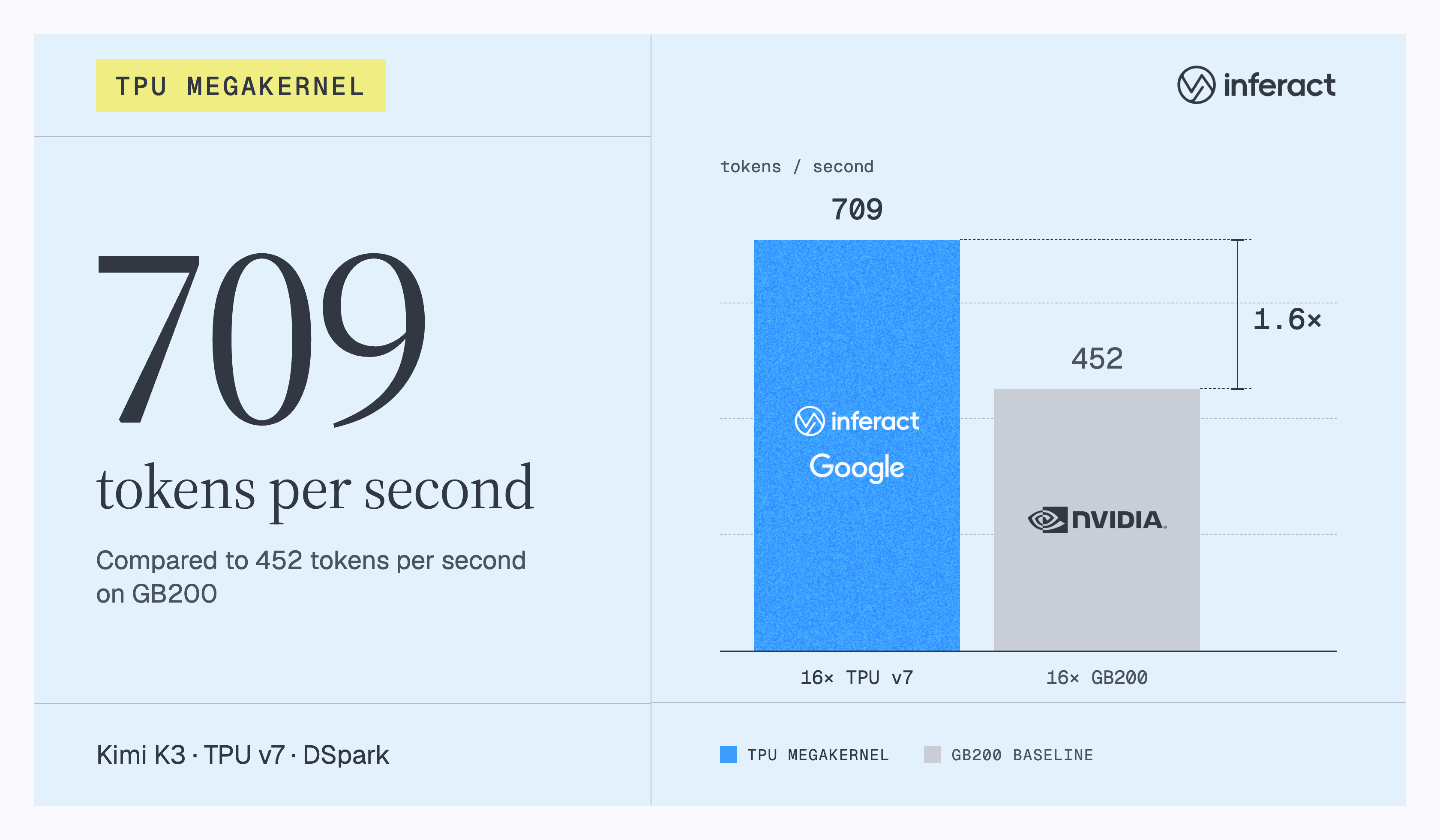
Inferact open-sourced inferact/tpu-megakernels on 2026-09-23: a Pallas megakernel collection for TPU v7. Their blog reports Kimi K3 at 709 tok/s on 16× TPU v7 Ironwood vs 452 tok/s on 16× GB200 under DSpark speculative decoding (acceptance length 6), and roughly 1.4–2× the GB200 baseline at batch sizes 1–8 without speculation. All 92 MoE layers of Kimi K3 run in a single kernel with cross-layer weight prefetch.

Inferact open-sources TPU megakernels: Kimi K3 hits 709 tok/s on 16× TPU v7 vs 452 on GB200

Key Takeaways

  • Inferact-reported (not independently reproduced): Kimi K3 + DSpark reaches 709 tok/s on 16× TPU v7 vs 452 tok/s on 16× GB200 (blog)
  • Without speculation: ~1.4–2× GB200 baseline at batch 1–8; Qwen 3.8 27B: 1,515 vs 695 tok/s on 4× chips with speculation
  • All 92 MoE layers of Kimi K3 run in one Pallas megakernel with cross-layer weight prefetch into VMEM
  • Repo: Inferact/tpu-megakernels (Apache-2.0)
Read full story
Linked Models & Agents:

LightSeek open-sources Kimi K3 draft trio: EAGLE-3, DFlash2, DSpark via TorchSpec + vLLM

LightSeek Foundation released a Kimi K3 draft-model collection (EAGLE-3, DFlash2, DSpark) trained with TorchSpec on 40 NVIDIA GB200 GPUs, with open data recipes. Their blog reports acceptance length across 10 benchmarks and SPEED-Bench end-to-end throughput; DFlash2 averages ~4.02 accepted tokens and leads EAGLE-3 at lower concurrency.

Key Takeaways

  • Three draft architectures for Kimi K3 speculative decoding: EAGLE-3, DFlash2, DSpark.
  • Trained on 40×GB200 with TorchSpec; data recipes plus Docker/CI shared.
  • On HumanEval, DFlash2 acceptance length ~5.08 vs EAGLE-3 ~3.29.
Read full story
Linked Models & Agents:
ADSponsored