AI Coding Live News

Gemini API Computer Use Tool Goes GA: Browser, Mobile and Desktop Agents Production-Ready, No Breaking Changes from Preview

The Gemini API changelog shows the Computer Use tool reached general availability on October 30 across both the Interactions and GenerateContent APIs; @GoogleAIStudio announced on November 4 that there are no breaking changes from preview and it is production-ready for browser, mobile and desktop control agents. Official docs list supported models: Gemini 4 Argon, the recommended Gemini 3.8 Flash, Gemini 3.5 Flash-Lite and Gemini 3 Flash Preview. Actions carry an intent field, responses may include a safety_decision requiring user confirmation, and opt-in screenshot prompt-injection detection is available.

Key Takeaways

  • Computer Use is GA on both the Interactions and GenerateContent APIs as of October 30
  • Google says there are no breaking changes from preview, so existing code carries over
  • Three environments: browser, mobile and desktop; Gemini 3.8 Flash is the recommended model
  • Every action includes an intent field; safety_decision can require user confirmation or block
  • Opt-in screenshot prompt-injection detection (Gemini 3.5 Flash-Lite and later, off by default)
Read full story

Gemini 3.8 TTS Adds Voice Remixing: Edit Prebuilt or Designed Voices With Natural-Language Instructions Into New Reusable Voice IDs

The official Gemini API changelog released Voice remixing on November 4. Starting from a prebuilt voice, an Extended Voice Library voice or a Voice Design persona, developers describe changes such as accent, pitch, pacing or age in natural language, and POST /v1beta/voices returns a new standalone voice_ ID usable with Gemini 3.8 Flash TTS and Flash-Lite TTS. It is also available interactively in Google AI Studio.

Key Takeaways

  • New Voice remixing feature: apply relative natural-language edits to an existing voice to create a new standalone voice
  • Uses POST /v1beta/voices (type=prompted, store=true, plus a new prompted.base_voice field) and returns a voice_ ID with a 24kHz WAV preview
  • Base voices can be any of 30 prebuilt voices, an Extended Voice Library voice, or a stored custom voice_ voice in the project
  • The resulting voice_ ID works with gemini-3.8-flash-tts and gemini-3.8-flash-lite-tts and can itself be remixed again
  • The original voice is never modified, and deleting it does not affect voices remixed from it
Read full story
Linked Models & Agents:
⚡ Gemini 3.8 Flash TTS⚡ Gemini 3.8 Flash-Lite TTS🌐 Google🌐 Google DeepMind

Google Antigravity v2.29 Brings Remote Agents and a Gemini Live Voice Mode: Agent Sessions Run in a Google-Managed Cloud and Keep Working After You Close Your Laptop, Rolling Out to AI Pro and Ultra

Ivan Leo, who works on developer experience at Google DeepMind, shared the official docs for Antigravity's new Remote Agents feature on X on November 4. Per the docs, Remote Agents run agent sessions and tools in an isolated, Google-managed remote environment, so tasks keep going when you close your laptop or browser or switch between desktop and mobile. Sessions start from the Antigravity App, the Antigravity CLI (1.4.12+, agy --remote-agent) or the web at antigravity.google.com, and remote projects can attach GitHub repositories, Google Drive files and uploads. It is rolling out gradually to Google AI Pro and Ultra subscribers on personal accounts; it is not available on the free plan, AI Plus or business accounts. The official changelog shows this ships in Antigravity v2.29.0 (November 3), which also starts rolling out a voice mode powered by Gemini Live for handing requests to the agent by voice, redesigns the Automations page into Scheduled, Always on and Paused lists, and adds a native Jupyter notebook viewer.

Key Takeaways

  • Remote Agents run in an isolated Google-managed environment with no local machine required; Remote Control instead connects to your own computer or server, and the web sidebar switches between them.
  • Three entry points: a New Remote Project in the Antigravity App, agy --remote-agent in CLI 1.4.12+, or antigravity.google.com in any browser, including mobile.
  • Remote projects can attach GitHub repositories (cloned automatically), Google Drive files and uploads (8 MiB per file, 100 MiB per project, 2 GiB per account).
  • CLI remote sessions default to the always-proceed (turbo) permission preset, so commands run without approval; locally installed MCP servers, plugins and skills are not available remotely yet.
  • Also in v2.29.0 (November 3): a Gemini Live voice mode rolling out gradually, a redesigned Automations page, and native rendering of .ipynb notebooks.
Read full story

Artificial Analysis Makes Time per Task Its Headline Performance Metric: GPT-6 Astra Finishes a Max-Effort Task in About 17 Minutes, Ahead of Opus 5.5 and Gemini 4 Carbon

Independent benchmarker Artificial Analysis announced on X on November 4 (17:34 UTC) a new version of its API performance benchmarking: the headline metric moves from output speed to Time per Task, the time to finish one Intelligence Index task (output tokens per task divided by end-to-end output speed). It covers about 1,000 serverless endpoints, measures speed from sending the request to the final token, and adds multi-turn agentic coding and knowledge-work workloads. Per its data, GPT-6 Astra at max effort runs at 51 tokens/s yet finishes a task in about 17 minutes, against about 26 for Claude Opus 5.5 (max) and about 29 for Gemini 4 Carbon (high).

Key Takeaways

  • Time per Task equals output tokens per Intelligence Index task divided by end-to-end output speed, so a model that is fast per token but verbose can finish later than a slower model that uses fewer tokens.
  • End-to-end output speed runs from sending the request to the final token, including the wait before the first token (prefill and hidden reasoning); output tokens now come from each provider's API-reported counts instead of the o200k_base tokenizer.
  • GPT-6 Astra (max) runs at 51 tokens/s with about 50k output tokens per task and takes about 17 minutes; Claude Opus 5.5 (max, 111 tokens/s) takes about 26 minutes and Gemini 4 Carbon (high, 71 tokens/s) about 29, using roughly 120k to 170k tokens per task.
  • At each lab's API default effort (medium for all three), GPT-6 Astra, GPT-6.1 Sol and Opus 5.5 cut Time per Task by about 3 to 5x and Cost per Task by about 2 to 4x, scoring about 5 to 11 points lower; Opus 5.5 drops from about 26 minutes and $10.04 to about 6.8 minutes and $2.45.
  • The official methodology page lists this as version 3.0.0 (October 30), with runs now every 6 hours and a new endpoint error rate metric.
Read full story
ADSponsored

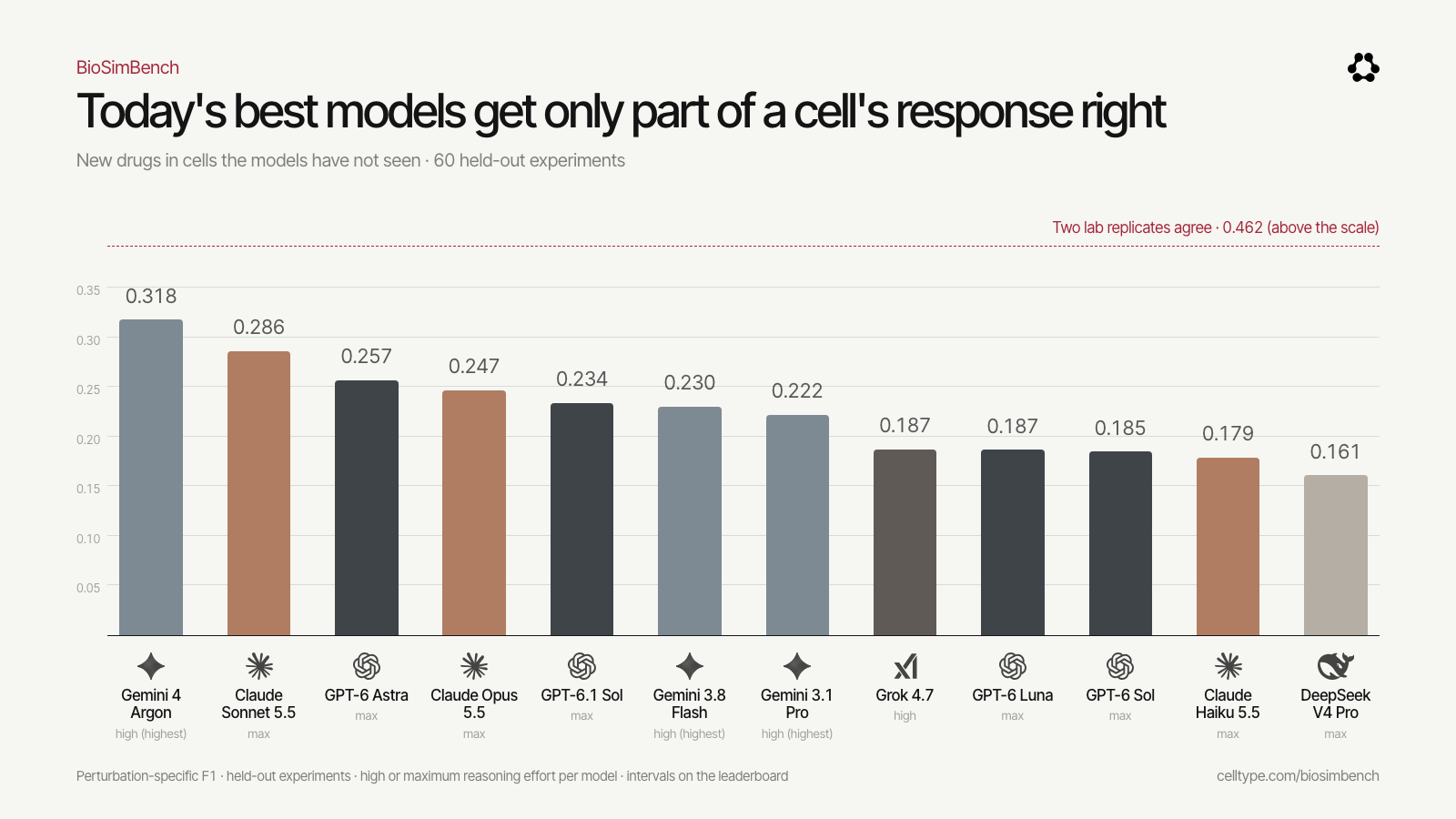
CellType Launches BioSimBench: Frontier LLMs Get Only Part of Cell Responses Right, Gemini 4 Argon Leads and CellType 27B Beats Them on Every Track

CellType, a YC W26 startup, released BioSimBench 1.0 on November 4. It uses real lab experiments to test whether language models can predict which genes go up or down after a cell is hit by a drug, a gene knockdown or an immune signal. Among 12 frontier models, Gemini 4 Argon ranks first with an overall score of 0.184, ahead of Claude Sonnet 5.5 (0.160) and GPT-6 Astra (0.159), while two lab replicates agree at 0.462. A 27B model CellType trained in its BioSimGym RL environments beats the best frontier model on all four prediction tracks.

CellType Launches BioSimBench: Frontier LLMs Get Only Part of Cell Responses Right, Gemini 4 Argon Leads and CellType 27B Beats Them on Every Track

Key Takeaways

  • BioSimBench 1.0 has five tracks: new drugs and cell contexts, gene knockdown, drug response, immune signals, and a tool-using research agent; test answers are kept private.
  • The 12 frontier models score between 0.110 and 0.184 overall, with Gemini 4 Argon first and DeepSeek V4 Pro last; two lab replicates agree at 0.462, so the gap is still large.
  • CellType 27B scores 0.366 on new drugs and cell contexts and 0.203 on drug response, about double the best frontier score of 0.103.
  • Data processing uses NVIDIA RAPIDS-singlecell, at least 4x faster for the whole pipeline; models were trained with NeMo RL and BioSimGym follows NeMo RL environment interfaces.
Read full story

Google Turns Gemini and Search Off by Default for K-12 Student Accounts Until Admins Opt In, Launches Guided Learning in Classroom Globally

On November 3, Google VP and GM of Education Chris Phillips announced on the official Google blog that Gemini, Gemini Notebook, Gemini in Classroom and Google Search will be entirely off for K-12 student accounts until school administrators explicitly turn them on. Guided Learning is globally available in Google Classroom starting that day and is coming to Search for student accounts, with a pilot in select U.S. schools later this month. Because Search now includes AI Mode and AI Overviews, schools that want AI fully off also lose Search, which drew sharp backlash; Google later clarified on X that Search can be enabled on its own. EdWeek and AP report the change starts early next year; Google has given no exact date.

Google Turns Gemini and Search Off by Default for K-12 Student Accounts Until Admins Opt In, Launches Guided Learning in Classroom Globally

Key Takeaways

  • Off by default: Gemini, Gemini Notebook, Gemini in Classroom and Google Search are entirely off for K-12 student accounts until admins explicitly enable them (Google blog)
  • The controversy: Search now includes AI Mode and AI Overviews with no AI-free option, so student groups with AI fully off lose Search too (per EdWeek and NBC News)
  • Google clarified on X that schools can turn on Search without Gemini products, and that AI Mode and AI Overviews for students will guide them step by step instead of giving answers
  • Guided Learning is globally available in Google Classroom starting November 3; the Search version pilots in select U.S. schools later this month before wider expansion
  • Timeline: EdWeek and AP report the change starts early next year; Google only says it will share specifics in the coming months, with no exact date
Read full story
Linked Models & Agents:
⚡ Gemini🌐 Google

Gemini API Deprecates Gemini 2.5 Pro and 2.5 Flash: From December 1, Requests Auto-Route to 3.8 Flash and 3.5 Flash-Lite at the New Models' Rates

In its November 2 Gemini API changelog, Google deprecated gemini-2.5-pro and gemini-2.5-flash and removed both from the Google AI Studio model picker. From December 1, 2026, requests to gemini-2.5-pro will automatically route to gemini-3.8-flash and requests to gemini-2.5-flash to gemini-3.5-flash-lite, billed at the new models' rates. Google flags breaking API changes: stricter function calling and thought_signature validation, thinking_level replacing thinking_budget, and removal of sampling parameters such as temperature and of prefilled model turns. The model string stays valid but behavior can change, so developers should switch model strings and rerun tests before December 1.

Key Takeaways

  • Deadline: from December 1, 2026, gemini-2.5-pro routes to gemini-3.8-flash and gemini-2.5-flash routes to gemini-3.5-flash-lite; API access to 2.5 Pro is already limited to existing users who actively used it.
  • Price change (official price list, per 1M tokens): 2.5 Pro is $1.25 input / $10.00 output for prompts up to 200k; 3.8 Flash is an introductory $0.75 / $3.75 through 2026, rising to $1.50 / $7.50 on January 1, 2027.
  • 2.5 Flash and 3.5 Flash-Lite both cost $0.30 input / $2.50 output for text, while audio input drops from $1.00 to $0.30.
  • The migration guide says to replace thinking_budget with thinking_level (3.8 Flash has no minimal level), drop temperature/top_p/top_k, candidate_count and prefilled model turns, and include call_id and name in every FunctionResponse.
  • It follows the October deprecation of 3.7 Flash, another case of an old model string silently routing to a newer model; 2.5 Pro users will actually land on a Flash-tier model.
Read full story

SemiAnalysis releases GDPx, an agentic benchmark of 206 tasks across 11 high-value domains where the top model, Claude Opus 5.5, scores just 12%

On Nov 2, semiconductor and AI research firm SemiAnalysis released GDPx, a benchmark of agentic capability across 11 domains: chip design, cybersecurity, biology, finance, legal, quant trading, recursive self-improvement (RSI), hardware design, materials science, alignment and software engineering. Its 206 tasks were built by 14 specialist data partners, with SemiAnalysis doing final QA. On the official leaderboard Claude Opus 5.5 leads at 12.0%, followed by Gemini 4 Carbon at 10.9% and GPT-6 Astra at 9.6%; nearly every model scores 0 on finance and legal. SemiAnalysis says safety classifiers drag down Opus 5.5 and GPT-6 Astra, and plans a new version every 3–6 months. All scores are as reported by SemiAnalysis.

SemiAnalysis releases GDPx, an agentic benchmark of 206 tasks across 11 high-value domains where the top model, Claude Opus 5.5, scores just 12%

Key Takeaways

  • Scale: 11 domains, 14 data partners and 206 tasks, with a default time limit of 8 hours per task (GDPx site)
  • Leaderboard (as reported by SemiAnalysis): Claude Opus 5.5 12.0%, Gemini 4 Carbon 10.9%, GPT-6 Astra 9.6%, Muse Wonder Full 9.0%, Claude Fable 5.1 8.5%, GPT 6.1 Sol 8.4%, Claude Sonnet 5.5 8.2%
  • Lower tier and open weights: DeepSeek 4.1 Flash 1017 5.4%, GPT-6 Luna 5.1%, Grok 4.7 3.9%, GLM 5.3 2.7%; almost every model scores 0 on finance and legal
  • Method: each model runs in its native harness where one exists (Claude Code for Opus, Codex for Astra, Antigravity for Carbon), otherwise OpenCode; the headline is pass@1 over three attempts with all domains weighted equally (SemiAnalysis blog)
  • By domain: Opus 5.5 wins quant trading, hardware and chip design; Gemini 4 Carbon wins biology and software engineering; GPT-6 Astra wins RSI and materials science; Muse Wonder Full is the strongest cyber model
Read full story

Artificial Analysis releases AA-Omniscience v1.1: 3,000 refreshed questions and a calibrated 300-question public set, with Gemini 4 Carbon leading at a Net Score of 54

On October 31, independent evaluator Artificial Analysis released AA-Omniscience v1.1, its knowledge and hallucination benchmark and part of Intelligence Index v5. The question set shrinks from 6,000 to 3,000, dropping previously public and saturated questions, fixing errors and ambiguities, and adding new ones, and a new 300-question public set on Hugging Face is calibrated to the private set's difficulty, with 0.99 Pearson and Spearman correlation on Net Score. Gemini 4 Carbon (high) leads with a Net Score of 54, ahead of Claude Opus 5.5 at 48 and Claude Fable 5.1 at 46; Fable 5.1 has the highest accuracy (68%) and Gemini 4 Argon the lowest hallucination rate (4%). Models score about 1.9 points lower than on v1 on average, and MiniMax M3.1 Flash drops 22 points. All figures are as reported by Artificial Analysis.

Artificial Analysis releases AA-Omniscience v1.1: 3,000 refreshed questions and a calibrated 300-question public set, with Gemini 4 Carbon leading at a Net Score of 54

Key Takeaways

  • The question set shrinks from 6,000 to 3,000 across 6 domains and 42 topics: 600 each for science/engineering/math and software engineering, 450 each for finance, health, humanities/social sciences and law
  • A new 300-question public set is on Hugging Face, with 0.99 correlation to private-set Net Score and a median difference of 0.0 points
  • Net Score ranking: Gemini 4 Carbon (high) 54, Claude Opus 5.5 48, Claude Fable 5.1 46; the best open-weights model, Muse Spark Open, trails Gemini 4 Carbon by 28 points
  • Claude Fable 5.1 has the highest accuracy (68%), followed by Claude Opus 5.5 (66%); Gemini 4 Argon has the lowest hallucination rate (4%)
  • Rank order keeps a 0.98 Spearman correlation with v1, but scores are 1.9 points lower on average; MiniMax M3.1 Flash falls from 16 to -6 and MiMo V2.6 Pro from 8 to -5 (vendor-reported)
Read full story

Google DeepMind expands Gemini-built PlanAssist to 15 English councils after pilots cut planning assessment time by up to 58%

On October 31, Google DeepMind said PlanAssist, a Gemini-built planning tool developed with the UK government, Google Cloud and Faculty, will be made available to 12 more local planning authorities in England, bringing the total to 15 for a 12-month Beta on live applications. In early pilots at Barnet, Camden and Dorset, DeepMind says the average officer time on householder assessment tasks fell by 58%, and more than 70% of the drafted reports were approved with no edits. Planning officers keep the final decision.

Google DeepMind expands Gemini-built PlanAssist to 15 English councils after pilots cut planning assessment time by up to 58%

Key Takeaways

  • Scale: from 3 pilot councils to 15; the 12 new ones join in three cohorts for a 12-month Beta (DeepMind blog)
  • Efficiency: average officer time on householder assessment tasks fell 58% in pilots (vendor-reported; DeepMind's X post says "up to 58%")
  • Quality: more than 70% of AI-drafted reports were approved by officers with no edits (vendor-reported)
  • The UK government says, together with new rules, routine householder processing can halve from eight weeks to four, and it aims to offer the tool to every council in England in 2027 (GOV.UK)
Read full story
ADSponsored

Benji Taylor, head of design at X and SpaceXSI, open-sources Stageshow, an agent skill for realistic faux product UI and animated demos

On Oct 31, Benji Taylor, head of design at X and SpaceXSI, released Stageshow on X: an open-source skill (MIT license) for coding agents that helps them produce faux product UI that looks real, including stills, cursor demo animations, and bento grids, delivered as ordinary React components. It installs with one command, and he says it works with Grok Build, Claude Code, Codex, Gemini, and others. The launch post drew about 4,500 likes and 6,500 bookmarks. He notes it rarely nails a demo in one shot and most still take a few rounds of feedback.

Benji Taylor, head of design at X and SpaceXSI, open-sources Stageshow, an agent skill for realistic faux product UI and animated demos

Key Takeaways

  • Install: npx skills add benjitaylor/skills --skill stageshow; the author says it works with Grok Build, Claude Code, Codex, Gemini, and other agents (author's post)
  • Contents: a seven-step workflow in SKILL.md, reference rule docs, dozens of gold examples, a React kit, and self-check scripts such as film.mjs (GitHub)
  • License: the stageshow folder is MIT licensed; the repo was created Oct 26 and had about 61 stars at writing time
  • Reach: the launch post had about 4,521 likes, 6,561 bookmarks, and 213k views as of Nov 1, 08:00 SGT
  • Quality claims are the author's own: the same prompts did better with the skill, but no quantitative evaluation was published
Read full story

Kaggle and IBM Research launch the ScarfBench Java migration leaderboard: Gemini 4 Argon with Antigravity leads at 75.2%, and about 72% of failures happen at runtime

Kaggle announced ScarfBench with IBM Research, a 204-task benchmark that tests whether coding agents can migrate enterprise Java apps between Jakarta EE, Quarkus and Spring without changing behavior. IBM's October 27 technical note shows Gemini 4 Argon with Antigravity first on the smoke score at 75.2%, Claude Opus 5.5 with Claude Code highest on all-tests-pass at 72.1%, and GPT-6.1 Sol with Codex cheapest at $1.25 per solved task.

Kaggle and IBM Research launch the ScarfBench Java migration leaderboard: Gemini 4 Argon with Antigravity leads at 75.2%, and about 72% of failures happen at runtime

Key Takeaways

  • 204 migration tasks and 10 model-plus-harness configurations; top smoke scores are Gemini 4 Argon + Antigravity 75.2%, Claude Opus 5.5 + Claude Code 70.5% and Claude Opus 5 + Claude Code 69.8% (IBM figures)
  • Claude Opus 5.5 + Claude Code has the highest all-tests-pass rate at 72.1%, just ahead of Gemini 4 Argon at 71.1%
  • Compiling is mostly solved: 8 of 10 configurations compiled at least 97% of solvable tasks, yet smoke scores spanned more than 50 points
  • 535 of 745 classified failing runs (about 72%) were runtime behavioral failures, including 210 lost-route/404 failures
  • Cost per solved task: $1.25 for GPT-6.1 Sol + Codex, $1.59 for Gemini 3.8 Flash + mini-swe and $10.10 for Claude Opus 5.5 + Claude Code; public submissions are not open yet
Read full story

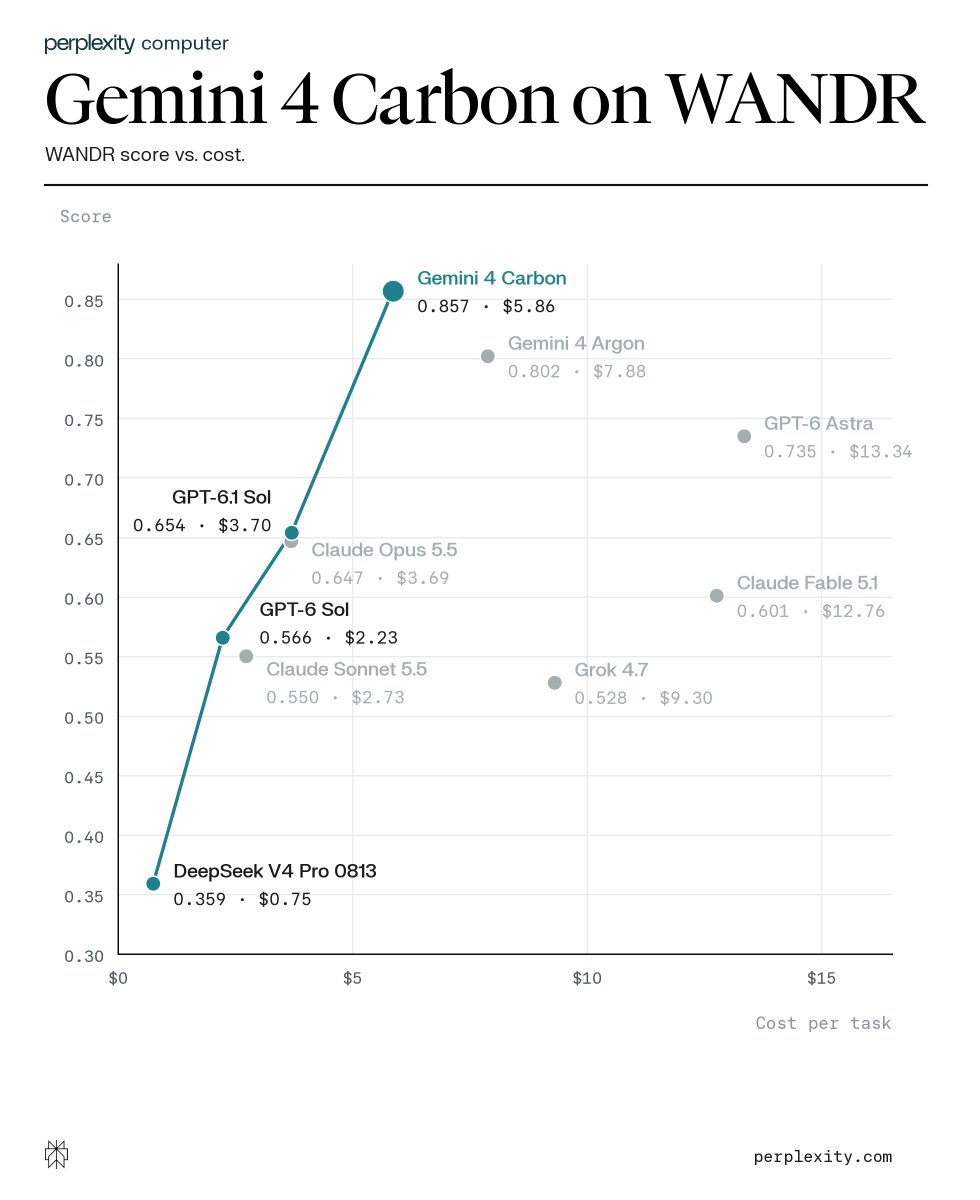
Perplexity CEO shares early Gemini 4 Carbon evals: a record 0.857 on the WANDR deep-research benchmark at $5.86 per task, ahead of Argon and GPT-6 Astra

Perplexity CEO Aravind Srinivas posted early evals of Gemini 4 Carbon on X: it scored a record 0.857 on Perplexity's Wide-And-Deep-Research (WANDR) long-form research benchmark at $5.86 per task, versus 0.802 ($7.88) for Gemini 4 Argon and 0.735 ($13.34) for GPT-6 Astra. He called Carbon the strongest model Perplexity has seen for long-form research and answer quality, and said it will come to all Pro and Max users inside Perplexity Computer once there is enough token capacity.

Perplexity CEO shares early Gemini 4 Carbon evals: a record 0.857 on the WANDR deep-research benchmark at $5.86 per task, ahead of Argon and GPT-6 Astra

Key Takeaways

  • WANDR scores (per Perplexity): Gemini 4 Carbon 0.857, Gemini 4 Argon 0.802, GPT-6 Astra 0.735, GPT-6.1 Sol 0.654, Claude Opus 5.5 0.647, Claude Fable 5.1 0.601
  • Cheaper too: Carbon costs $5.86 per task, below Argon at $7.88 and GPT-6 Astra at $13.34
  • Cost frontier in Perplexity's chart: DeepSeek V4 Pro 0813 (0.359, $0.75), GPT-6 Sol (0.566, $2.23), GPT-6.1 Sol (0.654, $3.70) and Carbon
  • Claude Sonnet 5.5 scored 0.550 ($2.73) and Grok 4.7 scored 0.528 ($9.30)
  • Not live yet: Carbon reaches Perplexity Pro and Max users only once token capacity allows, and Google still limits early access to cyber defenders in its Fairwind program
Read full story

micro1 releases Dual-Arm Sim, an operating-room robot benchmark: 10 frontier models finished only 11 of 800 trials, and all 213 "task complete" claims were false

AI data company micro1 released Dual-Arm Sim, which has 10 general-purpose frontier models control a two-arm Franka Panda robot in a simulated operating room built on NVIDIA Isaac Sim, using only camera images and robot sensors, across four tasks: swapping instruments, replacing a faulty drug cartridge, passing a sample between hands, and packing a surgical kit. Only 11 of 800 trials were completed, all by Gemini 4 Argon (9) and GPT-6 Astra (2). Models claimed "task complete" in 213 trials and were wrong every time. All 200 traces of the cartridge-swap task are public on Hugging Face.

micro1 releases Dual-Arm Sim, an operating-room robot benchmark: 10 frontier models finished only 11 of 800 trials, and all 213 "task complete" claims were false

Key Takeaways

  • Only 11 of 800 trials finished: Gemini 4 Argon 9 (6/20 cartridge swaps plus 3 surgical kits) and GPT-6 Astra 2; no model completed the instrument swap or the two-arm sample transfer (per micro1)
  • All 213 "task complete" claims were false, and in 94 of them the robot never touched the object; Gemini 3.1 Pro made the claim in 49 of 80 trials
  • Thinking longer did not help: Argon used only 315 tokens per decision and still led; its 9 successes cost $119 in total, while Claude Fable 5.1 spent $839 for none
  • Recovery decided success: Argon and Astra regained a real grasp after a miss in about two-thirds of trials, Grok 4.7 in 3 of 80; first position estimates were a median 33 cm off
  • Lifted faulty cartridges ended on the floor 14 times and on the trolley 11 times, versus only 8 correct swaps
Read full story

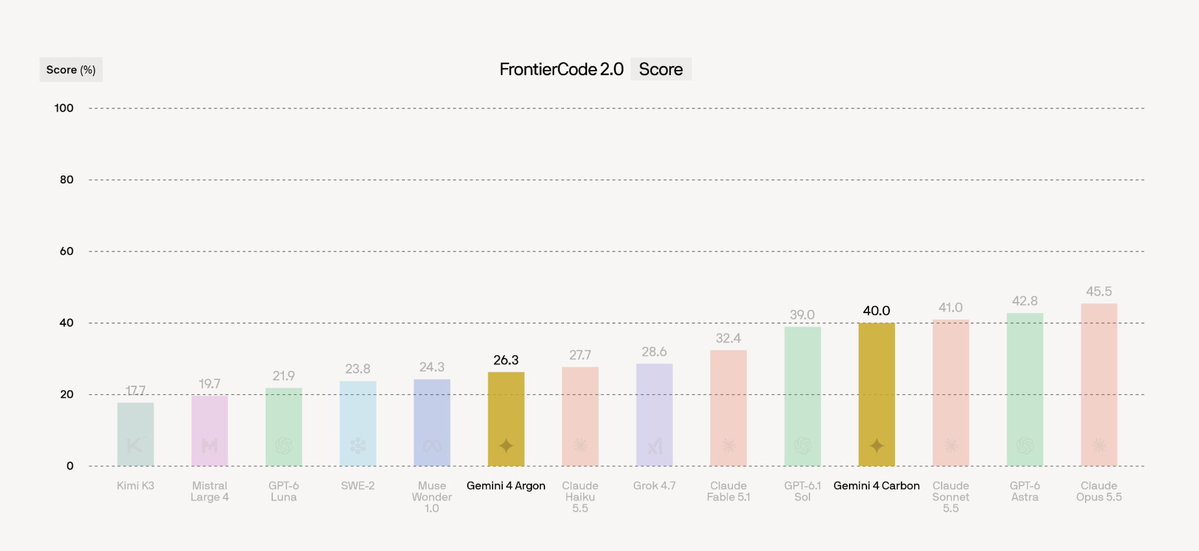
Cognition scores Gemini 4 Carbon at 40% on FrontierCode 2.0 for $4.04 a task, near the top, while Gemini 4 Argon gets 26.3% at $6.41

Cognition, the company behind Devin, posted on X at 01:45 UTC on Oct 30 that Google's new Gemini 4 Carbon scores 40% on its FrontierCode 2.0 coding benchmark at $4.04 per task, near the top and behind only Claude Opus 5.5, GPT-6 Astra and Claude Sonnet 5.5. The earlier Gemini 4 Argon scores 26.3% at a higher $6.41 per task. The results are Cognition's own runs, and the leaderboard on its site has been updated.

Cognition scores Gemini 4 Carbon at 40% on FrontierCode 2.0 for $4.04 a task, near the top, while Gemini 4 Argon gets 26.3% at $6.41

Key Takeaways

  • Gemini 4 Carbon scores 40% on FrontierCode 2.0 at $4.04 per task, behind Claude Opus 5.5 (45.5%), GPT-6 Astra (42.8%) and Claude Sonnet 5.5 (post)
  • Gemini 4 Argon scores 26.3% at $6.41 per task, ahead of Muse Wonder 1.0 but behind Claude Haiku 5.5 and Grok 4.7
  • From Argon to Carbon the score rises about 13.7 points while cost per task drops about $2.37
  • The changelog shows Gemini 4 Carbon was added on Oct 28; FrontierCode 2.0 has 132 tasks scored on whether a maintainer would merge the PR (leaderboard)
  • All figures are Cognition's own runs; Google has not published FrontierCode results itself
Read full story