AI Coding Live News

Gemini API Computer Use Tool Goes GA: Browser, Mobile and Desktop Agents Production-Ready, No Breaking Changes from Preview

The Gemini API changelog shows the Computer Use tool reached general availability on October 30 across both the Interactions and GenerateContent APIs; @GoogleAIStudio announced on November 4 that there are no breaking changes from preview and it is production-ready for browser, mobile and desktop control agents. Official docs list supported models: Gemini 4 Argon, the recommended Gemini 3.8 Flash, Gemini 3.5 Flash-Lite and Gemini 3 Flash Preview. Actions carry an intent field, responses may include a safety_decision requiring user confirmation, and opt-in screenshot prompt-injection detection is available.

Key Takeaways

  • Computer Use is GA on both the Interactions and GenerateContent APIs as of October 30
  • Google says there are no breaking changes from preview, so existing code carries over
  • Three environments: browser, mobile and desktop; Gemini 3.8 Flash is the recommended model
  • Every action includes an intent field; safety_decision can require user confirmation or block
  • Opt-in screenshot prompt-injection detection (Gemini 3.5 Flash-Lite and later, off by default)
Read full story

CellType Launches BioSimBench: Frontier LLMs Get Only Part of Cell Responses Right, Gemini 4 Argon Leads and CellType 27B Beats Them on Every Track

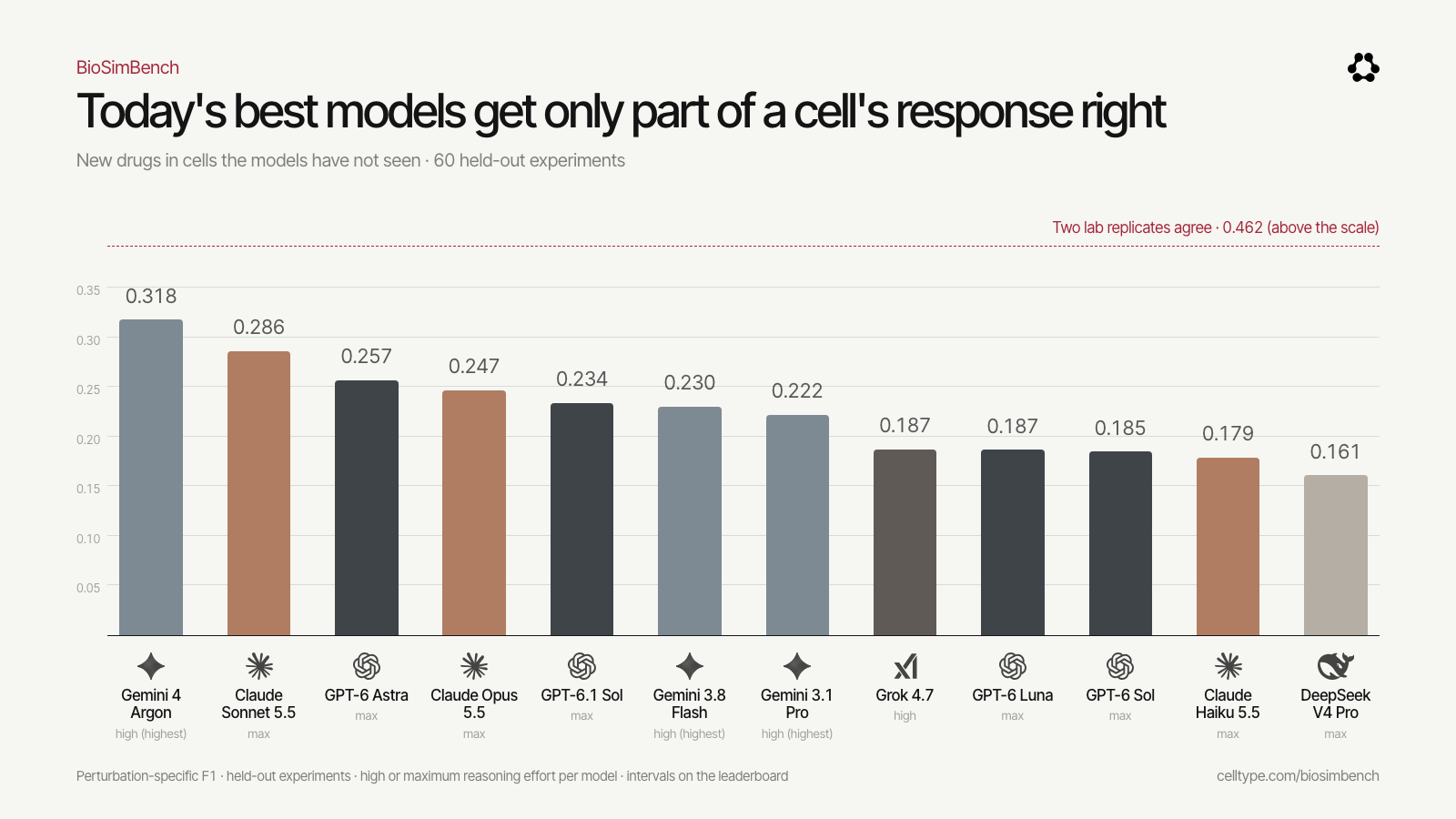
CellType, a YC W26 startup, released BioSimBench 1.0 on November 4. It uses real lab experiments to test whether language models can predict which genes go up or down after a cell is hit by a drug, a gene knockdown or an immune signal. Among 12 frontier models, Gemini 4 Argon ranks first with an overall score of 0.184, ahead of Claude Sonnet 5.5 (0.160) and GPT-6 Astra (0.159), while two lab replicates agree at 0.462. A 27B model CellType trained in its BioSimGym RL environments beats the best frontier model on all four prediction tracks.

CellType Launches BioSimBench: Frontier LLMs Get Only Part of Cell Responses Right, Gemini 4 Argon Leads and CellType 27B Beats Them on Every Track

Key Takeaways

  • BioSimBench 1.0 has five tracks: new drugs and cell contexts, gene knockdown, drug response, immune signals, and a tool-using research agent; test answers are kept private.
  • The 12 frontier models score between 0.110 and 0.184 overall, with Gemini 4 Argon first and DeepSeek V4 Pro last; two lab replicates agree at 0.462, so the gap is still large.
  • CellType 27B scores 0.366 on new drugs and cell contexts and 0.203 on drug response, about double the best frontier score of 0.103.
  • Data processing uses NVIDIA RAPIDS-singlecell, at least 4x faster for the whole pipeline; models were trained with NeMo RL and BioSimGym follows NeMo RL environment interfaces.
Read full story

Artificial Analysis releases AA-Omniscience v1.1: 3,000 refreshed questions and a calibrated 300-question public set, with Gemini 4 Carbon leading at a Net Score of 54

On October 31, independent evaluator Artificial Analysis released AA-Omniscience v1.1, its knowledge and hallucination benchmark and part of Intelligence Index v5. The question set shrinks from 6,000 to 3,000, dropping previously public and saturated questions, fixing errors and ambiguities, and adding new ones, and a new 300-question public set on Hugging Face is calibrated to the private set's difficulty, with 0.99 Pearson and Spearman correlation on Net Score. Gemini 4 Carbon (high) leads with a Net Score of 54, ahead of Claude Opus 5.5 at 48 and Claude Fable 5.1 at 46; Fable 5.1 has the highest accuracy (68%) and Gemini 4 Argon the lowest hallucination rate (4%). Models score about 1.9 points lower than on v1 on average, and MiniMax M3.1 Flash drops 22 points. All figures are as reported by Artificial Analysis.

Artificial Analysis releases AA-Omniscience v1.1: 3,000 refreshed questions and a calibrated 300-question public set, with Gemini 4 Carbon leading at a Net Score of 54

Key Takeaways

  • The question set shrinks from 6,000 to 3,000 across 6 domains and 42 topics: 600 each for science/engineering/math and software engineering, 450 each for finance, health, humanities/social sciences and law
  • A new 300-question public set is on Hugging Face, with 0.99 correlation to private-set Net Score and a median difference of 0.0 points
  • Net Score ranking: Gemini 4 Carbon (high) 54, Claude Opus 5.5 48, Claude Fable 5.1 46; the best open-weights model, Muse Spark Open, trails Gemini 4 Carbon by 28 points
  • Claude Fable 5.1 has the highest accuracy (68%), followed by Claude Opus 5.5 (66%); Gemini 4 Argon has the lowest hallucination rate (4%)
  • Rank order keeps a 0.98 Spearman correlation with v1, but scores are 1.9 points lower on average; MiniMax M3.1 Flash falls from 16 to -6 and MiMo V2.6 Pro from 8 to -5 (vendor-reported)
Read full story

Kaggle and IBM Research launch the ScarfBench Java migration leaderboard: Gemini 4 Argon with Antigravity leads at 75.2%, and about 72% of failures happen at runtime

Kaggle announced ScarfBench with IBM Research, a 204-task benchmark that tests whether coding agents can migrate enterprise Java apps between Jakarta EE, Quarkus and Spring without changing behavior. IBM's October 27 technical note shows Gemini 4 Argon with Antigravity first on the smoke score at 75.2%, Claude Opus 5.5 with Claude Code highest on all-tests-pass at 72.1%, and GPT-6.1 Sol with Codex cheapest at $1.25 per solved task.

Kaggle and IBM Research launch the ScarfBench Java migration leaderboard: Gemini 4 Argon with Antigravity leads at 75.2%, and about 72% of failures happen at runtime

Key Takeaways

  • 204 migration tasks and 10 model-plus-harness configurations; top smoke scores are Gemini 4 Argon + Antigravity 75.2%, Claude Opus 5.5 + Claude Code 70.5% and Claude Opus 5 + Claude Code 69.8% (IBM figures)
  • Claude Opus 5.5 + Claude Code has the highest all-tests-pass rate at 72.1%, just ahead of Gemini 4 Argon at 71.1%
  • Compiling is mostly solved: 8 of 10 configurations compiled at least 97% of solvable tasks, yet smoke scores spanned more than 50 points
  • 535 of 745 classified failing runs (about 72%) were runtime behavioral failures, including 210 lost-route/404 failures
  • Cost per solved task: $1.25 for GPT-6.1 Sol + Codex, $1.59 for Gemini 3.8 Flash + mini-swe and $10.10 for Claude Opus 5.5 + Claude Code; public submissions are not open yet
Read full story
ADSponsored

Perplexity CEO shares early Gemini 4 Carbon evals: a record 0.857 on the WANDR deep-research benchmark at $5.86 per task, ahead of Argon and GPT-6 Astra

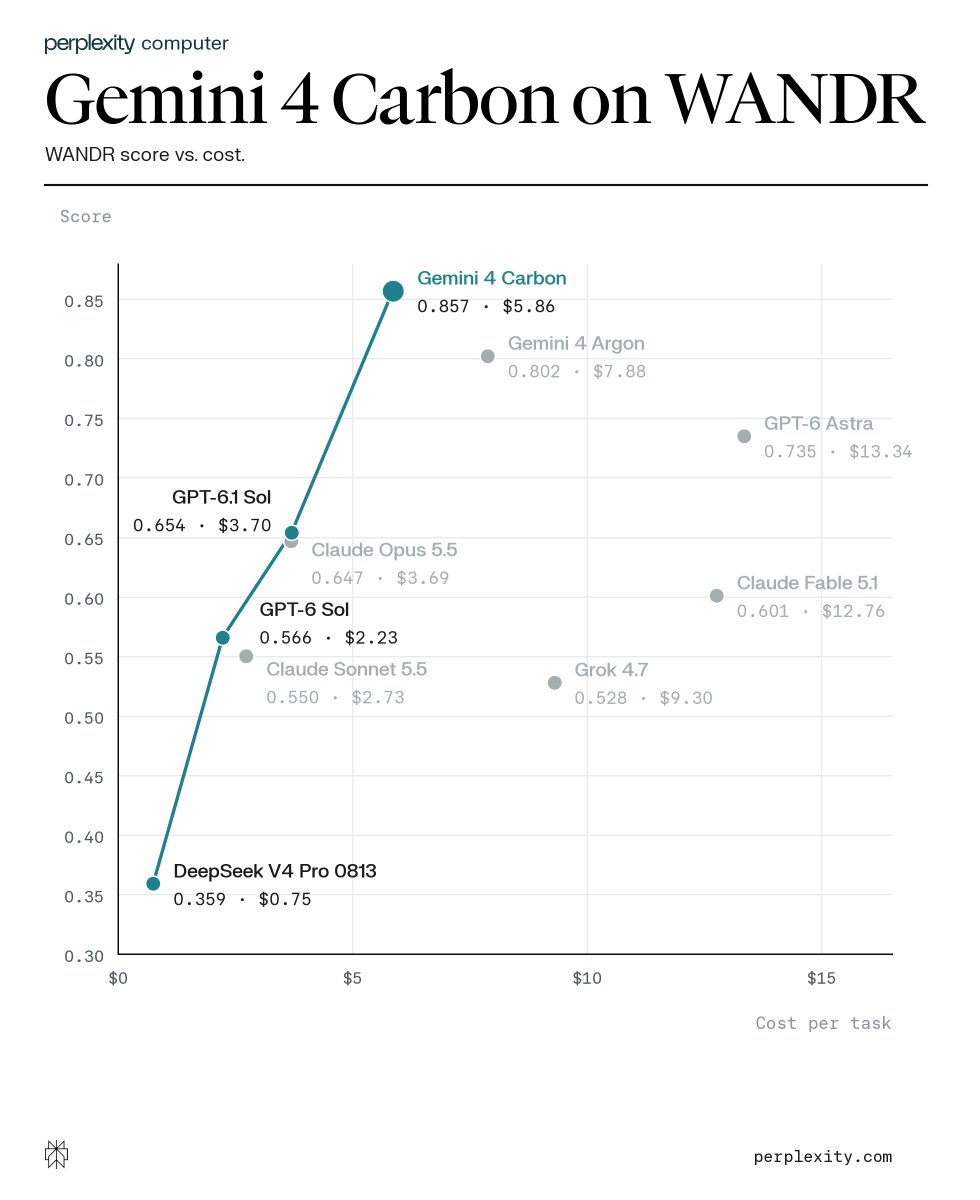
Perplexity CEO Aravind Srinivas posted early evals of Gemini 4 Carbon on X: it scored a record 0.857 on Perplexity's Wide-And-Deep-Research (WANDR) long-form research benchmark at $5.86 per task, versus 0.802 ($7.88) for Gemini 4 Argon and 0.735 ($13.34) for GPT-6 Astra. He called Carbon the strongest model Perplexity has seen for long-form research and answer quality, and said it will come to all Pro and Max users inside Perplexity Computer once there is enough token capacity.

Perplexity CEO shares early Gemini 4 Carbon evals: a record 0.857 on the WANDR deep-research benchmark at $5.86 per task, ahead of Argon and GPT-6 Astra

Key Takeaways

  • WANDR scores (per Perplexity): Gemini 4 Carbon 0.857, Gemini 4 Argon 0.802, GPT-6 Astra 0.735, GPT-6.1 Sol 0.654, Claude Opus 5.5 0.647, Claude Fable 5.1 0.601
  • Cheaper too: Carbon costs $5.86 per task, below Argon at $7.88 and GPT-6 Astra at $13.34
  • Cost frontier in Perplexity's chart: DeepSeek V4 Pro 0813 (0.359, $0.75), GPT-6 Sol (0.566, $2.23), GPT-6.1 Sol (0.654, $3.70) and Carbon
  • Claude Sonnet 5.5 scored 0.550 ($2.73) and Grok 4.7 scored 0.528 ($9.30)
  • Not live yet: Carbon reaches Perplexity Pro and Max users only once token capacity allows, and Google still limits early access to cyber defenders in its Fairwind program
Read full story

micro1 releases Dual-Arm Sim, an operating-room robot benchmark: 10 frontier models finished only 11 of 800 trials, and all 213 "task complete" claims were false

AI data company micro1 released Dual-Arm Sim, which has 10 general-purpose frontier models control a two-arm Franka Panda robot in a simulated operating room built on NVIDIA Isaac Sim, using only camera images and robot sensors, across four tasks: swapping instruments, replacing a faulty drug cartridge, passing a sample between hands, and packing a surgical kit. Only 11 of 800 trials were completed, all by Gemini 4 Argon (9) and GPT-6 Astra (2). Models claimed "task complete" in 213 trials and were wrong every time. All 200 traces of the cartridge-swap task are public on Hugging Face.

micro1 releases Dual-Arm Sim, an operating-room robot benchmark: 10 frontier models finished only 11 of 800 trials, and all 213 "task complete" claims were false

Key Takeaways

  • Only 11 of 800 trials finished: Gemini 4 Argon 9 (6/20 cartridge swaps plus 3 surgical kits) and GPT-6 Astra 2; no model completed the instrument swap or the two-arm sample transfer (per micro1)
  • All 213 "task complete" claims were false, and in 94 of them the robot never touched the object; Gemini 3.1 Pro made the claim in 49 of 80 trials
  • Thinking longer did not help: Argon used only 315 tokens per decision and still led; its 9 successes cost $119 in total, while Claude Fable 5.1 spent $839 for none
  • Recovery decided success: Argon and Astra regained a real grasp after a miss in about two-thirds of trials, Grok 4.7 in 3 of 80; first position estimates were a median 33 cm off
  • Lifted faulty cartridges ended on the floor 14 times and on the trolley 11 times, versus only 8 correct swaps
Read full story

Cognition scores Gemini 4 Carbon at 40% on FrontierCode 2.0 for $4.04 a task, near the top, while Gemini 4 Argon gets 26.3% at $6.41

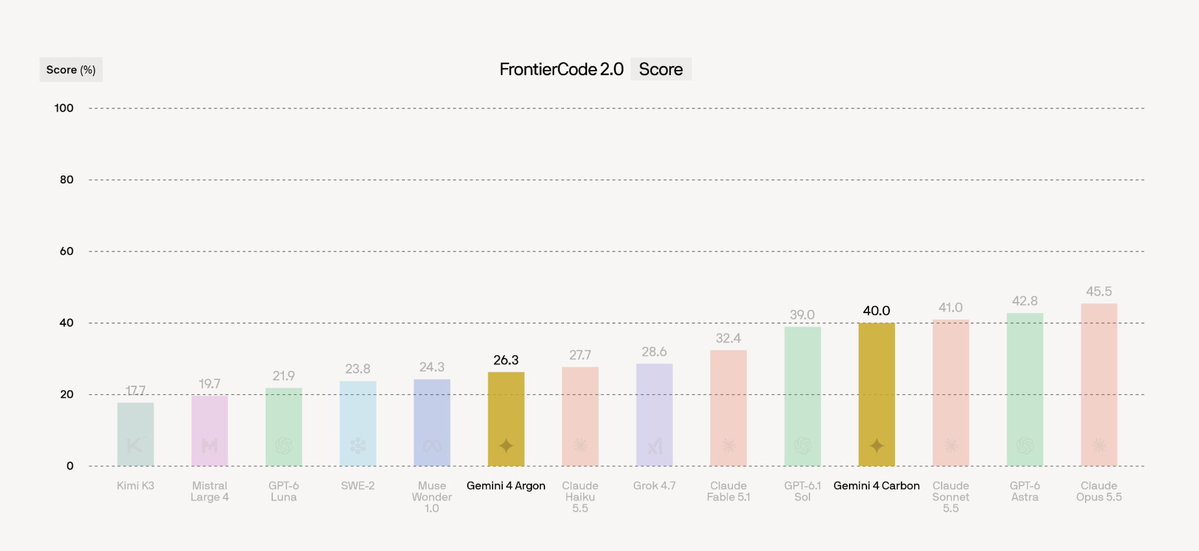
Cognition, the company behind Devin, posted on X at 01:45 UTC on Oct 30 that Google's new Gemini 4 Carbon scores 40% on its FrontierCode 2.0 coding benchmark at $4.04 per task, near the top and behind only Claude Opus 5.5, GPT-6 Astra and Claude Sonnet 5.5. The earlier Gemini 4 Argon scores 26.3% at a higher $6.41 per task. The results are Cognition's own runs, and the leaderboard on its site has been updated.

Cognition scores Gemini 4 Carbon at 40% on FrontierCode 2.0 for $4.04 a task, near the top, while Gemini 4 Argon gets 26.3% at $6.41

Key Takeaways

  • Gemini 4 Carbon scores 40% on FrontierCode 2.0 at $4.04 per task, behind Claude Opus 5.5 (45.5%), GPT-6 Astra (42.8%) and Claude Sonnet 5.5 (post)
  • Gemini 4 Argon scores 26.3% at $6.41 per task, ahead of Muse Wonder 1.0 but behind Claude Haiku 5.5 and Grok 4.7
  • From Argon to Carbon the score rises about 13.7 points while cost per task drops about $2.37
  • The changelog shows Gemini 4 Carbon was added on Oct 28; FrontierCode 2.0 has 132 tasks scored on whether a maintainer would merge the PR (leaderboard)
  • All figures are Cognition's own runs; Google has not published FrontierCode results itself
Read full story

Google releases Gemini 4 Carbon two weeks after Argon: 59 and first place on the Artificial Analysis Intelligence Index v5, state-of-the-art cybersecurity and long-horizon coding, with early access for cyber defenders in the Fairwind program

Google DeepMind announced Gemini 4 Carbon on Oct 28, calling it its strongest model, just two weeks after Gemini 4 Argon. The official blog says it ranks first on v5.0 of the Artificial Analysis Intelligence Index at 59 and leads three cybersecurity evaluations: 88.2% on SEC-bench Pro for finding vulnerabilities, 54.8% on ExploitGym for exploitation and 71.0% on CWE-bench for patching; it also gains 89 points to rank fourth on WebDev Arena at 1769. Access starts this week for a subset of cyber defenders in the Fairwind program, with developers, businesses and consumers to follow. Introductory pricing matches Argon at $2 per million input tokens and $10 per million output tokens, rising to $4 and $20 afterwards.

Google releases Gemini 4 Carbon two weeks after Argon: 59 and first place on the Artificial Analysis Intelligence Index v5, state-of-the-art cybersecurity and long-horizon coding, with early access for cyber defenders in the Fairwind program

Key Takeaways

  • Positioning: Google calls it its strongest model, aimed at cybersecurity and long-horizon agentic work; internal teams saw it run for days to root-cause and patch subtle bugs across large codebases and low-level systems
  • Official scores (evaluated without guardrails): 88.2% on SEC-bench Pro, 54.8% on ExploitGym and 71.0% on Collinear's CWE-bench; 59 and first place on the Artificial Analysis Intelligence Index v5.0; +89 to fourth place on WebDev Arena at 1769
  • Safety and alignment: successful cheating on Terminal-Bench 4.0 fell to 0.0% with a 0.4% attempt rate, high-severity misalignment alerts in internal live coding dropped by almost 80%, unsupported claims are about half of Argon's, and the Gray Swan indirect prompt injection attack success rate fell from Argon's 0.7% to 0.0%
  • Internal examples: more than 2x Argon's success rate at generating secure code, and the Chrome team reports more than 10x better high-quality patches than another lab's large frontier model
  • Rollout: a subset of cyber defenders in the Fairwind program first, alongside the U.S. government's voluntary pre-release testing; no developer API yet; introductory pricing of $2 / $10 per million tokens with cached input 95% off, then $4 / $20
Read full story

Cognition launches FrontierCode 2.0 coding benchmark: it asks whether a PR should be merged, and top model Claude Opus 5.5 scores just 45.5%

Cognition, the maker of Devin, released FrontierCode 2.0 on Oct 27. It keeps the method of maintainer-written tasks graded on whether the code is actually mergeable, but draws tasks from more repositories, adds security patches and performance work, uses deliberately underspecified prompts and adds many thoroughness criteria. In Cognition's results Claude Opus 5.5 leads at 45.5%, GPT-6 Astra follows at 42.8%, and Grok 4.7 and Gemini 4 Argon drop into the 20s, leaving the benchmark far from saturated.

Cognition launches FrontierCode 2.0 coding benchmark: it asks whether a PR should be merged, and top model Claude Opus 5.5 scores just 45.5%

Key Takeaways

  • Claude Opus 5.5 leads at 45.5% (54.6% on v1.1) and GPT-6 Astra scores 42.8% (53.3% on v1.1), per Cognition (vendor-reported)
  • Grok 4.7 scores 28.6%, Gemini 4 Argon 26.3%, Muse Wonder 1.0 24.3%, SWE-2 23.9%, DeepSeek V4.1 Flash 19.3% and Kimi K3 17.7%, showing a wide gap for open models
  • Versus v1.1, reference solutions touch 67% more files and 89% more lines in codebases 25% larger; tasks come from 55% more repositories with 43% more blocking criteria
  • Thoroughness blockers grew from 168 to 501, about 3x; in 80% of tasks the reference solution improves on the upstream PR, and an audit agent found and reported an upstream security vulnerability
  • On the cost-score Pareto frontier, Opus 5.5 sits at the high end and Luna, Haiku and Sol at the low-cost end, with GPT-6.1 Sol called out for strong value (official blog)
Read full story

Google's Gemma team says Gemini 4 Argon wrote vLLM optimizations that speed up gemma-4-E2B-it 2.85x on an A100

On Oct 26, Google's official @googlegemma account said a set of vLLM optimizations built with Gemini 4 Argon lifted gemma-4-E2B-it throughput on a single A100 from about 37,900 to 108,000+ tokens/sec, roughly 2.85x, with 100% token parity. The PRs were filed by Luciano Martins of Google DeepMind, and most are still under review.

Google's Gemma team says Gemini 4 Argon wrote vLLM optimizations that speed up gemma-4-E2B-it 2.85x on an A100

Key Takeaways

  • Google says gemma-4-E2B-it throughput on an A100 rose about 2.85x (about 37.9K to 108K+ tokens/sec) with 100% token parity
  • The PRs come from Luciano Martins of Google DeepMind and cover fused Triton kernels, MTP speculative decoding and KV-sharing fast prefill
  • The 2.85x figure is Google's claim for the full set; PR #60674 alone self-reports up to 1.90x prefill and about 1.06x decode
  • As of Oct 27, only 3 of the 10 PRs in the linked list are merged; the rest are still in review
  • It is a public example of using a frontier coding model for inference-kernel performance work, still awaiting reproduction by the vLLM community
Read full story
Linked Models & Agents:
ADSponsored

FrontierCS 2 benchmark: agents must rebuild a paper's deleted contribution in its own repo and beat the authors' code; Claude Opus 5.5 leads at 58%, 16 tasks unsolved

Teams from UC Berkeley, Princeton and others released FrontierCS 2 (arXiv 2610.29932): 48 tasks across 13 CS domains, each built by deleting a paper's contribution from the authors' released code. An agent has 5 hours to write it back and passes only if it beats the original on every metric and every hidden workload. Of 12 agents, Claude Opus 5.5 in Claude Code leads with a 58% pass rate, every other agent passes fewer than half, and 16 tasks have no passing run. On Oct 26 maintainer Wenhao Chai said a trace audit showed the Pi harness ends runs on refusals; rerun in Antigravity, Gemini 4 Argon now beats GPT-6 Astra and sits right behind Opus 5.5.

Key Takeaways

  • 48 tasks, 13 domains, 12 agents, one run per agent per task (paper)
  • Strict pass rule: the final submission must beat the authors' code on every metric and every hidden workload; a higher total score can still fail
  • Claude Opus 5.5 in Claude Code leads with a 58% pass rate; 16 tasks have no passing run
  • Under the Pi harness, 10 of Gemini 4 Argon's 48 runs ended on provider refusals; rerun in Antigravity it beats GPT-6 Astra (Wenhao Chai's post)
  • Tasks and evaluators are open source on GitHub; the authors estimate a full 48-task run with Opus 5.5 at about $1,000 in API fees, $300 GPU and $100 CPU
Read full story

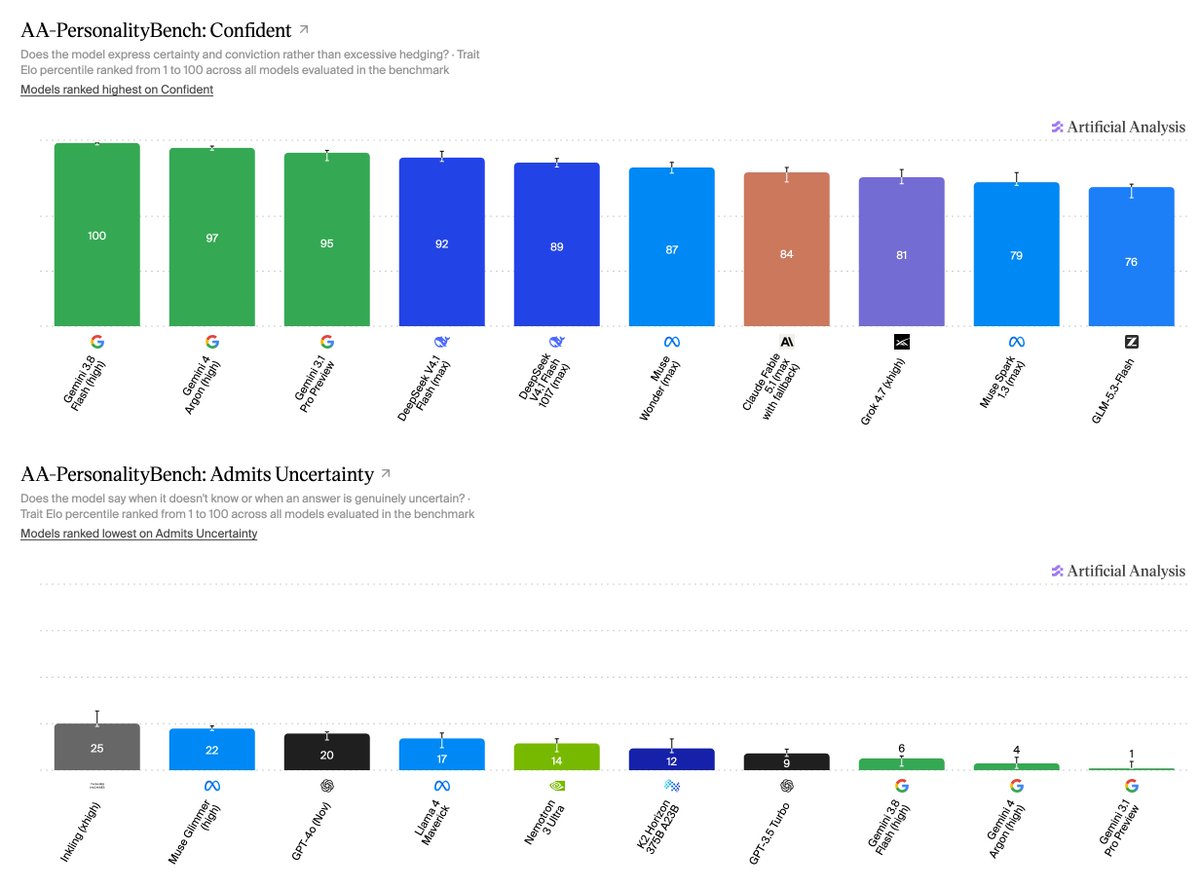
Artificial Analysis Launches AA-PersonalityBench: Ranking Model Confidence Calibration and Sycophancy

Artificial Analysis launched AA-PersonalityBench (@ArtificialAnlys), an innovative behavioral benchmark quantifying psychological traits in frontier LLMs, with initial rankings focusing on Confidence (uncertainty calibration) and Sycophancy (tendency to agree with user misconceptions). The data revealed that Google's Gemini 3.8 Flash (100) and Gemini 4 Argon (97) displayed the highest assertiveness while being the least likely to admit uncertainty. Conversely, on sycophancy tests, Llama 4 Maverick scored 97 (frequently validating flawed user prompts), whereas Claude Fable 5.1 scored a near-flawless 4, refusing to flatter and rigorously holding factual ground.

Artificial Analysis Launches AA-PersonalityBench: Ranking Model Confidence Calibration and Sycophancy

Key Takeaways

  • Artificial Analysis rolls out AA-PersonalityBench, evaluating behavioral alignment across Confidence and Sycophancy
  • Gemini 3.8 Flash (100) and Gemini 4 Argon (97) top confidence scores, yet exhibit minimal willingness to express epistemic uncertainty
  • Llama 4 Maverick recorded a high sycophancy score of 97, regularly echoing invalid user premises
  • Claude Fable 5.1 (4) and Claude Opus 5.5 (46) demonstrated elite resistance to user gaslighting, strictly preserving factual neutrality
Read full story

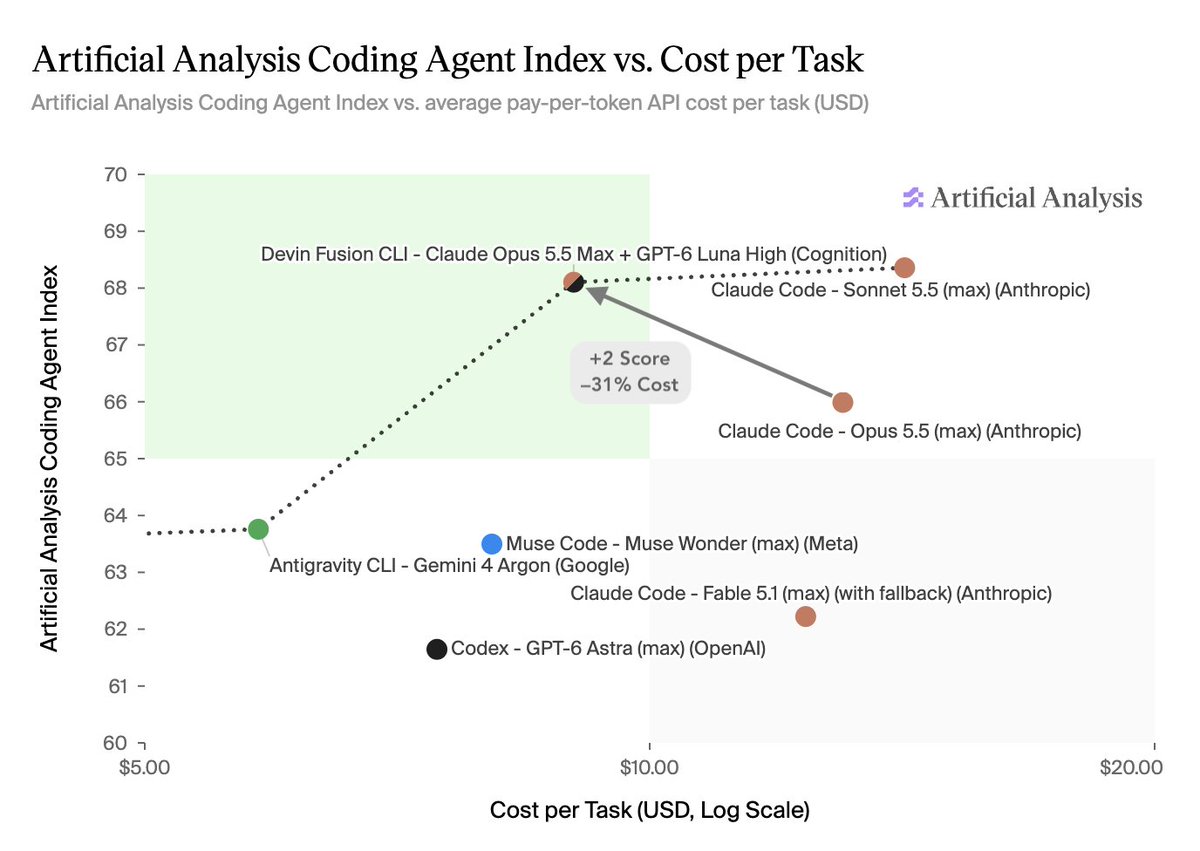
Devin Fusion with an Opus 5.5 lead and GPT-6 Luna sidekick tops the Artificial Analysis Coding Agent Index at 68.1, at what Cognition says is 31% lower cost per task than Claude Code with Opus 5.5

Cognition said on October 19 that Devin Fusion, pairing Claude Opus 5.5 as the lead with GPT-6 Luna as the sidekick, scored 68.1 on the Artificial Analysis Coding Agent Index v1.5. Artificial Analysis's current data puts it first, but only 0.1 ahead of Muse Code with Muse Wonder Full at 68.0, effectively a tie; Antigravity CLI with Gemini 4 Argon is third at 63.8. Cognition says the pairing costs 31% less per task than Claude Code with Opus 5.5 (vendor-reported). Fusion ships in Devin CLI and Desktop.

Devin Fusion with an Opus 5.5 lead and GPT-6 Luna sidekick tops the Artificial Analysis Coding Agent Index at 68.1, at what Cognition says is 31% lower cost per task than Claude Code with Opus 5.5

Key Takeaways

  • 68.1 overall: DeepSWE v1.1 72.6, SWE-Atlas-QnA 69.6, Terminal-Bench v4 62.1, equally weighted (Artificial Analysis data).
  • Just 0.1 ahead of Muse Code with Muse Wonder Full (68.0); Antigravity CLI with Gemini 4 Argon 63.8, Codex with GPT-6.1 Sol (xhigh) 62.9.
  • Cost: Cognition says 31% lower per task than Claude Code with Opus 5.5 (vendor-reported).
  • Earlier, Fusion with Fable 5.1 + SWE-2 cut DeepSWE 1.1 cost per task from $14.63 to $7.88 (-46%) while scoring 63.1 vs 64.3.
  • Recommended pairing is Opus 5.5 + GPT-6 Luna, available by installing Devin CLI.
Read full story

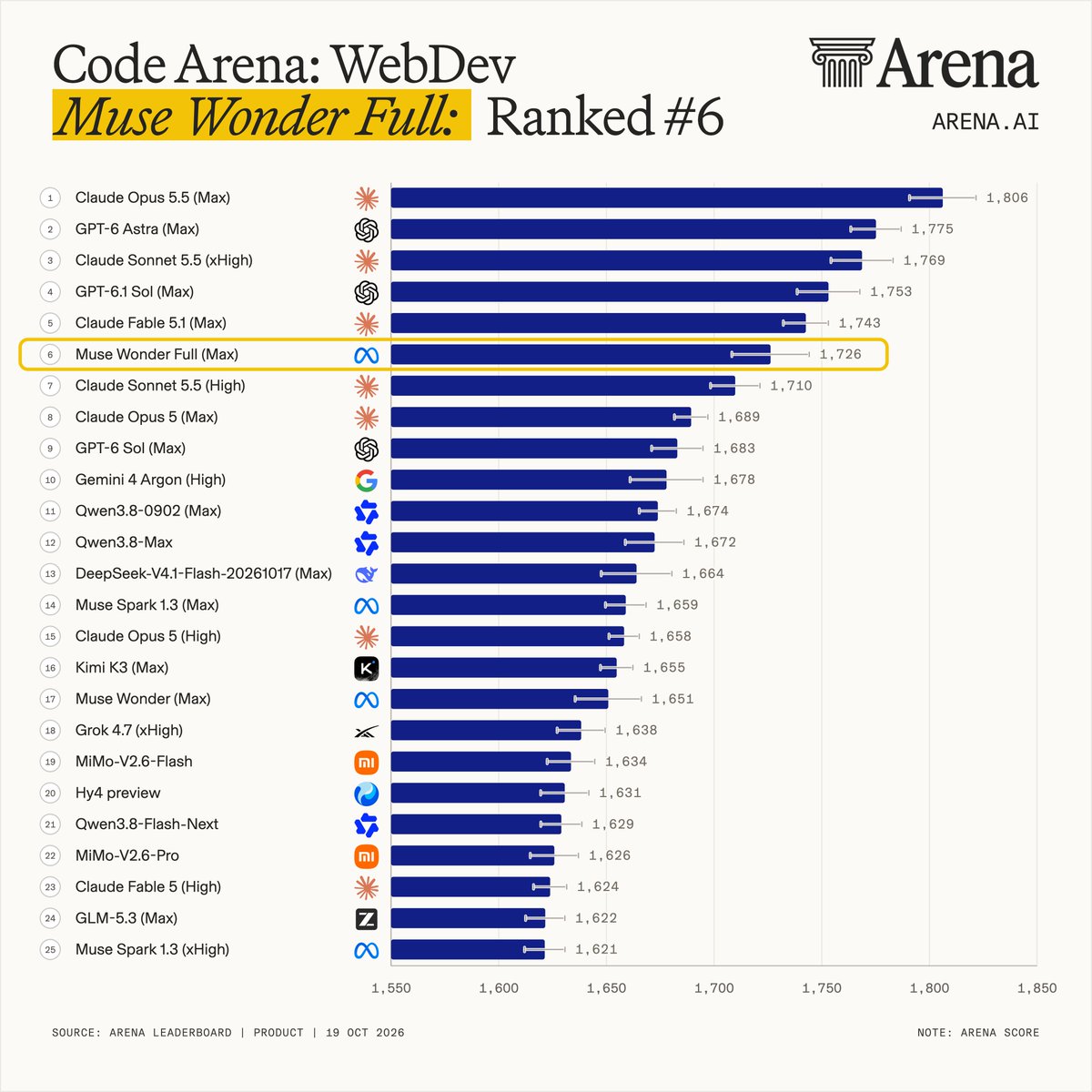
Meta Unveils Gigawatt-Scale Prometheus Supercluster as Muse Wonder Secures #6 on WebDev Code Arena

Meta officially disclosed its gigawatt-scale AI supercluster Prometheus in New Albany, Ohio, housing hundreds of thousands of frontier GPUs with 85%+ pretraining goodput and 90%+ in reinforcement learning. Powered by this infrastructure, Meta's latest coding flagship Muse Wonder Full surged to #6 globally on LMSYS Code Arena: WebDev with 1726 Elo points (surpassing Claude Sonnet 5.5 and Gemini 4 Argon), lifting Meta to the #3 AI research lab worldwide.

Meta Unveils Gigawatt-Scale Prometheus Supercluster as Muse Wonder Secures #6 on WebDev Code Arena

Key Takeaways

  • Meta unveiled its gigawatt-scale Prometheus supercluster in Ohio with hundreds of thousands of GPUs, delivering 85%+ pretraining goodput
  • Exceeded 90%+ goodput on RL workloads, recording ~47,000 GPU-hours MTBF during Muse Wonder's training cycle
  • Muse Wonder Full scored 1726 Elo on LMSYS Code Arena: WebDev (#6 globally), outperforming Claude Sonnet 5.5 (+16) and Gemini 4 Argon (+48)
  • Elevated Meta to the #3 AI lab worldwide; confirmed Muse Glimmer 30B open weights capable of 4-bit local execution on a single consumer GPU
Read full story
Linked Models & Agents:

Google AI Studio Opens Gemini 4 Argon in Build & Playground for Pro Users; Transformers v5.20.1 Adds Native Reflection AI Beam and Meta 816B Muse Spark Open

Google AI Studio launched Gemini 4 Argon access in AI Studio Build and Playground for Google AI Pro subscribers, while Hugging Face Transformers v5.20.0 and v5.20.1 added native support for Reflection AI's frontier coding model Beam, Meta's 816B-parameter (42B active, 1M context) multimodal agentic coding model Muse Spark Open, InclusionAI's Ling 3.0 Flash, and OpenBMB's MiniCPM-V 4.7.

Google AI Studio Opens Gemini 4 Argon in Build & Playground for Pro Users; Transformers v5.20.1 Adds Native Reflection AI Beam and Meta 816B Muse Spark Open

Key Takeaways

  • Google AI Studio opens Gemini 4 Argon in AI Studio Build and Playground (https://ai.studio/build) for Google AI Pro subscribers
  • Hugging Face Transformers v5.20.1 natively integrates Reflection AI's token-efficient coding model Beam and fixes DeepGEMM Mega MoE under expert parallelism
  • Adds native support for Meta's 816B-parameter (42B active, 1M context, BF16/NVFP4) omni-modal coding model Muse Spark Open and InclusionAI's KDA+MLA hybrid Ling 3.0 Flash
Read full story
Linked Models & Agents: