AI Coding Live News

Google Project Suncatcher Gets First AI Response From a TPU in Orbit: Gemma 4 Downlinks a Haiku, Twin Satellites Planned for 2027

Google CEO Sundar Pichai and Google Research announced that the Project Suncatcher prototype satellite, launched on October 1, finished commissioning and ran a prompt on its onboard TPU with the open Gemma 4 model, downlinking a haiku as it passed over Svalbard, Norway. Google calls it the first AI response from a data-center-class TPU in orbit. Next come thermal-stress and radiation tests, then two interconnected satellites in 2027 to test AI computation distributed across satellites.

Google Project Suncatcher Gets First AI Response From a TPU in Orbit: Gemma 4 Downlinks a Haiku, Twin Satellites Planned for 2027

Key Takeaways

  • The satellite launched on October 1 on SpaceX's Transporter-18 rideshare, built with Planet, and ran its first in-orbit inference after about three weeks of commissioning (official account).
  • Per TechCrunch, it carries four TPUs and generates up to about 1 kW, so power limits it to one TPU at a time for roughly 20 minutes.
  • Sundar Pichai's announcement drew about 26K likes and 3.97M views; Google's official account said "Our TPUs just phoned home... from space."
  • Ground proton-beam tests in Google's paper found high-bandwidth memory irregularities only after a cumulative 2 krad(Si), about 3x the 750 rad(Si) minimum requirement (as cited by The Register).
  • Two interconnected satellites are planned for 2027 to test optical inter-satellite links and AI computation distributed across satellites.
Read full story

X discussion: open-source AI builder Jun Song says he turned down an anonymous black hat group offering huge money to post-train open-weight models on exploit data

At 02:20 UTC on Nov 1, open-source AI builder Jun Song (@jun_song, who builds Supergemma) posted on X that an anonymous black hat group offered him an "astronomical" sum to post-train open-weight models with reinforcement learning on the exploit data it holds. He said the volume was so large he would have believed it was an undercover FBI dataset, that he turned it down, and that what scares him is that someone else will eventually take the deal. As of 17:10 SGT the post had about 2,029 likes, 222K views and 771 bookmarks, and it has been rewritten as a parody template. This is a personal account; the offer, the data volume and the group cannot be verified, so it is treated here as a discussion.

Key Takeaways

  • Reach: the original post had about 2,029 likes, 127 reposts, 101 replies, 771 bookmarks and 222.2K views as of Nov 1, 17:10 SGT
  • Claim: an anonymous black hat group offered an "astronomical" sum to post-train open-weight models on exploit data; he says he declined, and neither the amount nor the data volume is public or verifiable
  • Comparison: he says a white-hat project of his built on GLM-5.3 used under 1% of that volume and already beat frontier models "by a huge margin"; this is self-reported with no public benchmark
  • Reaction: accounts such as msuiche and Samuel Cardillo reused the opening lines as a parody template, so the thread splits between taking it seriously and joking about it
  • Issue: open-weight models cannot be recalled once released and their safeguards can be trained away, so a request like this makes the open-weights versus misuse debate concrete
Read full story
Linked Models & Agents:

Google Project Suncatcher runs its first in-orbit TPU inference, with Gemma 4 writing a haiku

On Oct 30 Google CEO Sundar Pichai announced a "hello world" milestone for Project Suncatcher on X: the team sent a command to the prototype satellite in orbit, booted the TPU, ran a prompt and received the first complete response back on Earth, a haiku. TechCrunch reports the reply came from Gemma 4 preloaded on the satellite.

Google Project Suncatcher runs its first in-orbit TPU inference, with Gemma 4 writing a haiku

Key Takeaways

  • The prototype launched Oct 1 on SpaceX Transporter-18 and ran its first in-orbit inference after about three weeks of commissioning (commissioning time per TechCrunch)
  • Per TechCrunch the onboard model is Google DeepMind's Gemma 4, and the first prompt asked for a haiku about being in space
  • TechCrunch says the satellite generates up to about 1 kW and the TPU can run only about 20 minutes at a time; TPU count differs by source (Google's earlier X post said four, TechCrunch says one)
  • Next step is two more satellites in 2027 to test higher power and inter-satellite optical links; Google has published no throughput or benchmark numbers
Read full story

Google's Gemma team says Gemini 4 Argon wrote vLLM optimizations that speed up gemma-4-E2B-it 2.85x on an A100

On Oct 26, Google's official @googlegemma account said a set of vLLM optimizations built with Gemini 4 Argon lifted gemma-4-E2B-it throughput on a single A100 from about 37,900 to 108,000+ tokens/sec, roughly 2.85x, with 100% token parity. The PRs were filed by Luciano Martins of Google DeepMind, and most are still under review.

Google's Gemma team says Gemini 4 Argon wrote vLLM optimizations that speed up gemma-4-E2B-it 2.85x on an A100

Key Takeaways

  • Google says gemma-4-E2B-it throughput on an A100 rose about 2.85x (about 37.9K to 108K+ tokens/sec) with 100% token parity
  • The PRs come from Luciano Martins of Google DeepMind and cover fused Triton kernels, MTP speculative decoding and KV-sharing fast prefill
  • The 2.85x figure is Google's claim for the full set; PR #60674 alone self-reports up to 1.90x prefill and about 1.06x decode
  • As of Oct 27, only 3 of the 10 PRs in the linked list are merged; the rest are still in review
  • It is a public example of using a frontier coding model for inference-kernel performance work, still awaiting reproduction by the vLLM community
Read full story
Linked Models & Agents:
ADSponsored

BOSS Zhipin's Nanbeige lab open-sources Nanbeige4.3-33B, a 33B dense agent model with 512K context under Apache 2.0, reporting 80.9 on Terminal-Bench 2.1 vs 73.0 for Qwen3.8-27B

At 12:11 UTC on 2026-10-25, the Nanbeige LLM Lab of BOSS Zhipin (Kanzhun Limited) announced Nanbeige4.3-33B from its account @nanbeige (post), with the model and its Base version released as open weights on Hugging Face under Apache 2.0 (model card). It is a 33B dense model on a Llama-style architecture with a 512K context window, positioned as the teacher model of the Nanbeige4.3 series that will be distilled into smaller models such as Nanbeige4.3-3B. The official model card compares it with Qwen3.8-27B, Muse-Glimmer-30B and Gemma4-31B using the same harness at highest thinking effort: 80.9 on Terminal-Bench 2.1 (Qwen3.8-27B 73.0) and 65.5 on DeepSWE (42.5), but 60.3 on SWE-Bench Pro, slightly below Qwen's 61.7, and 84.8 on GDPval vs 86.4. All figures are self-reported and not yet independently reproduced.

Key Takeaways

  • Official sources: @nanbeige post on X and the Hugging Face model card; the post had about 616 likes, 79 reposts and 38K views when we pulled it
  • Specs: 33B dense, Llama-style architecture, 512K context, Apache 2.0, with a Base checkpoint released too
  • Self-reported coding scores: Terminal-Bench 2.1 80.9, Terminal-Bench 4.0 23.8, DeepSWE 65.5, SWE-Bench Pro 60.3 (Qwen3.8-27B: 73.0, 6.3, 42.5, 61.7)
  • Self-reported cowork scores: Automation Bench 54.2, JobBench 44.8, GDPval 84.8 (Qwen3.8-27B: 38.3, 34.5, 86.4)
  • Deployment: Transformers, SGLang and vLLM, with official examples using 4-way tensor parallelism; Nanbeige4.3-3B distillation is next
Read full story
Linked Models & Agents:
⚡ Nanbeige4.3-33B⚡ Qwen3.8-27B⚡ Gemma4-31B⚡ Muse-Glimmer-30B🌐 Nanbeige🌐 BOSS Zhipin🌐 Kanzhun

NVIDIA open-sources Nemotron 3.5 Bolt E4B 4GB, a Gemma 4 E4B-based small model for local assistants, characters and robots with tool use

On 2026-10-23 (15:41 UTC) the official @NVIDIAAI account announced Nemotron 3.5 Bolt E4B 4GB, a small open model for local assistants, interactive characters and robots that can hold a conversation and use tools. The official Hugging Face model card says it is post-trained from Gemma-4-E4B-it, has 8B total parameters (4B effective), ships in Q4_K_M quantization, supports up to 64K input and 64K output tokens, and has a switchable thinking mode, plus a DFlash speculative-decoding drafter and a BF16 version. Weights, data and recipes are open under the OpenMDW-1.1 license, with commercial use allowed. On the model card the 4GB build scores 55.60 on MultiChallenge (Gemma4 E4B-it at the same quantization 39.36, Qwen3.5 4B 52.23), but trails Qwen3.5 4B on Tau2-Bench (52.32) and BFCL-v3 (67.31).

NVIDIA open-sources Nemotron 3.5 Bolt E4B 4GB, a Gemma 4 E4B-based small model for local assistants, characters and robots with tool use

Key Takeaways

  • NVIDIA officially released Nemotron 3.5 Bolt E4B 4GB for local assistants, interactive characters and robots
  • Post-trained from Gemma-4-E4B-it: 8B total parameters (4B effective), Q4_K_M quantization, 64K context, switchable thinking mode
  • Open weights, data and recipes under the OpenMDW-1.1 license with commercial use allowed, plus a DFlash speculative-decoding drafter
  • Model card results: 55.60 on MultiChallenge leads its size class, but it trails Qwen3.5 4B on Tau2-Bench and BFCL-v3
Read full story
Linked Models & Agents:
⚡ Nemotron 3.5 Bolt E4B⚡ Gemma 4 E4B🌐 NVIDIA🌐 Google

Meta Releases Muse Glimmer 30B: An Apache 2.0 On-Device Agentic Model Running on a Single Consumer GPU

Meta AI published the technical report for Muse Glimmer 30B (arXiv:2610.24628), an open-source 30-billion parameter causal language model with an integrated perception encoder designed for on-device autonomous agents. Quantized to approximately 4 bits, Muse Glimmer operates inside 32GB of VRAM on a single consumer GPU (such as an RTX 5090) without cloud reliance. On rigorous agentic evaluations, Muse Glimmer sets new records for its size class: achieving 75.5 on MCPAtlas (surpassing Gemma4-31B at 54.2 and Qwen3.6-27B at 62.5) and 51.2 on SWE-Bench Pro, released fully under the Apache 2.0 license.

Meta Releases Muse Glimmer 30B: An Apache 2.0 On-Device Agentic Model Running on a Single Consumer GPU

Key Takeaways

  • Meta released the technical report for Muse Glimmer 30B (arXiv:2610.24628), open-sourcing the agentic foundation model under Apache 2.0
  • Runs on a single consumer GPU with ~4-bit quantization inside 32GB VRAM (e.g. RTX 5090), enabling 100% offline edge autonomy
  • Scores 75.5 on MCPAtlas tool use benchmark, outperforming Gemma4-31B (54.2) and Qwen3.6-27B (62.5) by wide margins
  • Achieves 51.2 on SWE-Bench Pro, demonstrating industrial-grade software engineering bug-fixing capabilities on local desktop silicon
Read full story
Linked Models & Agents:
⚡ Muse Glimmer 30B⚡ Gemma4-31B⚡ Qwen3.6-27B🌐 Meta

Are Embeddings Overpriced? Frozen 16 MB Vocabulary Slashes Small Model Weights by 62% with Zero Downstream Accuracy Loss

In small language models, vocabulary embedding tables often account for over 60% of total parameters, posing severe bottlenecks for edge deployment and ternary quantization. A new study (arXiv:2610.22428) replaces trainable embeddings with a single frozen 16 MB table of 512-bit binary codes derived via PCA and sign binarization. On Gemma 3 270M, trainable parameters collapse from 268.1M to 101.0M (-62.3%) while matching or exceeding original performance across HellaSwag (30.4%), LAMBADA (23.2%), and PIQA (61.5%).

Are Embeddings Overpriced? Frozen 16 MB Vocabulary Slashes Small Model Weights by 62% with Zero Downstream Accuracy Loss

Key Takeaways

  • Highlights structural waste in SLMs: embedding tables occupy 167.8M parameters in Gemma 3 270M (62.6% of the entire model)
  • Introduces a frozen 16 MB table of 512-bit binary codes (arXiv:2610.22428) derived via PCA and sign binarization with zero trainable weights
  • Slashes trainable parameters in Gemma 3 270M from 268.1M to 101.0M (-62.3% reduction)
  • Maintains parity on HellaSwag (30.4%) and outperforms the baseline on LAMBADA (23.2% vs 21.6%) and PIQA (61.5% vs 60.6%), while seamlessly enabling ternary models
Read full story
Linked Models & Agents:

Fixing LLM & VLM Evaluation Blind Spots: Exact Two-Factor MCQ Option-Bias Identity, 61M-Edit semCER for OCR, and 14.5x SAE Feature Reproducibility Scaling

Three new evaluation and interpretability studies resolve critical measurement blind spots: POSTECH and KAIST researchers (arXiv:2610.20993) prove across 41 checkpoints and 12 benchmarks that multiple-choice pooled selection-rate SD equals the exact product of Flip Rate and Positional Skew, revealing that forward-reverse order aggregation lowers flip rates partly by locking onto wrong answers; semCER (arXiv:2610.20461) open-sources 61 million LLM-judged grapheme edits across 16 languages for severity-weighted OCR evaluation; and IISc/UVA researchers (arXiv:2610.20680) show that while SAE reconstruction converges with little data, strict 1-to-1 feature reproducibility on Gemma-2-2B BatchTopK jumps 14.5x from 2% at 5M tokens to 29% at 50M tokens.

Fixing LLM & VLM Evaluation Blind Spots: Exact Two-Factor MCQ Option-Bias Identity, 61M-Edit semCER for OCR, and 14.5x SAE Feature Reproducibility Scaling

Key Takeaways

  • POSTECH/KAIST prove that multiple-choice pooled selection-rate SD equals Flip Rate × Positional Skew across 41 checkpoints and 12 benchmarks, showing order aggregation lowers flip rates partly by locking onto wrong answers
  • semCER open-sources 61 million severity-judged grapheme edits across 16 languages and reveals that VLM character errors form real words far above chance compared to classical OCR
  • Testing 4 SAE architectures from 5M to 500M tokens shows functional reconstruction converges early while Gemma-2-2B BatchTopK 1-to-1 feature reproducibility jumps 14.5x from 2% (5M) to 29% (50M)
Read full story
Linked Models & Agents:

Judge-Free Test-Time Scaling Tops WebArena Infinity at 74.6%: Salesforce Introduces CLIFT, Alongside MMSearch-OPD and SCOPED-8B Beating 32B VLMs

Three new frameworks advance web and multimodal agent post-training: Salesforce AI Research's CLIFT (arXiv:2610.06829) certifies URL-conditional self-verification questions for dense RL rewards and judge-free Conformal Trajectory Selection (CTS), propelling Gemma-4 31B to a 74.6% SOTA on WebArena Infinity (beating Gemini 3 Flash at 70.1%) and lifting GPT-5.5 to 53.7% on VisualWebArena. Meanwhile, MMSearch-OPD (arXiv:2610.22240) boosts 9B multimodal deep search by +15.3 points to 60.2%, and Northeastern University's SCOPED-8B (arXiv:2610.22217) uses skill-decoupled on-policy expert distillation to reach 73.13% across 8 benchmarks—surpassing Qwen3-VL-32B (72.01%) and Claude Opus 4.6 (72.86%).

Judge-Free Test-Time Scaling Tops WebArena Infinity at 74.6%: Salesforce Introduces CLIFT, Alongside MMSearch-OPD and SCOPED-8B Beating 32B VLMs

Key Takeaways

  • Salesforce's CLIFT conformal self-verification propels Gemma-4 31B to 74.6% on WebArena Infinity (+12.8 pts over base, beating Gemini 3 Flash at 70.1%) with judge-free test-time trajectory selection
  • Transferring the open-trained CLIFT question bank to GPT-5.5 sets a 53.7% SOTA on VisualWebArena, while MMSearch-OPD boosts 9B multimodal deep search accuracy by +15.3 points to 60.2%
  • Northeastern University's SCOPED-8B reaches 73.13% average accuracy across 8 VLM benchmarks via skill-decoupled on-policy expert distillation, beating Qwen3-VL-32B (72.01%) and Claude-Opus-4.6 (72.86%)
Read full story
Linked Models & Agents:
ADSponsored

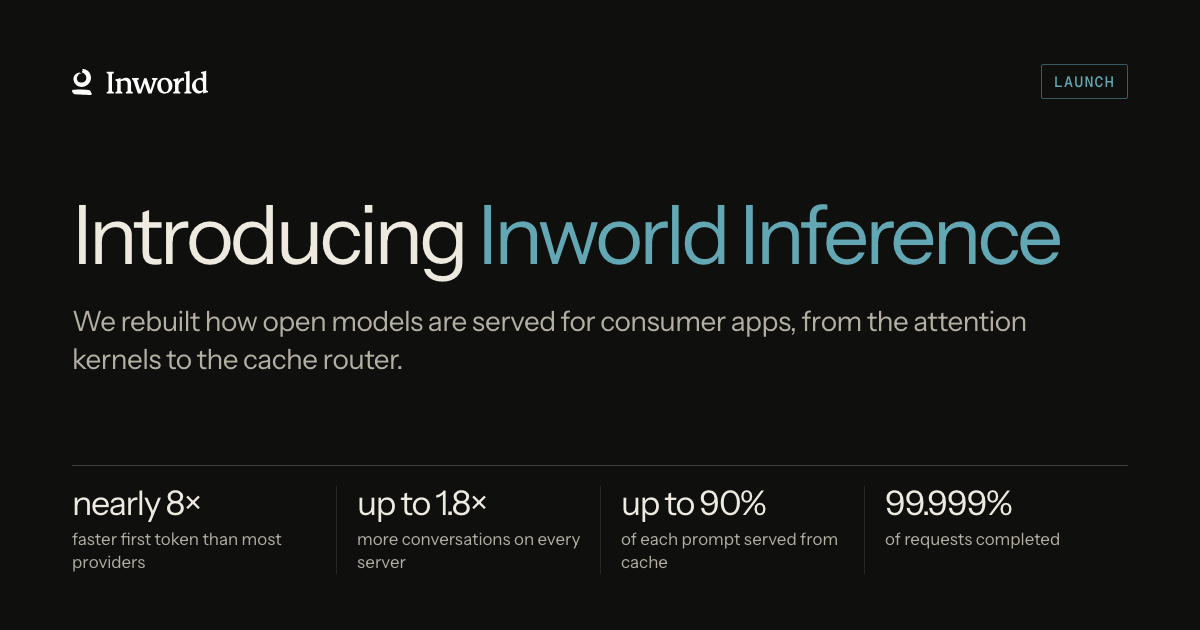
Inworld Inference opens to all developers: an open-model inference API built for consumer AI, with Gemma 4 26B p95 first token 7.8x faster than the median OpenRouter provider

On 2026-10-14 Inworld AI opened Inworld Inference to every developer, positioning it as an inference service for consumer apps (companions, tutors, voice, interactive fiction). Instead of listing thousands of models it builds a per-model serving stack for open models such as Gemma 4, GLM 5.3 Flash, DeepSeek and MiMo: draft-and-verify (speculative) decoding, a rewritten split-KV verify attention kernel, KV-aware routing and eval-gated low precision. Vendor-reported: Gemma 4 26B p95 first token of 0.31 s, 7.8x faster than the median OpenRouter provider; up to 90% of prompts from cache; 99.999% success over 20M+ GLM 5.3 Flash requests in 30 days. The API is OpenAI-compatible with Flex/Default/Priority/Fast tiers per request.

Inworld Inference opens to all developers: an open-model inference API built for consumer AI, with Gemma 4 26B p95 first token 7.8x faster than the median OpenRouter provider

Key Takeaways

  • Gemma 4 26B first token: p50 0.17 s / p95 0.31 s, 3.6x / 7.8x faster than the median OpenRouter provider (blog, vendor-reported snapshot, not a matched workload)
  • Pricing: Gemma 4 26B at $0.07 input, $0.035 cached, $0.34 output per 1M tokens, nearly 40% below the median no-training provider
  • Rewritten verify attention: 3.4–7.5x faster per layer, attention share of a decode step 27.5%→16.5%, p50 TTFT 154→117 ms at equal eval scores
  • KV-aware routing: GLM 5.3 Flash cache hits 25%→47%, DeepSeek V4.1 Flash 11%→33%; cached MiMo 2.6 Pro input costs 99% less
  • Reliability: 98 failures across 20M+ GLM 5.3 Flash requests in 30 days (~4.8 per million); per-request service_tier of Flex/Default/Priority/Fast
Read full story

GUI-Decisions open-sourced: slot-reading replaces coordinate JSON decoding for ~3× faster computer-use grounding (31B/2B)

On 2026-10-10 Logesh Kumar Umapathi published GUI-Decisions on Hugging Face: computer-use actions/coordinates are read from fixed next-token slots instead of autoregressive JSON. On an RTX PRO 6000 with vLLM, Gemma-4-31B slot reads median ~146–158 ms/step vs ~472–546 ms native JSON (~3.5×) and ~20–25× vs thinking decode. ScreenSpot click-in-element ~0.87. Open weights for 31B/2B, GitHub, and a Spaces demo.

GUI-Decisions open-sourced: slot-reading replaces coordinate JSON decoding for ~3× faster computer-use grounding (31B/2B)

Key Takeaways

  • Official: HF Blog (2026-10-10); code gui-decisions; Spaces demo
  • Latency (vendor, RTX PRO 6000, cold shots): slot read ~146 ms vs native JSON 472–546 ms (~3.5×); with thinking 2.6–3.1 s (~20–25×)
  • Quality: ScreenSpot click-in ~0.869; held-out AGUVIS steps ~0.65; RefCOCO val box IoU 0.770
  • Mechanism: 256-bin byte labels for coords; read only slots the action needs; type/answer still need base decode—slots speed grounding only
  • Serve: vllm serve infinitylogesh/GUI-Decisions-31B --max-logprobs 300 --api-server-count 8 then SlotModel.decide(...)
Read full story
Linked Models & Agents:
⚡ GUI-Decisions-31B⚡ GUI-Decisions-2B⚡ Gemma-4-31B🤖 computer-use🤖 GUI agent🌐 Hugging Face🌐 Google

Anthropic research: small models may be months from weight-based self-replication without a datacenter; IoT fleets can serve 26B shards

On 2026-10-12 Anthropic (William Zhou, Daniel Freeman) published research arguing small models may be months from autonomous weight-based replication on commercial IoT. Models ≤30B already complete many replication steps; in simplified evals GLM-5.2 finishes end-to-end. A demo ran Gemma4-26B-A4B across 15 ~$55 Android TV boxes via pipeline parallel (~0.39 tok/s). Extrapolating Epoch Capabilities Index gains, small models may hit the replication floor by end of 2026.

Key Takeaways

  • Official: Anthropic research post (2026-10-12)
  • Demo: 15 cheap Android TV boxes (~4GB RAM) pipeline-parallel serve Gemma4-26B-A4B at ~0.39 tok/s; a 9B model stood up inference on 8/9 hardware types
  • E2E: in a firewalled redroid VPC with unauthenticated ADB, GLM-5.2 reached 8/8 nodes in 4/5 trials (7/8 once), tasked to serve Llama3.1-8B then spawn
  • Timescale (vendor): full inference-setup trajectories ~71–150h (Gemma4-26B-A4B) / 28–51h (Qwen3.5-9B)—day-scale doubling, not minute-scale worms
  • Defenses: drive R₀ < 1; ISP flow anomalies, honeypots, quarantine; manufacturer defaults and compliance
Read full story
Linked Models & Agents:
⚡ GLM-5.2⚡ Gemma4-26B-A4B⚡ Qwen3.5-9B⚡ Llama3.1-8B🤖 Pi🤖 Memento🌐 Anthropic

openTPU, an open-source AI accelerator developed by AI agents, goes viral: full RTL/ISA/compiler stack runs Qwen3.5, Gemma 4 and a 35B MoE on a Kintex-7 FPGA card at up to 85.8 tok/s

FeSens/openTPU (Apache-2.0) hit the Hacker News front page (250+ points, 300+ comments). Reusing the AI-driven method from auto-arch-tournament (AI-designed RISC-V cores), the author had AI agents iterate on an inference accelerator; one repo holds SystemVerilog RTL, the ISA, a bit-exact simulator, a kernel language/compiler and a profiler. On a Kintex-7 xc7k480t PCIe card it runs Qwen3, Qwen3.5, Gemma 4, Phi-4-mini and others with real weights, token-for-token identical to the simulator; LFM2.5-230M decodes at 85.8 tok/s in 4-bit and Qwen3.5-35B-A3B reaches 3.95 tok/s with host-streamed experts.

openTPU, an open-source AI accelerator developed by AI agents, goes viral: full RTL/ISA/compiler stack runs Qwen3.5, Gemma 4 and a 35B MoE on a Kintex-7 FPGA card at up to 85.8 tok/s

Key Takeaways

  • Full stack in one repo: SystemVerilog RTL, 8x32-bit-word ISA, bit-exact Python simulator, @ol.jit kernel compiler and Lens profiler, Apache-2.0 (GitHub)
  • Measured device decode (4-bit, int8 head): LFM2.5-230M 85.8 tok/s, Qwen3-0.6B 31.3, Qwen3.5-2B 12.09, Gemma 4 E2B 12.14 tok/s
  • Uses 82-94% of the 17.1 GB/s DDR3-1066 peak while decoding; 133.33 MHz clock, four-column systolic array
  • MoE offload: Qwen3.5-35B-A3B at 3.95 tok/s (153 MB of experts streamed per token, 62% slot hit), LFM2.5-8B-A1B at 10.6 tok/s (offload docs)
  • 4-bit weights (FP4 with two-level block scales, 4.25 bits/weight) decode 40-45% faster than int8, with per-model perplexity cost documented
Read full story
Linked Models & Agents:
⚡ Qwen3.5⚡ Gemma 4⚡ LFM2.5⚡ Phi-4 Mini

Google DeepMind releases EmbeddingGemma 2: a 740M Apache-2.0 multimodal embedding model that maps text, code, images, audio and video into one space, +9.92 on MTEB Code

On 2026-10-06 Google DeepMind released EmbeddingGemma 2, a 740M-parameter Apache-2.0 embedding model built on Gemma 4 that maps text, code, images, audio and video into one 768-dim space with an 8K context. MTEB Code rises from 68.76 to 78.68, and quantized text-only inference needs ~191MB RAM on a Pixel 11 Pro. Hugging Face Transformers v5.19.0 supports it natively.

Google DeepMind releases EmbeddingGemma 2: a 740M Apache-2.0 multimodal embedding model that maps text, code, images, audio and video into one space, +9.92 on MTEB Code

Key Takeaways

  • Size: 740M params, modular 270M text backbone + 170M vision + 300M audio encoders, loadable on demand
  • Code retrieval: MTEB Code 68.76 → 78.68 (+9.92); Google claims leading sub-1B multimodal scores on MTEB Code and MAEB
  • Storage: Matryoshka embeddings truncate 768 → 512/256/128 dims, up to 6x smaller local vector stores
  • On-device: ~191MB RAM text-only / ~567MB full multimodal (quantized, Pixel 11 Pro); 8K context (4x v1) covers 5.5 min audio, 29 images or 58 video frames
  • Ecosystem: Apache 2.0 weights on Hugging Face and Kaggle; supported in Transformers v5.19.0, plus sentence-transformers, vLLM, llama.cpp, SGLang, Ollama and MLX per Google
Read full story
Linked Models & Agents:
⚡ EmbeddingGemma 2⚡ Gemma 4🌐 Google DeepMind🌐 Google