AI Coding Live News

Edge0 Releases Open Weights for Edge0-145B and Edge0-120B On-Device Models: About 10B Active Parameters per Token, Runs on a Single 24GB Consumer GPU, Vendor Claims 86.5 on Terminal-Bench 2.1, Ahead of Claude Opus 4.6

On November 12, on-device model company Edge0 released open weights for Edge0-145B and Edge0-120B, along with its C++ inference engine edge0-infer and Edge0 Chat 0.2.0. The 145B model is built on Qwen3.8-Flash-Next as a latent sparse MoE, with about 10.12B active parameters per token, native 4-bit training and a 256K context. Edge0 reports 29GB peak memory locally and 98.3 tok/s agent decode on an RTX 5090 D 24GB. It reports 86.52 on Terminal-Bench 2.1, versus 78.2 for Claude Opus 4.6 (Max). All scores come from Edge0 internal evaluations.

Edge0 Releases Open Weights for Edge0-145B and Edge0-120B On-Device Models: About 10B Active Parameters per Token, Runs on a Single 24GB Consumer GPU, Vendor Claims 86.5 on Terminal-Bench 2.1, Ahead of Claude Opus 4.6

Key Takeaways

  • Size and structure: Edge0-145B has 145B total parameters and about 10.12B active per token; 48 layers with 512 experts each, 10 routed plus 1 shared active; 256K context, trained natively at 4 bits
  • Benchmarks (vendor internal evals): 86.52 on Terminal-Bench 2.1, versus 83.3 for Qwen3.8-Flash-Next, 82.7 for DeepSeek-V4-Flash-0731 and 78.2 for Claude Opus 4.6 (Max); 64.6 on DeepSWE 1.1 and 90.4 on GPQA-Diamond
  • Local speed (model card figures): the NVFP4 build reaches 98.3 tok/s agent decode and 3165.7 tok/s prefill on a 16K input on an RTX 5090 D 24GB; the Q3_K build hits 91.7 tok/s agent decode on an RTX 4090
  • Hardware floor: the Windows package needs an NVIDIA RTX 20-series or newer GPU with at least 16GiB of VRAM plus 20GiB of system RAM; weights are 47.79GiB for NVFP4 and 40.81GiB for Q3_K
  • License limits: the model is under the Edge0 Community Model License 1.0 plus the Qwen Community License; personal, research and internal use are allowed, but reselling the model or running a commercial model service needs a separate license; the inference framework is Apache-2.0
Read full story
Linked Models & Agents:
⚡ Edge0-145B⚡ Edge0-120B⚡ Qwen3.8-Flash-Next⚡ DeepSeek-V4-Flash-0731⚡ Claude Opus 4.6🌐 Edge0🌐 Qwen🌐 Hugging Face🌐 NVIDIA

LMSYS Launches the SGLang Consortium at the First SGLang Summit: NVIDIA, AMD, Intel, Google, Meta, Cloudflare, Modal and RadixArk Join as Founding Members to Help Shape the Open-Source Inference Engine Roadmap

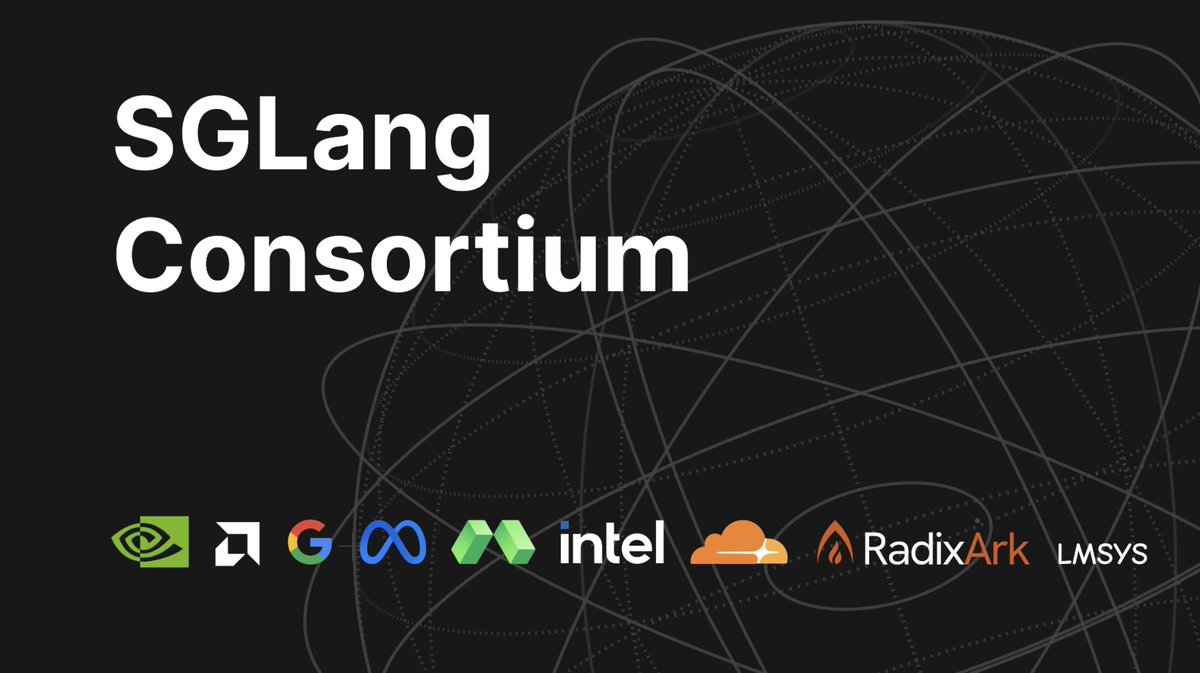
On November 12, LMSYS Org, the nonprofit behind the open-source inference engine SGLang, announced the SGLang Consortium in the opening keynote of the first SGLang Summit in San Francisco. Founding members NVIDIA, AMD, Intel, Google, Meta, Cloudflare, Modal and RadixArk will work with the SGLang maintainers on the roadmap, focusing on frontier model support, reasoning and multimodal workloads, distributed inference and hardware optimization. Each member names one technical representative and joins two roadmap meetings a year; SGLang maintainers keep authority over technical decisions and code acceptance, and the project stays open to the whole community.

LMSYS Launches the SGLang Consortium at the First SGLang Summit: NVIDIA, AMD, Intel, Google, Meta, Cloudflare, Modal and RadixArk Join as Founding Members to Help Shape the Open-Source Inference Engine Roadmap

Key Takeaways

  • Eight founding members: NVIDIA, AMD, Intel, Google, Meta, Cloudflare, Modal and RadixArk (the company founded by SGLang core authors), spanning GPU/CPU vendors, clouds and inference providers
  • Governance: each member names one technical representative and joins two roadmap meetings a year, with working groups and public progress updates in between; SGLang maintainers keep technical decisions and code acceptance
  • Four focus areas: frontier model support, reasoning and multimodal workloads, distributed inference, and optimization across hardware platforms
  • Scale (official figures): SGLang runs on hundreds of thousands of GPUs for users including Meta, Microsoft, Google, Amazon, Thinking Machines Lab, Cloudflare, Reflection and Modal
  • Context: citing Deloitte, LMSYS says inference will be about two-thirds of all AI compute in 2026, up from about half in 2025; the first summit runs November 12-13 at Fort Mason in San Francisco with 100+ speakers
Read full story

OpenAI Unveils Control Room: A Central System That Tracks Every Research Inference Job and Halts Model Output Within 35 Seconds, Failing Closed If It Goes Down

OpenAI introduced Control Room on its official account and blog: a central system across its research infrastructure that connects every research inference workload, including agentic sampling for training and evaluation and data processing. It works with OpenAIs misalignment monitoring systems and halts a jobs model output within 35 seconds of a decision to intervene. The kill switch lives in the inference engine layer rather than in research code: engines check a job_id with Control Room before serving each request, and if Control Room goes down or is tampered with, all inference requests are denied (fail-closed). Fail-closed already covers all frontier model research workloads and will reach the remaining research workloads over the next few days. This is a safety infrastructure announcement, not a new model or public API.

OpenAI Unveils Control Room: A Central System That Tracks Every Research Inference Job and Halts Model Output Within 35 Seconds, Failing Closed If It Goes Down

Key Takeaways

  • Scope: a central track-and-stop system for every research inference workload at OpenAI, including RL training, evals, high-volume sampling and data processing
  • Speed: at most 35 seconds from a stop instruction to no further progress; the lag comes from an inference-authorization cache, and OpenAI says it is working to bring it to zero
  • Mechanism: each job requests a job_id tied to an approved safety case, and inference engines check that ID with Control Room before every request
  • Fail-closed: if Control Room goes down, is disabled or is tampered with, all inference requests are denied; this covers all frontier model research workloads now and the rest over the next few days
  • Monitoring link: every frontier RL job runs with a monitor model that can order a stop; OpenAI says its recent DNS-related incident was caught by a monitor
Read full story
Linked Models & Agents:

Together AI Launches Together Compiler: Agents Continually Optimize Production Inference, Up to 2.6x Higher TPS

On November 4 Together AI launched Together Compiler (TKCC), which pairs a swarm of AI agents with a persistent inference engine to keep rewriting inference kernels for real traffic, models and hardware, as part of what it calls Polymorphic Inference. The company says that within 24 hours it reached up to 2.6x higher TPS on models such as Kimi K3, GLM 5.3, MiniMax M3.1-Flash and DeepSeek v4.1-Flash, up to 50% faster on customer workloads, and it already serves trillions of tokens a day in production.

Key Takeaways

  • Together Compiler recasts inference optimization from a classic compiler problem into an agentic search: agents propose kernel changes, a persistent engine checks speed and correctness, and only verified changes reach production
  • Together says that within 24 hours it reached up to 2.6x higher TPS on Kimi K3, GLM 5.3, MiniMax M3.1-Flash and DeepSeek v4.1-Flash, and up to 50% faster on customer workloads
  • On InferenceX low-latency batch size 1 it reports 1,111 TPS on MiniMax M3.1-Flash and 1,205 TPS on DeepSeek v4.1-Flash (company-reported); SemiAnalysis said it validated one of the results
  • The persistent engine hot-reloads candidate forward passes, cutting time to serving to 9 seconds versus 467 seconds for restarting an engine, with 252x higher experiment throughput than baseline agentic optimization systems
  • It already serves trillions of tokens a day in Together's production stack, where 40+ models are now optimized by agents
Read full story
ADSponsored

DeepSeek Open-Sources DeepInfer Inference Engine: Powering V4.1-Flash at Scale Across NVIDIA SM100 and Huawei Ascend 950

DeepSeek officially open-sourced DeepInfer under Apache 2.0, its production-grade inference engine serving DeepSeek-V4.1-Flash at scale. Originating from vLLM with architectural refinements from SGLang and TensorRT-LLM, DeepInfer natively targets NVIDIA SM100 GPUs and Huawei Ascend 950 NPUs. It integrates specialized kernels including FlashMLA, DeepGEMM, DeepEP, and TileKernels. The engine features DSpark confidence-scheduled speculative decoding with 5-token drafts, SWA bounded replay over a 140-token sliding window, and balanced MoE expert parallelism. DeepSeek simultaneously open-sourced deepseek-recipe, delivering an end-to-end open ecosystem across models, kernels, and inference runtimes.

DeepSeek Open-Sources DeepInfer Inference Engine: Powering V4.1-Flash at Scale Across NVIDIA SM100 and Huawei Ascend 950

Key Takeaways

  • DeepSeek officially open-sourced DeepInfer under Apache 2.0, releasing the production codebase powering DeepSeek-V4.1-Flash at massive scale
  • Natively optimized for both NVIDIA SM100 GPUs and Huawei Ascend 950 NPUs with deterministic, batch-independent output guarantees
  • Integrates custom FlashMLA, DeepGEMM, DeepEP, and TileKernels, alongside DSpark 5-token speculative decoding and 140-token SWA replay
  • Simultaneously released deepseek-recipe, aligning open-source local deployments perfectly with DeepSeek's official production API tokenization
Read full story

llm-d 1.0 ships: the Kubernetes-native open-source distributed inference stack led by Red Hat, IBM and Google hits production readiness, with vendors reporting 3,000 self-hosted coding agents at 5-10x lower cost than commercial APIs

At PyTorch Conference North America on Oct 20, the CNCF Sandbox project llm-d released version 1.0. It turns inference engines such as vLLM and SGLang into one coordinated serving pool, and 1.0 adds multi-tenant priority and fairness scheduling (flow control), router high availability with zero-downtime rolling upgrades (DisaggregatedSet), a v1 configuration API, and agent-aware session routing with Responses API state. Founded in 2025 by Red Hat, IBM, Google Cloud, CoreWeave and NVIDIA, the project has 500+ contributors, and JetBrains, DigitalOcean and Mistral already run it in production.

llm-d 1.0 ships: the Kubernetes-native open-source distributed inference stack led by Red Hat, IBM and Google hits production readiness, with vendors reporting 3,000 self-hosted coding agents at 5-10x lower cost than commercial APIs

Key Takeaways

  • Scale (Red Hat press release, vendor-reported): GLM 5.2, roughly 753B parameters, on NVIDIA GPUs peaked at 6.6M output tokens per minute and served up to 3,000 concurrent coding agents with zero preemptions, 5-10x cheaper per token than equivalent commercial API pricing at cloud rental rates
  • Cache reuse: IBM says the prefix-aware router captured 97% of available cache reuse on an agentic coding workload; an IBM Research quantum error correction project saw ~98% prefix hits, ~$0.11 per million tokens, and 11.5x lower cost than an all-proprietary setup
  • Google Cloud figures: on Ironwood TPU, prefix-aware routing plus host memory offload cut median time-to-first-token by more than 85% and raised throughput 2.4x on an agentic coding workload; the Gemini platform doubled its prefix cache hit rate from 35% to 70%
  • New in 1.0: flow-control multi-tenant QoS, router hot-standby HA, DisaggregatedSet for coordinated prefill/decode rollouts, a v1 config API, and previous_response_id support in the Responses API
  • Ecosystem: 500+ contributors from 25+ organizations; JetBrains' free Junie Lite, DigitalOcean Serverless Inference and Mistral's tiered commercial traffic run on it; the GitHub v1.0.0 notes admit not every tracked goal shipped
Read full story

SparseEngine: Harbin Institute of Technology Open-Sources Sparse-First Inference Engine Delivering 2.5x Faster Decoding Than vLLM for Long-Horizon Agents

Long-horizon LLM agents accumulate expanding interaction histories that saturate GPU KV-cache memory and choke self-attention throughput. While sparse attention algorithms mitigate these bottlenecks mathematically, existing production serving engines (e.g. vLLM) are tightly coupled to dense tensor layouts, preventing heterogeneous sparse mechanisms from sharing infrastructure. Researchers from Harbin Institute of Technology (HIT) release SparseEngine (arXiv:2609.39068), an open-source, sparse-first inference engine built from the ground up for long-horizon agent workloads. SparseEngine establishes a shared lifecycle contract enabling 15 diverse sparse attention methods across four distinct families to control their custom KV representations while unifying memory management. It introduces Chain Cache to resume stateful KV-evicted contexts across multi-turn requests and Controllable Prefix-Cache Pruning to discard stale history without disrupting prefix matching. Empirical evaluations on long-horizon agent benchmarks show that SparseEngine delivers over 10x higher throughput under KV eviction, over 2.5x faster decoding throughput than vLLM at matched concurrency, and more than 2x end-to-end task speedups with zero degradation in model reasoning accuracy.

Key Takeaways

  • Harbin Institute of Technology open-sources SparseEngine, a sparse-first inference engine natively supporting 15 sparse attention algorithms
  • Introduces Chain Cache and Controllable Prefix-Cache Pruning to preserve prefix-cache benefits across multi-turn sparse agent sessions
  • Delivers 2.5x faster decoding than vLLM, lifts throughput by 10x under KV eviction, and halves end-to-end agent task latency
Read full story

Strata goes viral: run 125B Qwen3.8-Flash-Next on a 12 GB gaming GPU, ~94 tok/s measured on RTX 5070

Strata, an open-source C++ inference engine, runs the 125B-parameter (6B active) Qwen3.8-Flash-Next on a 12 GB gaming GPU plus 32–64 GB RAM, exposing OpenAI, Anthropic and Responses-compatible APIs on localhost so Claude Code and Codex CLI can use it. The repo passed 10k GitHub stars and hit the Hacker News front page (507 points).

Strata goes viral: run 125B Qwen3.8-Flash-Next on a 12 GB gaming GPU, ~94 tok/s measured on RTX 5070

Key Takeaways

  • Scale: Qwen3.8-Flash-Next is 125B total / 6B active (512 experts, 10 routed + 1 shared), 262K native context
  • Measured: RTX 5070 12 GB + 64 GB RAM, Q2_0 decodes ~94 tok/s and prefills a 32K prompt at ~2,650 tok/s; RX 9070 XT ~60 tok/s
  • Requirements: 12 GB VRAM and 32 GB RAM minimum, ~70 GB download; the Coder pack drops half the experts and keeps ~91% of SWE-bench Verified per its authors
  • Integration: localhost OpenAI, Anthropic /v1/messages and Responses endpoints plus an MCP server
  • Traction: ~10.7k stars, 946 forks, MIT license, v0.1.39 released Oct 4
Read full story
Linked Models & Agents:

SGLang v0.5.21 Unveils Dynamic Prefill-Decode Switching and Native Rust Prefix Caching for Extreme LLM Serving

SGLang, a leading open-source high-throughput inference engine for large models, officially releases milestone version v0.5.21, merging 779 PRs across 227 contributors. The release introduces dynamic on-the-fly role switching between Prefill and Decode (PD) instances without restarting, an upgraded high-performance Rust core for the default prefix cache, and 22% faster first-token generation for DeepSeek-V4.1 on long prompts. It also debuts the /v1/decisions and /v1/score APIs, alongside complete support for next-gen models including MiMo-V2.6, DiffusionGemma, and GLM-5.3-Flash on AMD MI355X.

SGLang v0.5.21 Unveils Dynamic Prefill-Decode Switching and Native Rust Prefix Caching for Extreme LLM Serving

Key Takeaways

  • Pioneers zero-restart dynamic role switching between prefill and decode instances to eliminate cluster capacity skew
  • Upgrades default prefix cache to a native Rust core, cutting DeepSeek-V4.1 TTFT on long prompts by 22%
  • Improves Kimi K3 prefill throughput by 20.6% and adds native AMD MI355X support with FP8/MXFP4 MoE kernels
Read full story

Resolving Training-Inference Mismatch in LLM RLVR: Calibrated Importance Sampling Eliminates Gradient Variance

In reinforcement learning with verifiable rewards (RLVR), rollout trajectories are generated by high-throughput inference engines while backward gradients are computed by training engines, introducing subtle floating-point probability discrepancies that trigger unbounded variance under exact importance sampling. Researchers identified the invariance of logit displacement distributions and introduced Calibrated Importance Sampling (CIS), featuring confidence-aware truncation that replaces unbounded second moments with constant bounds, establishing top scores across five mathematical benchmarks.

Resolving Training-Inference Mismatch in LLM RLVR: Calibrated Importance Sampling Eliminates Gradient Variance

Key Takeaways

  • Exposing Engine Probability Discrepancies: Fast inference engines (vLLM) and training backends (Megatron) assign diverging probabilities to identical tokens due to kernel optimizations, inducing severe variance under standard importance sampling.
  • Logit-Displacement Invariance: Formulates that per-logit perturbations before softmax remain approximately invariant to token confidence, enabling a principled confidence-aware importance weight cap.
  • Theoretical Variance Bounds & Benchmark Leadership: Replaces unbounded second moments with strict constant bounds, outperforming existing baselines across three MoE backbones on five rigorous mathematical reasoning benchmarks.
Read full story
Linked Models & Agents:
ADSponsored

SGLang v0.5.20 Released: 713 Merged PRs, RL Sampling Masks & Overlap Scheduling Boost Throughput by 52%

High-throughput LLM inference engine SGLang released milestone v0.5.20, consolidating 713 merged PRs from 237 contributors. The update introduces native return_sampling_mask for reinforcement learning (RL) rollouts, returning exact token support and log-probabilities per decode step to eliminate post-hoc Top-k/Top-p reconstruction during PPO/GRPO/DPO training. Paired with overlap scheduling, decode throughput increases by 17% at batch size 1 and 52% at batch size 64 on Qwen3-8B. The release also implements a unified radix tree with branching-point caching for sliding window attention (SWA) and brings first-day support for GLM-5.3-Flash, Tencent Hy4-Preview, and Qwen3.8-Flash-Next.

SGLang v0.5.20 Released: 713 Merged PRs, RL Sampling Masks & Overlap Scheduling Boost Throughput by 52%

Key Takeaways

  • Massive release: 713 merged PRs from 237 contributors covering RL rollouts, overlap scheduling, and multi-model support
  • Zero-reconstruction RL rollouts: return_sampling_mask returns token candidates and log-probs to streamline GRPO/PPO training
  • 52% decode throughput gain: overlap scheduling boosts Qwen3-8B decoding by 17% at batch 1 and 52% at batch 64
  • Unified Radix Tree for SWA: enables branch-point caching across sliding-window and hybrid-attention model architectures
  • Day-one frontier model support: out-of-the-box support for GLM-5.3-Flash, Tencent Hy4-Preview, Qwen3.8-Flash-Next, and SenseNova MoT
Read full story
Linked Models & Agents:
⚡ GLM-5.3-Flash⚡ Qwen3.8-Flash-Next⚡ Hy4-Preview⚡ SenseNova-U1.5-8B-MoT🤖 SGLang Server🌐 Sgl project🌐 LMSYS

LM Studio ships Inco Splash day 0: ~144 tok/s Qwen3.8-27B on M5 Max

LM Studio announced a day-0 partnership with Inco to bring the Splash inference engine into LM Studio. They cite up to about 144 tok/s for Qwen3.8-27B on M5 Max, with setup docs at lmstudio.ai/blog/splash-engine. Splash was already open-sourced by Inco; this puts the Apple-silicon-optimized stack inside LM Studio so local desktop users do not have to assemble the engine separately.

Key Takeaways

  • LM Studio integrates Inco Splash on day 0 for one-click local desktop use.
  • Claims ~144 tok/s for Qwen3.8-27B on M5 Max, with an official setup post.
  • Moves Apple-silicon-optimized inference into a mainstream local client distribution path.
Read full story

Inco open-sources Splash: ~144 tok/s for Qwen3.8-27B on M5 Max

Inco AI open-sourced Splash, a local inference engine built for Apple silicon and models like Qwen3.8-27B. On an M5 Max MacBook Pro it reports about 144 tok/s—up to 3× Ollama, 2× oMLX, and nearly 4× when an agent fans out sub-agents. LM Studio shipped day-0 support under Settings > Runtime > Experimental backends.

Key Takeaways

  • Open-source Splash: local inference tuned for Apple silicon and Qwen3.8-27B.
  • Demo: ~144 tok/s on M5 Max; up to ~3× Ollama / 2× oMLX, nearly 4× with agent fan-out.
  • LM Studio day-0 support; repo github.com/incoai/splash; blog lmstudio.ai/blog/splash-engine.
Read full story

Meta Re-Architects Muse Spark 1.3: Linear Attention & Diffusion Decoding Yield 3.8x Speedup

Meta overhauled the inference engine for Muse Spark 1.3, combining sub-quadratic linear attention with lossless parallel diffusion decoding. The upgrade delivers a 3.8x throughput increase and 50% memory reduction during long-horizon agent coding workflows.

Key Takeaways

  • Pairs linear attention with diffusion decoding to achieve 3.8x generation throughput
  • Cuts VRAM footprints by half, enabling massive context generation on consumer GPUs
  • Cements Meta open-weights dominance across edge and high-concurrency developer systems
Read full story
Linked Models & Agents:

Perplexity open-sources Lily — local inference engine for Qwen3.6 on Apple silicon

Perplexity (@Perplexity_AI) open-sources Lily, the local inference engine built for hybrid compute in Perplexity Computer. Lily is specialized for Qwen3.6-35B-A3B on Apple silicon so on-device compute does not bottleneck Computer tasks.

Key Takeaways

  • Official open-source of Lily for Perplexity Computer hybrid local/cloud compute.
  • Specialized local inference for Qwen3.6-35B-A3B on Apple silicon.
  • Goal: keep on-device inference from bottlenecking Computer agent tasks.
Read full story