AI Coding Live News

Moonshot launches Kimi K3.1 Pro: 2.8T-total / 104B-active open-weight MoE with 1M context, 65.7% on Terminal-Bench 4.0, API at $2/$10, weights by Nov 4

On 2026-10-23 (17:15 UTC) the official @Kimi_Moonshot account launched Kimi K3.1 Pro, alongside K3.1 Pro Highspeed (2-3x faster). Both are live on Kimi.ai, Kimi Work, Kimi Code and the Kimi API, and full weights are promised by 2026-11-04. The official tech blog describes it as a post-trained version of K3 with much larger multi-domain joint RL: a 2.8T-total / 104B-active MoE, 1M-token context, multimodal. Vendor-reported scores: 65.7% on Terminal-Bench 4.0 (GPT-6 Astra 58.2%, Claude Opus 5.5 66.4%) and 92.7% on BenchCAD with tools. The Kimi API pricing page lists kimi-k3.1-pro at $2 input, $10 output and $0.20 cached input per million tokens, down from K3 at $3/$15.

Moonshot launches Kimi K3.1 Pro: 2.8T-total / 104B-active open-weight MoE with 1M context, 65.7% on Terminal-Bench 4.0, API at $2/$10, weights by Nov 4

Key Takeaways

  • 2.8T-total / 104B-active MoE, 1M-token context, multimodal; full weights promised by 2026-11-04 (official blog)
  • Vendor-reported: 65.7% on Terminal-Bench 4.0, ahead of GPT-6 Astra (58.2%) and just behind Claude Opus 5.5 (66.4%); 61.2% on the internal Kimi Code Bench 3.0 Long-horizon (K3: 55.95%)
  • API pricing: kimi-k3.1-pro at $2 input / $10 output / $0.20 cached input per million tokens; Highspeed at $4 / $20 (pricing page)
  • On the internal Kimi Hallu Bench Hard stress test, claim-level hallucination fell from 23.4% (K3) to 8.3%; Moonshot notes this is not a daily-use error rate
  • Cyber-related data was removed from mid-training and RL for the open-weight release: xdev-bench-hard pass@3 drops from 90.5% (unmitigated checkpoint) to 81.0%
Read full story
Linked Models & Agents:

Kimi teaser video shows the model name Kimi K3.1: Kimi Code terminal reads "K3.1 thinking: high" while generating a Three.js 3D scene

On 2026-10-23 (01:41 UTC) the official Kimi account @Kimi_Moonshot posted a 24-second, retro-CRT-style video with no caption text. The Kimi Code terminal at the start of the clip reads "Model: Kimi K3.1" and "Version: 2.2.0", the status bar shows "Kimi K3.1 thinking: high", and a notice says "Kimi Code Desktop is here". The user then types "Build a complex procedural 3D scene in Three.js." and the model calls the Write tool to create ./scene.js. This is the first time the Kimi K3.1 name has appeared in official material. The post has no caption and no release date, benchmark, price or parameter details, so this is a teaser and not a confirmed release.

Kimi teaser video shows the model name Kimi K3.1: Kimi Code terminal reads "K3.1 thinking: high" while generating a Three.js 3D scene

Key Takeaways

  • In the official teaser the Kimi Code terminal shows "Model: Kimi K3.1" and the status bar reads "Kimi K3.1 thinking: high", the first official appearance of the K3.1 name
  • The clip also shows Kimi Code version 2.2.0 and the notice "Kimi Code Desktop is here", with install via the /desktop command or kimi.com/code
  • The demo task is "Build a complex procedural 3D scene in Three.js." and the model uses the Write tool to create ./scene.js, in a clip of about 24 seconds
  • The post has no caption; release date, benchmarks, price and parameters are not officially announced, so treat this as a teaser and not a release. As of the evening of 10-23 SGT the post had about 1.63M views and 17.6K likes (public X counts)
Read full story

Empirical Benchmark Unmasks Sub-Agent Concurrency: SWE-bench Success Drops 24% as Token Costs Surge up to 3.3x

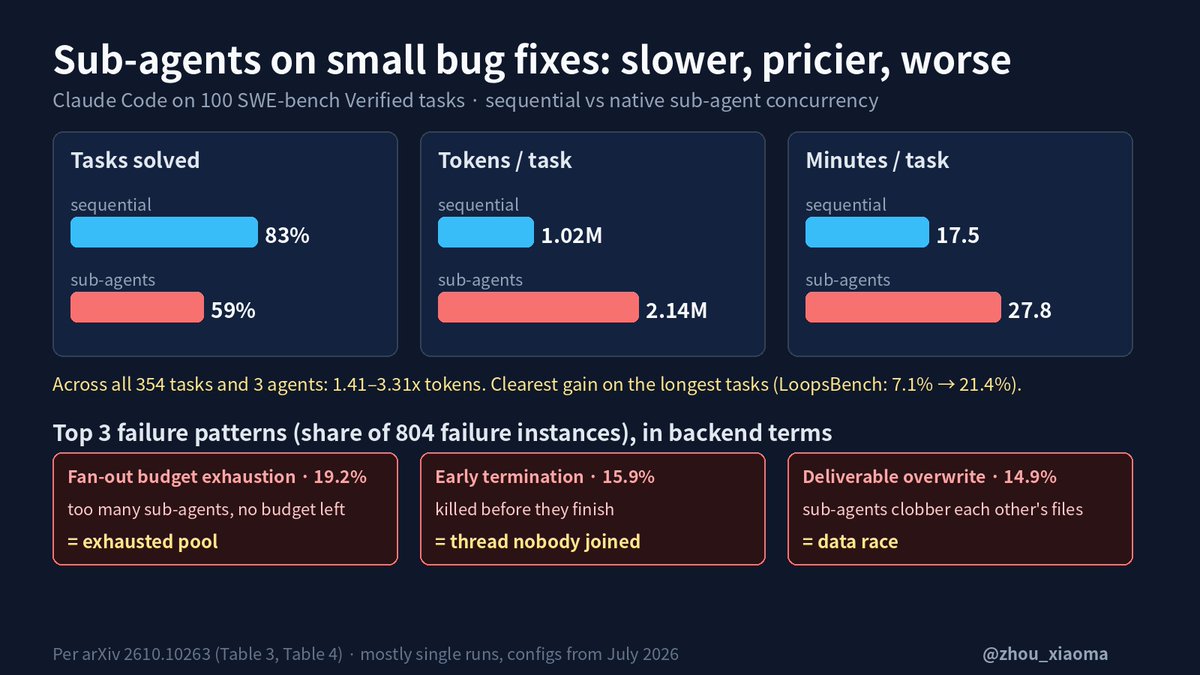
A comprehensive empirical study evaluated native sub-agent concurrency across 2,124 runs on Claude Code, Codex, and Kimi Code (354 tasks, ~$20.8K API cost). On 100 standard SWE-bench Verified tasks, enabling sub-agents caused Claude Code's solve rate to collapse from 83% to 59% (with latency increasing from 17.5 to 27.8 minutes) and Kimi Code from 77% to 59%, while token consumption inflated by 1.41x to 3.31x. The study revealed severe failure modes including budget-exhausting fan-outs, orphaned child processes, and concurrent delivery race conditions.

Empirical Benchmark Unmasks Sub-Agent Concurrency: SWE-bench Success Drops 24% as Token Costs Surge up to 3.3x

Key Takeaways

  • A $20,800 empirical study across 2,124 runs revealed the real costs of native sub-agent concurrency in Claude Code, Codex, and Kimi Code
  • On SWE-bench Verified, sub-agent concurrency dropped Claude Code's solve rate from 83% to 59% and Kimi Code from 77% to 59%
  • Token consumption inflated by 1.41x-3.31x while execution times lengthened, caused by thread race conditions and budget exhaustion
  • Delivered gains only on massive multi-file projects (LoopsBench: 7.1% to 21.4%); authors recommend sequential execution as the default
Read full story
Linked Models & Agents:

Moonshot ships Kimi Code Desktop: multi-agent Mac/Windows app for parallel long-horizon coding

@KimiDevs launched Kimi Code Desktop for Mac and Windows: a focused workspace to manage multiple agents, run tasks in parallel, and stay in sync on long-horizon programming work, aiming for faster and more reliable coding results.

Moonshot ships Kimi Code Desktop: multi-agent Mac/Windows app for parallel long-horizon coding

Key Takeaways

  • Official desktop client now available on macOS and Windows.
  • Manage multiple agents in one workspace with parallel task runs.
  • Built for long-horizon coding with ongoing agent sync and faster task completion.
Read full story
Linked Models & Agents:
ADSponsored