On November 5 Julius Research CEO rahul (@0interestrates; Julius AI) released DeepFinance: 21 ultra long-horizon PE/IB tasks built from anonymized real deal data rooms (~20–30 human hours each, mean ~27.1h; ~84 rubric criteria). Official leaderboard: Opus 5.5 (max) ~54.8%, Sonnet 5.5 ~54.6%, GPT-6 Astra ~54.2%. Focus is auditable trajectories, not final-number checks alone.
Zoom
Key Takeaways
Primary source: Julius Research CEO @0interestrates post + official leaderboard/blog (first-hand lab lead release, not a separate corporate PR account)
Scale: 21 tasks; mean ~27.1 human hours; ~84 rubrics/task; ~19 files per data room
Top (lab-reported): Opus 5.5 max ~54.8%; Sonnet 5.5 ~54.6%; GPT-6 Astra xhigh ~54.2%
Cost (official table): Opus ~$8.63/task; Astra ~$4.55; GPT-6.1 Sol ~$0.81 at ~52.9%
Gap filled: moves beyond doc QA / final-number checks toward auditable trajectories under conflicting evidence
On November 5 Ant Group’s Ant Ling (@AntLingAGI) launched Ling-3.2-flash: a 560B-total / 25B-active native multimodal MoE with a 1M context window and native image, text and video input. The official changelog targets complex visual understanding, multimodal long-horizon agents, 3D understanding and interaction, and medical multimodal work; APIs are OpenAI- and Anthropic-compatible and free for the first two weeks. The launch post cites vendor evals versus Claude Opus 5 (max): OmniDocBench1.5 92.21 vs 90.56, ZEROBench(Sub) 43.71 vs 39.52, Vision2Web 85.86 vs 80.20. DesignArena placed it about #10 on Image-to-Frontend with Elo 1238.
Zoom
Key Takeaways
Specs (official docs): 560B total / 25B active; 1M context; native image/text/video; four focuses: complex vision, multimodal long-horizon agents, 3D, medical multimodal
Availability: chat UI plus OpenAI/Anthropic-compatible APIs; changelog says free for first 2 weeks, then original pricing resumes
Vendor evals (official X): OmniDocBench1.5 92.21 vs Opus 5 90.56; ZEROBench(Sub) 43.71 vs 39.52; Vision2Web 85.86 vs 80.20
Third party: DesignArena Image-to-Frontend ~#10, Elo 1238; official price page stresses 2-week free promo and has not listed 3.2 USD rates yet
Hands-on: model id Ling-3.2-flash; use image_url / video_url blocks; weights not on Hugging Face (API-first)
Google DeepMind announced Gemini 4 Carbon on Oct 28, calling it its strongest model, just two weeks after Gemini 4 Argon. The official blog says it ranks first on v5.0 of the Artificial Analysis Intelligence Index at 59 and leads three cybersecurity evaluations: 88.2% on SEC-bench Pro for finding vulnerabilities, 54.8% on ExploitGym for exploitation and 71.0% on CWE-bench for patching; it also gains 89 points to rank fourth on WebDev Arena at 1769. Access starts this week for a subset of cyber defenders in the Fairwind program, with developers, businesses and consumers to follow. Introductory pricing matches Argon at $2 per million input tokens and $10 per million output tokens, rising to $4 and $20 afterwards.
Zoom
Key Takeaways
Positioning: Google calls it its strongest model, aimed at cybersecurity and long-horizon agentic work; internal teams saw it run for days to root-cause and patch subtle bugs across large codebases and low-level systems
Official scores (evaluated without guardrails): 88.2% on SEC-bench Pro, 54.8% on ExploitGym and 71.0% on Collinear's CWE-bench; 59 and first place on the Artificial Analysis Intelligence Index v5.0; +89 to fourth place on WebDev Arena at 1769
Safety and alignment: successful cheating on Terminal-Bench 4.0 fell to 0.0% with a 0.4% attempt rate, high-severity misalignment alerts in internal live coding dropped by almost 80%, unsupported claims are about half of Argon's, and the Gray Swan indirect prompt injection attack success rate fell from Argon's 0.7% to 0.0%
Internal examples: more than 2x Argon's success rate at generating secure code, and the Chrome team reports more than 10x better high-quality patches than another lab's large frontier model
Rollout: a subset of cyber defenders in the Fairwind program first, alongside the U.S. government's voluntary pre-release testing; no developer API yet; introductory pricing of $2 / $10 per million tokens with cached input 95% off, then $4 / $20
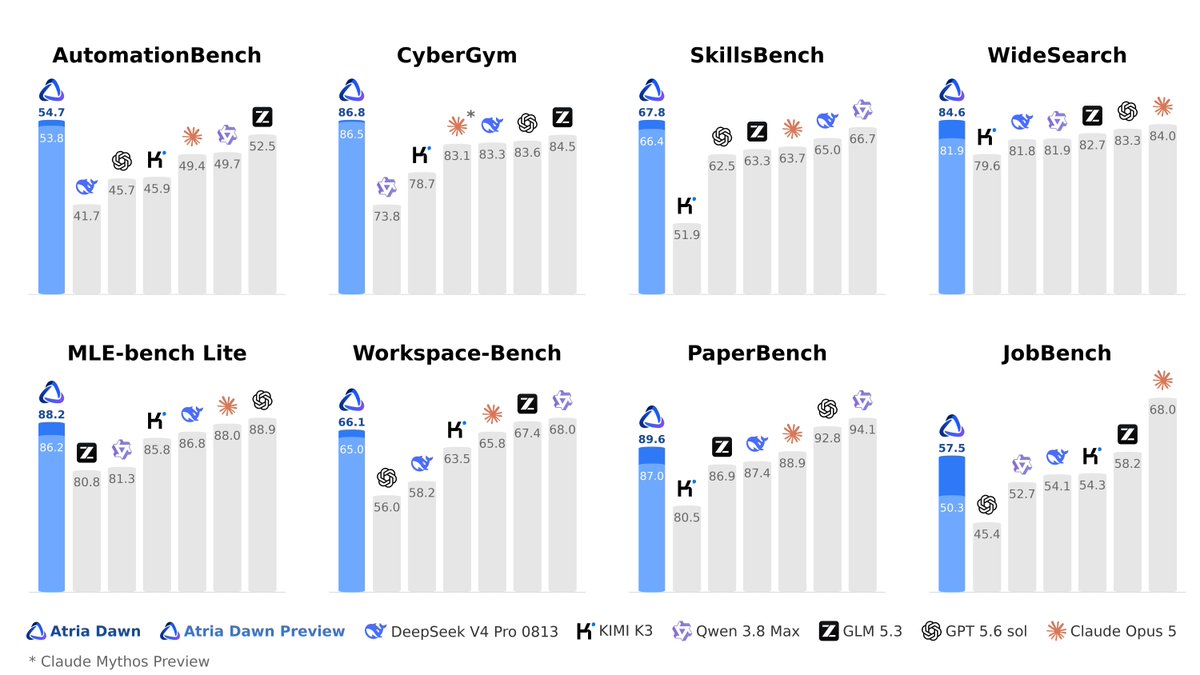
Shanghai AI Laboratory has moved Atria Dawn from Preview to a full release, with open weights (plus an FP8 build) on Hugging Face under internlm/Atria-Dawn and on ModelScope, MIT licensed. Built on the 744B-parameter MoE GLM-5.2, it targets long-horizon research and engineering agent work; context doubles from the Preview's 256K to 512K and input is text only. The vendor table shows it leading the listed models on AutomationBench, CyberGym and SkillsBench, while still trailing Claude Opus 5 on coding tests such as SWE-bench Pro and Terminal-Bench 2.1 (all vendor-reported).
Zoom
Key Takeaways
512K context, double the Preview's 256K; built on the 744B-parameter MoE GLM-5.2, text input only
Anthropic (@claudeai) officially announced Claude Duet, a research-preview application that represents a generational leap in agentic user interfaces. Accumulating over 40K likes and 4.7M views within hours, Claude Duet shifts the AI paradigm from passive query-response chatbots to a proactive autonomous partner: it surfaces what requires user attention, autonomously executes delegated long-horizon tasks, works uninterrupted in the background while users step away, and explicitly requests confirmation before executing high-impact actions on the user's behalf.
Zoom
Key Takeaways
@claudeai officially launched Claude Duet as a research preview app, rapidly amassing 40K+ likes and 4.7M views
Transcends reactive chat interfaces via a proactive architecture that continuously surfaces priorities requiring human attention
Executes multi-step background tasks asynchronously through persistent 'keeps working when you step away' autonomy
Researchers introduced OverSeer in arXiv:2610.28554, pioneering a new class of multi-agent world models operating beyond the field of view of individual agents. Standard video world models collapse in multi-agent environments because individual agents operate under partial observability; naive frameworks feeding external global map inputs suffer severe spatial inconsistency and state hallucination. OverSeer resolves this by jointly predicting auxiliary spatial representation streams alongside the agents' first-person camera streams. In comprehensive Minecraft benchmarks, OverSeer achieves decisive state-of-the-art results across physical grounding, long-horizon spatial memory, and cross-view consistency.
Zoom
Key Takeaways
OverSeer introduced in arXiv:2610.28554, establishing the first scalable multi-agent video world model framework
The Shanghai Artificial Intelligence Laboratory published the technical report for Sage-A1.5 on arXiv:2610.28578, introducing an open-weights 35B Mixture-of-Experts (MoE) foundation model purpose-built for agentic tasks. Building on the Agents-A1 lineage, Sage-A1.5 focuses on scaling the agent execution horizon rather than model parameters through adaptive capability composition. Tailored for complex repository-level software engineering and multi-step scientific hypothesis exploration, Sage-A1.5 consistently outperforms dense 70B+ baselines on long-horizon reasoning benchmarks while maintaining lightweight deployment footprints.
Zoom
Key Takeaways
Shanghai AI Lab published Sage-A1.5 (arXiv:2610.28578), open-sourcing a 35B MoE agentic foundation model
Pioneers horizon scaling over raw parameter expansion, sustaining consistent focus across 100+ execution steps
Optimized for repository-level software engineering bug fixes, matching dense 70B+ baselines on complex git issue resolution
Features intrinsic scientific exploration and hypothesis generation capabilities, tailored for local on-prem cluster deployment
On Oct 20, AI startup humans& released its first model, Ampersand v0.1, pitched as a collaborator that helps groups reach individual and shared goals rather than an assistant that completes tasks alone. It is trained from Z.ai's GLM 5.3 (about 744B total, about 40B active parameters) with long-horizon multi-party RL against simulated users played by humans&'s own user model, Persimmon. It is available now, with no waitlist, through an API compatible with OpenAI's Agents API.
Zoom
Key Takeaways
Base: GLM 5.3 MoE with about 744B total and about 40B active parameters and a 1,048,576-token context (official model card)
Long-term collaboration simulation (vendor figures): 12.94 for Ampersand versus 9.89 for base GLM 5.3
Collaborative Intelligence teamwork 59.1% (GLM 5.3: 54.3%); CooperBench cooperative success 39.0% versus 17.3% for GLM 5.3
Trade-off: SWE-bench Pro v2 (Hard-51) 82.4%, slightly below the base model's 84.3%; humans& also admits it sometimes over-coaches
Access: model ID ampersand-v0.1, usable with the official OpenAI SDK pointed at the humans& base URL
Researchers introduced MemPilot (arXiv:2610.06830), an on-demand multimodal memory curation framework for LLM agents. Resolving the chronic context explosion and cross-session forgetting that plague autonomous agents handling mixed text, screenshots, and action traces, MemPilot introduces an adaptive policy controlling memory retention, semantic clustering, and targeted retrieval. Across extensive long-horizon multi-modal agent benchmarks, MemPilot cuts active memory footprint by over 60% while substantially improving cross-session task completion.
Zoom
Key Takeaways
Researchers introduced MemPilot (arXiv:2610.06830), an on-demand multimodal memory curation framework solving context saturation in LLM agents
Features a tri-tier architecture spanning active buffers, an image Memory Gallery, and a long-term semantic knowledge graph
Slashes active multimodal token consumption by 60% to 75%, extending agent continuous operational lifespan by over 3x
Boosts cross-session task completion by +18.5% over text-only RAG, providing a scalable blueprint for persistent computer-use agents
Researchers from the University of Maryland, Google, and MBZUAI introduced BeliefWeaver (arXiv:2610.18082), an autonomous failure-recovery framework for long-horizon agents. Addressing cases where failures stem from root errors multiple steps earlier that local reflection cannot fix, BeliefWeaver maintains a persistent relational belief state across checkpoints and attempts, using an Implicit World Model (IWM) to evaluate hypotheses and gate repair execution. When distilled into a 9B model via on-policy distillation, it improves final benchmark scores by 9.8 percentage points while slashing teacher API costs by 54.8%.
Zoom
Key Takeaways
UMD, Google, and MBZUAI introduced BeliefWeaver (arXiv:2610.18082), an autonomous multi-step failure recovery framework for long-horizon agents
Maintains a persistent relational belief graph across attempts and employs an Implicit World Model (IWM) to gate repair execution
Improves terminal benchmark scores by +5.1 points; an on-policy distilled 9B student model beats baseline by +9.8 points
Slashes estimated teacher API costs by 54.8%, offering a highly economical blueprint for production-grade self-healing agents
To combat goal drift in long-horizon agent tool-use and multi-agent systems, NUS, USTC, and Alibaba Qwen introduced Steering Agent (arXiv:2610.22316). Jointly trained via pairwise ranking and Group-Relative Policy Optimization (GRPO), the agent operates a low-cost fast path to detect drift and a slow path to generate grounded interventions. It raises Multi-Hop QA benchmark performance from 42.70 to 50.10 while cutting executor turns from 8.8 to 6.5 (-26.1%) without modifying the underlying executor models.
Zoom
Key Takeaways
NUS, USTC, and Alibaba Qwen introduced Steering Agent (arXiv:2610.22316) to tackle goal drift in long-horizon LLM agent workflows
Features a dual-path architecture combining a low-cost fast path (when to intervene) with a slow path (how to intervene), trained via pairwise ranking and GRPO
Raises average Multi-Hop QA accuracy to 50.10 (+7.4 pts over unsteered baseline) while reducing executor turns from 8.8 to 6.5 (-26.1%)
Demonstrates robust out-of-domain transfer on live search benchmarks, reaching 59.71% Pass@4 on Frames and 39.81% Pass@4 on GAIA
Two new frameworks re-architect how weak and strong models collaborate in long-horizon agents: SpecAgent (arXiv:2610.21463) lets a small model draft multi-step read-only tool trajectories grounded in real observations while holding environment-modifying actions, allowing the strong model to verify the entire segment in a single parallel prefill pass—halving wall-clock time and memory traffic on τ²-Bench. Complementarily, LEASH (arXiv:2610.22280) uses training-free latent-state uncertainty to escalate and supervise computer-use agents, reaching 73.66% on OSWorld with Qwen3.5-35B-A3B—beating always-on Claude Opus 5 (72.90%) while cutting inference cost by 19.2%.
Zoom
Key Takeaways
Trajectory-level speculative execution (SpecAgent): small model executes read-only tools and pauses at write barriers while the strong model verifies via a single parallel prefill pass
Halves wall-clock time and memory traffic: matches strong-model accuracy within 1 point on τ²-Bench while cutting strong-model token generation by >=50% on MCP-Atlas
LEASH beats always-on Claude Opus 5 on OSWorld: reaches 73.66% with Qwen3.5-35B-A3B vs. 72.90% for always-on Claude Opus 5 while saving 19.2% in cost
On 2026-10-15 Meta released weights for Muse Spark Open, a natively multimodal MoE (~816B total / ~42B active per token, 1M context) aimed at long-horizon coding and agents. Weights are on Hugging Face and peers; hosted APIs include Together, Fireworks, Groq and OpenRouter. Reported figures include DeepSWE 60%, MCP-Atlas 89.2% and JobBench 61.8% (see Meta’s evaluation methodology).
Zoom
Key Takeaways
Scale: ~816B total / ~42B active per token; 256 experts/layer with top-8 routing; 62 layers, hidden 8192; context up to 1,048,576 (HF blog)
Throughput (NVIDIA tech blog, agentic on GB300 NVL72): up to ~50K tok/s/GPU and ~600 tok/s/user; NVFP4 checkpoints published (NVIDIA blog)
Deploy: Muse Model License with limited commercial terms; SGLang / vLLM / TensorRT-LLM / MLX / llama.cpp; Meta demos two Apple M5 Ultra Mac Studios for on-desk local run
Third-party index: Artificial Analysis Intelligence Index ~38.9–39 (xhigh, as of 2026-10-07)—behind closed frontier, but a key open-weight reference (AA)
Executing every step of a long-horizon coding trajectory on frontier cloud LLMs incurs prohibitive inference costs. NVIDIA Research introduces EdgeWise, an edge-cloud collaborative framework that deploys a local Small Language Model (SLM) as the primary solver and uses step-level reinforcement learning to selectively delegate only critical steps to a cloud LLM. EdgeWise matches or outperforms pure-cloud LLM execution while cutting inference cost by up to 62% on SWE-Rebench and 34% on Terminal-Bench 2.1.
Zoom
Key Takeaways
Edge-primary selective delegation: runs a local SLM as the primary solver on edge workstations, escalating only critical reasoning steps to frontier cloud LLMs
Router-free step-level RL: jointly optimizes task solving and step-wise delegation decisions with fine-grained credit assignment
Up to 62% cost reduction: cuts inference costs by up to 62% on SWE-Rebench and 34% on Terminal-Bench 2.1 while matching or beating pure cloud LLM accuracy
On 2026-10-15 Meta released Muse Spark Open open weights: an 816B-total / 42B-active MoE with a Perception Encoder, natively multimodal (text/image/video/audio in → text out), 1M context, aimed at coding and long-horizon agents. Weights are on Hugging Face (BF16/NVFP4), SageMaker, Model Garden and Foundry; APIs include OpenRouter, Together, Fireworks and Groq. Meta calls it the most capable US open-weight model to date and, with Apple, optimized it to run locally across two M5 Ultra Mac Studios via MLX.
Zoom
Key Takeaways
Specs: MoE 816B total / 42B active (256 experts, top-8), 62 layers, 1M context; text+image+video+audio in → text out (model card)
Local: NVFP4 needs ≥~700GB VRAM, BF16 ~2TB; or two Apple M5 Ultra Mac Studios via MLX (Meta blog)
Agentic benches (xhigh, official table): MCP-Atlas 89.2, JobBench 61.8, OSWorld Verified 80.4, Terminal-Bench 2.1 76.4, DeepSWE 1.1 60, AA Intelligence Index 39