AI Coding Live News

Meta Rolls Out Muse Realtime Avatar in the US Muse App: Speech-Driven Expression and Gesture at ~870ms First-Byte Latency

On November 5 Meta AI (@AIatMeta) said Muse Realtime Avatar, previewed at Connect, is rolling out in the US Muse app, turning Muse Realtime Voice into interactive live avatars. The research blog describes an audio-driven Diffusion Transformer that shares the speech-token stream with voice for lip-sync and expression; a single GB200 session streams 448×768 at 25 fps with about 870 ms from end of user turn to first synchronized audio-video byte, with Meta Video Seal invisible watermarking. Muse is for users 18+; no global schedule or developer API was announced.

Meta Rolls Out Muse Realtime Avatar in the US Muse App: Speech-Driven Expression and Gesture at ~870ms First-Byte Latency

Key Takeaways

  • US Muse app rollout of Realtime Avatar after the Connect preview (@AIatMeta)
  • Shared speech VQ tokens drive audio decode and avatar video; causal chunks with self-forcing distillation cut ~120 teacher NFEs to 2 student NFEs (~60x)
  • Vendor perf: 448×768@25fps, ~870ms first-byte latency; ~8x serving capacity vs BF16 baseline, up to 12 concurrent sessions on one GB200
  • Vendor preference study favored Muse over Runway Characters and HeyGen LiveAvatar on overall and most axes
  • Safety: Video Seal invisible watermark; blog demos are not the full in-app avatar set; no public developer API stated
Read full story
Linked Models & Agents:
⚡ Muse Spark⚡ Muse Presence🤖 Muse🌐 Meta

Conductor Is Joining Meta: The Multi-Agent Coding Tool Team Moves to MSL, Conductor Cloud Shuts Down on November 20

Charlie Holtz of Conductor announced on X on November 4 (18:18 UTC) that Conductor is joining Meta, where the team will build "the next interface" with Nat Friedman and Alexandr Wang at Meta Superintelligence Labs (MSL). The official announcement sets a timeline: from November 4 there are no new sign-ups and Pro features are free for existing users; on November 13 Conductor Cloud goes read-only and active subscribers get refunds; on November 20 Cloud shuts down and cloud data deletion begins; the local app keeps getting new models and critical fixes until early 2027. Terms were not disclosed.

Conductor Is Joining Meta: The Multi-Agent Coding Tool Team Moves to MSL, Conductor Cloud Shuts Down on November 20

Key Takeaways

  • Conductor launched in July 2025 as a tool for running a team of coding agents at once (it runs first-party agents such as Claude Code, Codex, Cursor and OpenCode under the hood), and its site claims 100k+ builders.
  • The team joins Meta Superintelligence Labs to work with Nat Friedman and Alexandr Wang; the official word on the new product is only "early next year", with no details.
  • Key dates: sign-ups and downloads stop on Nov 4, Cloud goes read-only with refunds on Nov 13, Cloud shuts down and data deletion starts on Nov 20, and the local app is maintained until early 2027.
  • To migrate, right-click a cloud workspace and choose Transfer to local, or export everything via Settings, Account, Export data.
  • Terms were not disclosed; on the same day HumanLayer announced it is joining Factory, a sign the coding-agent tooling market is consolidating quickly.
Read full story

AMD Q3 2026: Data Center Revenue Up 97% to $8.5B, First Helios Racks Running for Anthropic and OpenAI, Q4 Guide About $17B

AMD reported Q3 2026 results on November 3. Total revenue was $13.377B, up 45% year over year, and the Data Center segment hit a record $8.546B, up 97% year over year and 27% sequentially, driven by EPYC server CPUs and the newly launched Instinct MI450 Series GPUs. AMD says Anthropic, Meta, Microsoft, OpenAI and Oracle Cloud Infrastructure are running models and workloads on the first Helios rack-scale systems. It guided Q4 revenue to about $17B, plus or minus 3%, roughly 66% year-over-year growth at the midpoint.

Key Takeaways

  • Data Center revenue was $8.546B, up 97% year over year and 27% sequentially, about 64% of total revenue versus roughly 47% a year ago; segment operating income was $2.882B at a 34% margin
  • The first Helios racks (Instinct MI450 Series GPUs plus 6th Gen EPYC) are running models for Anthropic, Meta, Microsoft, OpenAI and Oracle Cloud, and MI455X began volume shipments this quarter
  • Total revenue was $13.377B (+45%), with 56% non-GAAP gross margin and $2.09 non-GAAP EPS; GAAP net income of $2.428B includes a $1.097B fair-value change on customer warrants
  • Q4 guidance is about $17B plus or minus 3%, roughly +66% year over year and +27% sequentially at the midpoint, with about 55% non-GAAP gross margin
  • AMD also released ROCm 10 with ROCm.AI, introduced the Helion reference architecture for rack-scale agentic systems, and announced agreements to acquire World Labs and Taalas
Read full story

X Discussion: Grok Bot Engineer poteto Calls Adversarial Agent Code Reviews "Mostly a Waste of Tokens" and Argues for Empirical Plus Formal Verification Instead

On November 3, @poteto (lauren), whose bio says she works on Grok @bot at SpaceXSI, is on the React Compiler core team, and previously worked at Cursor, Meta and Netflix, posted what she called "maybe a hot take": she now considers adversarial reviews mostly a waste of tokens and thinks those tokens are far better spent on empirical combined with formal verification. She says she has updated her agent skill pack pstack to use its interrogate (multi-model adversarial review) skill less and may eventually remove it. She adds that she has found very little value in code review in the abstract, because agents tend to get lost in nitpicks and YAGNIs. The post drew about 906K views, 9,227 likes and 5,538 bookmarks. It is a personal opinion that sparked debate over the value of AI code review.

Key Takeaways

  • Opinion (personal, not an official finding): adversarial reviews are "mostly a waste of tokens"; empirical plus formal verification is the better use of them
  • Action: the author says she has made pstack use the interrogate skill less and may remove it; at fetch time the public pstack folder in GitHub cursor/plugins had no commits after October 27, so the change is not visible there yet
  • What interrogate is: per its public SKILL.md, it spawns one read-only reviewer per configured model (defaults Claude Opus 5.5 xhigh and Grok 4.7 xhigh fast) to attack the diff, then sorts findings into Act on, Consider, Noted and Dismissed without auto-applying fixes
  • Author (per her X and GitHub bios): engineer on Grok Bot at SpaceXSI, React Compiler core team, previously at Cursor, Meta and Netflix
  • Reach: about 906K views, 9,227 likes, 5,538 bookmarks, 668 replies, 356 reposts and 210 quotes
Read full story
ADSponsored

X discussion: Flask creator Armin Ronacher says an Opus 5.5 agent could re-implement all of CPython in about two weeks with no human input, sparking a debate over whether the value is in the test suite

Flask creator Armin Ronacher (@mitsuhiko) posted on November 1 that he is convinced an Opus 5.5 agent could now re-implement all of CPython in about two weeks against just the tests, with no human input, possibly with ABI compatibility, no GIL, a JIT, and better numbers on every measurable metric. The post had about 1,637 likes, 98K views and 162 replies. He later added that a rewrite does not strictly need an existing test suite, and that having the agent build its own tests is often better for porting. antirez agreed, while Mario Zechner and Meta engineer Kevin Newton pushed back. This is a personal prediction; no such rewrite has been done.

Key Takeaways

  • Original post: @mitsuhiko, Nov 1, 11:52 UTC, about 1,637 likes, 269 bookmarks, 162 replies and 98K views at fetch time
  • His core claim: given just the tests and no human input, an agent could rewrite CPython in about two weeks, "probably" with full compatibility including ABI, no GIL and a JIT, which he called "completely crazy"; it is a prediction, not an experiment
  • Follow-up post (14:07 UTC, about 212 likes): an existing test suite is not required, and many pre-existing tests are bad for hill climbing; he says an agent he ran a few weeks ago re-implemented the Excel formula engine and built its own test suite from scratch
  • antirez (creator of Redis) agreed that you can ask an agent to build a large test suite before starting a port; Mario Zechner disagreed, saying his problem with agents is trust and pre-existing test and conformance suites increase it
  • Meta engineer Kevin Newton pushed back that very few Python JITs have succeeded because of complexity and compatibility, and that a good one without human input is unrealistic; others noted that under PEP 703 the free-threaded build is not ABI-compatible with the standard one
Read full story
Linked Models & Agents:

Shopify Fall ’26 Edition bets on agentic commerce: Shop.md shopping skill, Shop.dev single connection, and Shop Pay inside Muse, Claude Duet, Grok Bot and other personal agents

On Oct 28 Shopify shipped its 10th Edition (Fall ’26, theme Exponential, 150+ updates including 57 for developers), centered on opening its catalog, cart and checkout to any agent. Shop.dev gives one connection to Shopify Catalog (1B+ products), sign-in with Shop, cart, checkout and Shop Pay; Shop.md is a customizable skill that turns ChatGPT, Claude or other agents into personal shoppers; Shop Pay now works inside Meta’s Muse, Claude Duet and Instinct, and Claude Duet, Grok Bot and Instinct can also use it for brands not on Shopify. Every Liquid and Hydrogen storefront and checkout now exposes WebMCP tools.

Shopify Fall ’26 Edition bets on agentic commerce: Shop.md shopping skill, Shop.dev single connection, and Shop Pay inside Muse, Claude Duet, Grok Bot and other personal agents

Key Takeaways

  • Scale (vendor figures): Shopify Catalog has 1B+ products and Shop Pay 400M+ shoppers; the Edition has 150+ updates, 57 of them for developers
  • Shop.dev is one connection for Catalog, sign-in with Shop, cart, checkout and Shop Pay; the underlying Shop MCP server is mcp.shop.com and search needs no API key
  • Shop Pay in personal agents starts with Muse from Meta, Claude Duet and Instinct; Claude Duet, Grok Bot and Instinct can also buy from brands off Shopify, with the card never shared with the agent and tokens from Mastercard, Visa and Discover (Amex coming)
  • WebMCP tools ship on every Liquid and Hydrogen storefront and checkout so browser agents can search, update the cart and check out after buyer approval
  • For developers: a one-command app security check in the Shopify CLI AI Toolkit, and a rebuilt Hydrogen plus the open-source Next.js Vercel Shop template are now generally available
Read full story

Meta launches its Muse personal AI agent in Singapore with eight local partners including Shopee, Grab and Singapore Airlines

On Oct 28 Meta announced that Muse, its personal AI agent, is now available in Singapore on iOS, Android and muse.ai. Beyond Gmail, Google Calendar and Instagram, the first local connector partners are Shopee, Grab, Singapore Airlines, Agoda, ShopBack, Klook, Trip.com and Lazada, spanning shopping, groceries, dining and travel, with some connector features rolling out after launch. Muse runs on Muse Secure VM, a dedicated cloud computer that keeps passwords and payment methods out of the agent's view, and it asks before sensitive actions such as sending an email or making a purchase. It is free for most uses, with paid subscription plans.

Meta launches its Muse personal AI agent in Singapore with eight local partners including Shopee, Grab and Singapore Airlines

Key Takeaways

  • Muse is now available in Singapore on iOS, Android and the web at muse.ai, with AI glasses support "coming soon"
  • Eight initial local connector partners: Shopee, Grab, Singapore Airlines, Agoda, ShopBack, Klook, Trip.com and Lazada, with some features rolling out after launch
  • Users can compare prices on Shopee and Lazada, plan groceries and dining via GrabMart and Grab Dine Out, and explore travel and bookings via Singapore Airlines, Agoda, Klook and Trip.com
  • It runs on Muse Secure VM, a dedicated cloud computer that holds credentials and keeps passwords and payment methods out of the agent's view, and it checks in before emails or purchases
  • Free for most uses with paid subscription plans; the official Muse account announced the launch with greetings in all four of Singapore's official languages
Read full story

X discussion: OpenAI Codex/ChatGPT lead Tibo posts a hiring call to "scale dots to 1B users", and Meta chief AI officer Alexandr Wang replies with a Muse jab

At 19:21 UTC on 2026-10-24, Tibo (@thsottiaux), whose X bio reads "Codex & ChatGPT @OpenAI", posted: "DM if you want to help scale dots to 1B users and have done similar things in the past" (post); it had about 5,524 likes, 1,506 replies and 710K views when we pulled it. Alexandr Wang (@alexandr_wang), whose X bio says he is chief AI officer at Meta, replied "oops you misspelled muse" (about 1,935 likes), and Tibo shot back with "Celebrate your 12 users" (about 1,845 likes). The public back-and-forth between the two companies' executives became one of the most talked-about AI threads of the past half day. It is a hiring post and banter between executives, not a user count or product plan published by OpenAI.

Key Takeaways

  • Main post: Tibo's post, about 5,524 likes, 126 reposts, 131 quotes, 1,506 replies, 515 bookmarks and 710K views when we pulled it
  • Alexandr Wang replied "oops you misspelled muse" (post), about 1,935 likes and 240K views; Muse is the Meta model and product name he has been promoting lately
  • Tibo fired back: "Step 1: Quit posting butts and go buy containers / Step 2: ??? / Step 3: Celebrate your 12 users" (post), about 1,845 likes and 185K views
  • Wang answered "is the implication you have under 12 users?" (post), about 222 likes
  • "1B users" is a goal stated in a hiring post; OpenAI has not published Dots' actual user count, so this entry is treated as an X discussion
Read full story
Linked Models & Agents:

NVIDIA launches OpenShell Reference Architecture at GTC Berlin: Vera Rubin, Vera CPUs and BlueField-4 Sentry for hardware-enforced safe AI agents

At GTC Berlin on Oct 21, NVIDIA announced the OpenShell Reference Architecture: building on the open-source OpenShell secure runtime, it pairs Vera Rubin for inference, Vera CPUs for agent harnesses, and BlueField-4 DPUs running NVIDIA Sentry for in-silicon policy enforcement, so enterprises can build, contain, observe and govern agents on-prem and at the edge. NVIDIA says it is available now; partners named include Anthropic, OpenAI, Meta, Microsoft and ServiceNow. The software is Apache 2.0.

NVIDIA launches OpenShell Reference Architecture at GTC Berlin: Vera Rubin, Vera CPUs and BlueField-4 Sentry for hardware-enforced safe AI agents

Key Takeaways

  • Full stack: Vera Rubin for model inference, Vera CPUs for agent harnesses/tool use, BlueField-4 + Sentry for in-silicon policy and quarantine (vendor claims)
  • Vendor claims: Vera Rubin NVL72 about 30x throughput per megawatt on agentic workloads; Sentry can quarantine a boundary-breaking agent in milliseconds and boost agent capacity by up to 20%
  • Runtime: deny-by-default, enforcement outside the agent process; sandboxes have no direct network, syscalls are filtered in-kernel, credentials are injected only onto allowed requests
  • Stated agent paths include Claude Code, Codex, GitHub Copilot CLI, OpenCode, OpenClaw, LangChain Deep Agents; deploy with Docker, Podman or Kubernetes via Helm
  • Start: curl install script then openshell sandbox create; docs at docs.nvidia.com/openshell; GitHub NVIDIA/OpenShell (Apache 2.0) and PyPI package openshell
Read full story

Evolving Agent Interfaces: Empowering Computer-Use Agents to Synthesize Dynamic APIs for 58.58% Success

Researchers introduced 'Evolving Agent Interfaces' alongside the Agent S4 meta-framework in arXiv:2610.28601, removing the fundamental bottleneck of computer-use agents (CUAs). Conventional CUAs are forced to operate through human-designed graphical user interfaces—such as clicking spreadsheet cells one by one—inducing excessive action horizons and high failure rates. The new framework allows meta-agents to inspect live applications in scratch environments, dynamically synthesizing, testing, and evolving programmatic API wrappers and tool repositories on the fly. On OSWorld V2 and ScienceBoard, an open-weights 27B model raised task success from 55.03% to 58.58%, rivaling proprietary frontier models at a fraction of the cost.

Evolving Agent Interfaces: Empowering Computer-Use Agents to Synthesize Dynamic APIs for 58.58% Success

Key Takeaways

  • Evolving Agent Interfaces introduced in arXiv:2610.28601, pioneering dynamic API synthesis for computer-use agents (CUAs)
  • Meta-agents autonomously probe target applications in scratch VMs, writing bespoke programmatic wrappers to replace fragile GUI clicks
  • Elevates task completion rates on OSWorld V2 and ScienceBoard from 55.03% to 58.58% on an open 27B parameter model
  • Significantly compresses action sequences and token budgets, establishing an evolutionary paradigm for OS-level agent autonomy
Read full story
Linked Models & Agents:
ADSponsored

Krafton AI Open-Sources Raon-1 Mini: A 30B MoE with 4B Active Parameters Matching Muse Glimmer on Coding Autonomy

Krafton AI, the research division of global gaming giant Krafton, officially announced the open-weights release of Raon-1 mini under Apache 2.0. Pretrained from scratch, Raon-1 mini features a sparse Mixture-of-Experts (MoE) architecture with 30 billion total parameters and only 4 billion active parameters per token. The release is accompanied by a dedicated DFlash speculative drafting model and a live interactive playground. Internal evaluations reveal that Raon-1 mini matches Meta's Muse Glimmer across agentic tool-use and coding benchmarks while requiring substantially lower VRAM and sustaining lower generation latency.

Krafton AI Open-Sources Raon-1 Mini: A 30B MoE with 4B Active Parameters Matching Muse Glimmer on Coding Autonomy

Key Takeaways

  • Krafton AI released Raon-1 mini under Apache 2.0, architecting a 30B total / 4B active parameter sparse MoE model
  • Trained entirely from scratch, matching Meta's Muse Glimmer across agentic coding and multi-turn tool orchestration
  • Bundled with a dedicated DFlash draft model for high-throughput speculative decoding on consumer-grade workstations
  • Accompanied by a live public evaluation playground, providing a viable open backbone for local gaming and coding copilots
Read full story
Linked Models & Agents:
⚡ Raon-1 mini⚡ Muse Glimmer🌐 Krafton AI

Gradium open-sources Phonon on-device TTS: a 31M-parameter, 64 MB model that starts speaking in 7 ms on a laptop CPU, with the English version under Apache 2.0

On Oct 20, French voice AI company Gradium open-sourced Phonon, a family of on-device text-to-speech models: the English Phonon 31m (64 MB q8 weights, Apache 2.0) and Phonon 40m (single-language English, French, German, Spanish and Portuguese variants plus a five-language model, CC BY-NC non-commercial). Built on Kyutai's Pocket TTS and the Mimi codec, it ships its own runtime for CPU, Metal, CUDA, Vulkan, WebGPU, Core ML and Snapdragon, running offline on phones, browsers and a Raspberry Pi. Gradium reports 7 ms to first audio on a MacBook Air M5 CPU versus 517 ms for Kokoro.

Gradium open-sources Phonon on-device TTS: a 31M-parameter, 64 MB model that starts speaking in 7 ms on a laptop CPU, with the English version under Apache 2.0

Key Takeaways

  • Check the license: only the English Phonon 31m is Apache 2.0 for commercial use; every Phonon 40m variant, including multilingual, is CC BY-NC 4.0 and needs a deal with Gradium for commercial use
  • Size (official): 64 MB q8 weights for 31m and 74.6 MB for 40m; 37 built-in English voices, 102 in the multilingual model, plus voices cloned or designed with Gradium
  • Speed (vendor-measured): 6.9 ms to first audio and 29.9x real time on a MacBook Air M5 CPU with 4 threads, versus 517 ms for Kokoro (which does not stream); 38 ms and 3.7x real time on a Raspberry Pi 5; 7.5 ms on Snapdragon 8 Elite Gen 5
  • Accuracy (vendor-built hard-sentence set, 500 per language, public on HF): English WER of 1.70% for 31m and 2.22% for 40m versus 3.50% for Kokoro and 8.71% for NeuTTS Nano, with text normalization for numbers, dates and version strings
  • Get started with uvx ptts or pip install ptts, the phonon-tts npm package for browsers, or the gradium-ai/xn-ptts runtime on GitHub
Read full story
Linked Models & Agents:
⚡ Phonon 31m⚡ Phonon 40m⚡ Phonon 40m multilingual⚡ Pocket TTS⚡ Kokoro🤖 Pipecat🌐 Gradium🌐 Kyutai🌐 Arm🌐 Qualcomm🌐 Hugging Face

Google and Meta open-source TorchTPU: native PyTorch on TPUs, where porting is as simple as .to("cuda") to .to("tpu"), with native TPU backends for vLLM and SGLang

At PyTorch Conference 2026 on Oct 20, Google open-sourced TorchTPU on GitHub, co-developed with Meta's PyTorch team, making TPUs a native PyTorch device alongside GPUs and CPUs: eager mode and torch.compile, about 450 ATen ops, and torch.distributed collectives. Google also released vLLM-TorchTPU and SGLang-TorchTPU engines, integrations with TorchTitan, Ray, VeRL and Hugging Face Transformers v5 (device_map="tpu"), and a preview TPU agent suite for coding assistants such as Claude Code and Antigravity. AWS shipped the comparable TorchNeuron a day earlier.

Google and Meta open-source TorchTPU: native PyTorch on TPUs, where porting is as simple as .to("cuda") to .to("tpu"), with native TPU backends for vLLM and SGLang

Key Takeaways

  • Porting (official PyTorch blog): existing code runs by changing model.to("cuda") to model.to("tpu") and the distributed backend to tpu_dist; the team notes peak TPU performance still needs TPU-aware shapes and sharding
  • Coverage (vendor-reported): 98% of about 4,917 popular Hugging Face models (4,821) run without crashing, and 97% of 657 architecture representatives (638) match GPU numerics
  • Training scale (vendor-reported): Qwen3 MoE 235B on TorchTitan scales from 1,024 to 8,192 TPU v7 chips with MFU roughly flat at 27-29%; on 64 TPU v7 chips it reaches 1,828 TPS versus 1,937 TPS for JAX/MaxText
  • Inference cost (Google citing SemiAnalysis InferenceX): TPU v7 with vLLM-TorchTPU hits 2.01 cents per million tokens on 8K/1K, down from 3.6 cents at its September debut
  • Four repos open-sourced: torch_tpu, vllm-torchtpu, sglang-torchtpu and a TPU TorchTitan; the TPU agent suite is in preview for TPU v6e and TPU7x
Read full story

Meta Releases Muse Glimmer 30B: An Apache 2.0 On-Device Agentic Model Running on a Single Consumer GPU

Meta AI published the technical report for Muse Glimmer 30B (arXiv:2610.24628), an open-source 30-billion parameter causal language model with an integrated perception encoder designed for on-device autonomous agents. Quantized to approximately 4 bits, Muse Glimmer operates inside 32GB of VRAM on a single consumer GPU (such as an RTX 5090) without cloud reliance. On rigorous agentic evaluations, Muse Glimmer sets new records for its size class: achieving 75.5 on MCPAtlas (surpassing Gemma4-31B at 54.2 and Qwen3.6-27B at 62.5) and 51.2 on SWE-Bench Pro, released fully under the Apache 2.0 license.

Meta Releases Muse Glimmer 30B: An Apache 2.0 On-Device Agentic Model Running on a Single Consumer GPU

Key Takeaways

  • Meta released the technical report for Muse Glimmer 30B (arXiv:2610.24628), open-sourcing the agentic foundation model under Apache 2.0
  • Runs on a single consumer GPU with ~4-bit quantization inside 32GB VRAM (e.g. RTX 5090), enabling 100% offline edge autonomy
  • Scores 75.5 on MCPAtlas tool use benchmark, outperforming Gemma4-31B (54.2) and Qwen3.6-27B (62.5) by wide margins
  • Achieves 51.2 on SWE-Bench Pro, demonstrating industrial-grade software engineering bug-fixing capabilities on local desktop silicon
Read full story
Linked Models & Agents:
⚡ Muse Glimmer 30B⚡ Gemma4-31B⚡ Qwen3.6-27B🌐 Meta

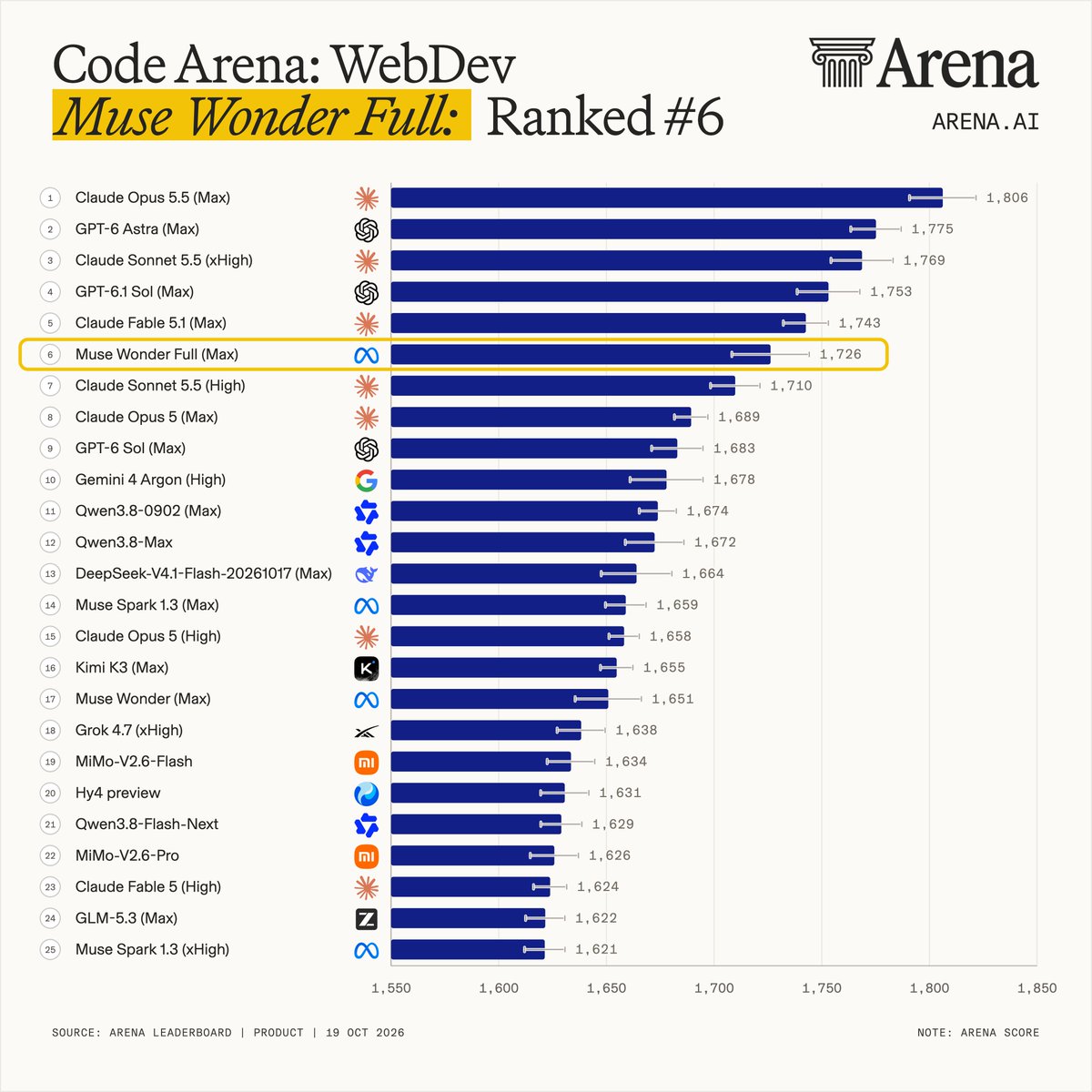
Meta Unveils Gigawatt-Scale Prometheus Supercluster as Muse Wonder Secures #6 on WebDev Code Arena

Meta officially disclosed its gigawatt-scale AI supercluster Prometheus in New Albany, Ohio, housing hundreds of thousands of frontier GPUs with 85%+ pretraining goodput and 90%+ in reinforcement learning. Powered by this infrastructure, Meta's latest coding flagship Muse Wonder Full surged to #6 globally on LMSYS Code Arena: WebDev with 1726 Elo points (surpassing Claude Sonnet 5.5 and Gemini 4 Argon), lifting Meta to the #3 AI research lab worldwide.

Meta Unveils Gigawatt-Scale Prometheus Supercluster as Muse Wonder Secures #6 on WebDev Code Arena

Key Takeaways

  • Meta unveiled its gigawatt-scale Prometheus supercluster in Ohio with hundreds of thousands of GPUs, delivering 85%+ pretraining goodput
  • Exceeded 90%+ goodput on RL workloads, recording ~47,000 GPU-hours MTBF during Muse Wonder's training cycle
  • Muse Wonder Full scored 1726 Elo on LMSYS Code Arena: WebDev (#6 globally), outperforming Claude Sonnet 5.5 (+16) and Gemini 4 Argon (+48)
  • Elevated Meta to the #3 AI lab worldwide; confirmed Muse Glimmer 30B open weights capable of 4-bit local execution on a single consumer GPU
Read full story
Linked Models & Agents: