AI Coding Live News

Moonshot Releases Kimi K3.1 Pro Open Weights on Hugging Face: 2.8T-Parameter, 104B-Active MoE in MXFP4 at About 1.56TB, Custom License Limits Large Model-as-a-Service Use

The official Kimi account @Kimi_Moonshot announced the Kimi K3.1 Pro model weights at 16:00 UTC on November 4; the moonshotai/Kimi-K3.1-Pro repository is public and not gated. The model card describes a natively multimodal MoE with 2.8T total and 104B active parameters and a 1M-token context, shipped as MXFP4 weights from quantization-aware training, about 1.56TB in total; vLLM, SGLang and TokenSpeed are the recommended engines. The license allows free use and modification, but Model-as-a-Service businesses with over $20M in annual revenue need a separate agreement.

Moonshot Releases Kimi K3.1 Pro Open Weights on Hugging Face: 2.8T-Parameter, 104B-Active MoE in MXFP4 at About 1.56TB, Custom License Limits Large Model-as-a-Service Use

Key Takeaways

  • Architecture: 93 layers (1 dense), 69 KDA plus 24 Gated DSA attention layers, 896 experts with 16 selected per token plus 2 shared experts, and a 401M MoonViT-V2 vision encoder.
  • Compared with K3, the full-attention Gated MLA layers are replaced with Gated DeepSeek Sparse Attention for more efficient long-context modeling.
  • Vendor-reported scores on the model card: Terminal-Bench 4.0 65.7 (Opus 5.5 66.4), SWE Marathon v1.1 51.7 (Opus 5.5 46.3), HLE-Full with tools 70.0 and BrowseComp 92.1; ProgramBench 31.5 trails Opus 5.5 at 65.0.
  • License: a Model-as-a-Service business with over $20M revenue in any 12 months needs a separate agreement with Moonshot, and products above 100M monthly users or $20M monthly revenue must prominently display "Kimi K3.1-Pro"; internal use is exempt from both.
Read full story

LiberAI Unveils Liber-0 World Action Model: Pretrained on 2.2M Hours of Human Experience, 36% Zero-Shot Success Across 60 Manipulation Tasks

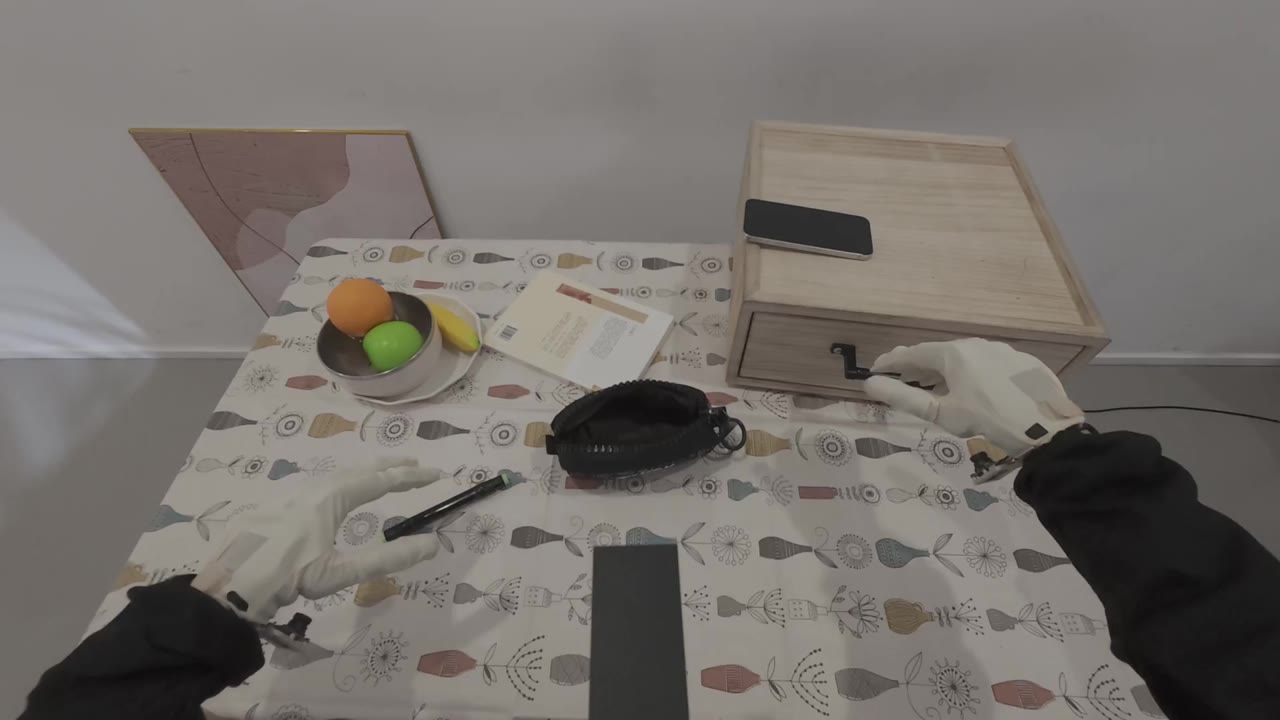
Robotics company LiberAI announced Liber-0 on its official X account and technical blog. It is a World Action Model that jointly predicts future frames and actions, pretrained on more than 2.2 million hours of human experience and anchored by precise hand-motion data from its own LiberSense Glove. On 60 tasks proposed by GPT-6 across 600 trials, Liber-0 reached 36.0% overall success without robot demonstrations collected for those tasks, but only 10.5% on challenging multi-step tasks. No open weights or API have been announced.

LiberAI Unveils Liber-0 World Action Model: Pretrained on 2.2M Hours of Human Experience, 36% Zero-Shot Success Across 60 Manipulation Tasks

Key Takeaways

  • Zero-shot results: 63.5% on pick-and-place, 34.0% on short non-pick-and-place tasks and 10.5% on challenging multi-step tasks, 36.0% overall (60 tasks x 10 trials)
  • For comparison, GPT-6 Astra used alone as a robot policy scored 8.3%, 5.0% and 1.7% on the same three task groups, with 87.3 s of reasoning per decision
  • 10K hours of glove data beat 200 times more web human video (2,000K hours), suggesting precise action labels matter more than raw video volume
  • Glove data plus 25% of the robot demonstrations reached a progress score of 75.6, above the 72.8 from robot-only training with the full pool, using 75% fewer robot demos
  • All figures are LiberAI self-reported internal evaluations; no open weights, API or commercial timeline has been announced
Read full story
Linked Models & Agents:

Tencent Releases Hy4: First Hy Model With Vision and Computer Use, Live on Tencent Cloud and OpenRouter, Open Weights Planned

On November 4, Tencent Hy published Hy4 on its official site. Versus Augusts Hy4 preview, Tencent says it scaled up pre-training and post-training, added vision for the first time, added computer use across CLI and GUI, and trained specifically on Blender, CAD and engines like Unreal, Unity and Godot. Hy4 is live on Tencent Cloud and OpenRouter (tencent/hy4, 1M context) at the same API price as the preview. Weights and a system card are promised soon, and a cheaper Hy4 flash is coming.

Key Takeaways

  • Official blog: Introducing Hy4, dated 2026-11-04; the Tencent Hy transparency center also lists V1.0 Hy4
  • Two firsts: vision (fine-grained image detail, complex charts, math visual reasoning) and computer use (CLI plus GUI, with targeted training on Blender, CAD and long cross-app workflows)
  • Tencent's own evals: on 579 real finance tasks rated by 213 finance professionals Hy4 scores 3.04, first among open-weight models (DeepSeek-V4.1-Flash-1017 2.97, Kimi K3.1 Pro 2.68, GLM-5.3 2.68); GameDev +19.1%, GameLogic +9.8%; internal search hallucination rate 15.76% to 5.45%
  • Same API price as the preview: $0.042 cached input, $0.834 input, $2.501 output per million tokens; the OpenRouter page currently shows 50% off ($0.417/$1.251), 1,048,576 context and up to 65,536 output tokens
  • Weights are not out yet: Tencent says it will open-source them with a full system card, working with vLLM and SGLang; Hy4 flash is due soon
Read full story
Linked Models & Agents:
⚡ Hy4⚡ Hy4 preview⚡ Hy4 flash🤖 CodeBuddy🤖 WorkBuddy🌐 Tencent

Mistral releases the open weights of Mistral Large 4 "Le Chonk": a 1T-total, ~52B-active multimodal MoE that Mistral says leads open models on FrontierCode 2.0

On Oct 29 Mistral released an improved Mistral Large 4 (Le Chonk) with open weights on Hugging Face (plus an NVFP4 quantized checkpoint), served on its API as mistral-large-4. After about three more weeks of reinforcement learning since the early-October preview, Mistral reports 19.7% on FrontierCode 2.0, Terminal-Bench 4.0 up from 28% to 41%, and new low/medium/high reasoning modes. The license is a modified MIT that allows commercial use, but running a model-as-a-service business needs a separate commercial license.

Mistral releases the open weights of Mistral Large 4 "Le Chonk": a 1T-total, ~52B-active multimodal MoE that Mistral says leads open models on FrontierCode 2.0

Key Takeaways

  • Specs: about 1T total parameters with 49B active per token (about 52B including embeddings and output layers), 128 routed experts with 4 active plus 1 shared expert, 1M context, text and image input
  • Per Mistral: 19.7% on Cognition's FrontierCode 2.0, ahead of DeepSeek V4.1 Flash at 19.3% and GLM-5.3 at 17.8%, first among open models
  • 48% on the Artificial Analysis Coding Agent Index, roughly tied with GLM-5.3 while using 47% fewer tokens per task on average; Terminal-Bench 4.0 rose from 28% in preview to 41%
  • 51% on the Artificial Analysis Cyber Index, and a 96.6% average refusal rate on malicious cyber requests, which Mistral says is the highest among open models
  • Trained from scratch on 3,800 NVIDIA Grace Blackwell GPUs in Mistral's own European datacenters; in Surge Code blind pairwise tests it ranked behind only Claude Opus 5.5
Read full story
Linked Models & Agents:
ADSponsored

Shanghai AI Lab ships Atria Dawn full release: 744B MoE GLM-5.2 agentic model, context doubled to 512K, MIT weights

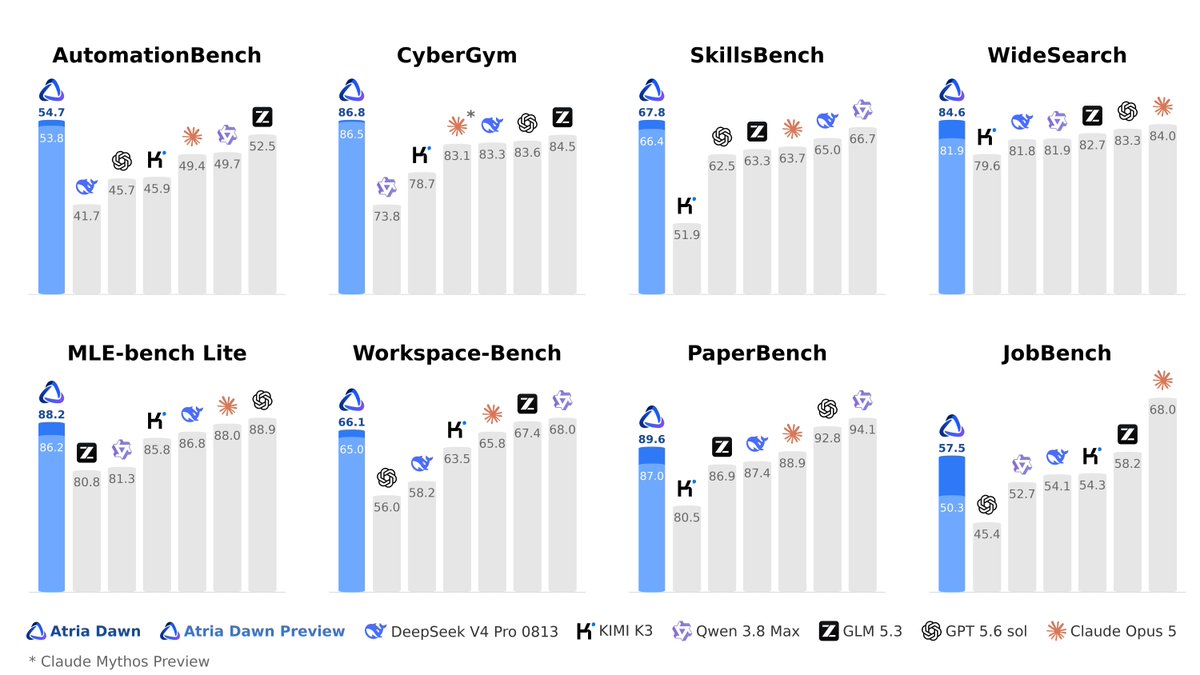
Shanghai AI Laboratory has moved Atria Dawn from Preview to a full release, with open weights (plus an FP8 build) on Hugging Face under internlm/Atria-Dawn and on ModelScope, MIT licensed. Built on the 744B-parameter MoE GLM-5.2, it targets long-horizon research and engineering agent work; context doubles from the Preview's 256K to 512K and input is text only. The vendor table shows it leading the listed models on AutomationBench, CyberGym and SkillsBench, while still trailing Claude Opus 5 on coding tests such as SWE-bench Pro and Terminal-Bench 2.1 (all vendor-reported).

Shanghai AI Lab ships Atria Dawn full release: 744B MoE GLM-5.2 agentic model, context doubled to 512K, MIT weights

Key Takeaways

  • 512K context, double the Preview's 256K; built on the 744B-parameter MoE GLM-5.2, text input only
  • BF16 and FP8 weights on Hugging Face and ModelScope, MIT license
  • Vendor-reported: AutomationBench 54.7, CyberGym 86.8, SkillsBench 67.8, BFCL V4 78.4, each the top score in its table
  • Weak spots from the same table: SWE-bench Pro 61.7 vs 76.5 for Claude Opus 5, Terminal-Bench 2.1 81.0 vs 90.2
  • Local serving needs SGLang v0.5.13.post1+ or vLLM v0.23.0+; an OpenAI-compatible API also plugs into Codex
Read full story
Linked Models & Agents:

BOSS Zhipin's Nanbeige lab open-sources Nanbeige4.3-33B, a 33B dense agent model with 512K context under Apache 2.0, reporting 80.9 on Terminal-Bench 2.1 vs 73.0 for Qwen3.8-27B

At 12:11 UTC on 2026-10-25, the Nanbeige LLM Lab of BOSS Zhipin (Kanzhun Limited) announced Nanbeige4.3-33B from its account @nanbeige (post), with the model and its Base version released as open weights on Hugging Face under Apache 2.0 (model card). It is a 33B dense model on a Llama-style architecture with a 512K context window, positioned as the teacher model of the Nanbeige4.3 series that will be distilled into smaller models such as Nanbeige4.3-3B. The official model card compares it with Qwen3.8-27B, Muse-Glimmer-30B and Gemma4-31B using the same harness at highest thinking effort: 80.9 on Terminal-Bench 2.1 (Qwen3.8-27B 73.0) and 65.5 on DeepSWE (42.5), but 60.3 on SWE-Bench Pro, slightly below Qwen's 61.7, and 84.8 on GDPval vs 86.4. All figures are self-reported and not yet independently reproduced.

Key Takeaways

  • Official sources: @nanbeige post on X and the Hugging Face model card; the post had about 616 likes, 79 reposts and 38K views when we pulled it
  • Specs: 33B dense, Llama-style architecture, 512K context, Apache 2.0, with a Base checkpoint released too
  • Self-reported coding scores: Terminal-Bench 2.1 80.9, Terminal-Bench 4.0 23.8, DeepSWE 65.5, SWE-Bench Pro 60.3 (Qwen3.8-27B: 73.0, 6.3, 42.5, 61.7)
  • Self-reported cowork scores: Automation Bench 54.2, JobBench 44.8, GDPval 84.8 (Qwen3.8-27B: 38.3, 34.5, 86.4)
  • Deployment: Transformers, SGLang and vLLM, with official examples using 4-way tensor parallelism; Nanbeige4.3-3B distillation is next
Read full story
Linked Models & Agents:
⚡ Nanbeige4.3-33B⚡ Qwen3.8-27B⚡ Gemma4-31B⚡ Muse-Glimmer-30B🌐 Nanbeige🌐 BOSS Zhipin🌐 Kanzhun

Mistral AI and NVIDIA Forge Industrial Engineering AI Alliance, Previewing 1T Mistral Large 4

At GTC Berlin, Mistral AI and NVIDIA announced a strategic partnership dedicated to advancing AI for industrial engineering, computational physics, and electronic design automation (EDA). The alliance couples Mistral frontier architectures with NVIDIA CUDA-X libraries, Warp physics simulation frameworks, and Omniverse digital twins. Mistral simultaneously revealed architectural specifics for its forthcoming flagship, Mistral Large 4: spanning roughly 1 trillion total parameters with 49 billion active parameters (MoE), trained on 3,800 Grace Blackwell GPUs, with open weights slated for official release at the end of October 2026.

Mistral AI and NVIDIA Forge Industrial Engineering AI Alliance, Previewing 1T Mistral Large 4

Key Takeaways

  • Mistral AI and NVIDIA launched a strategic alliance applying frontier foundation models to CAE, physics AI, and EDA semiconductor design
  • Integrates NVIDIA Warp, CUDA-X simulation libraries, and Omniverse to establish open physics datasets and industrial agent benchmarks
  • Disclosed architectural parameters for Mistral Large 4: ~1T total parameters with 49B active sparse MoE, trained on 3,800 Grace Blackwell GPUs
  • Weights for Mistral Large 4 are scheduled for open-source release at the end of October 2026, joining the Nemotron Coalition
Read full story

Cloudflare launches Clairic, a System One extraction model that returns typed values, dates and forecasts with confidence in one forward pass, in preview on Workers AI at $0.10 per million input tokens

On October 19 Cloudflare released a preview of Clairic, a "System One extraction model". Instead of generating tokens, it uses one parallel forward pass to extract, compute, estimate and forecast typed values from text or up to 4 images, with confidence, character spans and a null probability for each answer, returning null when a value is missing. It is live on Workers AI as @cf/cloudflare/clairic; the docs list a 64K context, vision support and $0.10 per million input tokens with no output charge. In Cloudflare's example, a Clairic+Clef+GLM-5.3 cascade ran about 3.2x faster and about 49% cheaper than GLM-5.3 alone (company figures). Open weights are planned later.

Cloudflare launches Clairic, a System One extraction model that returns typed values, dates and forecasts with confidence in one forward pass, in preview on Workers AI at $0.10 per million input tokens

Key Takeaways

  • Pricing and specs: $0.10 per million input tokens, no output charge, 65,536-token context, text plus up to 4 images (official docs).
  • Output types: text, number, date/time, duration, list, estimate, forecast; each answer carries confidence and p_null, and missing values return null.
  • Cascade test: Clairic to Clef to GLM-5.3 took 19.3 s vs 61.7 s, about 3.2x faster; $6,032 vs $11,740 per million claims, about 49% cheaper (company figures).
  • Forecast example: 21-day TSA checkpoint forecast averaged 3.3% error, with 17 of 21 days inside the 80% interval.
  • Limits: long arithmetic chains and multi-row aggregation are not reliable yet; it is a preview checkpoint with no date for open weights.
Read full story
Linked Models & Agents:
⚡ clairic⚡ clef⚡ GLM-5.3🌐 cloudflare

DeepSeek ships V4.1-Flash-1017: MIT open weights, live on web, app and API at unchanged prices, DeepSWE 77.0 (vendor-reported), plus public Search/Fetch APIs

On Oct 17 DeepSeek upgraded V4.1 Flash to V4.1-Flash-1017 across web, app and API (deepseek-flash, same call and price) and published MIT-licensed weights on Hugging Face and ModelScope. Vendor-reported DeepSWE v1.1 rises from 74.2 to 77.0 and Terminal-Bench 4.0 from 31.2 to 42.3, with shorter runtimes and outputs. It also opened Search/Fetch APIs backed by its in-house search engine at $0.75 per 1,000 calls.

DeepSeek ships V4.1-Flash-1017: MIT open weights, live on web, app and API at unchanged prices, DeepSWE 77.0 (vendor-reported), plus public Search/Fetch APIs

Key Takeaways

  • Vendor-reported DeepSWE v1.1 77.0 (prev. 74.2), above Claude Opus 5 (74.0) and GPT-5.6 Sol (73.0) in DeepSeek's table
  • Terminal-Bench 4.0 31.2 → 42.3 and ProgramBench 20.3 → 29.1, still behind Opus 5 (51.8 / 37.0); HLE w/o tools 42.6 vs Opus 5's 56.3
  • Pricing unchanged: deepseek-flash peak $0.30 input (cache miss) / $1.20 output per 1M tokens, off-peak half; 1M context, 384K max output
  • Search / Fetch APIs at $0.75 per 1,000 calls each; server-side calls via DeepSeek Harness, Claude Code and Codex are free until Oct 31, 2026 16:00 UTC
  • MIT weights on Hugging Face in FP8 (FP4 experts); no Jinja template — use the bundled encoding.py or deepseek-recipe
Read full story

Meta open-sources Muse Spark Open: 816B/42B natively multimodal US open-weight flagship, runs on two M5 Ultra Mac Studios

On 2026-10-15 Meta released Muse Spark Open open weights: an 816B-total / 42B-active MoE with a Perception Encoder, natively multimodal (text/image/video/audio in → text out), 1M context, aimed at coding and long-horizon agents. Weights are on Hugging Face (BF16/NVFP4), SageMaker, Model Garden and Foundry; APIs include OpenRouter, Together, Fireworks and Groq. Meta calls it the most capable US open-weight model to date and, with Apple, optimized it to run locally across two M5 Ultra Mac Studios via MLX.

Meta open-sources Muse Spark Open: 816B/42B natively multimodal US open-weight flagship, runs on two M5 Ultra Mac Studios

Key Takeaways

  • Specs: MoE 816B total / 42B active (256 experts, top-8), 62 layers, 1M context; text+image+video+audio in → text out (model card)
  • Local: NVFP4 needs ≥~700GB VRAM, BF16 ~2TB; or two Apple M5 Ultra Mac Studios via MLX (Meta blog)
  • Agentic benches (xhigh, official table): MCP-Atlas 89.2, JobBench 61.8, OSWorld Verified 80.4, Terminal-Bench 2.1 76.4, DeepSWE 1.1 60, AA Intelligence Index 39
  • Serve with SGLang / vLLM / TensorRT-LLM / Transformers / llama.cpp / Unsloth / MLX; Helion kernels claim 1.03–3.95× kernel speedups on NVIDIA/AMD
  • License: Muse Model License (display “Built with Muse Spark Open”; MaaS over $20M/yr needs a separate deal); OpenRouter ~$1.25/M in, $4.25/M out
Read full story
Linked Models & Agents:
ADSponsored

StepFun opens Step 5 Preview weights: 600B/27B sparse MoE agent flagship with 1M context now on Hugging Face and ModelScope

On 2026-10-15 StepFun released open weights for Step 5 Preview as promised: a 600B-total / 27B-active sparse MoE with up to 1M-token context and vision input, aimed at agentic software engineering and knowledge work. Checkpoints are on Hugging Face (FP8, BF16, NVFP4) and ModelScope. Official scores include StepCodeBench 49.0%, FrontierFinance 66.4%, and Artificial Analysis Intelligence Index 44. September coverage was API/index only; this is the first public weight drop.

StepFun opens Step 5 Preview weights: 600B/27B sparse MoE agent flagship with 1M context now on Hugging Face and ModelScope

Key Takeaways

  • Specs: sparse MoE 600B total / 27B active, up to 1M-token context, text+image input (model page)
  • Weights: stepfun-ai/Step-5-Preview plus BF16 and NVFP4 on Hugging Face and ModelScope (HF card)
  • Coding: StepCodeBench avg@4 49.0% (leads the open-weight set StepFun cites); DeepSWE v1.1 67.7% (official table)
  • Finance / index: FrontierFinance 66.4%; Artificial Analysis Intelligence Index 44 (matches earlier AA coverage)
  • Serve via official vLLM / SGLang Docker images and OpenAI-compatible APIs; license is StepFun Model License 1.0 (Apache-2.0-style with commercial conditions)
Read full story
Linked Models & Agents:

Fish Audio ships Drama 3: open-weight 35B MoE TTS with word-level emotion direction, #1 on Artificial Analysis Pronunciation Robustness at 93.2%

On 2026-10-13 Fish Audio launched Drama 3, a TTS model directed with plain-language bracket tags, open weights on Hugging Face, and API header model: drama-3. The backbone is a ~35B MoE (~3B active per token, initialized from Qwen3.5-35B-A3B's language tower) with a codebook-MTP audio decoder and preference-model RL. Independent Artificial Analysis Pronunciation Robustness: 93.2% vs 88.1% for S2.1 Pro; 83 languages and up to 16 speakers; Community License free for commercial use under US$500k annual revenue. Launch promo through Nov 12: about $10 per million characters on the API.

Fish Audio ships Drama 3: open-weight 35B MoE TTS with word-level emotion direction, #1 on Artificial Analysis Pronunciation Robustness at 93.2%

Key Takeaways

  • Open weights on Hugging Face fishaudio/drama-3 under Community License v1.0 (free commercial use under US$500k ARR; no non-consensual voice cloning)
  • Architecture: 35B MoE / ~3B active; hybrid attention (1 full-attn layer per 4); codebook-MTP decoder over 10 codebooks; initialized from Qwen3.5-35B-A3B LM
  • Benchmarks: Artificial Analysis Pronunciation Robustness 93.2% (#1) vs S2.1 Pro 88.1%; brand/place/tech names 95.9%, context-dependent readings 95.3%
  • Vendor H200 streaming: 271 frames/s single stream; concurrency-1 TTFA p50 88.9 ms; concurrency 16 ~927 frames/s, RTF 0.373
  • Ship: API POST /v1/tts with model: drama-3; self-host via SGLang-Omni (sgl-omni serve --model-path fishaudio/drama-3, typically ≥48GB NVIDIA VRAM)
Read full story
Linked Models & Agents:
⚡ Drama 3⚡ Fish Audio S2.1 Pro⚡ Qwen3.5-35B-A3B🌐 Fish Audio🌐 Artificial Analysis🌐 SGLang

Liquid AI open-sources LFM2.5-24B-A2B: a 24B-total, ~2B-active reasoning MoE built for on-device agents and tool use

On Oct 13 Liquid AI released LFM2.5-24B-A2B, the largest and final LFM2.5 model: 24B total parameters, ~2.45B active per token, 131K context, and always-on reasoning. By Liquid's own numbers it leads or matches Qwen3.6-35B-A3B on 5 of 8 tool-use/agent benchmarks (AutomationBench 27.69 vs 8.72) while trailing on SWE-Bench Verified, GPQA and other knowledge/coding tests. Open weights are on Hugging Face with GGUF, MLX, FP8 and ONNX builds; API pricing is $0.10 / $1.00 per million tokens and it is also on OpenRouter.

Liquid AI open-sources LFM2.5-24B-A2B: a 24B-total, ~2B-active reasoning MoE built for on-device agents and tool use

Key Takeaways

  • Specs (model card): 24.0B total / 2.45B active, 40 layers (30 gated short-conv + 10 GQA), 64 experts top-4, 131,072 context, 128K vocab
  • Agent benchmarks (vendor-reported, vs Qwen3.6-35B-A3B): AutomationBench 27.69 vs 8.72, LiveClaw 48.09 vs 38.19, ToolSandbox 80.71 vs 75.02, BFCLv4 65.01 vs 65.00
  • Disclosed weaknesses: SWE-Bench Verified (OpenCode) 51.00 vs 66.20, GPQA Diamond 74.42 vs 83.69, WebArena Verified 26.75 vs 37.62
  • Speed: 184 tok/s decode on Apple M5 Max, 114 tok/s on Ryzen AI Max+ 395, 21K+ output tok/s on one B300 with SGLang
  • Training: pretraining scaled 17T to 33T tokens; agentic RL inside OpenClaw, Hermes Agent, Pi and OpenCode; API $0.10 in / $1.00 out per M tokens
Read full story
Linked Models & Agents:
⚡ LFM2.5-24B-A2B⚡ LFM2.5-24B-A2B-Base⚡ LFM2-24B-A2B⚡ Qwen3.6-35B-A3B⚡ Gemma-4-26B-A4B-it🤖 Hermes Agent🤖 OpenClaw🤖 OpenCode🤖 Pi🌐 Liquid AI🌐 Hugging Face🌐 OpenRouter

GUI-Decisions open-sourced: slot-reading replaces coordinate JSON decoding for ~3× faster computer-use grounding (31B/2B)

On 2026-10-10 Logesh Kumar Umapathi published GUI-Decisions on Hugging Face: computer-use actions/coordinates are read from fixed next-token slots instead of autoregressive JSON. On an RTX PRO 6000 with vLLM, Gemma-4-31B slot reads median ~146–158 ms/step vs ~472–546 ms native JSON (~3.5×) and ~20–25× vs thinking decode. ScreenSpot click-in-element ~0.87. Open weights for 31B/2B, GitHub, and a Spaces demo.

GUI-Decisions open-sourced: slot-reading replaces coordinate JSON decoding for ~3× faster computer-use grounding (31B/2B)

Key Takeaways

  • Official: HF Blog (2026-10-10); code gui-decisions; Spaces demo
  • Latency (vendor, RTX PRO 6000, cold shots): slot read ~146 ms vs native JSON 472–546 ms (~3.5×); with thinking 2.6–3.1 s (~20–25×)
  • Quality: ScreenSpot click-in ~0.869; held-out AGUVIS steps ~0.65; RefCOCO val box IoU 0.770
  • Mechanism: 256-bin byte labels for coords; read only slots the action needs; type/answer still need base decode—slots speed grounding only
  • Serve: vllm serve infinitylogesh/GUI-Decisions-31B --max-logprobs 300 --api-server-count 8 then SlotModel.decide(...)
Read full story
Linked Models & Agents:
⚡ GUI-Decisions-31B⚡ GUI-Decisions-2B⚡ Gemma-4-31B🤖 computer-use🤖 GUI agent🌐 Hugging Face🌐 Google

Z.ai introduces GLM-Legal on GLM-5.3-Flash: 19.2% Harvey LAB all-pass (vendor-reported), API by application

On 2026-10-12 Z.ai introduced GLM-Legal, built on GLM-5.3-Flash with legal mid-training and RL across tens of thousands of legal environments, co-trained with its agent harness. Vendor-reported: 19.2% Harvey LAB all-pass (base 6.7%); LegalBench and PLawBench claimed at parity without scores. No open weights; API by application; AutoClaw support coming.

Z.ai introduces GLM-Legal on GLM-5.3-Flash: 19.2% Harvey LAB all-pass (vendor-reported), API by application

Key Takeaways

  • Official: Z.ai tech blog, 2026-10-12; base model GLM-5.3-Flash
  • Harvey LAB all-pass (vendor-reported): GLM-Legal 19.2%, Kimi K3 12.9%, Claude Fable 5 11.3%, GLM-5.3-Flash 6.7%, GPT-6 Astra 5.4%
  • LegalBench / PLawBench: 'parity with frontier closed models', no scores published
  • Training: legal mid-training plus RL across tens of thousands of legal environments, co-evolved with the agent harness
  • Availability: no open weights; API by application, pricing undisclosed; AutoClaw support coming, no date
Read full story
Linked Models & Agents:
⚡ Z.ai GLM Legal⚡ Z.ai GLM 5.3 Flash🤖 autoclaw🌐 zhipu🌐 zai