AI Coding Live News

Google Project Suncatcher Gets First AI Response From a TPU in Orbit: Gemma 4 Downlinks a Haiku, Twin Satellites Planned for 2027

Google CEO Sundar Pichai and Google Research announced that the Project Suncatcher prototype satellite, launched on October 1, finished commissioning and ran a prompt on its onboard TPU with the open Gemma 4 model, downlinking a haiku as it passed over Svalbard, Norway. Google calls it the first AI response from a data-center-class TPU in orbit. Next come thermal-stress and radiation tests, then two interconnected satellites in 2027 to test AI computation distributed across satellites.

Google Project Suncatcher Gets First AI Response From a TPU in Orbit: Gemma 4 Downlinks a Haiku, Twin Satellites Planned for 2027

Key Takeaways

  • The satellite launched on October 1 on SpaceX's Transporter-18 rideshare, built with Planet, and ran its first in-orbit inference after about three weeks of commissioning (official account).
  • Per TechCrunch, it carries four TPUs and generates up to about 1 kW, so power limits it to one TPU at a time for roughly 20 minutes.
  • Sundar Pichai's announcement drew about 26K likes and 3.97M views; Google's official account said "Our TPUs just phoned home... from space."
  • Ground proton-beam tests in Google's paper found high-bandwidth memory irregularities only after a cumulative 2 krad(Si), about 3x the 750 rad(Si) minimum requirement (as cited by The Register).
  • Two interconnected satellites are planned for 2027 to test optical inter-satellite links and AI computation distributed across satellites.
Read full story

Google Project Suncatcher runs its first in-orbit TPU inference, with Gemma 4 writing a haiku

On Oct 30 Google CEO Sundar Pichai announced a "hello world" milestone for Project Suncatcher on X: the team sent a command to the prototype satellite in orbit, booted the TPU, ran a prompt and received the first complete response back on Earth, a haiku. TechCrunch reports the reply came from Gemma 4 preloaded on the satellite.

Google Project Suncatcher runs its first in-orbit TPU inference, with Gemma 4 writing a haiku

Key Takeaways

  • The prototype launched Oct 1 on SpaceX Transporter-18 and ran its first in-orbit inference after about three weeks of commissioning (commissioning time per TechCrunch)
  • Per TechCrunch the onboard model is Google DeepMind's Gemma 4, and the first prompt asked for a haiku about being in space
  • TechCrunch says the satellite generates up to about 1 kW and the TPU can run only about 20 minutes at a time; TPU count differs by source (Google's earlier X post said four, TechCrunch says one)
  • Next step is two more satellites in 2027 to test higher power and inter-satellite optical links; Google has published no throughput or benchmark numbers
Read full story

Amp launches macOS Satellites beta: agents boot a cloud Mac with Xcode in ~30 seconds to build, test and run iOS and Mac apps, from $2/hour

On Oct 29 Amp shipped macOS Satellites: threads keep running on a Linux orb, and when work needs macOS Amp boots a fresh cloud Mac with Xcode and simulators, uses it only to build, run and test, and returns screenshots, logs and screen recordings to the thread. mac.medium costs $2/hour and mac.large $4/hour; the beta is waitlisted. CEO Quinn Slack says agents need a Mac only about 35% of the time even for macOS-heavy work.

Amp launches macOS Satellites beta: agents boot a cloud Mac with Xcode in ~30 seconds to build, test and run iOS and Mac apps, from $2/hour

Key Takeaways

  • Amp says the cloud Mac is ready in about 30 seconds with Xcode, iOS simulators and Homebrew preinstalled
  • Two sizes: mac.medium (6 CPUs, 14 GB) at $2/hour and mac.large (12 CPUs, 28 GB) at $4/hour, drawn first from plan orb usage, then Amp credits
  • A Mac stays up 20 minutes after use so follow-ups reuse its build cache, then it is deleted and nothing is saved
  • CEO Quinn Slack posted on X that even macOS-heavy agent work needs a Mac only ~35% of the time (company figure)
  • Beta only: join the waitlist under Settings > Experimental Features
Read full story
Linked Models & Agents:

GitLab brings Claude Mythos 5.1 into its Business Logic Security Analyzer and offers free-credit security sprints

On Oct 28, GitLab CEO Bill Staples announced in a blog post and on X that new and existing customers can request free credits to run a security sprint with Claude Mythos alongside GitLab Orbit, Secrets Manager and Duo Agent Platform. The core capability is the Business Logic Security Analyzer, the first GitLab feature to support Anthropic's Claude Mythos 5.1. It reads the whole repository, infers what each endpoint should enforce, and flags authorization and mass-assignment flaws that pattern-based SAST misses. The analyzer has been in early access for a small group of GitLab.com Ultimate customers since Oct 20.

GitLab brings Claude Mythos 5.1 into its Business Logic Security Analyzer and offers free-credit security sprints

Key Takeaways

  • The Business Logic Security Analyzer is the first GitLab feature to support Claude Mythos 5.1; it also supports Claude Opus 5.5, Sonnet 5.5, Sonnet 5 and Sonnet 4.6, all as GitLab-managed models via GitLab's AI gateway
  • It starts with three flaw classes: broken object-level authorization (BOLA), missing or improper authorization, and mass assignment
  • Scans can run on the whole repository from Duo Chat or the API, or automatically on each merge request after its pipeline passes; findings land in the Vulnerability Report and MR security widget as SAST results
  • Early access is limited to a small group of GitLab.com Ultimate customers; each scan consumes GitLab Credits, with cost scaling with the application's attack surface
  • New on Oct 28: a security sprint offer where qualifying teams can request free credits for Ultimate, Duo Agent Platform, Orbit and Secrets Manager
Read full story
ADSponsored

Cursor adds DeepSeek V4.1 Flash: all four effort levels sit on the CursorBench 4.0 cost frontier, with Max scoring 47.7% at $0.98 per task

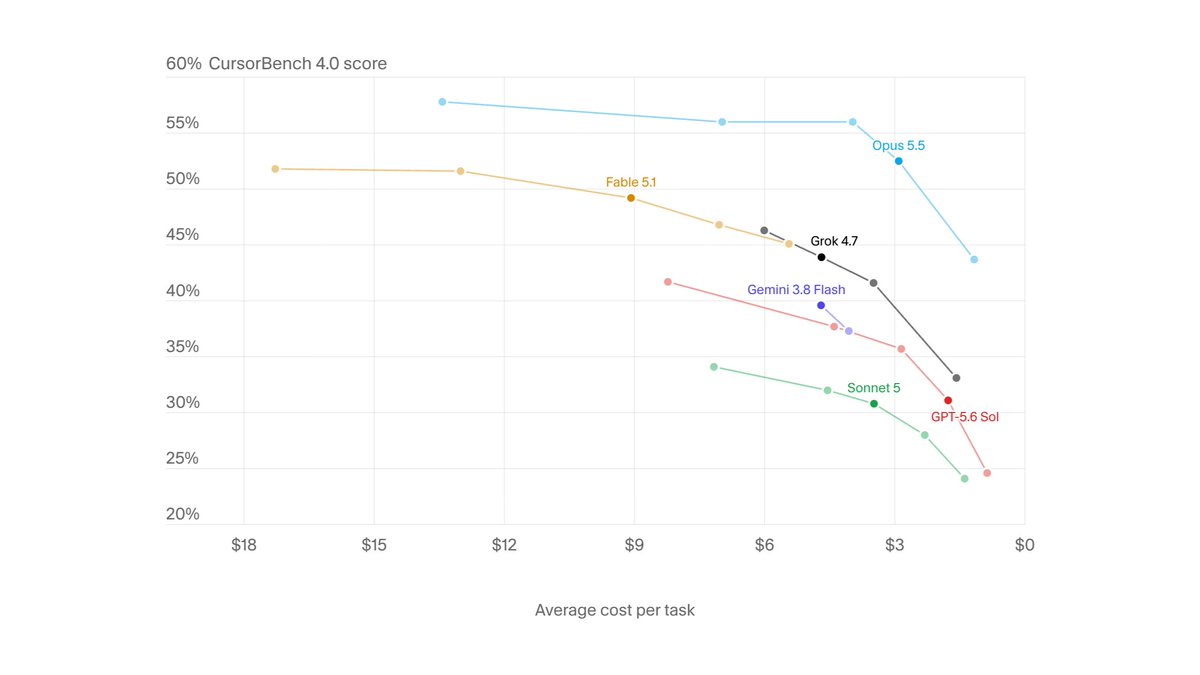
Cursor announced on Oct 26 (UTC) that DeepSeek V4.1 Flash is now available in Cursor and can be turned on under Cursor Settings > Models. Cursor says every effort level sits on the CursorBench cost frontier, from $0.60 to $0.98 per task, with no model scoring higher at those prices. The official CursorBench 4.0 leaderboard lists DeepSeek V4.1 Flash 1017 at 47.7% on Max ($0.98 per task), 46.3% on Medium ($0.80), 45.6% on High ($0.77) and 44.9% on Low ($0.60). The top score on the board, Opus 5.5 Max, is 57.8% but costs $13.43 per task.

Cursor adds DeepSeek V4.1 Flash: all four effort levels sit on the CursorBench 4.0 cost frontier, with Max scoring 47.7% at $0.98 per task

Key Takeaways

  • Four effort levels on the official CursorBench 4.0 board: Max 47.7% at $0.98, Medium 46.3% at $0.80, High 45.6% at $0.77, Low 44.9% at $0.60; Max ranks 17th overall
  • Value: Max at 47.7% nearly ties Sonnet 5.5 High (47.8%, $1.20) for about 18% less; Opus 5.5 Max scores about 10 points higher but costs $13.43 per task, roughly 13.7x more
  • Nearest rivals on price: Haiku 5.5 Max at 48.4% for $1.12 and Haiku 5.5 Extra High at 44.3% for $0.56, bracketing DeepSeek's price range
  • The trade-off is tokens and steps: Max averages about 537K tokens and 187 steps per task, versus about 37K tokens and 41 steps for Sonnet 5.5 High, so expect longer runs
  • Turn it on under Cursor Settings > Models; a counterintuitive detail is that Medium (46.3%) scores slightly above High (45.6%) for only $0.03 more
Read full story

Meta Muse Wonder and Wonder Full frontier agent models (Active Memory, Active Focus); Muse Wonder now in Cursor at 46.1% CursorBench, $4/$20

On 2026-10-12 Meta introduced Muse Wonder and Muse Wonder Full, its most capable models yet for personal and professional agentic work. Official posts highlight Active Memory (carry and retrieve what matters across conversations) and Active Focus (persist through hard tasks, recover from errors, clarify and confirm before consequential actions). Muse Wonder is available today via the Meta Model API and Muse Code; Muse Wonder Full is available today for Muse Code subscribers. Third-party Artificial Analysis Intelligence Index (max reasoning) lists Wonder Full at 56 and Wonder at 52 (Spark 1.3 Max was 48). Update Oct 16: Muse Wonder is now in Cursor with 300k context (1M Max Mode at the same rates), $4/$20 per million tokens, and 46.1% on CursorBench per Cursor.

Meta Muse Wonder and Wonder Full frontier agent models (Active Memory, Active Focus); Muse Wonder now in Cursor at 46.1% CursorBench, $4/$20

Key Takeaways

  • Announced 2026-10-12 via Meta Newsroom and @AIatMeta (official post)
  • Availability (Meta): Muse Wonder on Meta Model API + Muse Code; Muse Wonder Full for Muse Code subscribers only
  • Core mechanisms: Active Memory + Active Focus for long-horizon personal/professional agents
  • Third-party AA Intelligence Index (max): Wonder Full 56, Wonder 52 vs Spark 1.3 Max 48 (changelog)
  • Now in Cursor (2026-10-16): muse-wonder-1.0, 300k / 1M Max Mode at same rates, $4/$20 per M tokens; Cursor reports 46.1% CursorBench at default effort (Cursor docs)
Read full story

OuroWorld: Transforming Static 3D Gaussian Splats into Seamlessly Looping 3D Cinemagraphs Across Arbitrary Viewpoints

While 3D Gaussian Splatting (3DGS) has revolutionized photorealistic static 3D scene reconstruction, synthesized digital worlds remain frozen in time. Existing dynamic generation frameworks either constrain motion to simplistic Eulerian fluid simulations or synthesize finite non-looping video trajectories that rapidly degrade when explored from novel camera viewpoints. Researchers unveil OuroWorld (arXiv:2610.12461, site: ouroworld.userwei.com), the first mask-free framework capable of turning any static 3DGS scene into an endlessly looping 3D cinemagraph with seamless temporal continuity across arbitrary 6-DoF exploration trajectories. OuroWorld employs a vision-language model to infer plausible environmental physics and direct a foundation video model to synthesize a reference video, which is subsequently lifted and completed across multiple views. To reconcile cross-view generation discrepancies, the authors propose Inconsistency-Robust Periodic 4DGS: a Fourier-series deformation field guarantees seamless looping by construction, while a Grounded Drift Field anchored at the reference camera view absorbs cross-view generative noise. Evaluated across 39 complex reconstructed and generated scenes, OuroWorld decisively outscores existing dynamic 3D baselines and secures a 70.8% to 99.0% preference rate in human blind evaluations.

Key Takeaways

  • OuroWorld introduces the first mask-free 3D cinemagraph framework, transforming static 3DGS into endlessly looping 4D scenes
  • Employs Fourier-series periodic 4DGS deformation fields to guarantee seamless looping, securing 70.8% to 99.0% user study win rates
  • Integrates Grounded Drift Fields to absorb cross-view generative noise, ensuring rigid parallax across 360-degree free-viewpoint exploration
Read full story
Linked Models & Agents:
⚡ OuroWorld⚡ 3DGS⚡ Periodic-4DGS⚡ Fourier-Field🤖 Spatial-3D-Agent🤖 Cinemagraph-Animator🌐 NYCU🌐 Hugging Face

Google Falcon 9 Suncatcher: testing AI/TPU radiative cooling in vacuum

On 2026-10-01 @Google said a Planet prototype with four TPUs reached orbit on SpaceX Transporter-18 (Falcon 9)—first step of Project Suncatcher. Weeks of stress/radiation/thermal data follow; vacuum cooling uses heat pipes + radiators (Facts).

Google Falcon 9 Suncatcher: testing AI/TPU radiative cooling in vacuum

Key Takeaways

  • Official X: Google (2026-10-01 23:34 UTC) confirms four TPUs, Planet, Transporter-18 / Falcon 9
  • Blog: In orbit—contact OK, nominal ops
  • Cooling: heat pipes + radiators; thermal-vac tested (Facts)
  • Payload: Google TPUs; Trillium TID >~5-year mission dose; weeks of telemetry ahead
  • Press: ~1 kW solar, ~15 min duty (Ars); 2027 dual-sat laser ISL
Read full story
Linked Models & Agents:

Anthropic launches Claude Sonnet 5.5: Terminal-Bench 70.6%, 30%+ faster output, same $2/$10 price with lower task cost

Anthropic released Claude Sonnet 5.5 on 2026-09-28 (API id claude-sonnet-5-5), the second Claude 5.5-family model. Vs Sonnet 5: Terminal-Bench 4.0 70.6% (from 10.3%), CursorBench 4.0 55.5%, GDPval-AA near Opus 5.5; 30%+ faster output and up to ~30% lower task cost at the same $2/$10 pricing. Native 1M context; adaptive thinking on by default — use between_tools to disable up-front thinking.

Anthropic launches Claude Sonnet 5.5: Terminal-Bench 70.6%, 30%+ faster output, same $2/$10 price with lower task cost

Key Takeaways

  • Shipped 2026-09-28 — model id claude-sonnet-5-5 (announcement)
  • Terminal-Bench 4.0 70.6% (vs Sonnet 5 10.3%); CursorBench 4.0 55.5%; GDPval-AA 1844
  • Same $2/$10 pricing; ~30%+ faster output; up to ~30% lower task cost via fewer tokens
  • 1M context / 128K max out; adaptive thinking default; between_tools turns off up-front thinking
  • Migrate via docs; anthropic-sdk-python ≥1.9.0; Claude Code ≥2.1.284 sonnet alias → 5.5
Read full story

Xinference v3.5.0 Released: Native YuE2 Music Generation, MinerU2.5 PDF Parsing & Apple MLX Audio Models

Open-source distributed model serving engine Xinference (xorbitsai/inference) shipped v3.5.0, substantially upgrading its multimodal inference and edge acceleration capabilities. The release adds out-of-the-box support for YuE2 music generation, alongside AuK/AuK-Flash and Irodori TTS v4.1. On Apple Silicon, Xinference introduces native Apple MLX hardware acceleration for FishAudio-S2-Pro, Irodori TTS Small, and Breeze TTS 2. On the visual and document AI front, it integrates MinerU2.5 for complex document parsing and LingBot-World-V2 for embodied world simulation, while introducing distributed correlation metadata propagation across actor calls for enterprise observability.

Xinference v3.5.0 Released: Native YuE2 Music Generation, MinerU2.5 PDF Parsing & Apple MLX Audio Models

Key Takeaways

  • Generative audio expansion: native support for YuE2 music generation plus AuK, AuK-Flash, and Irodori TTS v4.1
  • Apple MLX acceleration: brings native MLX execution for FishAudio-S2-Pro, Irodori TTS Small, and Breeze TTS 2 on Apple Silicon
  • Document AI & World Models: out-of-the-box deployment for MinerU2.5 document parsing and LingBot-World-V2 world simulation
  • Distributed correlation tracing: propagates correlation metadata across actor calls for seamless multi-agent debugging
  • Enterprise audit controls: opt-in model request logging and refined virtualenv package management in the web dashboard
Read full story
Linked Models & Agents:
⚡ YuE2⚡ FishAudio-S2-Pro⚡ MinerU2.5⚡ LingBot-World-V2🤖 Xinference Worker🌐 Xorbits AI🌐 SenseTime
ADSponsored

Claude Opus 5.5 is now available in Cursor

Cursor announced that Claude Opus 5.5 is now available. It is the new top model on CursorBench at 57.8% (Max) and costs 40% less per task than Opus 5.

Claude Opus 5.5 is now available in Cursor

Key Takeaways

  • Cursor announced that Claude Opus 5.5 is now available. It is the new top model on CursorBench at 57.8% (Max) and costs 40% less per task than Opus 5.
Read full story
Linked Models & Agents:

Cursor ships Claude Opus 5.5: tops CursorBench at 57.8% (Max), ~40% cheaper per task than Opus 5

Cursor (@cursor_ai) announced Claude Opus 5.5 is available in Cursor. Officially it is the new top model on CursorBench at 57.8% (Max) and costs about 40% less per task than Opus 5, wiring Anthropic’s same-day Opus 5.5 launch into a leading AI IDE.

Cursor ships Claude Opus 5.5: tops CursorBench at 57.8% (Max), ~40% cheaper per task than Opus 5

Key Takeaways

  • Cursor integrates Claude Opus 5.5 day-one across Composer and Chat.
  • Sets a new high score on CursorBench (Max) at 57.8%, boosting multi-file editing precision.
  • Delivers ~40% lower cost per coding task with over 30% faster token generation.
Read full story

Humanizer open-sources an AI-writing cleanup skill for Claude Code and friends

@khyssabc highlighted Humanizer (github.com/blader/humanizer), an open Markdown skill that rewrites AI-flavored prose against Wikipedia’s 35 “Signs of AI writing” patterns in two passes; it forbids inventing facts, touches body text only, and installs via Skills CLI, the Claude Code plugin market, or Codex/Cursor skill loaders—plus a popular Humanizer-zh fork.

Key Takeaways

  • Two-pass cleanup against Wikipedia’s 35 AI-writing tells—not a vague “sound human” prompt.
  • Hard rules: no invented facts; file mode edits body text only, leaving code/data/frontmatter/link targets alone.
  • Ships as a Markdown skill for Claude Code, Codex, and Cursor; Humanizer-zh is a popular fork.
Read full story
Linked Models & Agents:

Safari 27 ships built-in MCP server: Claude Code and Codex can drive a real Safari window

Sebastien Lorber notes Safari 27’s built-in MCP server is out of beta for coding agents. WebKit documents that the Safari MCP connects an agent to a live Safari window with DOM, network, and screenshot access for more autonomous WebKit debugging; data stays local and is not sent to Apple. Agents no longer have to approximate Safari bugs via Chromium-only harnesses.

Key Takeaways

  • Safari 27 MCP is out of beta for Claude Code, Codex, and other MCP clients.
  • Agents can inspect DOM, network, and screenshots in a live Safari window.
  • Runs locally; no AutoFill/passwords/history; captured data goes to your chosen agent, not Apple.
Read full story

Google Home MCP early access: Claude, ChatGPT and other agents can control smart-home devices

Google Home opened early access to a Model Context Protocol (MCP) server for US Google Home Premium Advanced subscribers. Any MCP-capable agent—Claude, Hermes, OpenClaw, ChatGPT, Google Antigravity—can securely connect to the Home ecosystem: review camera summaries, monitor activity, control Nest doorbells/thermostats and Matter lights, and build custom dashboards. Setup means creating a Google Cloud project, configuring Home MCP, then handing the config to an agent for sign-in and permissions. It covers Google Home and Works with Google Home / Matter devices, rolling out over coming weeks.

Key Takeaways

  • US Premium Advanced early access: Home MCP lets MCP agents safely drive cameras, Nest, and Matter devices
  • Works with Claude, Hermes, OpenClaw, ChatGPT, Google Antigravity for summaries, monitoring, control, dashboards
  • Needs a Google Cloud project + Home MCP config; agent-guided sign-in; rolling out over weeks
Read full story
Linked Models & Agents: