AI Coding Live News

Thinking Machines Launches Inkling 2 Small: 594B/17B MoE, Vendor-Reported AA Intelligence Index ~31; Tinker Inference and Fine-Tuning Now, Apache 2.0 Weights Planned Next Week

On November 5 Thinking Machines Lab introduced Inkling 2 Small, the first second-generation model: a 594B-total / 17B-active MoE with image input and variable thinking effort. The company reports an Artificial Analysis Intelligence Index score of about 31, with large gains versus prior Inkling models in agentic coding, vision and knowledge work. It is available now on Tinker for inference and fine-tuning with closed weights; full Apache 2.0 weights are planned next week after external safety testing. Tinker list pricing is about $0.30/$1.00 per million input/output tokens at 64K context.
Thinking Machines Launches Inkling 2 Small: 594B/17B MoE, Vendor-Reported AA Intelligence Index ~31; Tinker Inference and Fine-Tuning Now, Apache 2.0 Weights Planned Next Week

Key Takeaways

  • Specs (official): 594B total / 17B active MoE; Hybrid + Vision; variable effort; no audio (unlike prior Inkling)
  • Scores (vendor): AA Intelligence Index ~31; FrontierCode v2.0 ~25.4%; DeepSWE v1.1 ~72.1%; DesignArena Website Elo ~1340
  • Availability: Tinker Playground / fine-tune and sampling today; closed weights; Apache 2.0 full weights planned next week after safety tests
  • Pricing (Tinker docs): Prefill $0.30 / Sample $1.00 / Train $1.50 per 1M tokens at 64K; cached Prefill $0.03
  • Training note (official): joint RL ~1,075 steps and 17M+ rollouts; early checkpoints tested on OpenCode as Fledge-Alpha
Read full story
Linked Models & Agents:
⚡ Inkling 2 Small⚡ Inkling-Small⚡ Inkling🤖 OpenCode🤖 Tinker🌐 Thinking Machines

Glasshand Launches: Monthly Real iPhone/Mac Rentals for AI Agents ($60/$90), Works with Claude Code, Codex, Cursor

On November 5, Solid founder Trevor Keith launched Glasshand: dedicated real iPhones and Macs hosted in a data center—not emulators—so agents can see the screen and tap or type via API. Works with Claude Code, Codex, Cursor and others; agents can install apps, sign into iCloud, add eSIM for SMS codes, run social workflows or build/test in Xcode. Official pricing is $60/mo for an iPhone and $90/mo for a Mac, month to month with cancel anytime and factory wipe on release. It ranked #1 on Product Hunt that day.

Glasshand Launches: Monthly Real iPhone/Mac Rentals for AI Agents ($60/$90), Works with Claude Code, Codex, Cursor

Key Takeaways

  • Form factor: real iPhones/Macs in a data center, not VMs or emulators; agents see the screen and tap via Glasshand API/controller
  • Compatibility: Claude Code, Codex, Cursor, OpenClaw, Hermes or any agent; start with “Tell your agent to rent”
  • Capabilities: App Store installs, iCloud sign-in, eSIM SMS verification and iMessage; Macs for Xcode build/test
  • Pricing (official site): iPhone $60/mo, Mac $90/mo (USD + tax), month-to-month cancel anytime; no hourly/daily rental
  • Security: dedicated device, user-set password; erase + factory reset on release (vendor)
Read full story

Cognition Ships Devin Review 2.0: ~82% Cheaper (~5x) Since August, Median Latency ~94s; Auto-Review, Autofix, Ultra & Custom Reviewers

On November 5, Cognition launched Devin Review 2.0. Since August, per-PR review cost fell about 82%, with a typical review at about $0.25–$0.75 and median latency about 94 seconds (down from about 139). It adds automatic review rules, incremental re-reviews, configurable per-PR spend limits, and tighter Devin Autofix loops. New controls include Devin Review Ultra and Custom Reviewers (beta).

Cognition Ships Devin Review 2.0: ~82% Cheaper (~5x) Since August, Median Latency ~94s; Auto-Review, Autofix, Ultra & Custom Reviewers

Key Takeaways

  • Cost: ~82% cheaper per PR since August (~5x); typical ~$0.25–$0.75; ~$2.25 average per fixed bug across customers (vendor)
  • Quality & speed: bugs found per PR rose 1.22→1.32 on average; median latency ~94s (~1.5x faster vs ~139s)
  • Incremental reviews: default re-reviews only changed parts; ~80% of PRs cost under $1 including all pushes; configurable per-PR spend cap
  • Loop: with Devin, findings can be fixed, dismissed, or escalated; Autofix available in Devin Cloud and Desktop
  • Controls: Devin Review Ultra for higher-effort reviews; Custom Reviewers (beta) run specialized checks from your instructions
Read full story

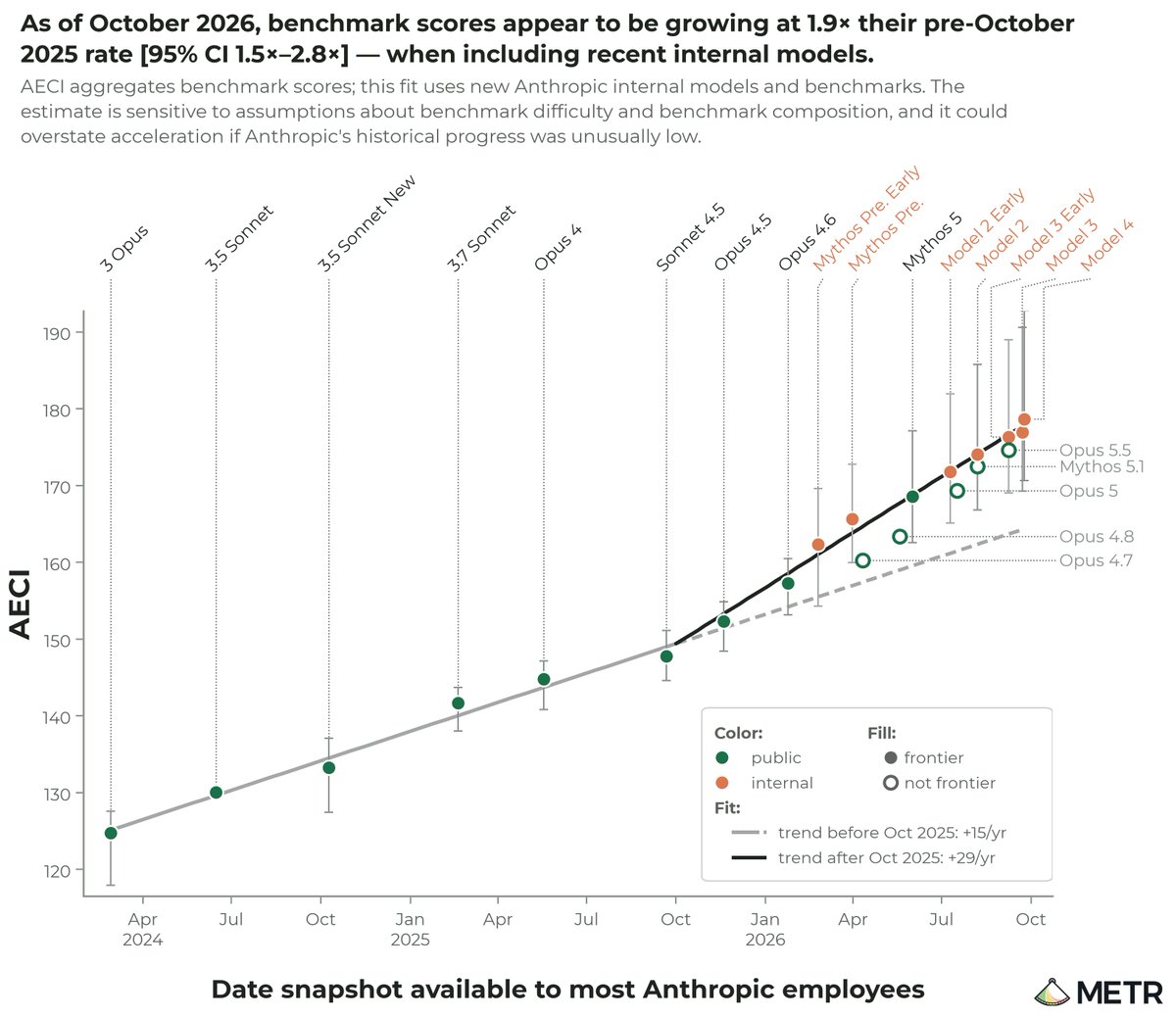
METR Assessment: Anthropic Capability Progress on Well-Specified Tasks ~2x Historical Rate; AECI ~1.9x Faster Since Oct 2025

On November 5, independent evaluator METR published a high-access assessment at Anthropic (Aug 12–Oct 29, 2026). As of October 2026, Anthropic is likely improving model capabilities on well-specified tasks at about twice the March 2024–October 2025 historical rate. Since October 2025, AECI scores grew at an estimated 1.9x the prior rate [95% CI 1.5–2.8]. METR judges that a majority of current acceleration is attributable to AI-assisted R&D, not faster training-compute scaling; Anthropic redacted much of the most informative evidence.

METR Assessment: Anthropic Capability Progress on Well-Specified Tasks ~2x Historical Rate; AECI ~1.9x Faster Since Oct 2025

Key Takeaways

  • Subjective call: ~2x historical rate on well-specified tasks (high uncertainty; ~1.3x–3x plausible; METR)
  • AECI: ~1.9x faster growth since Oct 2025 [95% CI 1.5–2.8], ~two years of prior progress in one year (includes unreleased models)
  • Attribution: confident not from faster training-compute growth; majority of current acceleration from AI-assisted R&D (~80% subjective guess), not fully autonomous contributions
  • Risk: no clear bottlenecks observed for next 12 months, so further acceleration risk; much key evidence redacted by Anthropic
  • Process: separate from the Oct 15 employee-like access pilot; compute-allocation verification was canceled mid-engagement
Read full story
Linked Models & Agents:
ADSponsored

Goodfire Introduces Mechanistic Shaping: Training Against Internal Concepts; Reward-Hacking Honesty Rises to 96–98%

On November 5, interpretability lab Goodfire published a paper and blog on mechanistic shaping: add training penalties on a model's reliance on or expression of specific internal concepts, so training specifies how a task is solved—not only whether the answer is right. Experiments cover chest X-ray shortcuts, DPO-induced sycophancy and Countdown reward hacking. Per vendor figures, expression shaping raised honest solving from ~0% to 96–98% and transferred to unseen chess puzzles.

Goodfire Introduces Mechanistic Shaping: Training Against Internal Concepts; Reward-Hacking Honesty Rises to 96–98%

Key Takeaways

  • Framework: reliance shaping ("don't rely on this") and expression shaping ("don't express this"); needs a concept direction and a readable layer
  • Reward hacking: on Countdown with Qwen3.5-9B, expression shaping hit 96–98% honest solves; filtering cheating rollouts worked in ~1/3 of runs (vendor)
  • Transfer: on unseen chess puzzles, standard RL cheated ~99%; shaped models barely cheated while still improving (vendor)
  • DPO sycophancy: reliance shaping kept DPO capability gains with sycophancy near baseline on 7B/13B/32B; data filtering only moved along the capability–sycophancy trade-off
  • Monitorability: L1–L5 hierarchy; concepts stayed monitorable, often needing a retrained probe (sycophancy AUROC 0.98→0.93 on the original probe)
Read full story
Linked Models & Agents:
⚡ Qwen3.5-9B⚡ OLMo-3-7B🌐 Goodfire

Perplexity Launches Teammates: Persistent Work Agents on Computer with Slack, Research Preview for Max on Web

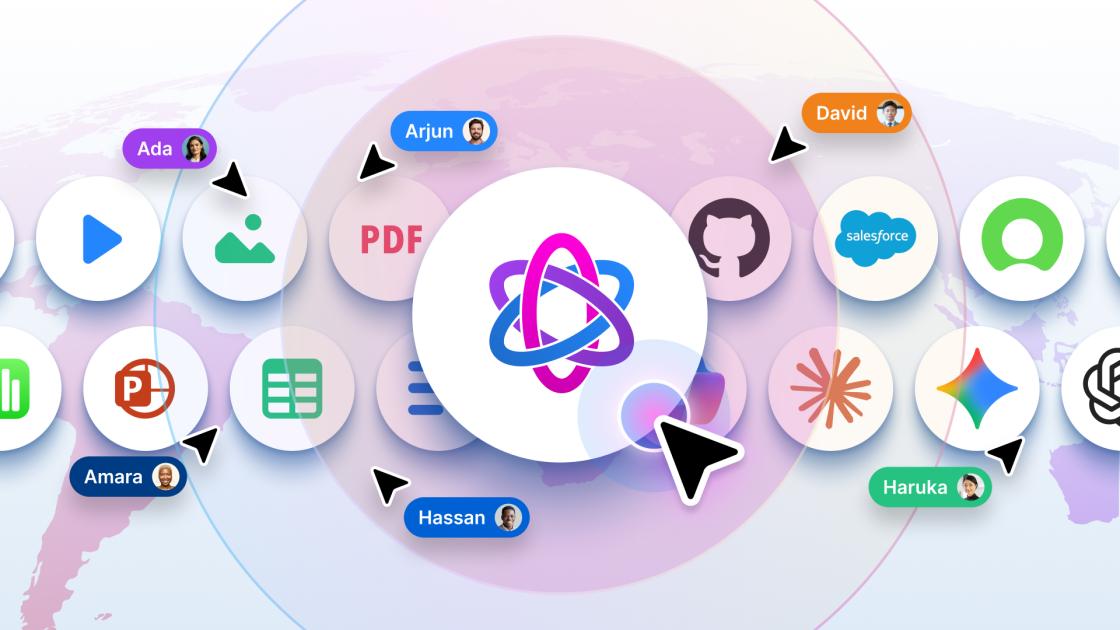
On November 5 Perplexity (@perplexity_ai) and CEO Aravind Srinivas (@AravSrinivas) launched Teammates: persistent personal agents on Computer that own ongoing responsibilities, inherit Projects, Skills, Memory and tool permissions, run in isolated desktops and browsers, collaborate with other teammates, and proactively monitor Slack. Official help docs call it a research preview for individual Max subscribers on the web; Enterprise Pro/Max are not included by default; native mobile and desktop apps are coming later.

Perplexity Launches Teammates: Persistent Work Agents on Computer with Slack, Research Preview for Max on Web

Key Takeaways

  • Shift from one-shot prompts to high-level goals; a teammate keeps its role until you reassign it (vendor/CEO)
  • Multi-agent orchestration, isolated desktop/browser, proactive monitoring of Slack/GitHub/Linear connectors
  • Individual Max (~$200/mo, ~10k Computer credits/mo) web research preview; Enterprise not included by default (help center)
  • Internal adoption: CEO says ~10k teammates in 30 days (~20x headcount) with ~1k active yesterday (personal claim, not an audit)
  • Setup on web: assign role and escalation, take over the desktop, or redirect; shared chats are read-only for others
Read full story

Meta Rolls Out Muse Realtime Avatar in the US Muse App: Speech-Driven Expression and Gesture at ~870ms First-Byte Latency

On November 5 Meta AI (@AIatMeta) said Muse Realtime Avatar, previewed at Connect, is rolling out in the US Muse app, turning Muse Realtime Voice into interactive live avatars. The research blog describes an audio-driven Diffusion Transformer that shares the speech-token stream with voice for lip-sync and expression; a single GB200 session streams 448×768 at 25 fps with about 870 ms from end of user turn to first synchronized audio-video byte, with Meta Video Seal invisible watermarking. Muse is for users 18+; no global schedule or developer API was announced.

Meta Rolls Out Muse Realtime Avatar in the US Muse App: Speech-Driven Expression and Gesture at ~870ms First-Byte Latency

Key Takeaways

  • US Muse app rollout of Realtime Avatar after the Connect preview (@AIatMeta)
  • Shared speech VQ tokens drive audio decode and avatar video; causal chunks with self-forcing distillation cut ~120 teacher NFEs to 2 student NFEs (~60x)
  • Vendor perf: 448×768@25fps, ~870ms first-byte latency; ~8x serving capacity vs BF16 baseline, up to 12 concurrent sessions on one GB200
  • Vendor preference study favored Muse over Runway Characters and HeyGen LiveAvatar on overall and most axes
  • Safety: Video Seal invisible watermark; blog demos are not the full in-app avatar set; no public developer API stated
Read full story
Linked Models & Agents:
⚡ Muse Spark⚡ Muse Presence🤖 Muse🌐 Meta

Mistral Studio Adds Managed Agents and Apps: Durable Background Agents, Natural-Language Workflow Builder, HTTP Connectors and Online Evals

On November 5 Mistral expanded Mistral Studio. Managed Agents, built with the Agents SDK (mistralai-agents), run the same code in-process, self-hosted (agents serve) or Mistral-managed (agents deploy), with durable execution for hours or days, crash resume and human approvals. Mistral also shipped a Vibe-powered workflow builder, the mistral apps CLI, HTTP API connectors, webhooks and triggers, a managed search index, and offline and online evaluations, mostly in Public Preview.

Mistral Studio Adds Managed Agents and Apps: Durable Background Agents, Natural-Language Workflow Builder, HTTP Connectors and Online Evals

Key Takeaways

  • One agent codebase, three run modes: in-process, self-hosted agents serve, or managed agents deploy
  • Durable background execution for hours or days, resuming from the last finished step; Mistral stores sessions
  • Connectors now speak HTTP APIs with no MCP server needed; webhooks and triggers start workflows or agents
  • Managed agents emit agent, model and tool spans by default, and traces can become eval datasets in one click
  • Observability and evaluations are Enterprise-tier; most new features are Public Preview (vendor statement)
Read full story

Claude Launches Personal Finance Beta in the US: Read-Only Bank Linking via Plaid, Up to 16 Banks and 24 Months of Transactions

On November 5 Anthropic announced a US beta of Personal Finance in Claude via @claudeai. Users link bank, card, loan and investment accounts through Plaid, see balances, cash flow, subscriptions and bills on one page, and ask questions in plain language. The official help article says access is read-only, so Claude cannot move, manage or invest money. It is limited to US Pro, Max and Ultra personal plans (not Free, Team or Enterprise) and is rolling out gradually.

Claude Launches Personal Finance Beta in the US: Read-Only Bank Linking via Plaid, Up to 16 Banks and 24 Months of Transactions

Key Takeaways

  • Read-only: balances, credit limits and up to 24 months of transactions; no money movement (vendor statement)
  • Up to 16 linked banks, US banks only; sign-in via Plaid so Claude never sees bank passwords
  • Pro, Max and Ultra personal plans only, on web, Desktop, iOS and Android, rolling out gradually
  • Chats inside the Personal Finance hub are not used for training; chats using account data are kept out of memory
  • Linked accounts cannot yet be used in Cowork, scheduled tasks or Claude Code
Read full story

OpenAI Launches GPT-6 Cyber: ExploitGym 48.5%, Out-of-Scope Rate Down to 0.07%, Daybreak Red Select Access, Critical Preparedness

On November 5 OpenAI launched GPT-6 Cyber for authorized security research: ExploitGym rose from GPT-5.6 Cyber's 32.1% to 48.5% (about 51% relative), out-of-scope exploitation fell to 0.07% without deployment prompts and 0% with them. The model helped find 81 novel high-severity Firefox bugs and develop exploits for 948 Linux privilege-escalation cases, and OpenAI raised its Preparedness Framework cyber rating from High to Critical. It is initially available via API and Codex to select Daybreak Red customers, with expansion to all Red customers planned.

OpenAI Launches GPT-6 Cyber: ExploitGym 48.5%, Out-of-Scope Rate Down to 0.07%, Daybreak Red Select Access, Critical Preparedness

Key Takeaways

  • ExploitGym 48.5% vs GPT-5.6 Cyber 32.1% (~51% relative gain; vendor figures)
  • Scope alignment: 99.93% avoided out-of-scope services without deployment prompts; 100% with them
  • Real-world: 81 novel high-severity Firefox vulns; 1,724 Linux vulns reproduced, 948 exploits developed
  • Preparedness raised to Critical; RemoteExploitBench 95% completion (Astra refused 100%)
  • Select Daybreak Red via API/Codex first; Daybreak Blue alpha for Astra defensive use expanding
Read full story
Linked Models & Agents:
ADSponsored

Gemini Omni 1.2 Flash GA: Up to 15s Clips, ~30% Lower Output Price, About $0.07/s at 720p; 1.1 Routes to 1.2 on Dec 3

On November 5 Google made Gemini Omni 1.2 Flash (gemini-omni-1.2-flash) generally available in AI Studio and the Gemini API: video generate/edit length rises to 15 seconds, vendor pricing cuts video output about 30% (~$12 per 1M tokens, roughly $0.07/s at 720p), with stronger multi-reference consistency and more natural speech. The changelog states that from December 3, 2026, requests to gemini-omni-1.1-flash will automatically route to 1.2 at 1.2 rates.

Gemini Omni 1.2 Flash GA: Up to 15s Clips, ~30% Lower Output Price, About $0.07/s at 720p; 1.1 Routes to 1.2 on Dec 3

Key Takeaways

  • Model id gemini-omni-1.2-flash live in AI Studio and Gemini API (changelog Nov 5)
  • Clips 3–15s at 360p/720p/1080p/4K; vendor notes consistency across up to 6 reference images
  • Vendor pricing: ~30% lower video output; ~$0.07/s at 720p (~$1.04 for 15s)
  • From 2026-12-03, gemini-omni-1.1-flash auto-routes to 1.2 at 1.2 rates
  • Consumers: Flow, Google Vids, and Gemini App support up to 15s clips and multi-turn edits
Read full story
Linked Models & Agents:
⚡ gemini-omni-1.2-flash⚡ gemini-omni-1.1-flash🌐 Google DeepMind

BoxWorks 2026: Box and NVIDIA Unveil Box Context Retrieval, Permission-Aware Retrieval for Enterprise Agents Built on Nemotron Retriever, Plus Box Architect and Box Mount

At BoxWorks 2026 on November 5, Box announced an expanded NVIDIA collaboration: Box Context Retrieval, a new engine built on NVIDIA Nemotron Retriever embedding models, combines keyword and semantic search to return the most relevant passages to AI agents while honoring existing file permissions, with general availability for Enterprise Advanced customers planned for early next year. Box's press release claims 20% better search accuracy (Recall@5), 90% fewer tokens and 4x faster answers. Open-weight Nemotron models, starting with Nemotron 3 Ultra, are available in Box AI now. Box also unveiled Box Architect, which designs workflows from a stated goal; Box Mount, which mounts Box folders inside agent sandboxes and works with NVIDIA OpenShell; and agent security controls including MCP Guardrails.

BoxWorks 2026: Box and NVIDIA Unveil Box Context Retrieval, Permission-Aware Retrieval for Enterprise Agents Built on Nemotron Retriever, Plus Box Architect and Box Mount

Key Takeaways

  • Box Context Retrieval uses NVIDIA Nemotron Retriever with hybrid keyword and semantic search, honoring existing file permissions
  • Vendor claims: +20% Recall@5 accuracy, 90% fewer tokens, 4x faster answers; GA for Enterprise Advanced early next year
  • Open-weight Nemotron models, starting with Nemotron 3 Ultra, are available in Box AI now
  • Box Mount puts Box folders inside agent sandboxes and works with the NVIDIA OpenShell secure runtime
  • New agent security controls include MCP Guardrails, classification-based access policies and audit trails
Read full story
Linked Models & Agents:
⚡ Nemotron 3 Ultra⚡ Nemotron Retriever🌐 box🌐 Nvidia (NIM)

Gemini API Computer Use Tool Goes GA: Browser, Mobile and Desktop Agents Production-Ready, No Breaking Changes from Preview

The Gemini API changelog shows the Computer Use tool reached general availability on October 30 across both the Interactions and GenerateContent APIs; @GoogleAIStudio announced on November 4 that there are no breaking changes from preview and it is production-ready for browser, mobile and desktop control agents. Official docs list supported models: Gemini 4 Argon, the recommended Gemini 3.8 Flash, Gemini 3.5 Flash-Lite and Gemini 3 Flash Preview. Actions carry an intent field, responses may include a safety_decision requiring user confirmation, and opt-in screenshot prompt-injection detection is available.

Key Takeaways

  • Computer Use is GA on both the Interactions and GenerateContent APIs as of October 30
  • Google says there are no breaking changes from preview, so existing code carries over
  • Three environments: browser, mobile and desktop; Gemini 3.8 Flash is the recommended model
  • Every action includes an intent field; safety_decision can require user confirmation or block
  • Opt-in screenshot prompt-injection detection (Gemini 3.5 Flash-Lite and later, off by default)
Read full story

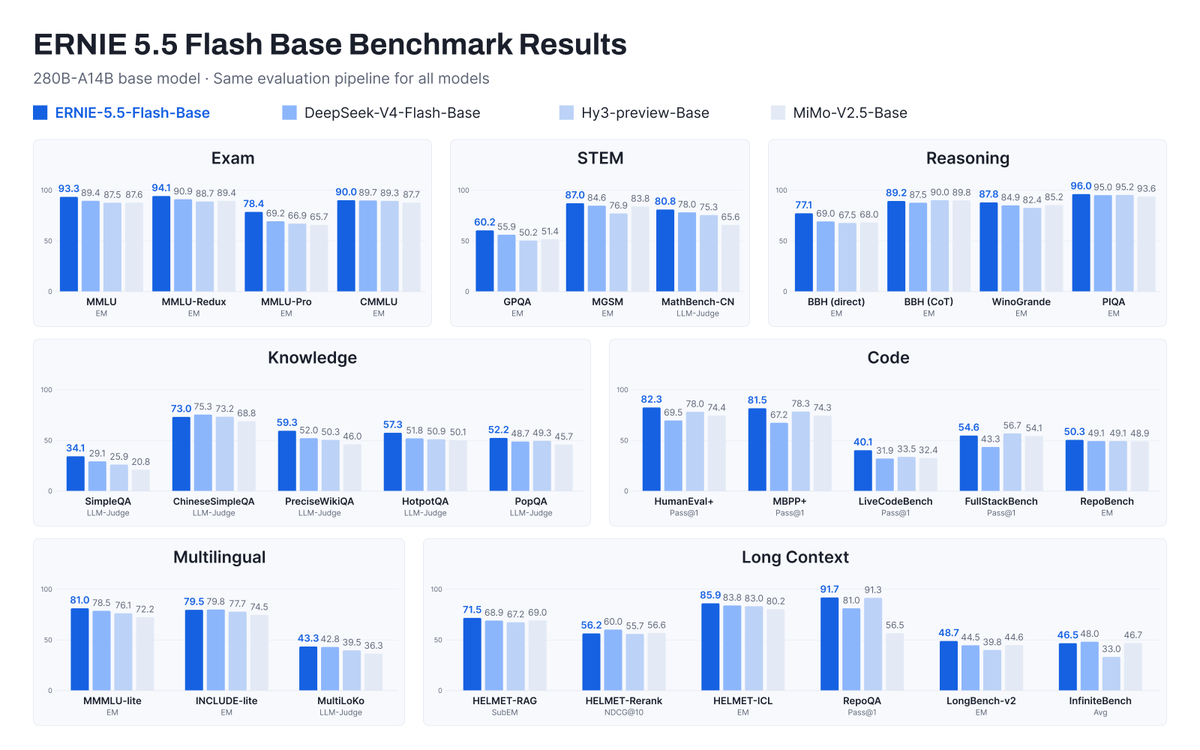
Baidu Opens ERNIE-5.5-Flash-Base: 280B-A14B MoE, 33.5T Pretrain, Vendor-Reported MMLU 93.3

On November 5 Baidu (official blog + @BaiduResearch) open-sourced ERNIE-5.5-Flash-Base: a text-only MoE base checkpoint at end of pre-training (no mid/post-training), 280B total / 14B active per token, 33.5T pretrain tokens, up to 128K train context and 1M for fine-tune/inference. FP8 and BF16 weights are on Hugging Face and ModelScope. Under Baidu's unified eval pipeline vs similar bases: MMLU 93.3, HumanEval+ 82.3, LiveCodeBench 40.1 (vendor-reported). Post-trained ERNIE 5.5 Flash "will follow". License is custom (excludes EU/UK/South Korea; commercial use above $50M related revenue needs prior written authorization).

Baidu Opens ERNIE-5.5-Flash-Base: 280B-A14B MoE, 33.5T Pretrain, Vendor-Reported MMLU 93.3

Key Takeaways

  • Nov 5 open base at end of pre-training: 280B total / 14B active — not a chat/instruct model
  • 33.5T pretrain tokens; up to 128K train context, 1M for fine-tune and inference
  • Vendor unified eval: MMLU 93.3, HumanEval+ 82.3, LiveCodeBench 40.1 vs similar bases
  • Architecture: 37 HCA + 6 MLA-DSA layers; Multi-Router Latent MoE (512 routed top-10 + 1 shared)
  • Custom license (not Apache): excludes EU/UK/South Korea; >$50M related revenue needs Baidu written authorization
Read full story
Linked Models & Agents:
⚡ Ernie 5.5 Flash Base🌐 Baidu (百度文心)

OpenAI Publishes National Community Compact: Pays Full Campus Power Costs, No NDAs With Officials, Public Impact Reporting

On November 5 OpenAI published a National Community Compact for U.S. compute campuses it owns and operates: no NDAs with public officials except narrow security carve-outs, public construction and impact reporting (noise, water, energy), Ratepayer Protection Pledge to pay full electricity and incremental grid costs with stranded-asset assurances, Grid Protector peak curtailment (up to 1,000 MW in Effingham, Georgia), and community investments already listed at $80M in Effingham and $40M in Pike County, Ohio. A PDF of the Compact is on openai.com.

OpenAI Publishes National Community Compact: Pays Full Campus Power Costs, No NDAs With Officials, Public Impact Reporting

Key Takeaways

  • On November 5 OpenAI published a National Community Compact as the baseline for campuses it owns and operates
  • It pledges no NDAs with public officials (narrow carve-outs) and public reporting on noise, water, energy and sustainability
  • Ratepayer Protection Pledge: OpenAI pays full campus power and incremental grid costs, with assurances against stranded assets
  • Grid Protector continues: up to 1,000 MW peak demand response at Effingham, Georgia
  • Community investments cited: $80M Effingham and $40M Pike County; each campus still gets a local Compact
Read full story
Linked Models & Agents: