AI Coding Live News

Hugging Face ML Intern Available as Installable Slack Bot for Workspace ML Tasks

On 2026-11-05 Hugging Face said its open-source ML Intern is available as a Slack bot you can install in your own workspace. Mention @ML Intern to evaluate models, build datasets, and fine-tune using your own Hugging Face account; each thread is a session with an approved compute budget and optional HuggingChat MCP servers.

Hugging Face ML Intern Available as Installable Slack Bot for Workspace ML Tasks

Key Takeaways

  • Official: @huggingface 2026-11-05; docs ML Intern in Slack; install at huggingface.co/chat/slack/install
  • Form: Slack bot running the same agent as HuggingChat, billed and publishing under each user's HF account
  • Capabilities: evaluate models, build datasets, fine-tune; connect data/files and HuggingChat-enabled MCP servers
  • Sessions: each thread is its own session (up to 200 messages, 10 attachments); Jobs/sandboxes need an approved compute budget (starts at $0)
  • Limits: Marketplace-only workspaces cannot install; Enterprise Grid needs per-workspace installs
Read full story

Vercel Token Pass Credit Applies Automatically on AI Gateway via API Key, OIDC, or fx Login

On 2026-11-06 Vercel updated Token Pass so featured-model usage through AI Gateway draws credit automatically with a standard API key, OIDC token, or fx login. When credit runs out, those auth modes fall back to team AI Gateway credits; dedicated Token Pass keys still stop until the next billing period.

Vercel Token Pass Credit Applies Automatically on AI Gateway via API Key, OIDC, or fx Login

Key Takeaways

  • Official: Vercel changelog 2026-11-06 — Token Pass credit now applies automatically across AI Gateway
  • Behavior: standard API key, OIDC, or fx login can draw Token Pass credit; dedicated key optional
  • Fallback: when credit ends, standard key/OIDC use team AI Gateway credits; dedicated Token Pass keys still stop until next period
  • Product terms: ~$30/month for ~$80 featured open-weight credit on Pro; Token Pass path stays ZDR
  • Guidance: early Token Pass key users should switch to standard key/OIDC to enable fallback
Read full story

Vercel Schedules Public Beta: Static and Dynamic Jobs Agents Can Create at Runtime via Queues

On 2026-11-05 Vercel launched Schedules in public beta on all plans: static jobs in vercel.json plus dynamic one-shot/cron schedules via SDK/CLI/API targeting private Functions, HTTP paths, or Queues. Eve and AI SDK samples let agents schedule follow-up work. Existing Cron Jobs remain supported.

Vercel Schedules Public Beta: Static and Dynamic Jobs Agents Can Create at Runtime via Queues

Key Takeaways

  • Official: Vercel 2026-11-05 changelog + blog Introducing Vercel Schedules; amplified on @vercel
  • Capabilities: static (vercel.json) and dynamic (SDK/CLI/API) one-shot/cron; Function, HTTP, or Queue targets
  • Agents: Eve ships dynamic scheduling; AI SDK sample uses Schedules.create + Queue wake-up
  • Billing (vendor): ~$5 per 1M runs and $10 per 1M creations on Pro/Enterprise; Hobby 500 creates / 5,000 runs per month
  • Existing Cron Jobs keep working; schedule/v1beta functions have no public URL
Read full story

Google Donates Agent Substrate, gVisor, and OpenRL to CNCF; Agent Substrate 1.0 GA on GKE

On 2026-11-05 Google Cloud announced donating Agent Substrate, gVisor, and OpenRL to the CNCF (Sandbox accepted) and that Agent Substrate reached 1.0 with Agent Substrate on GKE generally available. Vendor claim: idle agents snapshot and resume on any ready Worker in under 500ms at about 10x container density.

Google Donates Agent Substrate, gVisor, and OpenRL to CNCF; Agent Substrate 1.0 GA on GKE

Key Takeaways

  • Official: @GoogleOSS 2026-11-05 17:05 UTC; Google Cloud blog; VP Drew Bradstock
  • Donation: Agent Substrate, gVisor, and OpenRL enter CNCF Sandbox; gVisor on a path toward Incubation
  • GA: Agent Substrate 1.0 / Agent Substrate on GKE; managed or self-host on any Kubernetes
  • Vendor figures: resume <500ms, ~10x density, >500 suspend/resume per second; microVM or gVisor
  • Entry points: ate.dev / gvisor.dev / openrl.dev
Read full story
ADSponsored

Artificial Analysis Ships Endpoint Accuracy Index v1.1: Nearly 1 in 4 of 100+ Serverless Endpoints Score Below Reference

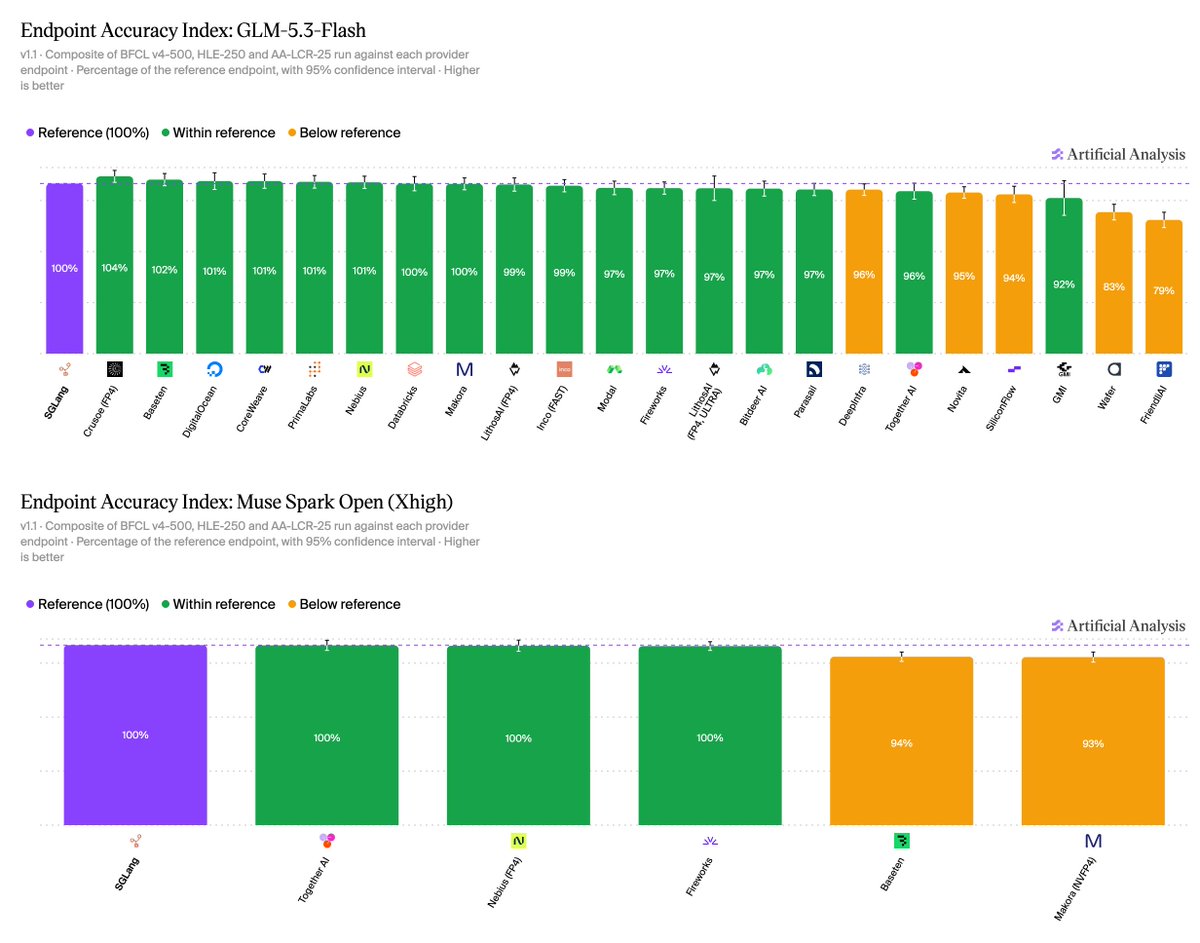
On 2026-11-06 Artificial Analysis launched Endpoint Accuracy Index v1.1: each serverless endpoint is scored as a percentage of a self-hosted official-weights reference across equally weighted BFCL-500, HLE-250, and AA-LCR-25. Vendor claim: nearly 1 in 4 of 100+ benchmarked endpoints score below the reference. AA-LCR-25 moved to v1.1 with repeats raised from 10 to 25 (average 95% CI ~±4.7 to ±2.6), and coverage expanded to six open-weights models including GLM-5.3 Flash and Muse Spark Open.

Artificial Analysis Ships Endpoint Accuracy Index v1.1: Nearly 1 in 4 of 100+ Serverless Endpoints Score Below Reference

Key Takeaways

  • Official: @ArtificialAnlys 2026-11-06 02:44 UTC; changelog 05 Nov 2026; methodology Endpoint Accuracy Index v1.1
  • Vendor claim: nearly 1 in 4 of 100+ serverless endpoints score below the self-hosted reference; providers often quantize, custom-kernel, tune stacks, or cap outputs
  • Equal-weight suite: BFCL v4-500 (3 repeats), HLE-250 (10), AA-LCR-25 (25); 95% CIs vs reference with significance flags
  • GLM-5.3 Flash: 16 of 22 endpoints statistically in line, one ~104.2; ~32K output caps scored ~22%/29% on HLE-250 vs 55% reference
  • Muse Spark Open: 3 of 5 endpoints ~99.5–99.9 (incl. FP4); two mainly lose on tool calling (BFCL-500 ~50%/51% vs 59%)
Read full story

Hyperstition Open-Sources Hyperkernel: Recursive Megakernel Generator; Vendor Claims Beat NVIDIA-Published vLLM on DeepSeek v4.1 Flash Latency

On 2026-11-05 Hyperstition open-sourced Hyperkernel’s first generated megakernels (Hyperserve), with vendor-reported gains versus NVIDIA-published vLLM baselines; Alpha, B300-oriented.

Hyperstition Open-Sources Hyperkernel: Recursive Megakernel Generator; Vendor Claims Beat NVIDIA-Published vLLM on DeepSeek v4.1 Flash Latency

Key Takeaways

  • Official: @hyperstition_cc on 2026-11-05; GitHub Hyperstitioncc/Hyperkernel (MIT, Alpha)
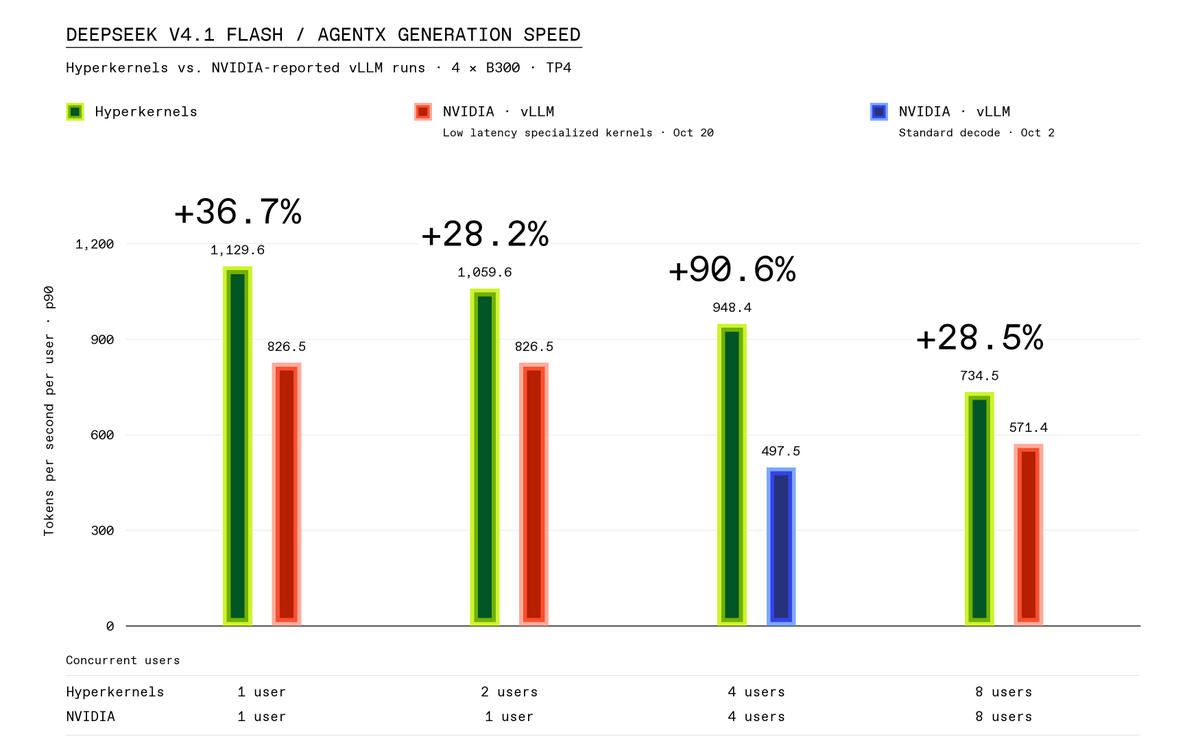
  • Vendor claim: DeepSeek v4.1 Flash ~36.7% higher per-user gen at C1 vs NVIDIA-published vLLM; ~90.6% at C4 vs AgentX
  • π₀-FAST ~94 vs ~243 ms; Matrix-Game ~37.4 vs ~11.6 FPS (~3.2×)
  • CLI: hyperserve llm|drive|dna|world; BYO weights, B300/R580+
  • Not independent reruns; full stack + Kimi/GLM serving planned in weeks
Read full story
Linked Models & Agents:

Kakao Open-Sources Kanana-2-v-decide-3b: 3.67B Multimodal Decision Model Returning Probabilities, Choices and Scores; Vendor Decision Index Avg 61.23

On 2026-11-06 Kakao open-sourced Kanana-2-v-decide-3b-2611 on Hugging Face (~3.67B), built on Kanana-2-v-3b: no text generation, only choice / noul / score with probabilities. Vendor: 72.50 on Kanana Decision Bench; 61.23 avg on Decision Index + Vision; mean <0.04s on one H200, claimed ~43x vs GPT-6 Luna. Commercial Kanana Open License.

Kakao Open-Sources Kanana-2-v-decide-3b: 3.67B Multimodal Decision Model Returning Probabilities, Choices and Scores; Vendor Decision Index Avg 61.23

Key Takeaways

  • Official: HF open weights kakaocorp/kanana-2-v-decide-3b-2611 (~3.67B), commercial Kanana Open License
  • Form: embedding similarity + softmax; choice / noul / score — no text generation
  • Vendor: 72.50 on Kanana Decision Bench; 61.23 avg on Decision Index + Vision
  • Vendor: mean <0.04s on one H200; claimed ~43x vs GPT-6 Luna
  • Try: transformers system_one / pipeline("decision") or HTTP System One server
Read full story
Linked Models & Agents:
⚡ Kanana-2-v-decide-3b-2611⚡ Kanana-2-v-3b⚡ GPT-6 Luna🤖 Agent decision / tool selection🌐 Kakao

AWS Kiro Crew Ships Bots GA: Named Long-Running Agents with Own Memory and Parallel Sessions — Delegate Processes, Not Tasks

On November 5 Kiro (@kirodotdev) announced Kiro bots GA in open-source multi-agent Kiro Crew. Each bot has persistent Notes, its own workspace and Dashboard; it launches parallel workers, redirects drift, consolidates results, and asks approval when needed — with schedules and per-role minimal tool permissions.

AWS Kiro Crew Ships Bots GA: Named Long-Running Agents with Own Memory and Parallel Sessions — Delegate Processes, Not Tasks

Key Takeaways

  • Primary: @kirodotdev 2026-11-05 post + official blog Introducing bots in Kiro Crew
  • Shape: named long-running bot = Notes memory + parallel workers + one ongoing chat
  • Capabilities: monitor/redirect/consolidate; schedules; Dashboards
  • Permissions: tools scoped per role; expansion needs approval; Notes editable
  • Start: Kiro Crew sidebar Bots → Add a bot (default or custom agent)
Read full story

Baidu Opens ERNIE-5.5-Flash-Base: 280B-A14B MoE, 33.5T Pretrain, Vendor-Reported MMLU 93.3

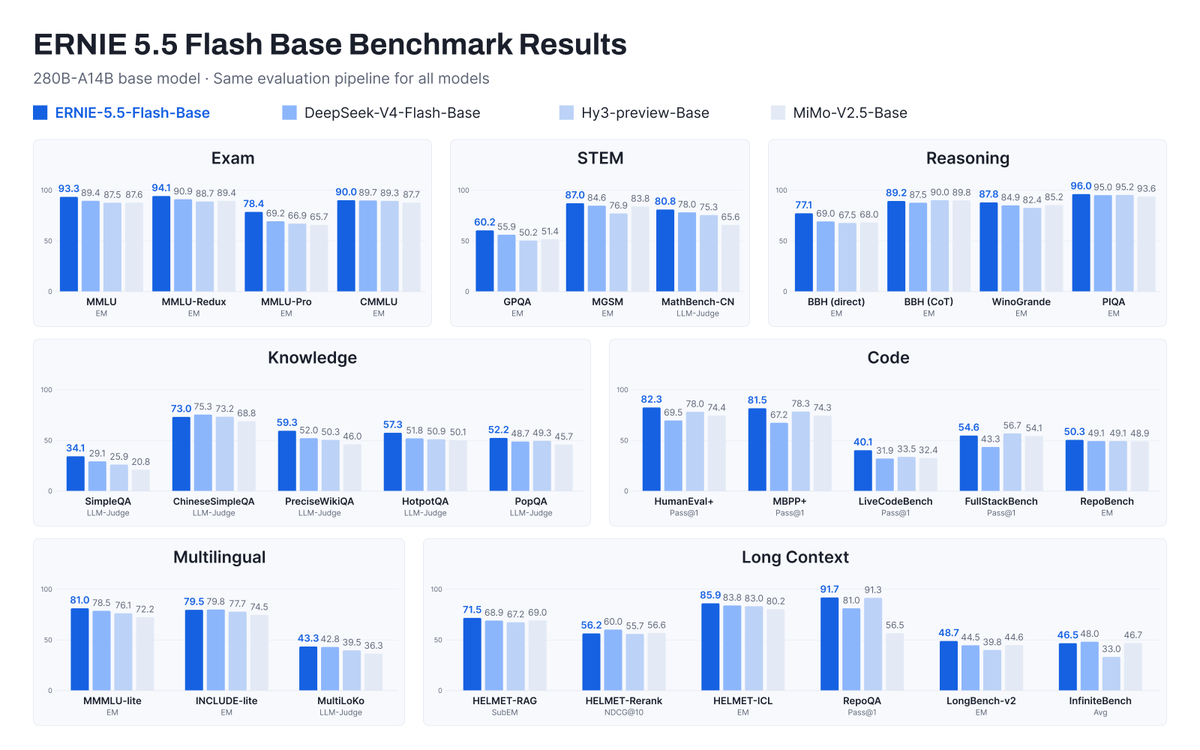
On November 5 Baidu (official blog + @BaiduResearch) open-sourced ERNIE-5.5-Flash-Base: a text-only MoE base checkpoint at end of pre-training (no mid/post-training), 280B total / 14B active per token, 33.5T pretrain tokens, up to 128K train context and 1M for fine-tune/inference. FP8 and BF16 weights are on Hugging Face and ModelScope. Under Baidu's unified eval pipeline vs similar bases: MMLU 93.3, HumanEval+ 82.3, LiveCodeBench 40.1 (vendor-reported). Post-trained ERNIE 5.5 Flash "will follow". License is custom (excludes EU/UK/South Korea; commercial use above $50M related revenue needs prior written authorization).

Baidu Opens ERNIE-5.5-Flash-Base: 280B-A14B MoE, 33.5T Pretrain, Vendor-Reported MMLU 93.3

Key Takeaways

  • Nov 5 open base at end of pre-training: 280B total / 14B active — not a chat/instruct model
  • 33.5T pretrain tokens; up to 128K train context, 1M for fine-tune and inference
  • Vendor unified eval: MMLU 93.3, HumanEval+ 82.3, LiveCodeBench 40.1 vs similar bases
  • Architecture: 37 HCA + 6 MLA-DSA layers; Multi-Router Latent MoE (512 routed top-10 + 1 shared)
  • Custom license (not Apache): excludes EU/UK/South Korea; >$50M related revenue needs Baidu written authorization
Read full story
Linked Models & Agents:
⚡ Ernie 5.5 Flash Base🌐 Baidu (百度文心)

X Discussion: Vercel CEO Guillermo Rauch Says AI Will Rewrite All Human-Made Software, Sparking Debate on Formal Verification and Rewrite Risk

On November 5 Guillermo Rauch posted on X that most human-made software was slow, insecure and under-specified, and that AI will rewrite it all, many times, then formally verify, load test and harden it: "the true birth of software engineering." The post drew 3,000+ likes, 270+ reposts and nearly 100K views. Supporters cite from-scratch AI rewrites; critics warn that missing specs and human review still matter. This is a personal opinion, not a Vercel announcement.

Key Takeaways

  • Rauch's post (Nov 5, 02:22 UTC) had about 3,060 likes, 272 reposts, 681 bookmarks and ~99K views when fetched
  • Core claim: AI will rewrite human software "many times", formally verifying, load testing and hardening it, and replacing memory-unsafe foundations
  • An hour earlier he shared Vercel Security Review figures: 6,817 vulnerabilities found in 24 hours, 580 critical/high, 1,411 already patched by Agent (vendor-reported)
  • Pushback: rewriting under-specified code can just ship the same wrong behavior faster, and formal verification moves bugs up an abstraction level rather than eliminating them
  • This is an opinion thread, not an established fact or official roadmap
Read full story
Linked Models & Agents:
ADSponsored

Ricursive Open-Sources Ripple-65B Preview: A 65B Dense Model Pretrained From Scratch, TerminalBench 2.1 80.5, Apache 2.0

Ricursive Intelligence released its first model, Ripple-65B Preview, on November 4 (18:24 UTC), open-sourcing the instruction-tuned model (BF16 and NVFP4) and a base model on Hugging Face under Apache 2.0. The official model card describes a 65B dense Transformer pretrained on 12T tokens with up to 1M context, and self-reports TerminalBench 2.1 80.5, SWE-bench Pro v2.0 Hard 79.1 and DeepSWE 1.1 44.3, ahead of much larger US open-weight models on agentic coding. It fits on local hardware such as the DGX Spark. CEO Anna Goldie says it cost about a tenth of the prior comparable state of the art.

Ricursive Open-Sources Ripple-65B Preview: A 65B Dense Model Pretrained From Scratch, TerminalBench 2.1 80.5, Apache 2.0

Key Takeaways

  • Ripple-65B Preview is a 65B dense model with a thin-and-deep shape (80 layers, d_model 5120), moving from an Olmo 3 baseline to a Gemma 3N-like architecture.
  • It was pretrained on 12T tokens at 8K sequence length, then went through mid-training, long-context training, SFT and mixed-domain RL, with up to 1M context.
  • Self-reported TerminalBench 2.1 is 80.5, above Reflection Beam 501B (80.1) and Muse Spark Open 816B (76.4), but SWE-bench Verified 76.5 and DeepSWE 1.1 44.3 show it does not lead everywhere.
  • Ricursive says the core team grew from one to five people and code compute efficiency improved 16x versus the Olmo 3 ladder; it reaches about 250 tok/s on 2x B200.
  • Hugging Face hosts BF16, NVFP4, base and DFlash2 speculative-decoding checkpoints, all under Apache 2.0.
Read full story
Linked Models & Agents:
⚡ Ripple-65B Preview⚡ Reflection Beam 501B⚡ Muse Spark Open⚡ Nemotron 3 Ultra🌐 Ricursive Intelligence🌐 NVIDIA

Cognition Launches SWE-2 Flash: A Fast Coding Model Built on Inkling-Small, 200 tok/s at One-Fifth the Price of SWE-2

Cognition released SWE-2 Flash on November 4 (19:55 UTC). Its official blog says the model is built on Thinking Machines' Inkling-Small (276B total, 12B active parameters) and, for the first time, adds a large mid-training stage before reinforcement learning, lifting FrontierCode 2.0 from 3.2% to 24.0% and Terminal-Bench 4.0 from 0.9% to 20.0%. Cognition says it beats every American open-weight model. It generates about 200 tokens per second at one-fifth the price and 3x the speed of SWE-2, and is free for Pro, Max and Teams users in Devin Desktop and CLI until the end of November. Weights are not public; a secure sharing program for partners and researchers is planned.

Cognition Launches SWE-2 Flash: A Fast Coding Model Built on Inkling-Small, 200 tok/s at One-Fifth the Price of SWE-2

Key Takeaways

  • SWE-2 Flash is built on Thinking Machines' Inkling-Small, with 276B total and 12B active parameters, about one-tenth the size of SWE-2 (2.8T-A104B).
  • Training adds a three-stage mid-training run on a few trillion tokens of scientific articles, blogs, code and other sources, followed by large-scale RL with higher-quality and more diverse tasks.
  • Official scores: FrontierCode 2.0 24.0 (SWE-2 scores 23.8), DeepSWE 1.1 60.1, Terminal-Bench 2.1 89.2, SWE-Bench Pro v2 Hard 89.9 and Terminal-Bench 4.0 20.0.
  • It runs at about 200 tokens per second versus about 60 for SWE-2, at one-fifth the price, and is free for Pro, Max and Teams users in Devin Desktop and CLI through November.
  • Citing cyber risk, the weights are not openly released; Cognition says details of a secure weight-access program will follow in the coming weeks.
Read full story
Linked Models & Agents:
⚡ SWE-2 Flash⚡ SWE-2⚡ Inkling-Small🤖 Devin🌐 Cognition🌐 Thinking Machines

webAI Open-Sources TwIL-8B: An 8.8B Reasoning Model With LiveCodeBench 81.6 and MATH-500 98.2, Under a Non-Commercial License

webAI CEO David Stout announced on X on November 4 (17:37 UTC) that the company is open-sourcing TwIL-8B. The official Hugging Face model card says it is post-trained from IBM Granite 4.2 8B with full-parameter SFT, GRPO/DAPO reinforcement learning and a length-aware RL stage, and ships in balanced and verbose variants. Self-reported scores include LiveCodeBench 81.6 (verbose), MATH-500 98.2 and IFBench 74.4, about 93% and 92% of the best frontier score, while GPQA Diamond is only 70.2. A 4.98 GiB Q4_K_M GGUF runs locally; the license is the webAI Non-Commercial License.

webAI Open-Sources TwIL-8B: An 8.8B Reasoning Model With LiveCodeBench 81.6 and MATH-500 98.2, Under a Non-Commercial License

Key Takeaways

  • TwIL-8B has 8.79B parameters, is built on IBM's ibm-granite/granite-4.2-8b, has a 131,072-token context window and is English-only, text to text.
  • Self-reported scores: MATH-500 98.2, AIME 2025 88.3, LiveCodeBench 81.6 (verbose) and IFBench 74.4 (verbose); GPQA Diamond at 70.2 trails Qwen3.5-9B (81.7) clearly.
  • The balanced variant averages about 19.5k output tokens per AIME 2026 problem, about 38% fewer than Qwen3.5-9B's 31.2k, but still roughly 4x GPT-5.5.
  • All scores are webAI internal evaluations; competitor figures are quoted from public sources and were not re-run. SWE-bench, tool use and agentic tasks were not evaluated.
  • The license is the webAI Non-Commercial License 1.0, so it cannot be used commercially as is; the Q4_K_M GGUF is about 4.98 GiB and runs with llama.cpp.
Read full story
Linked Models & Agents:
⚡ TwIL-8B⚡ Granite 4.2 8B⚡ Qwen3.5-9B⚡ Gemma 4 31B🌐 webAI🌐 IBM

Axiom Formalizes the Entire Stacks Project in Lean With AI Agent Swarms: About 16 Million Lines, Billed as the Largest Reusable Formal Math Library Yet

Axiom released a Lean formalization of the entire Stacks Project on November 4 (official X post at 17:13 UTC, with over 2 million views). The roughly 7,500-page open-source algebraic geometry reference, started by Johan de Jong in 2005, becomes about 16 million lines of code, which Axiom calls the largest integrated, reusable formal math library ever built. Hierarchically coordinated AI agent swarms did the work and surfaced dozens of statements in the original that needed local fixes, with counterexamples. The library is open source and browsable side by side with the original text at stacks.axiommath.ai.

Axiom Formalizes the Entire Stacks Project in Lean With AI Agent Swarms: About 16 Million Lines, Billed as the Largest Reusable Formal Math Library Yet

Key Takeaways

  • Scale: about 7,500 pages of source text and roughly 16 million lines of Lean, which Axiom calls the largest integrated reusable formal math library (vendor claim).
  • Method: hierarchical AI agent swarms translate statements, search Mathlib for existing abstractions and build proofs in parallel, with multi-agent auditing and semantic cross-checks against the source to keep statements faithful.
  • Findings: the system surfaced dozens of statements needing local refinement, including missing hypotheses and edge cases in positive characteristic, and built explicit counterexamples where claims failed.
  • The permanent Stacks tag structure is preserved so every Lean declaration links back to the original text; stacks.axiommath.ai offers side-by-side reading and a dependency graph.
  • This follows Axiom's October 27 formalization of the Classification of Finite Simple Groups (CFSG); per de Jong's request, corrections are kept in Axiom's own repository rather than sent upstream.
Read full story
Linked Models & Agents:

OpenAI to Acquire Pierre Computer Company: Code Storage Will Fold Into Codex, Trees and Diffs Stay Open Source, Targeting Git and Code Review for the Agent Era

OpenAI announced on November 4 (OpenAI Newsroom post at 15:15 UTC) that it will acquire Pierre Computer Company. Pierre's open-source Trees (file navigation) and Diffs (change viewing) libraries already power file browsing and code review in the Codex app; after closing, OpenAI plans to bring the features of Code Storage, Pierre's Git-based code storage service, into Codex. Pierre's open-source projects stay open source and Code Storage customers can keep using it. Terms were not disclosed and the deal still needs regulatory approval.

OpenAI to Acquire Pierre Computer Company: Code Storage Will Fold Into Codex, Trees and Diffs Stay Open Source, Targeting Git and Code Review for the Agent Era

Key Takeaways

  • OpenAI names 3 Pierre products, Trees, Diffs (with an Edit mode that fixes code inside a diff) and the new Highlights syntax highlighter, plus Code Storage, a Git-based code storage API.
  • The Codex app already uses Trees and Diffs for file browsing and code review, so OpenAI is bringing in technology and a team it already depends on.
  • Official commitments: the open-source projects stay open source with continued contributions, and Code Storage customers can keep using it after closing while its features move into Codex.
  • Terms were not disclosed; the deal needs regulatory approval, and the two companies stay independent until closing (per OpenAI).
  • It is OpenAI's second source-control move this week, after revealing its in-house Git backend Pando; Axios frames it as a direct challenge to GitHub.
Read full story