AI Coding Live News

BoxWorks 2026: Box and NVIDIA Unveil Box Context Retrieval, Permission-Aware Retrieval for Enterprise Agents Built on Nemotron Retriever, Plus Box Architect and Box Mount

At BoxWorks 2026 on November 5, Box announced an expanded NVIDIA collaboration: Box Context Retrieval, a new engine built on NVIDIA Nemotron Retriever embedding models, combines keyword and semantic search to return the most relevant passages to AI agents while honoring existing file permissions, with general availability for Enterprise Advanced customers planned for early next year. Box's press release claims 20% better search accuracy (Recall@5), 90% fewer tokens and 4x faster answers. Open-weight Nemotron models, starting with Nemotron 3 Ultra, are available in Box AI now. Box also unveiled Box Architect, which designs workflows from a stated goal; Box Mount, which mounts Box folders inside agent sandboxes and works with NVIDIA OpenShell; and agent security controls including MCP Guardrails.
BoxWorks 2026: Box and NVIDIA Unveil Box Context Retrieval, Permission-Aware Retrieval for Enterprise Agents Built on Nemotron Retriever, Plus Box Architect and Box Mount

Key Takeaways

  • Box Context Retrieval uses NVIDIA Nemotron Retriever with hybrid keyword and semantic search, honoring existing file permissions
  • Vendor claims: +20% Recall@5 accuracy, 90% fewer tokens, 4x faster answers; GA for Enterprise Advanced early next year
  • Open-weight Nemotron models, starting with Nemotron 3 Ultra, are available in Box AI now
  • Box Mount puts Box folders inside agent sandboxes and works with the NVIDIA OpenShell secure runtime
  • New agent security controls include MCP Guardrails, classification-based access policies and audit trails
Read full story
Linked Models & Agents:
⚡ Nemotron 3 Ultra⚡ Nemotron Retriever🌐 box🌐 Nvidia (NIM)

Gemini 3.8 TTS Adds Voice Remixing: Edit Prebuilt or Designed Voices With Natural-Language Instructions Into New Reusable Voice IDs

The official Gemini API changelog released Voice remixing on November 4. Starting from a prebuilt voice, an Extended Voice Library voice or a Voice Design persona, developers describe changes such as accent, pitch, pacing or age in natural language, and POST /v1beta/voices returns a new standalone voice_ ID usable with Gemini 3.8 Flash TTS and Flash-Lite TTS. It is also available interactively in Google AI Studio.

Key Takeaways

  • New Voice remixing feature: apply relative natural-language edits to an existing voice to create a new standalone voice
  • Uses POST /v1beta/voices (type=prompted, store=true, plus a new prompted.base_voice field) and returns a voice_ ID with a 24kHz WAV preview
  • Base voices can be any of 30 prebuilt voices, an Extended Voice Library voice, or a stored custom voice_ voice in the project
  • The resulting voice_ ID works with gemini-3.8-flash-tts and gemini-3.8-flash-lite-tts and can itself be remixed again
  • The original voice is never modified, and deleting it does not affect voices remixed from it
Read full story
Linked Models & Agents:
⚡ Gemini 3.8 Flash TTS⚡ Gemini 3.8 Flash-Lite TTS🌐 Google🌐 Google DeepMind

Ricursive Open-Sources Ripple-65B Preview: A 65B Dense Model Pretrained From Scratch, TerminalBench 2.1 80.5, Apache 2.0

Ricursive Intelligence released its first model, Ripple-65B Preview, on November 4 (18:24 UTC), open-sourcing the instruction-tuned model (BF16 and NVFP4) and a base model on Hugging Face under Apache 2.0. The official model card describes a 65B dense Transformer pretrained on 12T tokens with up to 1M context, and self-reports TerminalBench 2.1 80.5, SWE-bench Pro v2.0 Hard 79.1 and DeepSWE 1.1 44.3, ahead of much larger US open-weight models on agentic coding. It fits on local hardware such as the DGX Spark. CEO Anna Goldie says it cost about a tenth of the prior comparable state of the art.

Ricursive Open-Sources Ripple-65B Preview: A 65B Dense Model Pretrained From Scratch, TerminalBench 2.1 80.5, Apache 2.0

Key Takeaways

  • Ripple-65B Preview is a 65B dense model with a thin-and-deep shape (80 layers, d_model 5120), moving from an Olmo 3 baseline to a Gemma 3N-like architecture.
  • It was pretrained on 12T tokens at 8K sequence length, then went through mid-training, long-context training, SFT and mixed-domain RL, with up to 1M context.
  • Self-reported TerminalBench 2.1 is 80.5, above Reflection Beam 501B (80.1) and Muse Spark Open 816B (76.4), but SWE-bench Verified 76.5 and DeepSWE 1.1 44.3 show it does not lead everywhere.
  • Ricursive says the core team grew from one to five people and code compute efficiency improved 16x versus the Olmo 3 ladder; it reaches about 250 tok/s on 2x B200.
  • Hugging Face hosts BF16, NVFP4, base and DFlash2 speculative-decoding checkpoints, all under Apache 2.0.
Read full story
Linked Models & Agents:
⚡ Ripple-65B Preview⚡ Reflection Beam 501B⚡ Muse Spark Open⚡ Nemotron 3 Ultra🌐 Ricursive Intelligence🌐 NVIDIA

Cognition Launches SWE-2 Flash: A Fast Coding Model Built on Inkling-Small, 200 tok/s at One-Fifth the Price of SWE-2

Cognition released SWE-2 Flash on November 4 (19:55 UTC). Its official blog says the model is built on Thinking Machines' Inkling-Small (276B total, 12B active parameters) and, for the first time, adds a large mid-training stage before reinforcement learning, lifting FrontierCode 2.0 from 3.2% to 24.0% and Terminal-Bench 4.0 from 0.9% to 20.0%. Cognition says it beats every American open-weight model. It generates about 200 tokens per second at one-fifth the price and 3x the speed of SWE-2, and is free for Pro, Max and Teams users in Devin Desktop and CLI until the end of November. Weights are not public; a secure sharing program for partners and researchers is planned.

Cognition Launches SWE-2 Flash: A Fast Coding Model Built on Inkling-Small, 200 tok/s at One-Fifth the Price of SWE-2

Key Takeaways

  • SWE-2 Flash is built on Thinking Machines' Inkling-Small, with 276B total and 12B active parameters, about one-tenth the size of SWE-2 (2.8T-A104B).
  • Training adds a three-stage mid-training run on a few trillion tokens of scientific articles, blogs, code and other sources, followed by large-scale RL with higher-quality and more diverse tasks.
  • Official scores: FrontierCode 2.0 24.0 (SWE-2 scores 23.8), DeepSWE 1.1 60.1, Terminal-Bench 2.1 89.2, SWE-Bench Pro v2 Hard 89.9 and Terminal-Bench 4.0 20.0.
  • It runs at about 200 tokens per second versus about 60 for SWE-2, at one-fifth the price, and is free for Pro, Max and Teams users in Devin Desktop and CLI through November.
  • Citing cyber risk, the weights are not openly released; Cognition says details of a secure weight-access program will follow in the coming weeks.
Read full story
Linked Models & Agents:
⚡ SWE-2 Flash⚡ SWE-2⚡ Inkling-Small🤖 Devin🌐 Cognition🌐 Thinking Machines
ADSponsored

Axiom Formalizes the Entire Stacks Project in Lean With AI Agent Swarms: About 16 Million Lines, Billed as the Largest Reusable Formal Math Library Yet

Axiom released a Lean formalization of the entire Stacks Project on November 4 (official X post at 17:13 UTC, with over 2 million views). The roughly 7,500-page open-source algebraic geometry reference, started by Johan de Jong in 2005, becomes about 16 million lines of code, which Axiom calls the largest integrated, reusable formal math library ever built. Hierarchically coordinated AI agent swarms did the work and surfaced dozens of statements in the original that needed local fixes, with counterexamples. The library is open source and browsable side by side with the original text at stacks.axiommath.ai.

Axiom Formalizes the Entire Stacks Project in Lean With AI Agent Swarms: About 16 Million Lines, Billed as the Largest Reusable Formal Math Library Yet

Key Takeaways

  • Scale: about 7,500 pages of source text and roughly 16 million lines of Lean, which Axiom calls the largest integrated reusable formal math library (vendor claim).
  • Method: hierarchical AI agent swarms translate statements, search Mathlib for existing abstractions and build proofs in parallel, with multi-agent auditing and semantic cross-checks against the source to keep statements faithful.
  • Findings: the system surfaced dozens of statements needing local refinement, including missing hypotheses and edge cases in positive characteristic, and built explicit counterexamples where claims failed.
  • The permanent Stacks tag structure is preserved so every Lean declaration links back to the original text; stacks.axiommath.ai offers side-by-side reading and a dependency graph.
  • This follows Axiom's October 27 formalization of the Classification of Finite Simple Groups (CFSG); per de Jong's request, corrections are kept in Axiom's own repository rather than sent upstream.
Read full story
Linked Models & Agents:

Moonshot Releases Kimi K3.1 Pro Open Weights on Hugging Face: 2.8T-Parameter, 104B-Active MoE in MXFP4 at About 1.56TB, Custom License Limits Large Model-as-a-Service Use

The official Kimi account @Kimi_Moonshot announced the Kimi K3.1 Pro model weights at 16:00 UTC on November 4; the moonshotai/Kimi-K3.1-Pro repository is public and not gated. The model card describes a natively multimodal MoE with 2.8T total and 104B active parameters and a 1M-token context, shipped as MXFP4 weights from quantization-aware training, about 1.56TB in total; vLLM, SGLang and TokenSpeed are the recommended engines. The license allows free use and modification, but Model-as-a-Service businesses with over $20M in annual revenue need a separate agreement.

Moonshot Releases Kimi K3.1 Pro Open Weights on Hugging Face: 2.8T-Parameter, 104B-Active MoE in MXFP4 at About 1.56TB, Custom License Limits Large Model-as-a-Service Use

Key Takeaways

  • Architecture: 93 layers (1 dense), 69 KDA plus 24 Gated DSA attention layers, 896 experts with 16 selected per token plus 2 shared experts, and a 401M MoonViT-V2 vision encoder.
  • Compared with K3, the full-attention Gated MLA layers are replaced with Gated DeepSeek Sparse Attention for more efficient long-context modeling.
  • Vendor-reported scores on the model card: Terminal-Bench 4.0 65.7 (Opus 5.5 66.4), SWE Marathon v1.1 51.7 (Opus 5.5 46.3), HLE-Full with tools 70.0 and BrowseComp 92.1; ProgramBench 31.5 trails Opus 5.5 at 65.0.
  • License: a Model-as-a-Service business with over $20M revenue in any 12 months needs a separate agreement with Moonshot, and products above 100M monthly users or $20M monthly revenue must prominently display "Kimi K3.1-Pro"; internal use is exempt from both.
Read full story

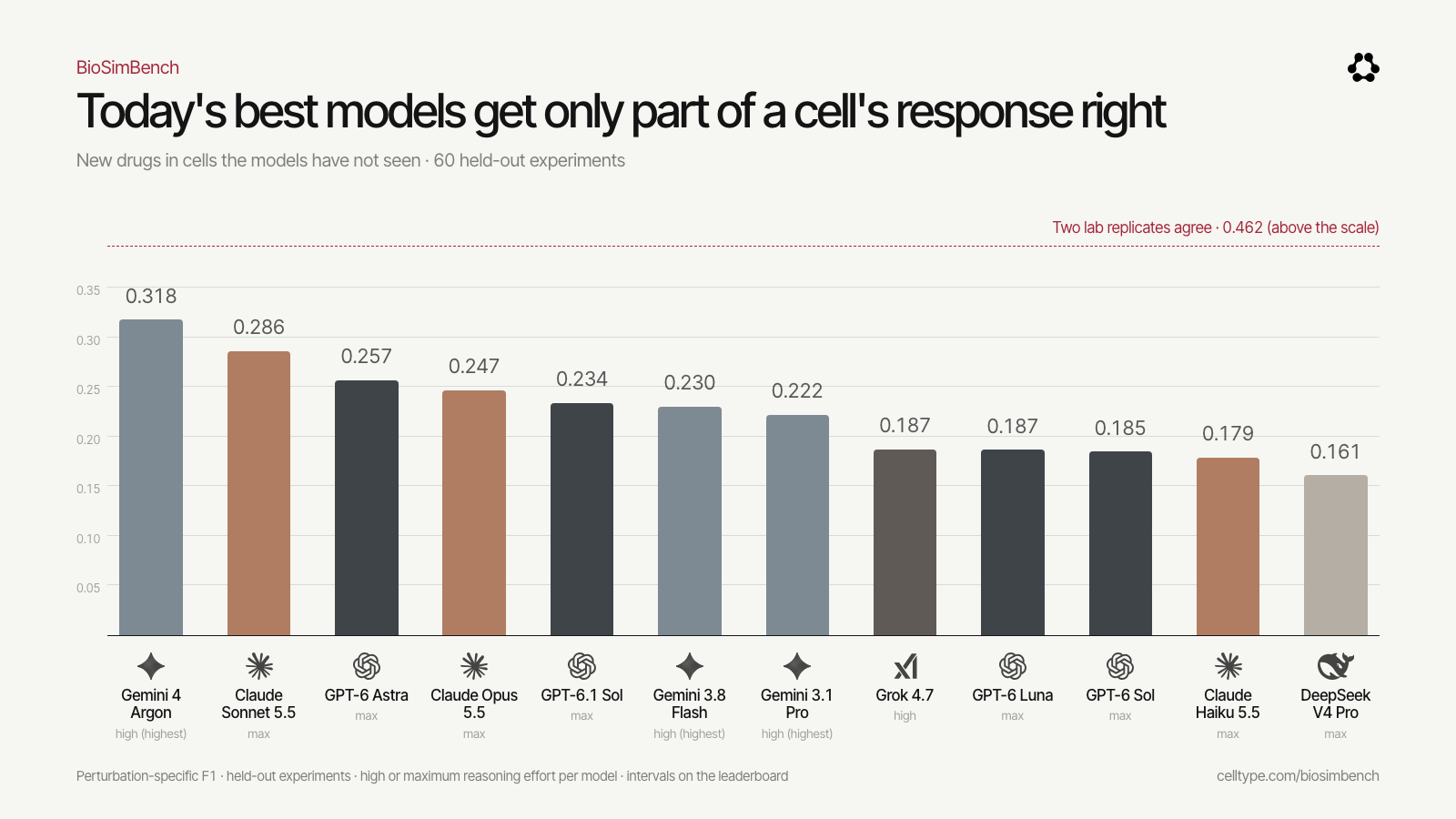
CellType Launches BioSimBench: Frontier LLMs Get Only Part of Cell Responses Right, Gemini 4 Argon Leads and CellType 27B Beats Them on Every Track

CellType, a YC W26 startup, released BioSimBench 1.0 on November 4. It uses real lab experiments to test whether language models can predict which genes go up or down after a cell is hit by a drug, a gene knockdown or an immune signal. Among 12 frontier models, Gemini 4 Argon ranks first with an overall score of 0.184, ahead of Claude Sonnet 5.5 (0.160) and GPT-6 Astra (0.159), while two lab replicates agree at 0.462. A 27B model CellType trained in its BioSimGym RL environments beats the best frontier model on all four prediction tracks.

CellType Launches BioSimBench: Frontier LLMs Get Only Part of Cell Responses Right, Gemini 4 Argon Leads and CellType 27B Beats Them on Every Track

Key Takeaways

  • BioSimBench 1.0 has five tracks: new drugs and cell contexts, gene knockdown, drug response, immune signals, and a tool-using research agent; test answers are kept private.
  • The 12 frontier models score between 0.110 and 0.184 overall, with Gemini 4 Argon first and DeepSeek V4 Pro last; two lab replicates agree at 0.462, so the gap is still large.
  • CellType 27B scores 0.366 on new drugs and cell contexts and 0.203 on drug response, about double the best frontier score of 0.103.
  • Data processing uses NVIDIA RAPIDS-singlecell, at least 4x faster for the whole pipeline; models were trained with NeMo RL and BioSimGym follows NeMo RL environment interfaces.
Read full story

SenseTime Ships SenseNova 6.8 Flash: An Office Agent Model With Long-Term Memory and Proactive Interaction That Builds Animated Slides, Motion Posters and Editable Blender 3D Projects

On the evening of November 2, SenseTime released the official version of SenseNova 6.8 Flash, a multimodal agent model with two main upgrades. First, long-term memory and proactive interaction: it keeps user goals and constraints across tasks and sessions and flags affected items when information changes. Second, design generation across Web, SVG, Three.js, Blender, animated PPT and motion posters, with Figma integration. It is live in SenseNova Studio, the Raccoon assistant and the SenseNova Token Plan; the official X account says the Token Plan offers a free trial of 1,500 API requests every 5 hours. SenseTime says it beats some international frontier models on agent collaboration, data analysis and presentation generation, but the announcement lists no specific scores.

SenseTime Ships SenseNova 6.8 Flash: An Office Agent Model With Long-Term Memory and Proactive Interaction That Builds Animated Slides, Motion Posters and Editable Blender 3D Projects

Key Takeaways

  • The official release landed on the evening of November 2, positioned as a multimodal agent model for office collaboration and design delivery
  • Long-term memory plus proactive interaction: it remembers goals, constraints and preferences across sessions and suggests changes when related information shifts (demos ran on an internal Raccoon build)
  • Design output spans Web, SVG, Three.js, Blender, animated PPT and motion posters, producing editable PPTX files and Blender projects, with Figma integration
  • Available in SenseNova Studio, the Raccoon assistant and the SenseNova Token Plan; the official X post cites 1,500 free API requests every 5 hours
  • SenseTime only says it beats some international frontier models on agent collaboration, data analysis and presentation generation; no scores were published and there is no independent evaluation yet
Read full story
Linked Models & Agents:
⚡ SenseNova 6.8 Flash⚡ SenseNova Loop-9B-Preview🤖 Raccoon🌐 SenseTime

Axion 1.0 Open Agent Foundation Model: Two SFT Stages Plus RL, 35B-A3B Reproduction Checkpoint Under Apache 2.0, Full Recipe Released

arXiv paper 2611.03233 by Yuqi Jia, Yunjie Tian and five co-authors introduces Axion 1.0, an agent foundation model that is open beyond its weights. It uses just two lightweight SFT stages plus reinforcement learning, with no dedicated mid-training, DPO or on-policy distillation, and about 18K SFT trajectories in total. Training code is hosted under the bytedance GitHub organization, and the training data and an Axion 1.0-35B reproduction checkpoint (Qwen3.6-35B-A3B base, 35B total / 3B active, Apache 2.0) are on Hugging Face; weights for the paper's 122B model are listed as coming soon.

Axion 1.0 Open Agent Foundation Model: Two SFT Stages Plus RL, 35B-A3B Reproduction Checkpoint Under Apache 2.0, Full Recipe Released

Key Takeaways

  • A minimal recipe: SFT stage one for self-contained scientific reasoning, stage two for tool use and information seeking, then RL for long-horizon interaction, with 18,363 SFT trajectories and 484 RL tasks
  • The release covers data construction, generation, filtering, verification, prompts and training code (GitHub), not just weights
  • The 35B reproduction checkpoint scores 52.8 on HLE, 60.4 on SEAL-0, 85.0 on FrontierScience Olympiad and 55.0 on FrontierScience Research (HF model card)
  • The paper's 122B model reports 59.0 on HLE with restricted website access and 66.7 on FrontierScience Research; 122B weights are not out yet
  • All scores are self-reported; the HF card lists Claude Opus 5 at 63.6 on HLE, so Axion still trails the strongest closed models
Read full story
Linked Models & Agents:
⚡ Axion 1.0-35B⚡ Axion 1.0-122B⚡ Qwen3.6-35B-A3B🌐 ByteDance🌐 Hugging Face

Tencent Releases Hy4: First Hy Model With Vision and Computer Use, Live on Tencent Cloud and OpenRouter, Open Weights Planned

On November 4, Tencent Hy published Hy4 on its official site. Versus Augusts Hy4 preview, Tencent says it scaled up pre-training and post-training, added vision for the first time, added computer use across CLI and GUI, and trained specifically on Blender, CAD and engines like Unreal, Unity and Godot. Hy4 is live on Tencent Cloud and OpenRouter (tencent/hy4, 1M context) at the same API price as the preview. Weights and a system card are promised soon, and a cheaper Hy4 flash is coming.

Key Takeaways

  • Official blog: Introducing Hy4, dated 2026-11-04; the Tencent Hy transparency center also lists V1.0 Hy4
  • Two firsts: vision (fine-grained image detail, complex charts, math visual reasoning) and computer use (CLI plus GUI, with targeted training on Blender, CAD and long cross-app workflows)
  • Tencent's own evals: on 579 real finance tasks rated by 213 finance professionals Hy4 scores 3.04, first among open-weight models (DeepSeek-V4.1-Flash-1017 2.97, Kimi K3.1 Pro 2.68, GLM-5.3 2.68); GameDev +19.1%, GameLogic +9.8%; internal search hallucination rate 15.76% to 5.45%
  • Same API price as the preview: $0.042 cached input, $0.834 input, $2.501 output per million tokens; the OpenRouter page currently shows 50% off ($0.417/$1.251), 1,048,576 context and up to 65,536 output tokens
  • Weights are not out yet: Tencent says it will open-source them with a full system card, working with vLLM and SGLang; Hy4 flash is due soon
Read full story
Linked Models & Agents:
⚡ Hy4⚡ Hy4 preview⚡ Hy4 flash🤖 CodeBuddy🤖 WorkBuddy🌐 Tencent
ADSponsored

Artificial Analysis Upgrades Its Six Capability Indexes to v2.0, Weighting Non-Hallucination and Agentic Tool Use; Claude Opus 5.5 Leads All Six

Independent evaluator Artificial Analysis announced on X on November 4 that its six Capability Indexes (Finance & Accounting, Strategy & Ops, Legal, Healthcare & Medical, Engineering, Economics) are now v2.0, aligned with Intelligence Index v5.0 evaluations and weighting Non-Hallucination and Agentic Tool Use more heavily. Across the indexes, HLE becomes HLE-Diamond, AA-Omniscience moves to v1.1 and GDPval-AA is removed; Engineering gains a new Science capability. Per Artificial Analysis, Claude Opus 5.5 (max) leads all six, with GPT-6 Astra (max) second in Finance & Accounting, Legal and Engineering. Among open-weights models, Kimi K3.1 Pro (weights not yet released) leads all six at #5 to #8.

Artificial Analysis Upgrades Its Six Capability Indexes to v2.0, Weighting Non-Hallucination and Agentic Tool Use; Claude Opus 5.5 Leads All Six

Key Takeaways

  • The six indexes map O*NET occupation tasks to representative benchmarks, weighted by how often each capability appears in that occupation (methodology page)
  • Common changes: HLE becomes HLE-Diamond, AA-Omniscience moves to v1.1, and GDPval-AA is dropped from Agentic Knowledge Work (now AA-Briefcase v1.1)
  • Non-Hallucination weight rises to 15% in Finance & Accounting and Legal; Agentic Tool Use (AutomationBench-AA) is 35% of Strategy & Ops, its largest component
  • Engineering adds Science (20%, CritPt v2 Hard Subset plus Terminal-Bench-Science 0.1) and FrontierCode 2.0 under Agentic Coding; Economics swaps AA-LCR for GDP.pdf
  • Results per Artificial Analysis: Claude Opus 5.5 (max) is #1 in all six; among open weights, Kimi K3.1 Pro leads all six, MiniMax-M3.1-Flash leads Strategy & Ops (#10) and DeepSeek V4.1 Flash 1017 (max) leads Healthcare & Medical (#12)
Read full story

Epic Confirms Unreal Engine 5.9: Preview Next Week With Improved AI Workflows and Web Back as a Target Platform

On November 3, the official Unreal Engine account said UE 5.9 is happening, with a Preview build next week that includes improved AI workflows, web as a target platform, and rendering and animation updates; changes are already landing in the 5.9 branch on GitHub, with more details to come. This reverses Epic's June State of Unreal stance that 5.8 was the last planned major UE5 release, with 5.9 kept only as an option. UE 5.8 shipped the Experimental Unreal MCP plugin, which lets MCP clients such as Claude Code and Cursor drive the editor; the 5.9 AI workflow changes likely build on it, but Epic has not published a feature list yet.

Key Takeaways

  • Timing: the official post went out at 13:05 UTC on November 3 and says the 5.9 Preview arrives next week; the exact date and the final release date are not announced
  • Scope (per Epic): improved AI workflows, web as a target platform, and rendering and animation updates; changes are already landing in the 5.9 branch on GitHub
  • Context: in June, State of Unreal called 5.8 the last planned major UE5 release; UE6 targets Early Access at the end of 2027, with the full release 12 to 18 months later
  • AI groundwork: the Experimental Unreal MCP plugin in 5.8 embeds an MCP server in the editor at http://127.0.0.1:8000/mcp by default, loopback only and with no authentication
  • Reach: about 2,552 likes, 251 reposts, 114 quotes and 215K views at fetch time
Read full story

Pruna Open-Sources P-H3-Image: MiniMax-H3 Video Model Turned Into an Image Generation and Editing Model, 8 Steps, 5x Faster, 7x Smaller

On November 3, model-compression company Pruna AI open-sourced P-H3-Image, which turns MiniMax-H3, the open-weights video model MiniMax released this summer, into a text-to-image and image-editing model. Per Pruna: sampling drops from 50 to 8 steps, a 4 MP image on one B200 goes from 12.4 s to 2.6 s, the 4-bit set is a 20 GB download (vs 143 GB for H3), and peak VRAM at 8 MP is about 21 GB. It renders 2 to 16 MP and edits with multiple reference images. Weights are on Hugging Face with native ComfyUI support. It keeps the MiniMax H3 Community License, which by default excludes the EU, UK, South Korea and the US.

Pruna Open-Sources P-H3-Image: MiniMax-H3 Video Model Turned Into an Image Generation and Editing Model, 8 Steps, 5x Faster, 7x Smaller

Key Takeaways

  • Speed (Pruna figures): 8 steps instead of 50; on one B200 a 4 MP image goes from 12.4 s to 2.6 s and 8 MP from 30.6 s to 5.8 s; the 4-bit set does 4 MP in about 6.3 s on an L40S
  • Size: the transformer shrinks from 33B to 20B parameters and the text encoder is distilled from 32B to 4B (67 GB to 9 GB); downloads are 55 GB in bf16 and 20 GB in 4-bit vs 143 GB for H3
  • Memory: peak VRAM at 8 MP is about 56 GB in bf16 and 21 GB in 4-bit; the bf16 diffusers pipeline with the prompt upsampler needs about 100 GB
  • Capabilities: renders 2 to 16 MP, strongest at photorealistic and documentary photography, film stills, anime and graphics with short text; supports multi-reference editing (8 images per the X post, 9 per the blog)
  • License: MiniMax H3 Community License; the EU, UK, South Korea and US need a separate license from MiniMax, and products must show "Powered by MiniMax H3"
Read full story
Linked Models & Agents:
⚡ P-H3-Image⚡ MiniMax-H3⚡ Qwen3.5-9B🌐 Pruna AI🌐 MiniMax🌐 Hugging Face🌐 ComfyUI

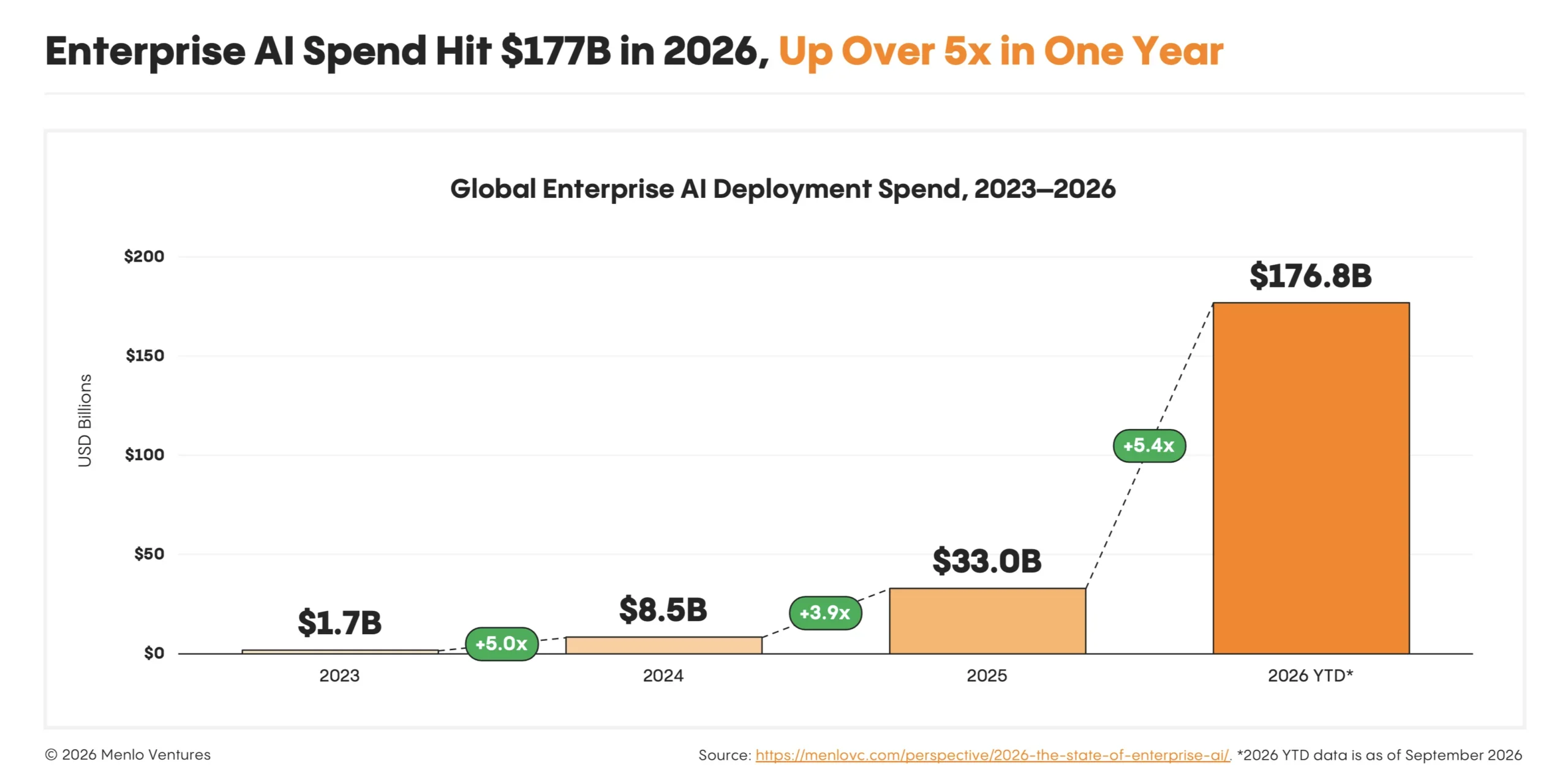
Menlo Ventures 2026 State of Enterprise AI: Enterprise AI Spend Hits $176.8B, Up 5.4x, as Anthropic Takes 55% of Enterprise API Spend

On November 3, Menlo Ventures released its fourth annual enterprise AI report. It estimates enterprise spending on using AI reached $176.8B by September 2026, up 5.4x from $33B in 2025. In enterprise LLM API spend, Anthropic rose from 40% to 55%, OpenAI from 27% to 31%, and Google fell from 21% to 9%. Coding is the largest app category at $34.0B. Figures come from a survey of about 400 US enterprise AI decision-makers plus third-party data, so they are estimates; Menlo is an Anthropic investor.

Menlo Ventures 2026 State of Enterprise AI: Enterprise AI Spend Hits $176.8B, Up 5.4x, as Anthropic Takes 55% of Enterprise API Spend

Key Takeaways

  • Enterprise AI deployment spend: $1.7B (2023) to $8.5B (2024) to $33B (2025) to $176.8B by Sep 2026, up 5.4x vs 3.9x last year (Menlo estimate)
  • Enterprise LLM API spend share: Anthropic 55% (from 40%), OpenAI 31% (from 27%), Google 9% (from 21%); open-source models are about 19% of usage but only 4% of spend
  • App-layer spend is about $77.3B: coding $34.0B and chatbots/productivity $25.0B make up 76%; Claude Code and Codex account for $24.0B (70%) of coding spend
  • On OpenRouter, agents generate 80% of tokens (about 130.9T per week), roughly 7x human usage, and have grown 37x since overtaking human traffic in February
  • 55% of incremental AI spend comes from net-new budgets and 22% from existing software budgets; the share of enterprises paying for AI rose only from 55% to 65%
Read full story

Sarvam Releases Prism, an Open-Weight Decision Model Built on Sarvam 105B That Returns Calibrated Option Probabilities in About 44 ms, Apache 2.0

Indian AI company Sarvam released Sarvam Prism on November 3, a "System One" decision model for enterprise workflows: given a context and questions with fixed answer options, it returns a probability for every option in a single forward pass instead of generating text. Sarvam says that across the 25 decision models it tested, Prism averages 71.8 over three indices with a median response time of 44 ms on one B200, the highest score under 100 ms, and scores 82.5 on its Indian-language benchmark. Weights are on Hugging Face under Apache 2.0, with a hosted API as well. All scores are Sarvam's own measurements.

Sarvam Releases Prism, an Open-Weight Decision Model Built on Sarvam 105B That Returns Calibrated Option Probabilities in About 44 ms, Apache 2.0

Key Takeaways

  • Trained on the Sarvam 105B (105B-10B MoE) base; it only outputs option probabilities, so the answer is always one of the given options.
  • Vendor-reported indices: Jev Decision Index 67.0, Sarvam's recreation of the Artificial Analysis decision index 65.9, internal Indian-language benchmark 82.5, average 71.8; Perplexity Decider v1.2 averages 68.0 at about 117 ms.
  • Calibration: on English answers at 90%+ confidence it expects 3.3% errors and makes 2.2%; in Indian languages 5.4% expected vs 4.4% actual, while rivals underestimate errors by 1.5x to 4.8x.
  • By sorting options into a fixed order before scoring, it changed 0 of 2,000 answers across four shuffled option orders.
  • On 700 recorded agent runs it judges correctly 78.5% of the time overall, vs 70.7% for Claude Haiku 5.5.
  • Self-hosting needs one FP8-capable GPU with about 120 GB free memory (such as B200 or H200) and about 106 GB of disk for weights.
Read full story
Linked Models & Agents:
⚡ Sarvam Prism⚡ Sarvam 105B⚡ Perplexity Decider v1.2⚡ Jev 1.14⚡ Microsoft-Decision-1⚡ Claude Haiku 5.5🌐 Sarvam