AI Coding Live News

OpenCode 2.2.3 adds a built-in Claude Agent provider that runs Claude models through your own Claude Code login, subscriptions included

OpenCode, the open-source coding agent, shipped v2.2.3 at 09:55 UTC on Oct 30 with a built-in "Claude Agent" provider. After installing Claude Code and running claude auth login, users pick Claude Agent in /connect and can call Claude models through their own Claude Code login, whether that is a subscription, an API key or a cloud account. It runs the user's local claude program through Anthropic's public Claude Agent SDK, but turns off Claude Code's built-in tools and uses OpenCode's own tools and permission system instead. Hours earlier, OpenCode team member dax (@thdxr) teased on X "what if you could use your claude subscription in opencode", drawing about 2,300 likes.

Key Takeaways

  • v2.2.3 shipped at 09:55 UTC on Oct 30; its first highlight is "Use Claude Code in OpenCode", from PR #58782 (release notes)
  • Setup is three steps: install Claude Code, run claude auth login, and pick Claude Agent in /connect; OPENCODE_CLAUDE_PATH overrides the claude binary
  • The design spec says it uses only the public SDK, never reads Claude Code's saved login and never intercepts or changes its requests; subscription, API key and cloud logins all work (spec)
  • Claude Code's built-in tools, CLAUDE.md, hooks, MCP servers, skills, auto compaction and auto memory are all off; OpenCode's tools, permissions and compaction apply, with one claude process per session that stops after 5 idle minutes
  • dax's (@thdxr) teaser post drew about 2,300 likes and 280 replies (post); no performance comparison has been published
Read full story

xAI adds a guidelines field to the Grok API for per-request moderation of NSFW, violence and profanity

On Oct 28 xAI announced on the official @grok account that all API customers can now add a guidelines array to text requests and set the nsfw, violence and profanity categories to decline, so Grok tightens that content while it writes rather than through after-the-fact filtering. The field works on the Responses API, Chat Completions and the xAI Python SDK; multi-agent models and deferred completions are not supported, and invalid values are rejected with 400 or 422 before the model runs.

xAI adds a guidelines field to the Grok API for per-request moderation of NSFW, violence and profanity

Key Takeaways

  • Three categories: nsfw, violence and profanity; the only behavior today is decline, and unlisted categories keep the default (docs)
  • Works on the Responses API, Chat Completions and chat.create in the xAI Python SDK; with the OpenAI Python SDK pass it via extra_body
  • Applies only to the request that carries it, so send it on every turn; the xAI SDK chat object stores it for you
  • Not supported on multi-agent models such as grok-4.20-multi-agent or deferred completions; duplicate categories return 400 and unknown values return 422
  • The official post had about 592K views and 271 likes when this was written
Read full story
Linked Models & Agents:

Claude Code lead Boris Cherny on faster usage drain: every shared session reviewed, no regression found, fixes for a few smaller issues rolling out

Since Oct 21 many developers on X have complained that Claude Code was draining usage limits much faster. On Oct 28 (UTC) Boris Cherny, who leads Claude Code at Anthropic, replied on X that the team reviewed every session ID users shared, found no single root cause and no regression in Claude Code, and is rolling out fixes for a few smaller issues that made some sessions burn tokens faster. Most fast-drain cases traced back to one or two heavy sessions using xhigh effort, /goal, Workflows, Agent Teams or long SDK jobs.

Key Takeaways

  • The complaint post that started it said usage was draining 5x faster and drew about 1,660 likes and 240+ replies (a user claim, not official data)
  • Boris Cherny: the team checked every shared session ID, found no single root cause or Claude Code regression, and is rolling out fixes for a few smaller issues
  • Heavy features were the main driver: xhigh effort, /goal, Workflows, Agent Teams and long SDK jobs
  • Subagents inherit the session effort level by default, which adds up fast; /usage shows where tokens went
  • The official docs say Agent Teams use about 7x more tokens than standard sessions when teammates run in plan mode
Read full story
Linked Models & Agents:

Cursor launches Agent SDK: agents as code with Markdown prompts, TypeScript tools, built-in evals, and hosted or self-run deployment

On Oct 26 Cursor announced that its Agent SDK is generally available. An agent's system prompt is written in Markdown and its tools in TypeScript; agents can be deployed on Cursor's hosted infrastructure or run on your own machines, and built-in evals measure every change. Cursor's docs say it uses the same Cursor SDK harness that powers Bugbot, Security Review, Approval Bot and Rollouts, can be triggered from source-control events, issue trackers, Slack or schedules, and is managed under Deployed Agents after deployment. Cursor has not published pricing or benchmarks.

Cursor launches Agent SDK: agents as code with Markdown prompts, TypeScript tools, built-in evals, and hosted or self-run deployment

Key Takeaways

  • Same harness: Cursor's docs say Agent SDK runs on the harness behind four of its own agents: Bugbot, Security Review, Approval Bot and Rollouts
  • Project layout: bot/instructions.md is the required always-on system prompt, each bot/tools/*.ts file is one typed tool, with folders for skills, MCP connections, subagents, channels, hooks and schedules, and evals live in evals/*.eval.ts
  • Triggers and deployment: runs can be triggered from source control, issue trackers, Slack, webhooks or schedules; deploy on Cursor-managed hosting or self-host, then manage under Deployed Agents
  • CLI: agent-sdk validate, run and eval check the project, run a real turn and run evals; Cursor says only run and eval need a Cursor credential
  • Cursor has not published pricing or benchmarks
Read full story
Linked Models & Agents:
ADSponsored

Alibaba Tongyi Labs Open-Sources OpenGCUA: Full-Stack Generalist Computer-Use Agent Cutting OSWorld Steps by 53%

Alibaba Tongyi Labs (Tongyi-MAI) has published and open-sourced OpenGCUA (arXiv:2610.22200), establishing a fully open software stack for Generalist Computer Use Agents. Moving beyond brittle single-click GUI paradigms, OpenGCUA introduces a 'Code-Execution-as-Action' framework combining visual screen perception, accessibility trees, bash scripts, and Playwright APIs into unified programmatic execution blocks. Evaluated across eight frontier models on OSWorld-v2, OpenGCUA boosted mean scores by +19.6 points while cutting task steps by 53.0%, releasing an Apache-2.0 macOS menu-bar harness and Cross-Device SDK.

Alibaba Tongyi Labs Open-Sources OpenGCUA: Full-Stack Generalist Computer-Use Agent Cutting OSWorld Steps by 53%

Key Takeaways

  • OpenGCUA published in arXiv:2610.22200 and released under Apache 2.0 as an open generalist computer-use agent stack
  • Pioneers 'Code-Execution-as-Action', synthesizing loops, conditionals, and programmatic APIs into unified Python/Bash blocks
  • On OSWorld-v2, boosts mean score by +19.6 points across eight frontier models while reducing steps per task by 53.0%
  • Releases a native macOS menu-bar harness for physical execution alongside a Cross-Device SDK spanning PC, web, and mobile
Read full story

VS Code 1.143 makes the Copilot SDK-based harness the default, adds multi-model comparison and on-device MAI Code 1.1 Flash

Microsoft shipped Visual Studio Code 1.143. The Copilot harness, built on the Copilot SDK, is now the default for new sessions and works across the editor and Agents window. A Compare Models preview runs several models on one task with an optional Judge model, an experimental mode runs MAI Code 1.1 Flash on a local NVIDIA GPU, and large chats open much faster.

VS Code 1.143 makes the Copilot SDK-based harness the default, adds multi-model comparison and on-device MAI Code 1.1 Flash

Key Takeaways

  • Default harness: new sessions use the Copilot harness built on the Copilot SDK, which can run in the background and move between the editor and the Agents window
  • Compare Models (Preview): one prompt runs 2 or more models in parallel, mixing Copilot, Claude and Codex harnesses, with an optional Judge model scoring time and token use and a Synthesize step
  • On-device models (Experimental): download MAI Code 1.1 Flash to run locally, labeled On-device with no AI credits used; needs an NVIDIA GPU with 96 GB+ memory
  • Performance (vendor figures): cold-opening a ~1,150-request chat dropped from 35.6 s to 9.0 s, and window freeze time from 28.3 s to 0.6 s
  • Also: the editor diagnostic highlight limit rises from 500 to 5,000 per file, and the Windows installer can install GitHub Copilot CLI
Read full story

Claude API ships version 2026-10-21, its first since 2023: sampling parameters removed, new major SDKs across languages

On Oct 21 Anthropic released Claude API version 2026-10-21, its first official version since 2023. It removes the temperature, top_p and top_k sampling parameters and drops old Admin API field names, while new SDK majors (Python 2.0, TypeScript 1.0, Go 2.0, Java 3.0 and more) default to it. Version 2023-06-01 is not deprecated.

Key Takeaways

  • Version: 2026-10-21 is the Claude API's first official version since 2023; 2023-06-01 is not deprecated and more frequent versions are planned
  • Breaking: sending temperature, top_p or top_k returns a 400 on every model; Claude 4.7+ models behave as before
  • SDKs: Python 2.0.0, TypeScript 1.0.0, Go 2.0.0 (/v2 path), Java 3.0.0, C# 13.0.0, Ruby 2.0.0, PHP 1.0.0, ant CLI 2.0.0
  • Auth: SDKs send the API key as Authorization: Bearer and hold 1 credential per client; SDK license moves to Apache 2.0
  • Platforms: Claude API, Claude Platform on AWS, Microsoft Foundry, Google Cloud; Bedrock only for Claude 4.7+, see the migration guide
Read full story

Mistral Releases Voxtral 3 Audio Model Suite and Real-Time Voice-Agent API with Sub-500ms Latency

Mistral AI unveiled Voxtral 3, a production audio intelligence suite paired with a real-time Voice-Agent API. The lineup features the 4B-parameter Mini Transcribe, Small Transcribe 3, and a turn-key voice agent SDK built on LiveKit. Supporting transcription across 50 languages with diarization, multi-lingual TTS with emotional tags across 35+ languages, and 30-minute voice cloning, Voxtral 3 redefines voice AI economics. In Artificial Analysis independent benchmarks, Small Transcribe 3 secured rank #3 globally with a 2.1% error index (outperforming ElevenLabs Scribe v2), while Realtime Transcribe delivers sub-500ms latency at $0.04/min for full voice agent turns.

Mistral Releases Voxtral 3 Audio Model Suite and Real-Time Voice-Agent API with Sub-500ms Latency

Key Takeaways

  • Mistral AI launched the Voxtral 3 suite spanning transcription, emotional TTS, studio-grade voice cloning, and a LiveKit-powered Voice-Agent SDK
  • Artificial Analysis independently verified Small Transcribe 3 at a 2.1% error index, outperforming ElevenLabs Scribe v2 (2.2%) and Grok Voice 2.0 (2.3%)
  • Realtime Transcribe 3 achieves sub-500ms latency, delivering sub-second full conversational voice-agent turns
  • Aggressive pricing: Mini Transcribe starts at $0.0035/min, and managed voice agent sessions cost just $0.04/min paired with Mistral Small 4
Read full story

Vercel open-sources durable-harness: Claude Code, Codex, OpenCode and Pi agents resume from a durable log after crashes instead of starting over

On Oct 20, Vercel released durable-harness, an open-source package (Apache 2.0, npm 0.0.1-beta.6, marked experimental). It adds durability from the outside to existing coding-agent harnesses such as Pi, OpenCode, Codex and Claude Code: every model and tool call is logged before and after it runs in a Workflow SDK World, and if a function times out or crashes, a queue hands the turn to a new function that resumes from the log, so finished model calls are not billed twice. It runs on Vercel, on local files, or on self-hosted Postgres and other backends.

Vercel open-sources durable-harness: Claude Code, Codex, OpenCode and Pi agents resume from a durable log after crashes instead of starting over

Key Takeaways

  • Supports 5 harnesses: Pi, OpenCode, Codex, Claude Code and libfx's fx (eve and fx are already durable on their own)
  • Mechanism: an intent is recorded before each model or tool call and the outcome after it; each turn is backstopped by a queue message so a new function resumes from the log
  • Finished model calls are read back from the log, so Vercel says you never pay twice for the same call's tokens; only tools marked replay: 'safe' are rerun
  • Swappable backends: Vercel World, local files, Postgres, plus MongoDB, Redis and Turso; two environment variables move it to Postgres
  • Status: Apache 2.0, npm 0.0.1-beta.6, and the README marks it experimental with an API that may change
Read full story

Mistral launches the Voxtral 3 speech model family and a voice agent SDK: transcription in 50+ languages, TTS at $13 per 1M characters, EU-hosted or self-deployed

On Oct 20 Mistral released Voxtral 3: the Voxtral Small/Mini Transcribe 3 speech-to-text models, Voxtral Mini Transcribe Realtime 3, the Voxtral Mini TTS 3 (Voxtral Speech 3) text-to-speech model, and a LiveKit-based voice agent SDK that streams listening, reasoning with tool calls, and speaking as one pipeline, with each turn completing in under a second per Mistral. Transcription covers 50+ languages with diarization and context biasing; TTS covers 35+ languages and 50+ dialects, plus Pro Voice cloning from 30 minutes of audio. It is live on the Mistral API (EU, US and global endpoints) and can be self-deployed.

Mistral launches the Voxtral 3 speech model family and a voice agent SDK: transcription in 50+ languages, TTS at $13 per 1M characters, EU-hosted or self-deployed

Key Takeaways

  • Multilingual transcription (vendor-reported): macro WER over 45 FLEURS languages is 4.1% (language forced) / 4.0% (inferred) for Voxtral Small Transcribe 3, tied with Microsoft AI Transcribe 2 and ahead of Scribe v2 (4.9%) and Whisper large-v3 (16.0%/14.9%)
  • Diarization (vendor-reported): cpWER of 18.4% for Small and 18.6% for Mini, vs 30.9% for the previous Voxtral Mini Transcribe 2 and 38.4% for Gemini 3.5 Transcribe
  • Pricing: Voxtral Mini Transcribe 3 is 4B parameters at $0.0035/min (docs list it as Public Preview with 32k context); Voxtral Speech 3 costs $13 per 1M characters
  • Realtime: Voxtral Mini Transcribe Realtime 3 runs below 500 ms latency; in Mistral's 35-language FLEURS chart the 480 ms setting scores 6.4% WER, still behind Gemini 3.5 Realtime Transcribe at 4.2%
  • The voice agent SDK is built on LiveKit with SIP telephony and WebRTC; each stage (LLM, voice, language) is swappable, and Pro Voice clones a voice from 30 minutes of audio
Read full story
Linked Models & Agents:
⚡ Voxtral Small Transcribe 3⚡ Voxtral Mini Transcribe 3⚡ Voxtral Mini Transcribe Realtime 3⚡ Voxtral Mini TTS 3🤖 Voxtral voice agent SDK🌐 Mistral AI🌐 LiveKit
ADSponsored

Tencent Hunyuan open-sources Hy Memory 2.0: ~3B-active memory writer averages 55.49 across four harnesses (vendor-reported, edging Opus 5), plus MemHub local memory for Claude Code, Cursor and Codex

On Oct 16 Tencent Hunyuan open-sourced Hy Memory 2.0 in three layers: the Apache-2.0 memory-writer model Hy-Memory-30B-A3B (~3B active, HF weights plus arXiv report), a Python SDK covering Chat, Working and Coding scenes (PyPI hy-memory 2.0.x), and local-first MemHub (CLI + macOS, preview). Per Tencent, swapping it in as the writer across Mem0, MemOS, Hy-Memory and held-out EverMemOS yields a 55.49 average vs 54.62 for Claude Opus 5, measured on fixed 20% subsamples; it still trails Opus 5 on several individual metrics.

Tencent Hunyuan open-sources Hy Memory 2.0: ~3B-active memory writer averages 55.49 across four harnesses (vendor-reported, edging Opus 5), plus MemHub local memory for Claude Code, Cursor and Codex

Key Takeaways

  • Vendor-reported: 55.49 four-harness average vs 54.62 for Claude Opus 5 and 53.64 for DeepSeek V4.1 Flash
  • Held-out EverMemOS: 56.89 vs Opus 5 at 54.04; still trails on Mem0 LoCoMo (59.54 vs 69.47)
  • ~3B active, Apache-2.0, tested on vLLM v0.31.0 with an OpenAI-compatible API
  • SDK installs via pip install hy-memory with automatic Chat/Working/Coding routing
  • MemHub runs on Linux and macOS (preview); Windows unsupported
Read full story
A
Anthropicgithub.com·
👀137
🔥87

Claude Code 2.1.302 turns on fork subagents by default across claude -p, Agent SDK, desktop and VS Code; standalone Claude Design closes Dec 14

Claude Code v2.1.302 (Oct 16) makes fork subagents the default in claude -p, the Agent SDK, desktop and VS Code, starts permission-mode-less headless sessions on third-party providers in default mode, and adds CLAUDE_CODE_AUTO_MODE_MODEL. It also flags that standalone Claude Design (claude.ai/design) closes on Dec 14, 2026; design systems must be migrated to Claude Artifacts, while chats and comments are not carried over.

Key Takeaways

  • Fork subagents now default-on in claude -p, Agent SDK, desktop and VS Code; disable with CLAUDE_CODE_FORK_SUBAGENT=0
  • Headless sessions with no permission mode on third-party providers start in default mode (telemetry off or fresh install); --permission-mode auto keeps auto
  • New CLAUDE_CODE_AUTO_MODE_MODEL picks the client-side auto mode classifier model; prompt/agent hooks capped at 12 concurrent per event
  • Read tool refuses image sources over 128 MB; MCP servers on protocol 2026-07-28 that omit resultType/ttlMs/cacheScope no longer break
  • Standalone claude.ai/design closes Dec 14, 2026; chats, comments and public links are not migrated and originals are deleted afterward
Read full story

Claude Platform opens OpenTelemetry tracing beta: Messages API, Managed Agents and SDK spans flow to your own observability stack

On 2026-10-14 Anthropic put OpenTelemetry tracing for Claude Platform into public beta. Admins add a telemetry destination in the Claude Console and the API exports spans for Messages API requests and Managed Agents sessions server-side with no code changes, while the Claude SDKs export client-side spans for requests and tool-runner tools. Spans follow the OpenTelemetry gen_ai conventions and default to metadata (duration, status, token counts, model, tool names), with an optional full-content mode.

Claude Platform opens OpenTelemetry tracing beta: Messages API, Managed Agents and SDK spans flow to your own observability stack

Key Takeaways

  • Two paths: a server-side destination via Console/Admin API (Messages API + Managed Agents, no code changes) or client-side spans from the Claude SDK (overview)
  • Destinations need OTLP/HTTP with protobuf over HTTPS on port 443; the Admin API uses the anthropic-beta: telemetry-destinations-2026-08-11 header (API guide)
  • SDK tracing covers Python, TypeScript, Go and Java (anthropic-java 2.72.0+), and runs on Claude API, AWS, Bedrock, Google Cloud and Microsoft Foundry, all in beta (SDK guide)
  • Metadata-only or full-content modes; ZDR customers can still export full content for Messages API requests (held in memory until delivered); Managed Agents is not ZDR-eligible
  • Anthropic warns span names and SDK options may change during the beta, so pin SDK versions
Read full story

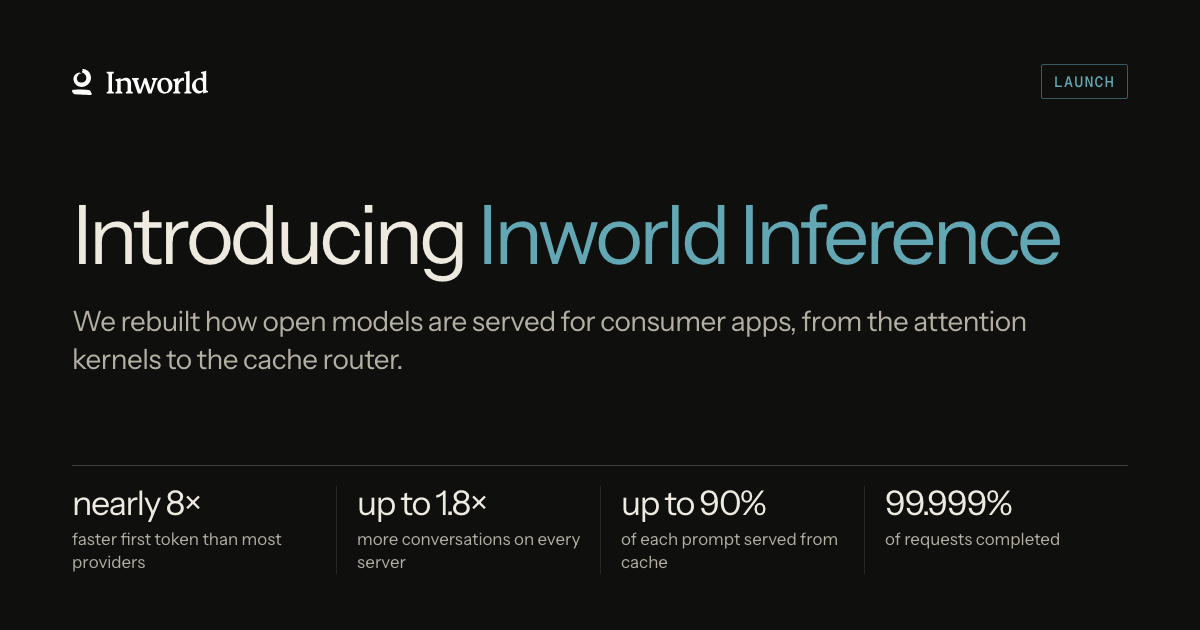
Inworld Inference opens to all developers: an open-model inference API built for consumer AI, with Gemma 4 26B p95 first token 7.8x faster than the median OpenRouter provider

On 2026-10-14 Inworld AI opened Inworld Inference to every developer, positioning it as an inference service for consumer apps (companions, tutors, voice, interactive fiction). Instead of listing thousands of models it builds a per-model serving stack for open models such as Gemma 4, GLM 5.3 Flash, DeepSeek and MiMo: draft-and-verify (speculative) decoding, a rewritten split-KV verify attention kernel, KV-aware routing and eval-gated low precision. Vendor-reported: Gemma 4 26B p95 first token of 0.31 s, 7.8x faster than the median OpenRouter provider; up to 90% of prompts from cache; 99.999% success over 20M+ GLM 5.3 Flash requests in 30 days. The API is OpenAI-compatible with Flex/Default/Priority/Fast tiers per request.

Inworld Inference opens to all developers: an open-model inference API built for consumer AI, with Gemma 4 26B p95 first token 7.8x faster than the median OpenRouter provider

Key Takeaways

  • Gemma 4 26B first token: p50 0.17 s / p95 0.31 s, 3.6x / 7.8x faster than the median OpenRouter provider (blog, vendor-reported snapshot, not a matched workload)
  • Pricing: Gemma 4 26B at $0.07 input, $0.035 cached, $0.34 output per 1M tokens, nearly 40% below the median no-training provider
  • Rewritten verify attention: 3.4–7.5x faster per layer, attention share of a decode step 27.5%→16.5%, p50 TTFT 154→117 ms at equal eval scores
  • KV-aware routing: GLM 5.3 Flash cache hits 25%→47%, DeepSeek V4.1 Flash 11%→33%; cached MiMo 2.6 Pro input costs 99% less
  • Reliability: 98 failures across 20M+ GLM 5.3 Flash requests in 30 days (~4.8 per million); per-request service_tier of Flex/Default/Priority/Fast
Read full story

OpenCode 2.0 ships: one background service for TUI, web and desktop, Code Mode for all MCP servers, background subagents, and @opencode/sdk

Anomaly published the OpenCode 2.0 launch note on Oct 12: a single auto-started local service shared by the TUI, web and desktop apps; a rewritten server API with the new @opencode/client; @opencode/codemode, which turns MCP servers and OpenAPI endpoints into functions the model composes in scripts (all MCP servers opt into Code Mode by default); background subagents and background shell commands; 80+ internal features rebuilt as hot-reloadable plugins; and @opencode/sdk for embedding the same engine as a library. V1 plugins and the old server API are not compatible.

OpenCode 2.0 ships: one background service for TUI, web and desktop, Code Mode for all MCP servers, background subagents, and @opencode/sdk

Key Takeaways

  • Architecture: one auto-started local background service shared by TUI, web, desktop and @opencode/client scripts; opencode pair connects other hosts
  • Code Mode: @opencode/codemode converts MCP servers and OpenAPI endpoints into script-callable functions; every MCP server defaults to Code Mode (codemode: false opts out)
  • Orchestration: background subagents (background: true, default nesting depth 1) and background shell commands with no default timeout; Ctrl+B moves running work to the background
  • Extensibility: 80+ features implemented as internal plugins, TUI plugins now stable and hot-reloadable; @opencode/sdk is the same code as the CLI
  • Migration: three breaking areas (plugin API, server API/clients, tui.json to global cli.json); upgrade with opencode upgrade --major
Read full story
Linked Models & Agents: