AI Coding Live News

Perplexity Launches Teammates: Persistent Work Agents on Computer with Slack, Research Preview for Max on Web

On November 5 Perplexity (@perplexity_ai) and CEO Aravind Srinivas (@AravSrinivas) launched Teammates: persistent personal agents on Computer that own ongoing responsibilities, inherit Projects, Skills, Memory and tool permissions, run in isolated desktops and browsers, collaborate with other teammates, and proactively monitor Slack. Official help docs call it a research preview for individual Max subscribers on the web; Enterprise Pro/Max are not included by default; native mobile and desktop apps are coming later.

Perplexity Launches Teammates: Persistent Work Agents on Computer with Slack, Research Preview for Max on Web

Key Takeaways

  • Shift from one-shot prompts to high-level goals; a teammate keeps its role until you reassign it (vendor/CEO)
  • Multi-agent orchestration, isolated desktop/browser, proactive monitoring of Slack/GitHub/Linear connectors
  • Individual Max (~$200/mo, ~10k Computer credits/mo) web research preview; Enterprise not included by default (help center)
  • Internal adoption: CEO says ~10k teammates in 30 days (~20x headcount) with ~1k active yesterday (personal claim, not an audit)
  • Setup on web: assign role and escalation, take over the desktop, or redirect; shared chats are read-only for others
Read full story

Notion: MCP Shared Brain Lets ChatGPT, Claude, Muse and Bot Share Memories and Skills, With Official Agent Setup Prompts

On November 4 NotionHQ announced that via Notion MCP, ChatGPT, Claude, Muse and Bot can read and write the same Memories and Skills—one shared brain across agents. Official setup prompts (v0.0.6, Oct 30), help docs and a Nov 3 MCP use-cases blog corroborate the product push.

Notion: MCP Shared Brain Lets ChatGPT, Claude, Muse and Bot Share Memories and Skills, With Official Agent Setup Prompts

Key Takeaways

  • NotionHQ post (Nov 4, 19:14 UTC) had about 3,271 likes, 225 reposts, 4,560 bookmarks and ~589K views when fetched
  • Product claim: ChatGPT / Claude / Muse / Bot share Memories and Skills in Notion so switching agents does not reset context
  • Official setup prompt v0.0.6 (2026-10-30): walks agents through an Agent Operating Guide and custom-instruction paste for ChatGPT / Claude
  • Help center: Notion MCP works with Claude, Cursor, ChatGPT Pro and more; Enterprise can approve a whitelist and govern connections
  • Vendor blog (Nov 3): five team stories of MCP workflows as reusable SOPs; Skills via MCP are listed as coming soon
Read full story

Apple Opens Siri AI to All Developers: iOS 27.3 Betas Add a Developer Preview for App Intents and Multi-Step Skills

On November 3, Apple announced on its Developer site that a new Developer Preview in the iOS 27.3, iPadOS 27.3, macOS 27.3 and visionOS 27.3 betas lets any app bring its content and actions into Siri AI through App Intents, tapping personal context, onscreen awareness and natural language. Apple also introduced skills, which teach Siri AI to combine several actions into one experience, and Siri AI can now surface any entity in the Spotlight semantic index. It is a preview only: customer rollout is a few months away and App Store submissions open in spring. Siri AI remains unavailable in the EU on iOS, iPadOS and watchOS.

Apple Opens Siri AI to All Developers: iOS 27.3 Betas Add a Developer Preview for App Intents and Multi-Step Skills

Key Takeaways

  • Covers four platform betas: iOS 27.3, iPadOS 27.3, macOS 27.3 and visionOS 27.3 (Apple Developer news)
  • Any app can join Siri AI via App Intents; new skills combine several actions into one request, and Siri AI can surface any Spotlight semantic-index entity, not just ones that fit an existing schema
  • Apple has already rolled the capabilities into 15 of its own apps, including Calendar, Files, Finder, Mail, Maps, Messages, Notes, Photos, Safari, Shortcuts and Weather
  • Timeline: customers get it "in a few months," App Store submissions open in spring, and Apple Intelligence Group Labs run November 4-5
  • Limits: Siri AI is unavailable in the EU on iOS, iPadOS and watchOS and for users under 13; server-model features have daily usage limits, with paid expanded access promised later
Read full story
Linked Models & Agents:

X Discussion: Grok Bot Engineer poteto Calls Adversarial Agent Code Reviews "Mostly a Waste of Tokens" and Argues for Empirical Plus Formal Verification Instead

On November 3, @poteto (lauren), whose bio says she works on Grok @bot at SpaceXSI, is on the React Compiler core team, and previously worked at Cursor, Meta and Netflix, posted what she called "maybe a hot take": she now considers adversarial reviews mostly a waste of tokens and thinks those tokens are far better spent on empirical combined with formal verification. She says she has updated her agent skill pack pstack to use its interrogate (multi-model adversarial review) skill less and may eventually remove it. She adds that she has found very little value in code review in the abstract, because agents tend to get lost in nitpicks and YAGNIs. The post drew about 906K views, 9,227 likes and 5,538 bookmarks. It is a personal opinion that sparked debate over the value of AI code review.

Key Takeaways

  • Opinion (personal, not an official finding): adversarial reviews are "mostly a waste of tokens"; empirical plus formal verification is the better use of them
  • Action: the author says she has made pstack use the interrogate skill less and may remove it; at fetch time the public pstack folder in GitHub cursor/plugins had no commits after October 27, so the change is not visible there yet
  • What interrogate is: per its public SKILL.md, it spawns one read-only reviewer per configured model (defaults Claude Opus 5.5 xhigh and Grok 4.7 xhigh fast) to attack the diff, then sorts findings into Act on, Consider, Noted and Dismissed without auto-applying fixes
  • Author (per her X and GitHub bios): engineer on Grok Bot at SpaceXSI, React Compiler core team, previously at Cursor, Meta and Netflix
  • Reach: about 906K views, 9,227 likes, 5,538 bookmarks, 668 replies, 356 reposts and 210 quotes
Read full story
ADSponsored

X Discussion: DHH Says the Age of Agents Will Be Great for Most Programmers but Hard on Cantankerous Ones Who Relied on Rare Skills

Ruby on Rails creator and 37signals CTO DHH (David Heinemeier Hansson) posted two related takes on X on November 2. First: "The great gift of agents is how they allow you to route around every insufferable gatekeeper in software." Then: the age of agents will be amazing for most programmers but hard on the cantankerous ones, because specialized knowledge and rare skills will no longer offer immunity to people who are a pain to work with, so they should learn basic people skills. The second post drew about 3,600 likes, 106K views and 280+ replies in roughly four hours. This is a personal opinion, not an announcement from any company.

Key Takeaways

  • This is a personal opinion post by DHH, not an official statement from 37signals or any AI company, and it cites no data or study.
  • The main post (2026-11-02 13:03 UTC) had about 3,609 likes, 180 reposts, 282 replies, 60 quotes, 106K views and 400 bookmarks at fetch time.
  • His earlier post about 1.5 hours before, saying agents let you route around every insufferable gatekeeper in software (11:41 UTC), had about 2,831 likes, 131 reposts and 80K views.
  • Supporters: tech analyst Ben Dickson (@bendee983) quoted it saying great engineers used to get a free pass for being difficult, and AI is leveling the field, though solid engineering knowledge is still required.
  • Pushback and additions: one reply joked that cantankerous people just found a coworker who never complains back; another argued an agent will do the work but will not make you nicer, so being easy to work with becomes more valuable.
Read full story
Linked Models & Agents:

Benji Taylor, head of design at X and SpaceXSI, open-sources Stageshow, an agent skill for realistic faux product UI and animated demos

On Oct 31, Benji Taylor, head of design at X and SpaceXSI, released Stageshow on X: an open-source skill (MIT license) for coding agents that helps them produce faux product UI that looks real, including stills, cursor demo animations, and bento grids, delivered as ordinary React components. It installs with one command, and he says it works with Grok Build, Claude Code, Codex, Gemini, and others. The launch post drew about 4,500 likes and 6,500 bookmarks. He notes it rarely nails a demo in one shot and most still take a few rounds of feedback.

Benji Taylor, head of design at X and SpaceXSI, open-sources Stageshow, an agent skill for realistic faux product UI and animated demos

Key Takeaways

  • Install: npx skills add benjitaylor/skills --skill stageshow; the author says it works with Grok Build, Claude Code, Codex, Gemini, and other agents (author's post)
  • Contents: a seven-step workflow in SKILL.md, reference rule docs, dozens of gold examples, a React kit, and self-check scripts such as film.mjs (GitHub)
  • License: the stageshow folder is MIT licensed; the repo was created Oct 26 and had about 61 stars at writing time
  • Reach: the launch post had about 4,521 likes, 6,561 bookmarks, and 213k views as of Nov 1, 08:00 SGT
  • Quality claims are the author's own: the same prompts did better with the skill, but no quantitative evaluation was published
Read full story

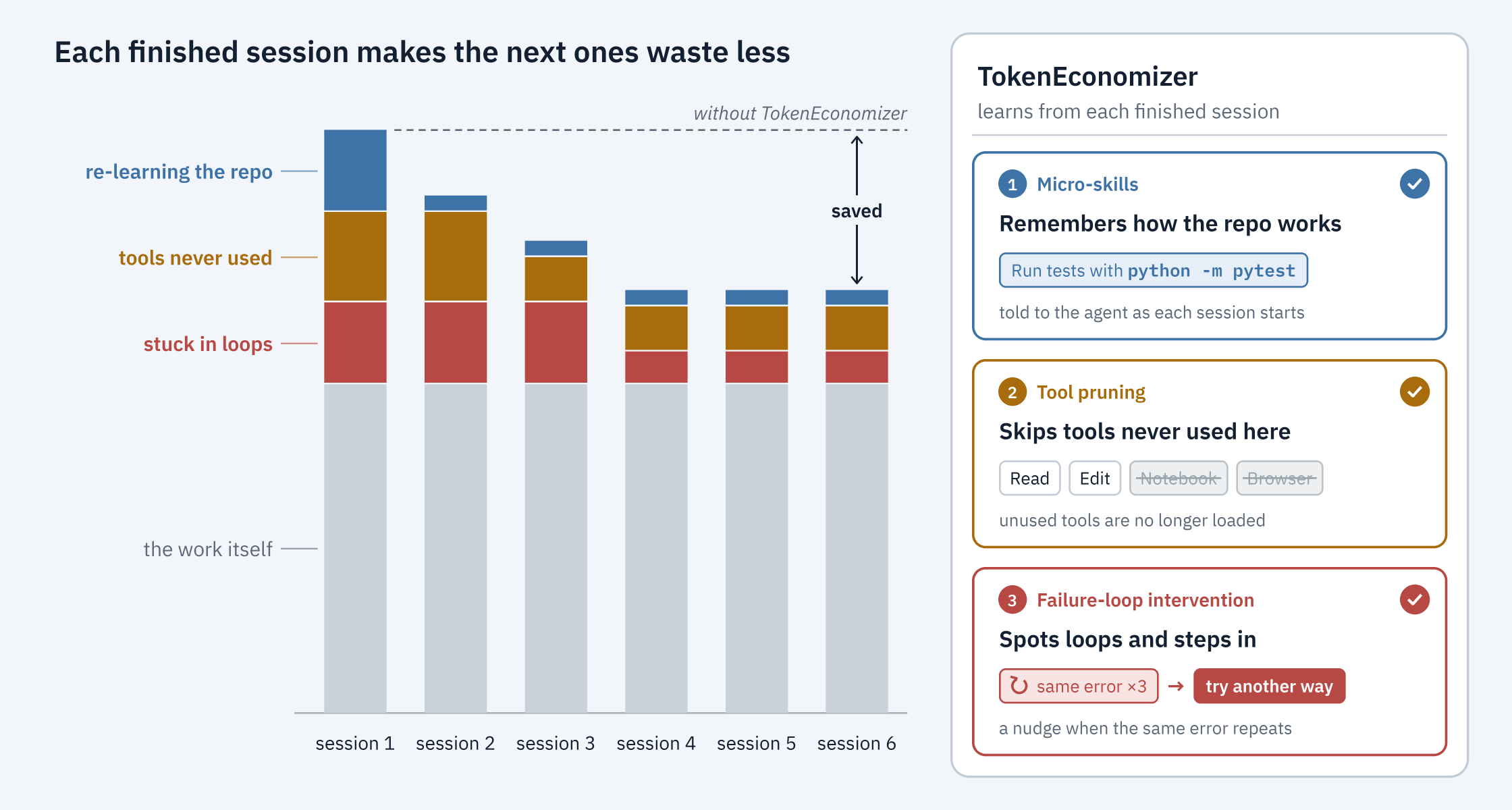
Microsoft Research and UC Berkeley open-source TokenEconomizer, a plugin that cuts Claude Code and Codex costs by 18.4–30.9% on SWE-Bench without changing the agent

Microsoft Research, Microsoft Security and UC Berkeley open-sourced TokenEconomizer on GitHub (Apache 2.0, v0.1.0 released October 26), a plugin for Claude Code, Codex, GitHub Copilot CLI and Pi, with experimental opencode support. It learns from earlier sessions in the same repository: micro-skills remember repo facts, tool pruning drops tool definitions that go unused, and a loop guard nudges an agent that is stuck. The paper reports 18.4–30.9% lower mean cost across five agent and model combinations on 277 SWE-Bench tasks (paper figures).

Microsoft Research and UC Berkeley open-source TokenEconomizer, a plugin that cuts Claude Code and Codex costs by 18.4–30.9% on SWE-Bench without changing the agent

Key Takeaways

  • Cost: on 277 SWE-Bench tasks across 6 repositories and 5 agent and model combinations, mean cost fell 18.4–30.9%, and all 30 repository-by-combination cells got cheaper (paper figures, including the plugin's own model calls)
  • Success rate: Pass@1 rose in 4 of 5 combinations, e.g. Copilot CLI with Sonnet 5 cost 18.4% less with Pass@1 +2.6, while Claude Code with Opus 4.8 cost 30.9% less with Pass@1 -1.0
  • Three mechanisms: micro-skills (repo facts stated only after three sessions confirm them), tool pruning (by default a tool unused over 10 prompts across 2 sessions is left out), and a failure-loop guard (one redirect when a judge is at least 0.7 confident, never stopping a turn itself)
  • Generalization: 16–21% lower cost on Web-Bench and 6–20% lower on two security-auditing benchmarks where every task is a new repository
  • Deployment: Apache 2.0, Python 3.10+, no API key of its own, and learned experience stays local in ~/.tokeneconomizer
Read full story

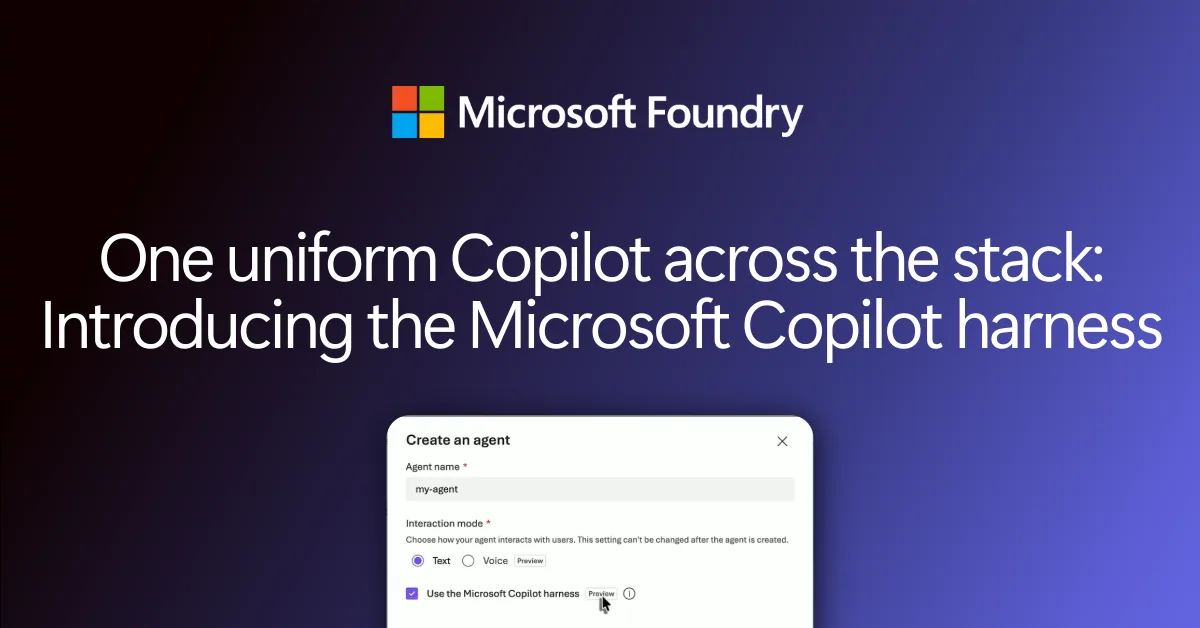
Microsoft opens the GitHub-built Copilot harness in Foundry Agent Service: public preview, 20+ frontier models plus BYOK, billing from Dec 1

During GitHub Universe on Oct 28, Microsoft put the Microsoft Copilot harness, the shared agent execution layer behind Copilot Code, Copilot Studio, the GitHub Copilot app, the CLI and VS Code, into Foundry Agent Service as a public preview. Microsoft runs the agent loop and sandbox while developers supply instructions, skills, tools and model choice; Microsoft says it works across 20+ frontier models plus bring-your-own-key. Long-running resilience for hosted agents also reached GA. Harness runtime usage is free until Dec 1.

Microsoft opens the GitHub-built Copilot harness in Foundry Agent Service: public preview, 20+ frontier models plus BYOK, billing from Dec 1

Key Takeaways

  • Microsoft says the harness spans 20+ frontier models plus bring-your-own-key, so you can swap models without rewriting orchestration (official blog)
  • Preview building blocks: reusable skills, Foundry and MCP tools with explicit auth and approvals, file and code execution with built-in subagent delegation, and source-controlled agent definitions
  • Pricing: harness runtime is free until Dec 1; after that sandbox compute is USD 0.0994 per vCPU-hour and 0.0118 per GiB-hour, with model inference billed separately (Foundry blog)
  • Long-running resilience for hosted agents went GA the same week: interrupted work restarts with its original input, and your app saves checkpoints
  • Limits: you pick the harness only when creating a new agent; existing agents are unchanged and switching later is not supported yet
Read full story

Android Studio Rabbit 2 goes stable with Bring Your Own Agent: 40+ coding agents including Claude Agent, Codex and Antigravity via the open ACP

On Oct 28, the day of Android Dev Summit, Google shipped Android Studio Rabbit 2 (2026.2.2) to the stable channel. The headline change is that Bring Your Own Agent (BYOA) moves from its September Canary preview to a stable feature: developers can plug any Agent Client Protocol (ACP) compatible coding agent into the IDE agent window. Google says more than 40 are available, including Anthropic Claude Agent, OpenAI Codex, JetBrains Junie and Google Antigravity, and users can sign in with personal or enterprise plans. The release also adds an agent skills manager, AI Change Review and agent-assisted LeakCanary fixes.

Android Studio Rabbit 2 goes stable with Bring Your Own Agent: 40+ coding agents including Claude Agent, Codex and Antigravity via the open ACP

Key Takeaways

  • Version 2026.2.2 reached the Stable channel on Oct 28; BYOA first appeared in preview with the Rabbit 2 Canary in September
  • Google says 40+ ACP-compatible agents are available; Claude Agent, Codex and Antigravity are the defaults, and others install from the registry under Settings > Tools > AI > Agents
  • Agents get IDE tools: the project graph and build diagnostics, Android SDK tools, terminal execution, emulator control, Logcat and Compose Preview
  • Sign in with personal API keys or consumer and enterprise subscriptions; the built-in Android Studio agent stays free
  • Also new: a skills manager preloaded with Android and Firebase skills, AI Change Review from three entry points, and agent-assisted LeakCanary fixes; Google's Mishaal Rahman said Android CLI users grew 10x
Read full story

Shopify Fall ’26 Edition bets on agentic commerce: Shop.md shopping skill, Shop.dev single connection, and Shop Pay inside Muse, Claude Duet, Grok Bot and other personal agents

On Oct 28 Shopify shipped its 10th Edition (Fall ’26, theme Exponential, 150+ updates including 57 for developers), centered on opening its catalog, cart and checkout to any agent. Shop.dev gives one connection to Shopify Catalog (1B+ products), sign-in with Shop, cart, checkout and Shop Pay; Shop.md is a customizable skill that turns ChatGPT, Claude or other agents into personal shoppers; Shop Pay now works inside Meta’s Muse, Claude Duet and Instinct, and Claude Duet, Grok Bot and Instinct can also use it for brands not on Shopify. Every Liquid and Hydrogen storefront and checkout now exposes WebMCP tools.

Shopify Fall ’26 Edition bets on agentic commerce: Shop.md shopping skill, Shop.dev single connection, and Shop Pay inside Muse, Claude Duet, Grok Bot and other personal agents

Key Takeaways

  • Scale (vendor figures): Shopify Catalog has 1B+ products and Shop Pay 400M+ shoppers; the Edition has 150+ updates, 57 of them for developers
  • Shop.dev is one connection for Catalog, sign-in with Shop, cart, checkout and Shop Pay; the underlying Shop MCP server is mcp.shop.com and search needs no API key
  • Shop Pay in personal agents starts with Muse from Meta, Claude Duet and Instinct; Claude Duet, Grok Bot and Instinct can also buy from brands off Shopify, with the card never shared with the agent and tokens from Mastercard, Visa and Discover (Amex coming)
  • WebMCP tools ship on every Liquid and Hydrogen storefront and checkout so browser agents can search, update the cart and check out after buyer approval
  • For developers: a one-command app security check in the Shopify CLI AI Toolkit, and a rebuilt Hydrogen plus the open-source Next.js Vercel Shop template are now generally available
Read full story
ADSponsored

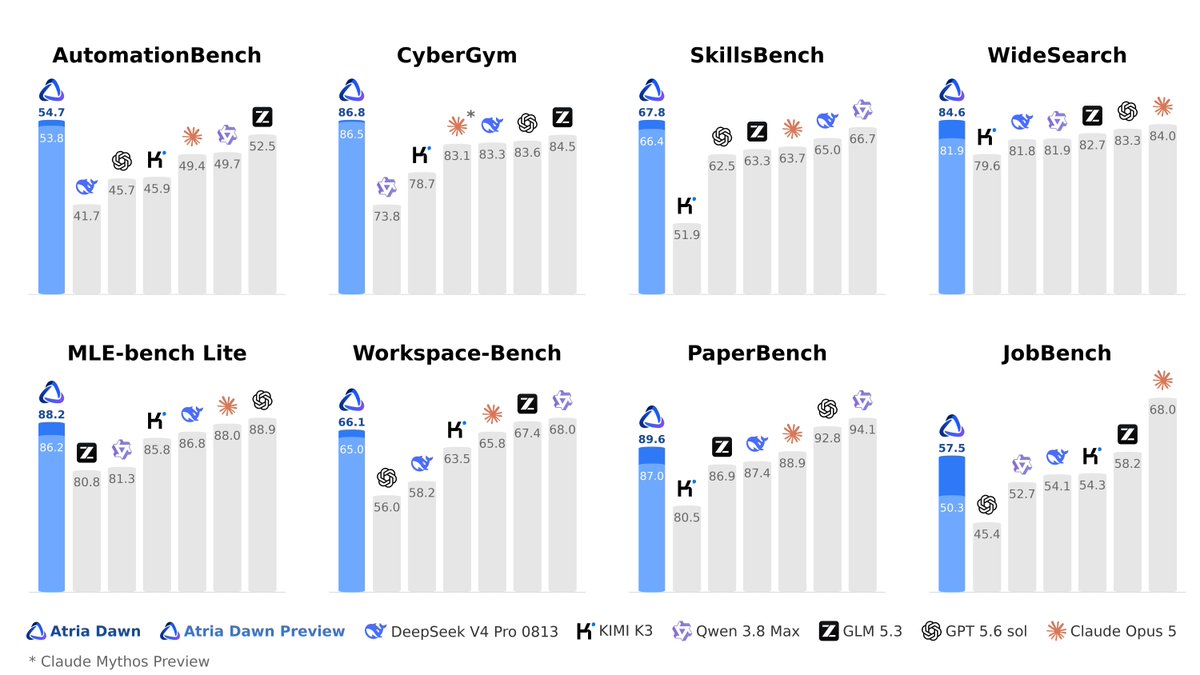
Shanghai AI Lab ships Atria Dawn full release: 744B MoE GLM-5.2 agentic model, context doubled to 512K, MIT weights

Shanghai AI Laboratory has moved Atria Dawn from Preview to a full release, with open weights (plus an FP8 build) on Hugging Face under internlm/Atria-Dawn and on ModelScope, MIT licensed. Built on the 744B-parameter MoE GLM-5.2, it targets long-horizon research and engineering agent work; context doubles from the Preview's 256K to 512K and input is text only. The vendor table shows it leading the listed models on AutomationBench, CyberGym and SkillsBench, while still trailing Claude Opus 5 on coding tests such as SWE-bench Pro and Terminal-Bench 2.1 (all vendor-reported).

Shanghai AI Lab ships Atria Dawn full release: 744B MoE GLM-5.2 agentic model, context doubled to 512K, MIT weights

Key Takeaways

  • 512K context, double the Preview's 256K; built on the 744B-parameter MoE GLM-5.2, text input only
  • BF16 and FP8 weights on Hugging Face and ModelScope, MIT license
  • Vendor-reported: AutomationBench 54.7, CyberGym 86.8, SkillsBench 67.8, BFCL V4 78.4, each the top score in its table
  • Weak spots from the same table: SWE-bench Pro 61.7 vs 76.5 for Claude Opus 5, Terminal-Bench 2.1 81.0 vs 90.2
  • Local serving needs SGLang v0.5.13.post1+ or vLLM v0.23.0+; an OpenAI-compatible API also plugs into Codex
Read full story
Linked Models & Agents:

Cadence launches Maestro, a domain-specialized AI model portfolio for agentic chip and system design built in part on NVIDIA Nemotron, claiming up to 30% better results and 5x token efficiency

EDA leader Cadence announced the Maestro AI Model Portfolio on October 26: domain post-trained LLMs, trained decision models and self-improving agent skills that power its AuraStack, ChipStack, InnoStack and ViraStack AI Super Agents as they drive Cadence EDA and SDA tools. Cadence solvers score outputs against engineering constraints to close a reinforcement learning loop. Initial results per Cadence show up to 30% higher quality and up to 5x token efficiency versus a general-purpose foundation model. NVIDIA contributes Nemotron and OpenShell, and the stack runs on Cadence cloud, public cloud or on-premises. The first models reach select early access customers in Q4 2026.

Key Takeaways

  • Maestro is a portfolio, not one model: domain post-trained LLMs, decision models and self-improving agent skills, mixed with frontier and open-weight models per task
  • Deterministic solvers and EDA tools score outputs against engineering objectives and constraints, feeding a verified reinforcement learning loop
  • Per Cadence: up to 30% higher quality of results and up to 5x token efficiency versus a general-purpose foundation model; no third-party evaluation yet
  • NVIDIA supplies Nemotron models and the OpenShell sandbox reference architecture; customers can post-train on their own designs and run on-premises
  • First models go only to select early access customers in Q4 2026; Socionext expects up to 5x productivity from deploying InnoStack
Read full story

Anthropic releases a Claude for Nonprofits plugin with fundraising, marketing and hiring skills built with ~30 organizations

On Oct 26 Anthropic released the Claude for Nonprofits plugin, a set of skills and connectors built with about 30 nonprofits. It covers the full fundraising cycle (finding funders, breaking down RFPs, drafting proposals and reports, donor stewardship), marketing, hiring and board work, and starts by having Claude map where the organization keeps its records and answer questions against the organization's own AI policy. It is installed automatically at no extra cost for verified nonprofits on Team and Enterprise plans. Anthropic says more than 25,000 nonprofits use Claude, and over 75% of them have fewer than 10 seats.

Anthropic releases a Claude for Nonprofits plugin with fundraising, marketing and hiring skills built with ~30 organizations

Key Takeaways

  • Scale (vendor-reported): more than 25,000 nonprofits use Claude, and over 75% of them have fewer than 10 seats, per the official article
  • How it was built: about 30 design-partner organizations, including the IRC, the Gates Foundation and International Justice Mission, tested early skills on real work and fed back changes
  • Pricing: the plugin is installed automatically at no extra cost on nonprofit Team and Enterprise plans; nonprofit discounts reach 75%, and about 90% in low- and middle-income countries, bringing Team seats to $3/user/month, with Claude Code included
  • Talent: Claude Corps is placing 1,000 early-career fellows in at least 400 US nonprofits, and Anthropic plans to extend it with Taproot for shorter pro bono projects
  • Onboarding: two official webinars run on Nov 10 (admins, data handling and AI policy) and Nov 12 (staff, day-one use)
Read full story

Anthropic guide: fold most subagents back into one main agent loop with on-demand skills and tools; one customer ran about 2x faster

On 2026-10-22, Anthropic's Applied AI team published "Building agents: When to fold subagents into your main agent loop" on claude.com, along with an open-source reference implementation, anthropics/single-agent-loop-kit. The article says that across several enterprise deployments, a single agent with skills frequently beat both the one-big-prompt design and the subagent design on quality, often at lower cost and latency per task; one customer that swapped its multi-agent harness for a single loop saw roughly 2x faster runtime. Anthropic also says it cut Claude Code's system prompt for more advanced models by over 80%. Subagents still make sense in three cases: measurable context bloat, parallel tasks with disposable context, or trouble selecting tools and conflicting instructions. The piece has drawn wide discussion on X over the past two days.

Anthropic guide: fold most subagents back into one main agent loop with on-demand skills and tools; one customer ran about 2x faster

Key Takeaways

  • Original article: Building agents: When to fold subagents into your main agent loop, dated 2026-10-22 on the page
  • Customer result (vendor-reported): one customer comparing its multi-agent harness with a single agent loop saw roughly 2x faster runtime with the single loop
  • Anthropic says it cut Claude Code's system prompt for more advanced models by over 80%, partly by progressively disclosing skills and tools
  • Keep subagents in only 3 cases: measurable degradation from context bloat, parallel tasks with disposable fresh context, or difficulty choosing tools and conflicting system-prompt instructions
  • Companion open-source single-agent-loop-kit migrates in three steps (measure, combine, fold); Anthropic suggests starting with an end-to-end eval of as few as 10 golden examples
Read full story

Anthropic donates the Agent Skills open standard to the Linux Foundation’s Agentic AI Foundation, after 70+ agent platforms adopted it with 1M skills published and nearly 280M installs

On 2026-10-22 Anthropic said it is donating Agent Skills, the open standard that teaches agents a task through a folder with a SKILL.md file, to the Agentic AI Foundation (AAIF) under the Linux Foundation, the same neutral home it gave MCP. The donation covers the Agent Skills name and logo, the GitHub organization and the agentskills.io domain. Anthropic says more than 70 agent platforms, including ChatGPT, Cursor, GitHub Copilot and VS Code, have integrated the standard since December 2025, with 1 million skills published and nearly 280 million installs. Engineers from Anthropic, Google, OpenAI and others will maintain it as individuals.

Anthropic donates the Agent Skills open standard to the Linux Foundation’s Agentic AI Foundation, after 70+ agent platforms adopted it with 1M skills published and nearly 280M installs

Key Takeaways

  • Official figure: 70+ agent platforms have integrated Agent Skills, including ChatGPT, Cursor, GitHub Copilot and VS Code
  • 1 million skills published and nearly 280 million installs so far (Anthropic figures)
  • Donated: the Agent Skills name and logo, the GitHub organization and the agentskills.io domain; you can keep using or contributing without joining AAIF
  • Lead Maintainers are David Soria Parra and Mahesh Murag, with engineers from Anthropic, Google, OpenAI and others maintaining it as individuals
  • Proposed first roadmap: versioned releases, a formal proposal process and security guidance for people who write and install skills
Read full story