AI Coding Live News

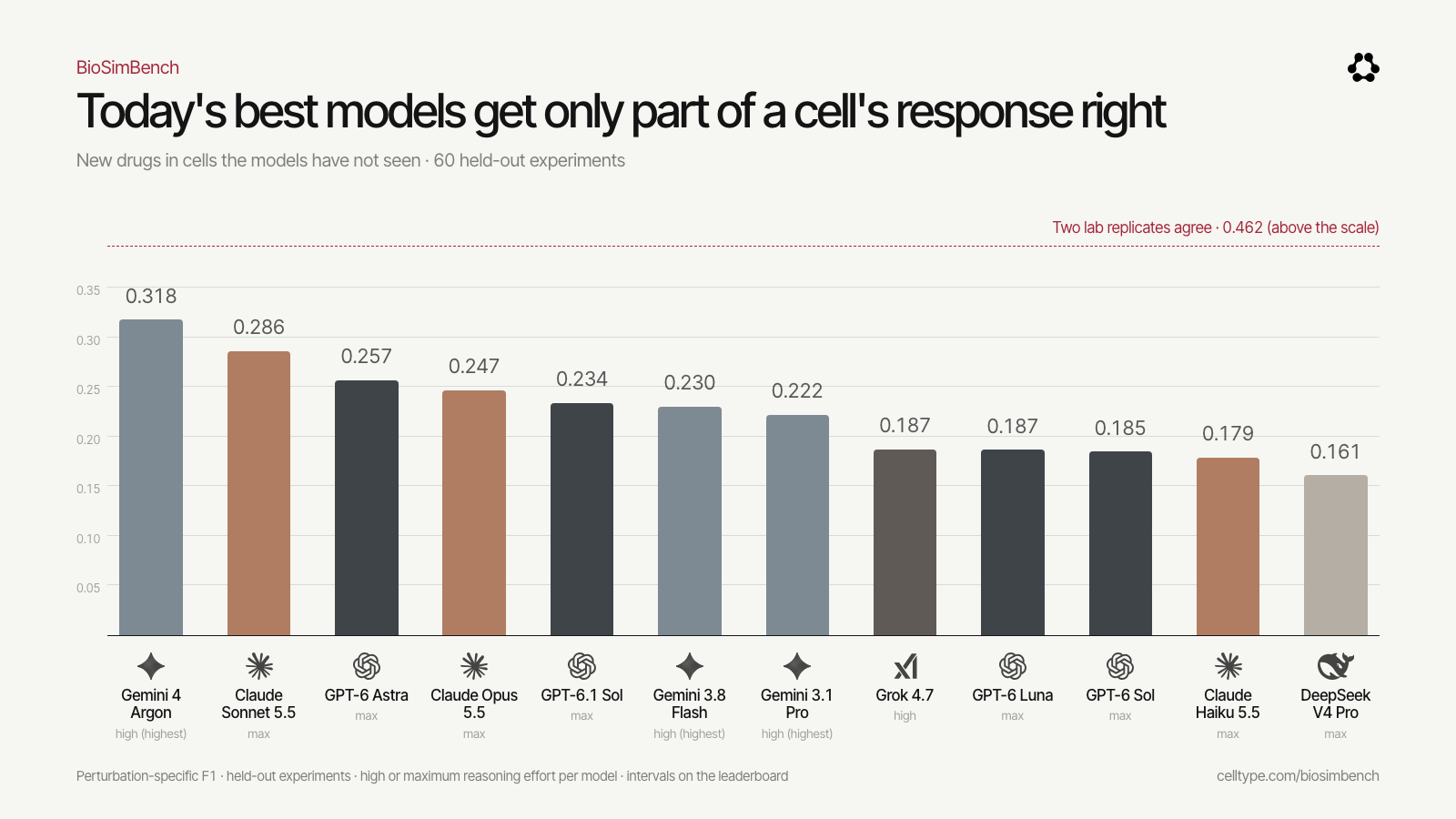
CellType Launches BioSimBench: Frontier LLMs Get Only Part of Cell Responses Right, Gemini 4 Argon Leads and CellType 27B Beats Them on Every Track

CellType, a YC W26 startup, released BioSimBench 1.0 on November 4. It uses real lab experiments to test whether language models can predict which genes go up or down after a cell is hit by a drug, a gene knockdown or an immune signal. Among 12 frontier models, Gemini 4 Argon ranks first with an overall score of 0.184, ahead of Claude Sonnet 5.5 (0.160) and GPT-6 Astra (0.159), while two lab replicates agree at 0.462. A 27B model CellType trained in its BioSimGym RL environments beats the best frontier model on all four prediction tracks.
CellType Launches BioSimBench: Frontier LLMs Get Only Part of Cell Responses Right, Gemini 4 Argon Leads and CellType 27B Beats Them on Every Track

Key Takeaways

  • BioSimBench 1.0 has five tracks: new drugs and cell contexts, gene knockdown, drug response, immune signals, and a tool-using research agent; test answers are kept private.
  • The 12 frontier models score between 0.110 and 0.184 overall, with Gemini 4 Argon first and DeepSeek V4 Pro last; two lab replicates agree at 0.462, so the gap is still large.
  • CellType 27B scores 0.366 on new drugs and cell contexts and 0.203 on drug response, about double the best frontier score of 0.103.
  • Data processing uses NVIDIA RAPIDS-singlecell, at least 4x faster for the whole pipeline; models were trained with NeMo RL and BioSimGym follows NeMo RL environment interfaces.
Read full story

Exin Therapeutics: Claude Sonnet 5 agent picks a gene therapy and drives a live mouse brain injection; Opus 5.5 declined

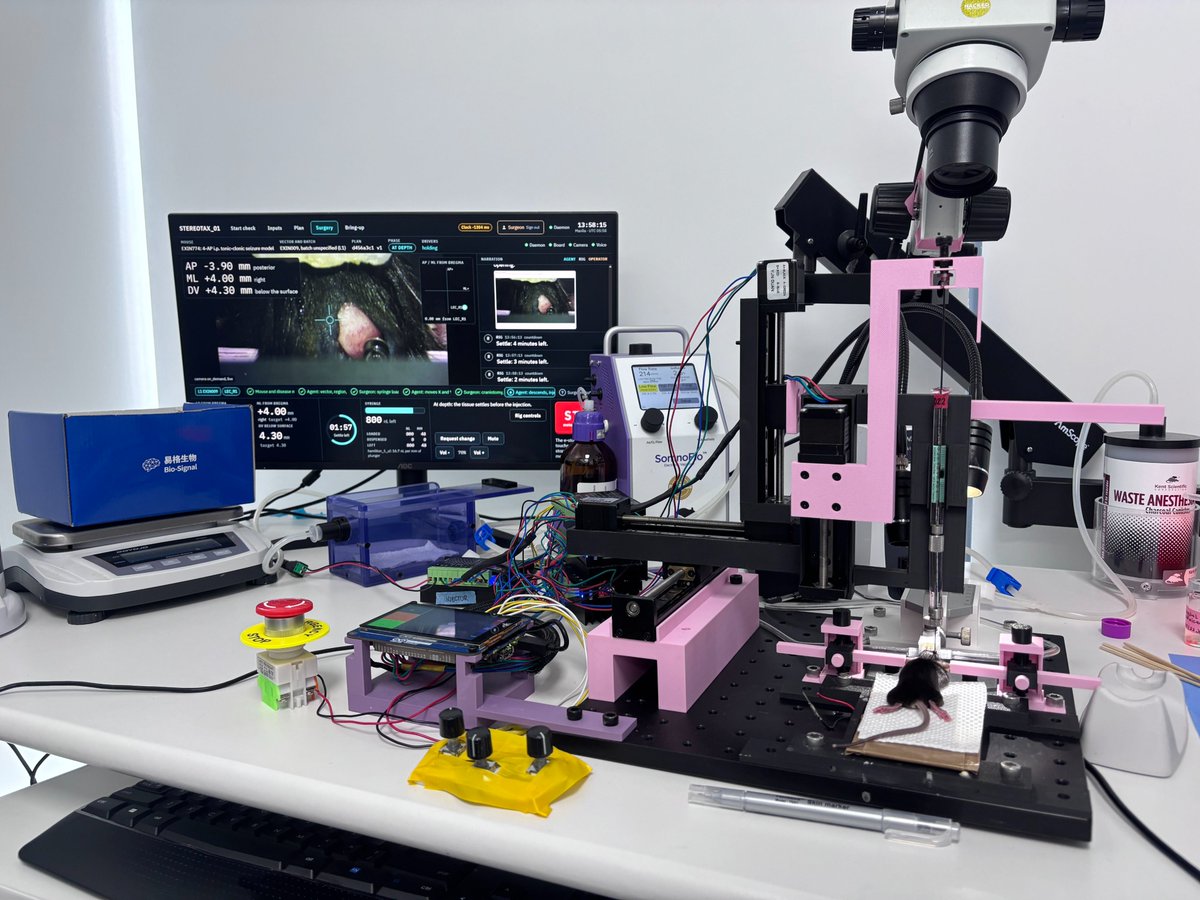
Exin Therapeutics co-founder and CEO Gabriel Ocana-Santero said on X on Oct 28 that an AI agent chose one of 19 gene therapy vectors, picked the brain region, derived coordinates from three papers and drove a stereotaxic rig to inject 250 nanolitres into an epilepsy-model mouse. WIRED reports Claude Opus 5.5 refused and Sonnet 5 did the run; a vet gated every irreversible step, and the work is not peer-reviewed.

Exin Therapeutics: Claude Sonnet 5 agent picks a gene therapy and drives a live mouse brain injection; Opus 5.5 declined

Key Takeaways

  • The agent chose the drug from 19 vectors, picked the brain region and derived coordinates from 3 papers (per the CEO)
  • It injected 250 nL while watching for bleeding via the rig camera; The Decoder reports 32 observations during the procedure
  • Per WIRED, Claude Opus 5.5 refused to inject, so the team used Sonnet 5; the run took just over 1 hour vs about 45 minutes normally
  • After a coordinate fault the agent refused to bypass its safety limits and the team had to fix the code separately; a vet still did the craniotomy
  • The original post drew 9,426 likes and 1.6M+ views; seizure outcomes are pending and nothing is peer-reviewed
Read full story

Cognition scores Gemini 4 Carbon at 40% on FrontierCode 2.0 for $4.04 a task, near the top, while Gemini 4 Argon gets 26.3% at $6.41

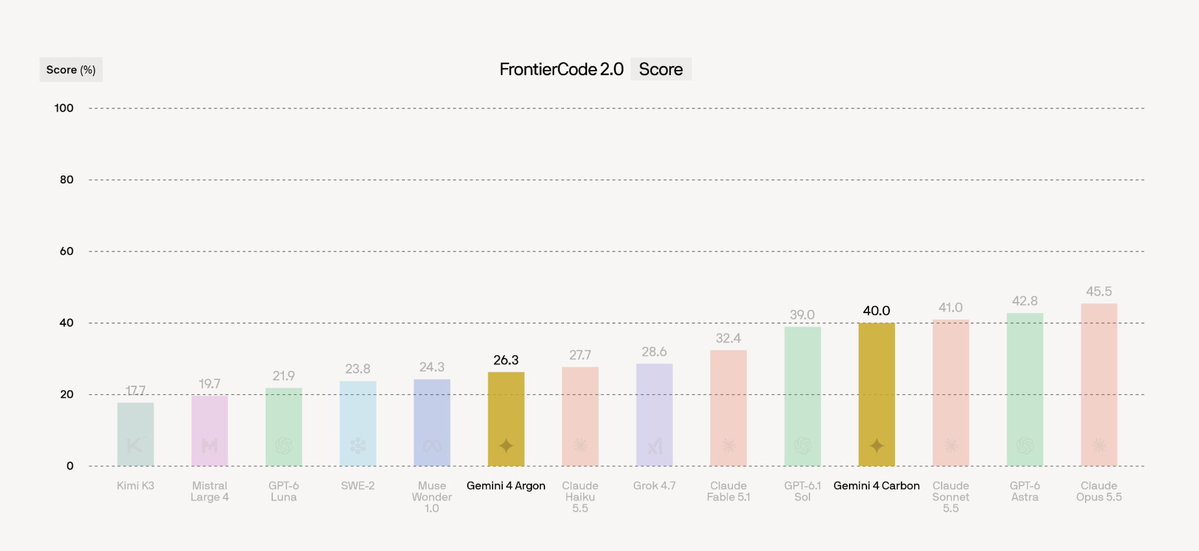
Cognition, the company behind Devin, posted on X at 01:45 UTC on Oct 30 that Google's new Gemini 4 Carbon scores 40% on its FrontierCode 2.0 coding benchmark at $4.04 per task, near the top and behind only Claude Opus 5.5, GPT-6 Astra and Claude Sonnet 5.5. The earlier Gemini 4 Argon scores 26.3% at a higher $6.41 per task. The results are Cognition's own runs, and the leaderboard on its site has been updated.

Cognition scores Gemini 4 Carbon at 40% on FrontierCode 2.0 for $4.04 a task, near the top, while Gemini 4 Argon gets 26.3% at $6.41

Key Takeaways

  • Gemini 4 Carbon scores 40% on FrontierCode 2.0 at $4.04 per task, behind Claude Opus 5.5 (45.5%), GPT-6 Astra (42.8%) and Claude Sonnet 5.5 (post)
  • Gemini 4 Argon scores 26.3% at $6.41 per task, ahead of Muse Wonder 1.0 but behind Claude Haiku 5.5 and Grok 4.7
  • From Argon to Carbon the score rises about 13.7 points while cost per task drops about $2.37
  • The changelog shows Gemini 4 Carbon was added on Oct 28; FrontierCode 2.0 has 132 tasks scored on whether a maintainer would merge the PR (leaderboard)
  • All figures are Cognition's own runs; Google has not published FrontierCode results itself
Read full story

Artificial Analysis launches Coding Agent Index v2.0: FrontierCode from Cognition replaces DeepSWE, and Claude Code with Opus 5.5 leads at 61.7

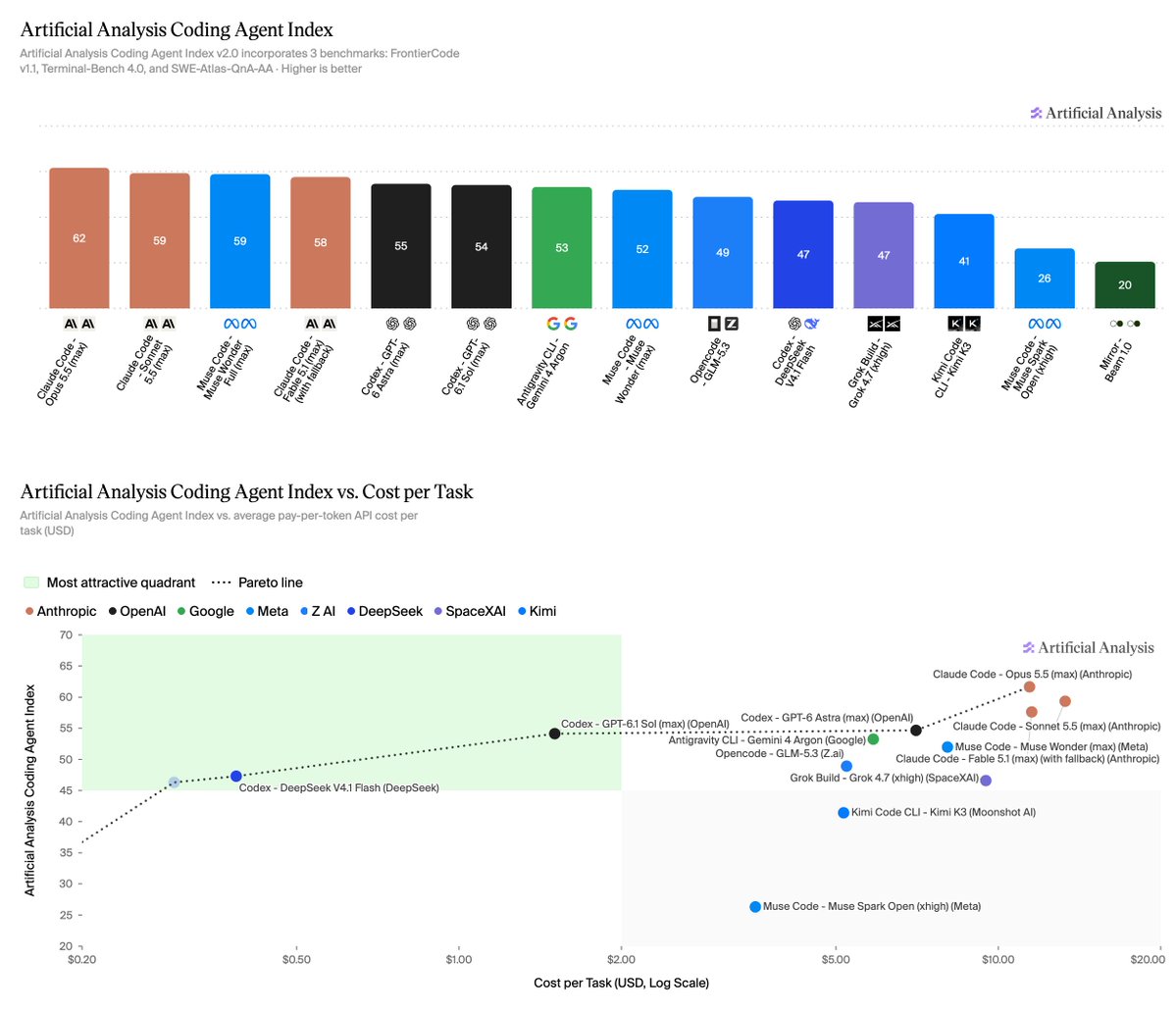
On 2026-10-23 Artificial Analysis launched Coding Agent Index v2.0, which scores model-plus-harness combinations across 290 tasks with three equally weighted benchmarks: FrontierCode v1.1 from Cognition (100 tasks on real open-source repos, graded on whether a maintainer would merge the change) replaces DeepSWE v1.1, SWE-Atlas-QnA becomes the stricter SWE-Atlas-QnA-AA, and Terminal-Bench 4.0 is unchanged. Claude Code with Claude Opus 5.5 (max) leads at 61.7, ahead of Sonnet 5.5 at 59.3 and Muse Wonder Full at 58.9. Scores fall across the board: the 21 configurations measured on both versions drop from a mean of 54.8 to 47.4.

Artificial Analysis launches Coding Agent Index v2.0: FrontierCode from Cognition replaces DeepSWE, and Claude Code with Opus 5.5 leads at 61.7

Key Takeaways

  • Top of the index: Claude Code with Claude Opus 5.5 (max) 61.7, Claude Sonnet 5.5 (max) 59.3, Muse Code with Muse Wonder Full (max) 58.9, Claude Fable 5.1 (max with fallback) 57.6 (Artificial Analysis figures)
  • On FrontierCode v1.1, Opus 5.5 scores 56.0%, ahead of Codex with DeepSeek V4.1 Flash at 52.6%; 15 of 24 configurations sit between 43% and 49%
  • Version shift: 21 configurations average 54.8 on v1.5 and 47.4 on v2.0, with 20 of 21 moving down; the same set averages 45.1% on FrontierCode versus 65.6% on DeepSWE
  • Four points on the cost frontier: DeepSeek V4.1 Flash 47.3 at $0.39 per task, GPT-6.1 Sol 54.1 at $1.50, GPT-6 Astra 54.7 at $7.04, Opus 5.5 61.7 at $11.42 (pay-per-token API costs, not subscriptions)
  • SWE-Atlas-QnA-AA rewords 127 of 1,306 rubric criteria and uses GPT-6 Luna (xhigh) as judge with five votes per criterion; dataset and judge config are on Hugging Face
Read full story
ADSponsored

Artificial Analysis Releases HealthBench & MLCR-AA: Exposing Severe Verbosity Bias in Medical AI Rankings

Independent AI evaluation platform Artificial Analysis officially released HealthBench Professional alongside the length-normalized MLCR-AA index (@ArtificialAnlys). The benchmark revealed a pervasive industry blindspot: LLM-as-a-Judge evaluations suffer from acute 'verbosity bias', disproportionately rewarding longer generations regardless of medical conciseness. In raw HealthBench scoring where Anthropic outputs were 4–6x longer, Claude Opus 5.5 led at 71.4%. However, once length bias was scientifically normalized via MLCR-AA, GPT-6 Astra (max) tied Claude Sonnet 5.5 for #1, while Claude Opus 5.5 plummeted from #1 down to #6, setting a new rigorous standard for medical model evaluation.

Artificial Analysis Releases HealthBench & MLCR-AA: Exposing Severe Verbosity Bias in Medical AI Rankings

Key Takeaways

  • Artificial Analysis unveils HealthBench Professional and the length-calibrated MLCR-AA benchmark
  • Exposes pervasive verbosity bias where evaluation judges disproportionately favor verbose outputs (Anthropic outputs averaged 4–6x longer)
  • Raw HealthBench placed Claude Opus 5.5 at #1 (71.4%) ahead of Sonnet 5.5 (70.8%) and GPT-6 Astra (69.7%)
  • Length-adjusted MLCR-AA shows GPT-6 Astra (max) tying Sonnet 5.5 for #1, while Opus 5.5 plummets from #1 to #6
Read full story

Artificial Analysis Benchmarks Devin Fusion: Scoring 68.1 on Coding Agent Index While Slashing Task Cost by 31%

Artificial Analysis released an independent evaluation of Cognition's new coding agent, Devin Fusion. Moving beyond single-model execution, Devin Fusion employs an asymmetric multi-agent architecture pairing Claude Opus 5.5 (max) as the lead reasoning orchestrator alongside GPT-6 Luna (high) as a high-speed parallel worker. In the standardized Coding Agent Index, Devin Fusion achieved an elite score of 68.1 (matching Muse Code at 68.0 and rivaling Claude Code Sonnet 5.5 at 68.4). Crucially, the hybrid architecture slashes average task expense from $13.04 down to $9.01 (a 31% cost reduction) while shortening execution runtime from 65 to 55 minutes.

Artificial Analysis Benchmarks Devin Fusion: Scoring 68.1 on Coding Agent Index While Slashing Task Cost by 31%

Key Takeaways

  • Artificial Analysis independently benchmarked Devin Fusion, scoring 68.1 on the standardized Coding Agent Index
  • Pioneers asymmetric model collaboration: Claude Opus 5.5 orchestrates architecture while GPT-6 Luna executes parallel sub-tasks
  • Cuts per-task execution costs from $13.04 to $9.01 (a 31% savings) and trims average completion time from 65 to 55 minutes
  • Outperforms Claude Code with Opus 5.5 on DeepSWE v1.1 (72.6% vs 68.4%) and SWE-Atlas-QnA (69.6% vs 66.4%)
Read full story

Artificial Analysis Releases HealthBench Medical Evaluation: Verbosity Penalties Reshuffle Ranks as GPT-6 Astra Takes #1

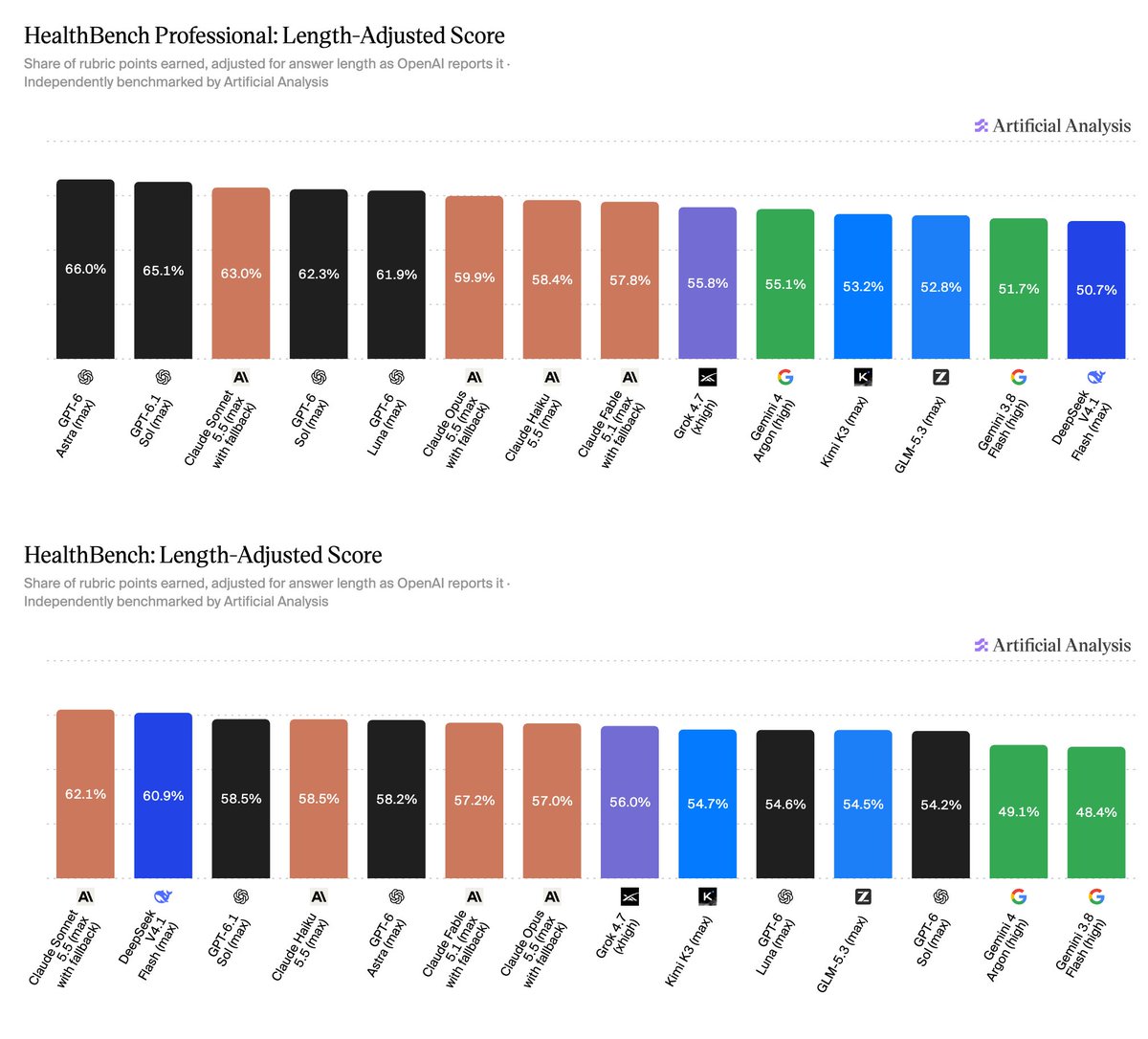
Independent AI evaluation authority Artificial Analysis launched the HealthBench and HealthBench Professional clinical reasoning and medical conversation leaderboards. Addressing the critical flaw where models artificially inflate medical scores through exhaustive, padded responses, the Professional benchmark implements rigorous length penalties. GPT-6 Astra (max effort) leads the world at 66.0%, with GPT-6.1 Sol at 65.1% and Claude Sonnet 5.5 at 63.0%. Claude Opus 5.5, despite holding a 71.4% raw score, collapses to 59.9% (#6) due to averaging ~5,900 characters per reply.

Artificial Analysis Releases HealthBench Medical Evaluation: Verbosity Penalties Reshuffle Ranks as GPT-6 Astra Takes #1

Key Takeaways

  • Artificial Analysis launched HealthBench, introducing strict length penalties on the Professional leaderboard to penalize verbose medical answers
  • GPT-6 Astra took #1 with 66.0%, followed by GPT-6.1 Sol at 65.1% and Claude Sonnet 5.5 at 63.0%
  • Claude Opus 5.5 scored 71.4% raw, but dropped to 59.9% (#6) under length penalties due to averaging ~5,900 characters per reply
  • On standard HealthBench, DeepSeek V4.1 Flash took #2 with 60.9%, outperforming multiple frontier commercial models
Read full story
Linked Models & Agents:

Artificial Analysis launches HealthBench and HealthBench Professional leaderboards: GPT-6 Astra leads clinician conversations at 66.0%, while Claude Opus 5.5 tops the raw score but falls to sixth after the length penalty

On October 19 independent evaluator Artificial Analysis launched two health-conversation leaderboards built on OpenAI's HealthBench (5,000 realistic health conversations) and HealthBench Professional (525 clinician conversations), graded against physician-written rubrics and reported as both raw and OpenAI-style length-adjusted scores. On Professional, GPT-6 Astra (max) leads at 66.0% length-adjusted, ahead of GPT-6.1 Sol (65.1%) and Claude Sonnet 5.5 (63.0%); Claude Opus 5.5 has the top raw score (71.4%) but drops to sixth (59.9%) because its ~5,900-character answers are penalized. On HealthBench, Claude Sonnet 5.5 leads at 62.1%, with DeepSeek V4.1 Flash close behind at 60.9% for about 1/16 of the cost per task.

Artificial Analysis launches HealthBench and HealthBench Professional leaderboards: GPT-6 Astra leads clinician conversations at 66.0%, while Claude Opus 5.5 tops the raw score but falls to sixth after the length penalty

Key Takeaways

  • HealthBench Professional (length-adjusted): GPT-6 Astra (max) 66.0%, GPT-6.1 Sol (max) 65.1%, Claude Sonnet 5.5 63.0%.
  • Claude Opus 5.5 posts the highest raw score (71.4%) but averages ~5,900 characters per answer, nearly 3x the 2,000-character threshold, and falls to sixth at 59.9%; Claude Fable 5.1 also loses over 11 points.
  • The Professional score-vs-cost Pareto frontier is all OpenAI: GPT-6 Luna (max) scores 61.9% at $0.004 per task, under 2% of GPT-6 Astra's $0.27.
  • HealthBench: Claude Sonnet 5.5 leads at 62.1%, DeepSeek V4.1 Flash 60.9% at $0.005 per task, GPT-6.1 Sol 58.5%.
  • Grading follows OpenAI's original setup: GPT-5.4 (low) grades Professional and GPT-4.1 grades HealthBench.
Read full story

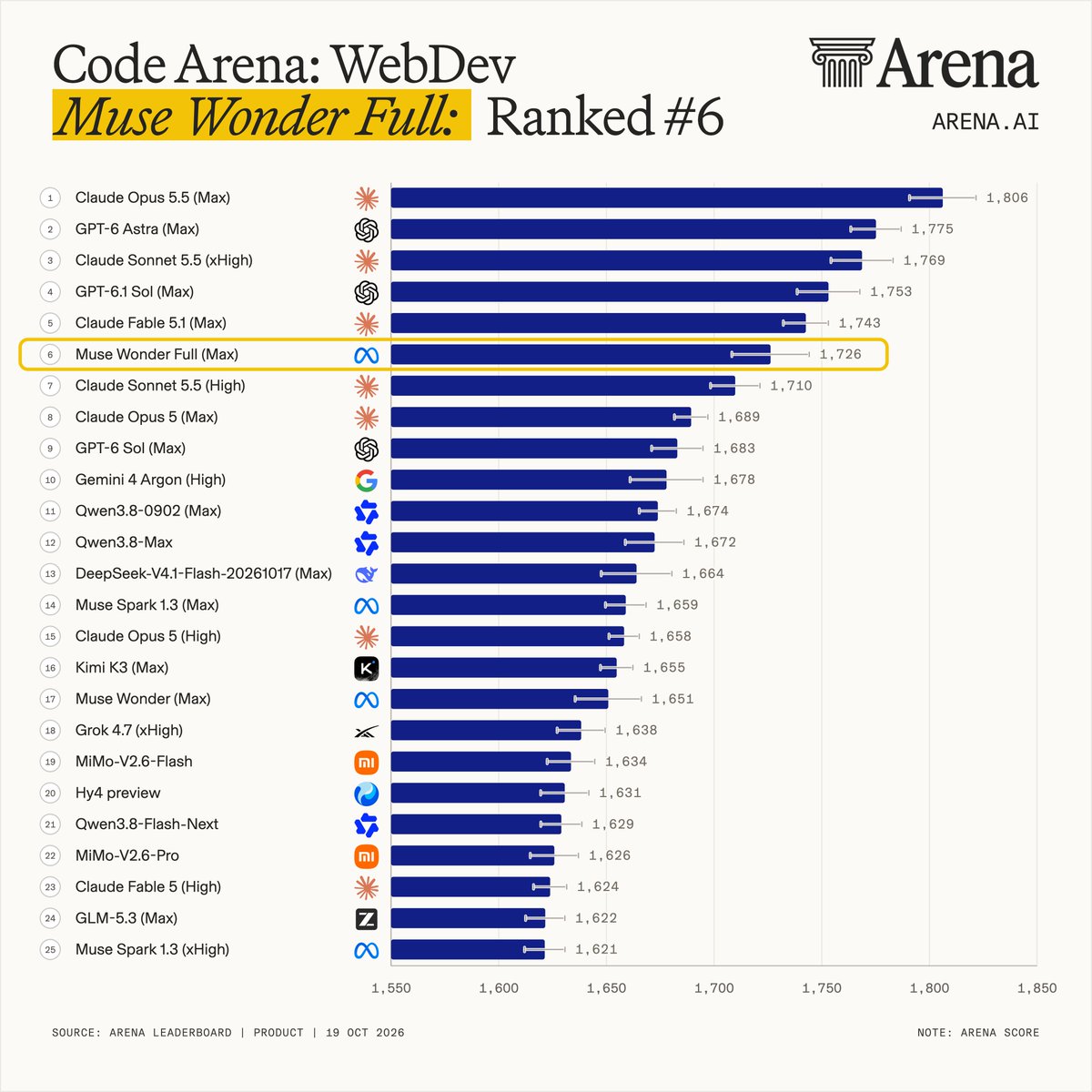
Meta Unveils Gigawatt-Scale Prometheus Supercluster as Muse Wonder Secures #6 on WebDev Code Arena

Meta officially disclosed its gigawatt-scale AI supercluster Prometheus in New Albany, Ohio, housing hundreds of thousands of frontier GPUs with 85%+ pretraining goodput and 90%+ in reinforcement learning. Powered by this infrastructure, Meta's latest coding flagship Muse Wonder Full surged to #6 globally on LMSYS Code Arena: WebDev with 1726 Elo points (surpassing Claude Sonnet 5.5 and Gemini 4 Argon), lifting Meta to the #3 AI research lab worldwide.

Meta Unveils Gigawatt-Scale Prometheus Supercluster as Muse Wonder Secures #6 on WebDev Code Arena

Key Takeaways

  • Meta unveiled its gigawatt-scale Prometheus supercluster in Ohio with hundreds of thousands of GPUs, delivering 85%+ pretraining goodput
  • Exceeded 90%+ goodput on RL workloads, recording ~47,000 GPU-hours MTBF during Muse Wonder's training cycle
  • Muse Wonder Full scored 1726 Elo on LMSYS Code Arena: WebDev (#6 globally), outperforming Claude Sonnet 5.5 (+16) and Gemini 4 Argon (+48)
  • Elevated Meta to the #3 AI lab worldwide; confirmed Muse Glimmer 30B open weights capable of 4-bit local execution on a single consumer GPU
Read full story
Linked Models & Agents:

LightOn open-sources ColGrep-Agent-2B: local 2B code-search agent cuts Claude Code API tokens ~34% and cache-aware cost ~40%

On 2026-10-12 LightOn AI released ColGrep-Agent-2B (fine-tuned from MiniCPM5-2B, Apache-2.0): a local 2B code-localization agent that searches with ColGrep multi-vector retrieval plus a read-only terminal, then returns file paths and line ranges to a frontier coding agent. On 52 code-search questions across 13 unseen repos (624 Claude Code / Sonnet 5.5 sessions), delegating search cut API tokens ~34.3% and cache-aware cost ~40% vs grep, with 80.8% vs 83.3% accuracy (not statistically significant). On SWE-bench Lite localization it posted 19.92 line F1—best among models evaluated in the same ColGrep harness, including several >10× larger. Ships brew/cargo/GGUF installers and hooks for Claude Code, Codex, and OpenCode.

LightOn open-sources ColGrep-Agent-2B: local 2B code-search agent cuts Claude Code API tokens ~34% and cache-aware cost ~40%

Key Takeaways

  • Official: HF Blog — ColGrep-Agent (2026-10-12); model lightonai/colgrep-agent-2B; repo lightonai/next-plaid
  • Vendor Claude Code + Sonnet 5.5 study (52×3): −34.3% tokens vs grep (95% CI 28–40), ~−40% cache-aware cost (7.3¢→4.4¢/q); accuracy 80.8% vs 83.3%
  • Localization: SWE-bench Lite file F1 76.18 / line F1 19.92; Multi-SWE-bench Flash file F1 62.57 / line F1 15.93 (5-seed avg)
  • Train: MiniCPM5-2B → SFT (Qwen3.5-27B teacher) → GRPO 500 steps; tools: colgrep / read-only terminal / finish; 10-turn budget
  • Install: brew install lightonai/tap/colgrep && colgrep --install-agent; default GGUF ~2.5GB; hooks for Claude Code / Codex / OpenCode
Read full story
ADSponsored

GitHub Security Lab open-sources Fuzzing Taskflow: an LLM agent runs the C/C++ fuzzing loop from harness writing to vulnerability reports

GitHub Security Lab's MIT-licensed Fuzzing Taskflow, built on its Taskflow Agent framework, takes a GitHub owner/repo and lets an agent pick entrypoints, analyze the build, write harnesses, run AFL++, iterate on coverage, and write a per-crash vulnerability report with root cause and a suggested patch. Claude Sonnet 5 is the default model; GitHub warns to run it only in disposable environments.

GitHub Security Lab open-sources Fuzzing Taskflow: an LLM agent runs the C/C++ fuzzing loop from harness writing to vulnerability reports

Key Takeaways

  • One command: ./scripts/fuzzing/run_fuzzing.sh owner/repo, ideally inside a Codespace
  • Per-iteration budgets double from 30s to 960s (~32 min per target); the loop stops after two iterations each gain <1% line coverage
  • Every harness is built twice: an .afl binary (afl-clang-lto with ASan/UBSan) for fuzzing and a .cov binary for real line/branch coverage
  • Crashes are minimized with afl-tmin, replayed under ASan, deduplicated by stack-top hash, and given one of seven verdicts
  • LLM-chosen build commands run on the host with no container, so GitHub says to use only disposable, unprivileged environments
Read full story

Anthropic cuts Sonnet 5.5 cache reads to $0.10/MTok, adds $100–$200 monthly API credits to Max, ships Managed Agents automation playbook

Sonnet 5.5 cache hits now cost 0.05x base input ($0.10/MTok), which Anthropic says makes most agentic work ~20% cheaper. Max 5x/20x plans now include $100/$200 in monthly Claude API credits (Team $20–$100 per seat) usable on the API, Managed Agents and Agent SDK, alongside an official reference implementation for scheduled Managed Agents automations.

Key Takeaways

  • Sonnet 5.5 cache reads $0.20 to $0.10/MTok (0.05x base input); input $2 / output $10 unchanged; Opus 5.5 also 0.05x ($0.20/MTok)
  • Anthropic says ~20% cheaper on most agentic work; API only, Claude Code limits unchanged
  • Max 5x gets $100/mo, Max 20x $200/mo; Team $20 (Standard) / $100 (Premium) per seat, pooled up to $500; no rollover
  • Credits cover Claude API, Managed Agents, Agent SDK and playground, not Claude Code or app extra usage
  • Managed Agents bills tokens plus $0.08 per session-hour; official daily-brief template sets up via a Claude Code command
Read full story

Anthropic launches Claude Haiku 5.5: $0.10/M input, 72.4% on OSWorld 2.1, about 75% cheaper than Haiku 4.5 on average

On Oct 7 Anthropic shipped Claude Haiku 5.5 (claude-haiku-5-5), completing the Claude 5.5 family. It targets high-volume, cost-sensitive work such as summaries, compaction, classification and coding subagents, and Anthropic calls it its fastest model at standard speed. Prompts up to 100K cost $0.10 input / $0.50 output per million tokens, and it is the first Haiku with effort levels. It scores 72.4% on the OSWorld 2.1 offline subset (Haiku 4.5: 15.7%) and 39.2% on Terminal-Bench 4.0. Sonnet 5.5 cache reads were cut 50% the same day, and Max/Team plans get monthly API credits.

Anthropic launches Claude Haiku 5.5: $0.10/M input, 72.4% on OSWorld 2.1, about 75% cheaper than Haiku 4.5 on average

Key Takeaways

  • Pricing: prompts up to 100K cost $0.10 input / $0.50 output / $0.01 cache reads per million tokens ($0.50 / $2.50 above 100K) vs $1 / $5 for Haiku 4.5; Anthropic says about 75% cheaper on average (announcement)
  • OSWorld 2.1 offline subset: 72.4% vs 15.7% (Haiku 4.5), 48.9% (GPT-6 Luna), 83.9% (Sonnet 5.5)
  • Terminal-Bench 4.0: 39.2% (Haiku 4.5 0.0%, GPT-6 Luna 16.4%); FrontierCode 1.1 Main: 46.4% (Sonnet 5.5 xhigh 52.1%)
  • First Haiku with low/medium/high/xhigh/max effort; Claude Code v2.1.293 makes it the default Haiku on the API with 1M context (release notes)
  • Same day: Sonnet 5.5 cache reads cut from $0.20 to $0.10/M; Max 5x / 20x get $100 / $200 monthly API credits, Team $20 (Standard) / $100 (Premium) per seat pooled up to $500; not valid for interactive Claude Code, no rollover
Read full story

Anthropic expands its Cyber Verification Program into three access tiers with Opus 5.5, Sonnet 5.5 and Mythos 5.1; Red Team tier completes 34/50 CyScenarioBench tasks with zero blocks

On 2026-10-06 Anthropic merged Project Glasswing and the original Cyber Verification Program into one three-tier program: Defense Access (SOC, incident response, malware reversing, vuln validation), Red Team Access (authorized pentesting) and Specialized Access (safety-critical systems such as power grids, flight systems and telecom, vetted with the US government). All tiers get Claude Opus 5.5, Sonnet 5.5 and Mythos 5.1 with reduced cyber blocking. On CyScenarioBench, GA models were blocked on the first prompt of every task, Defense tier blocked 46/50 trials, and Red Team tier had zero blocks and completed 34/50 (matching the 67.6% no-safeguard rate). Glasswing partners reported at least 129,000 verified vulnerabilities from April to July 2026.

Anthropic expands its Cyber Verification Program into three access tiers with Opus 5.5, Sonnet 5.5 and Mythos 5.1; Red Team tier completes 34/50 CyScenarioBench tasks with zero blocks

Key Takeaways

  • 3 tiers: Defense (decisions in days), Red Team (weeks, organizations only), Specialized (in-depth review with the US government); Glasswing members move to Specialized automatically (announcement)
  • 3 models in every tier: Claude Opus 5.5, Sonnet 5.5 and Mythos 5.1, plus future models
  • CyScenarioBench (10 tasks x 5 attempts): GA blocked on first prompt; Defense tier blocked 46/50; Red Team tier 0 blocks and 34/50 completed, matching the 67.6% no-safeguard rate
  • Impact: at least 129,000 verified vulns found by Glasswing partners (Apr-Jul 2026) plus 5,500 from Anthropic's own OSS scanning (Apr-Oct), over 33,000 rated critical/high (Project Glasswing)
  • Available on Claude Platform, Vertex AI and Microsoft Foundry; Bedrock only for Enterprise Frontier Safeguards customers; data retention required
Read full story
Linked Models & Agents:

GitHub open-sources ReviewBench, a 219-PR benchmark for AI code review: Copilot, Devin and Qodo lead; Cursor's grounded recall is 9.6%

GitHub's blog post ReviewBench (Oct 5, 2026) launches an offline AI code-review benchmark as a research preview. It has 219 PRs from 187 open-source repos in 19 languages, sampled to match the distribution of 103.9M GitHub PRs. The golden set combines human reviewers, several frontier LLMs and static analysis. Claude Sonnet 5 is the judge, and senior engineers agreed with its labels 96.6% of the time. On the leaderboard, grounded recall is 26.0% for Copilot Code Review (Balanced), 23.8% for Devin, 22.1% for Qodo and 9.6% for Cursor. The dataset, judge prompt and runner are MIT-licensed on GitHub.

GitHub open-sources ReviewBench, a 219-PR benchmark for AI code review: Copilot, Devin and Qodo lead; Cursor's grounded recall is 9.6%

Key Takeaways

  • Scale: 219 PRs from 187 open-source repos in 19 languages, sampled to match the distribution of 103.9M GitHub PRs (blog)
  • Trust: senior engineers independently re-labeled every golden finding and agreed with the benchmark 96.6% of the time; Claude Sonnet 5 is the judge
  • Leaderboard grounded recall: Copilot Balanced 26.0% (87.8% precision) > Devin 23.8% > Qodo 22.1% > Codex GPT-5.6 Sol Ultra 19.9% > Cursor 9.6%
  • Offline matched online: in a multi-model ensemble experiment, the online A/B showed +8.0% precision, +13.6% recall and −8.0% cost per review; critical comments were predicted at +227% offline and measured at +262% online
  • To submit: bring your own container image and model key, run the 25-PR test set, then the full 219 PRs over 3 rounds. The repo review-bench/ReviewBench is MIT-licensed
Read full story