AI Coding Live News

Artificial Analysis: Tencent Hy4 Scores 35 on Intelligence Index v5, Ranked No.2 Among China Labs, 31% on FrontierCode 2.0

Independent evaluator Artificial Analysis published Tencent Hunyuan Hy4 results on the Intelligence Index v5 on November 5 (08:28 UTC): a composite score of 35, tying Grok 4.7 (xhigh) and one point behind Claude Haiku 5.5 (max). Among China-based labs it ranks second only to Kimi K3.1 Pro (46). On agentic coding it scores 31% on FrontierCode 2.0 and 37% on Terminal-Bench 4.0; cost per Intelligence Index task is about $0.78, roughly one-tenth of same-score Grok 4.7.

Artificial Analysis: Tencent Hy4 Scores 35 on Intelligence Index v5, Ranked No.2 Among China Labs, 31% on FrontierCode 2.0

Key Takeaways

  • Intelligence Index v5 composite 35: ties Grok 4.7 (xhigh), one point behind Haiku 5.5 (max, 36); No.2 China-lab model behind Kimi K3.1 Pro (46)
  • FrontierCode 2.0 at 31% (leads China labs; DeepSeek V4.1 Flash 1017 max 28%, Kimi K3.1 Pro 25%); Terminal-Bench 4.0 at 37%
  • AA-Omniscience v1.1 accuracy 50% but hallucination rate 89% (Kimi K3.1 Pro hallucination 37%); HLE-Diamond 33%
  • About $0.78 per Intelligence Index task: ~10x cheaper than same-score Grok 4.7, ~13x cheaper than Qwen3.8 Max (34), nearly 2x Haiku 5.5
  • Pricing about $0.834/$2.501 per 1M input/output tokens, cache reads $0.042; 1M context; text and image input
Read full story

Cognition Launches SWE-2 Flash: A Fast Coding Model Built on Inkling-Small, 200 tok/s at One-Fifth the Price of SWE-2

Cognition released SWE-2 Flash on November 4 (19:55 UTC). Its official blog says the model is built on Thinking Machines' Inkling-Small (276B total, 12B active parameters) and, for the first time, adds a large mid-training stage before reinforcement learning, lifting FrontierCode 2.0 from 3.2% to 24.0% and Terminal-Bench 4.0 from 0.9% to 20.0%. Cognition says it beats every American open-weight model. It generates about 200 tokens per second at one-fifth the price and 3x the speed of SWE-2, and is free for Pro, Max and Teams users in Devin Desktop and CLI until the end of November. Weights are not public; a secure sharing program for partners and researchers is planned.

Cognition Launches SWE-2 Flash: A Fast Coding Model Built on Inkling-Small, 200 tok/s at One-Fifth the Price of SWE-2

Key Takeaways

  • SWE-2 Flash is built on Thinking Machines' Inkling-Small, with 276B total and 12B active parameters, about one-tenth the size of SWE-2 (2.8T-A104B).
  • Training adds a three-stage mid-training run on a few trillion tokens of scientific articles, blogs, code and other sources, followed by large-scale RL with higher-quality and more diverse tasks.
  • Official scores: FrontierCode 2.0 24.0 (SWE-2 scores 23.8), DeepSWE 1.1 60.1, Terminal-Bench 2.1 89.2, SWE-Bench Pro v2 Hard 89.9 and Terminal-Bench 4.0 20.0.
  • It runs at about 200 tokens per second versus about 60 for SWE-2, at one-fifth the price, and is free for Pro, Max and Teams users in Devin Desktop and CLI through November.
  • Citing cyber risk, the weights are not openly released; Cognition says details of a secure weight-access program will follow in the coming weeks.
Read full story
Linked Models & Agents:
⚡ SWE-2 Flash⚡ SWE-2⚡ Inkling-Small🤖 Devin🌐 Cognition🌐 Thinking Machines

Mistral releases the open weights of Mistral Large 4 "Le Chonk": a 1T-total, ~52B-active multimodal MoE that Mistral says leads open models on FrontierCode 2.0

On Oct 29 Mistral released an improved Mistral Large 4 (Le Chonk) with open weights on Hugging Face (plus an NVFP4 quantized checkpoint), served on its API as mistral-large-4. After about three more weeks of reinforcement learning since the early-October preview, Mistral reports 19.7% on FrontierCode 2.0, Terminal-Bench 4.0 up from 28% to 41%, and new low/medium/high reasoning modes. The license is a modified MIT that allows commercial use, but running a model-as-a-service business needs a separate commercial license.

Mistral releases the open weights of Mistral Large 4 "Le Chonk": a 1T-total, ~52B-active multimodal MoE that Mistral says leads open models on FrontierCode 2.0

Key Takeaways

  • Specs: about 1T total parameters with 49B active per token (about 52B including embeddings and output layers), 128 routed experts with 4 active plus 1 shared expert, 1M context, text and image input
  • Per Mistral: 19.7% on Cognition's FrontierCode 2.0, ahead of DeepSeek V4.1 Flash at 19.3% and GLM-5.3 at 17.8%, first among open models
  • 48% on the Artificial Analysis Coding Agent Index, roughly tied with GLM-5.3 while using 47% fewer tokens per task on average; Terminal-Bench 4.0 rose from 28% in preview to 41%
  • 51% on the Artificial Analysis Cyber Index, and a 96.6% average refusal rate on malicious cyber requests, which Mistral says is the highest among open models
  • Trained from scratch on 3,800 NVIDIA Grace Blackwell GPUs in Mistral's own European datacenters; in Surge Code blind pairwise tests it ranked behind only Claude Opus 5.5
Read full story
Linked Models & Agents:

OpenAI launches GPT-6.1 Terra: fast, low-cost computer use at $1/$5 per million tokens, half the price of GPT-5.6 Terra and GPT-6.1 Sol

On Oct 26 OpenAI released GPT-6.1 Terra, an efficient model for visual reasoning, precise computer use and natural writing. It is rolling out today to Plus, Pro, Enterprise and Edu users in ChatGPT Work and Codex, and in the API as gpt-6.1-terra. Standard API pricing is $1 input, $0.05 cached input and $5 output per million tokens, which OpenAI says is 50% lower than GPT-5.6 Terra and GPT-6.1 Sol, with a 1,050,000-token context window. By OpenAI's figures it scores 15 points higher than GPT-5.6 Terra on Agents' Last Exam at medium effort for about a third of the cost, and solves 50.3% of Terminal-Bench 4.0 at max effort.

OpenAI launches GPT-6.1 Terra: fast, low-cost computer use at $1/$5 per million tokens, half the price of GPT-5.6 Terra and GPT-6.1 Sol

Key Takeaways

  • Pricing (official docs): $1 input, $0.05 cached input, $1.25 for 30-minute cache writes and $5 output per million tokens; requests over 272K input tokens are billed at 2x input and 1.5x output; Batch/Flex are half price and Fast mode is 2x
  • Specs: 1,050,000-token context, 922,000 max input and 128,000 max output tokens, Jun 1 2026 knowledge cutoff; reasoning.effort from none to max, and tool calling requires the Responses API
  • Computer use (OpenAI figures): on Agents' Last Exam at medium effort it beats GPT-5.6 Terra by 15 points at about one-third the cost, and matches GPT-6 Astra at one-tenth the price per token; it finishes tasks over 3x faster than GPT-6 Astra and GPT-6.1 Sol
  • Coding and factuality (OpenAI figures): 50.3% on Terminal-Bench 4.0 at max effort, more than double GPT-5.6 Terra's published 21.5%; error rate on an internal error-inducing prompt set fell from 53.6% to 16.7% at low effort
  • Safety: OpenAI says it meets the Critical cybersecurity threshold under its Preparedness Framework and keeps the safeguards built for GPT-6 Astra
Read full story
ADSponsored

Moonshot launches Kimi K3.1 Pro: 2.8T-total / 104B-active open-weight MoE with 1M context, 65.7% on Terminal-Bench 4.0, API at $2/$10, weights by Nov 4

On 2026-10-23 (17:15 UTC) the official @Kimi_Moonshot account launched Kimi K3.1 Pro, alongside K3.1 Pro Highspeed (2-3x faster). Both are live on Kimi.ai, Kimi Work, Kimi Code and the Kimi API, and full weights are promised by 2026-11-04. The official tech blog describes it as a post-trained version of K3 with much larger multi-domain joint RL: a 2.8T-total / 104B-active MoE, 1M-token context, multimodal. Vendor-reported scores: 65.7% on Terminal-Bench 4.0 (GPT-6 Astra 58.2%, Claude Opus 5.5 66.4%) and 92.7% on BenchCAD with tools. The Kimi API pricing page lists kimi-k3.1-pro at $2 input, $10 output and $0.20 cached input per million tokens, down from K3 at $3/$15.

Moonshot launches Kimi K3.1 Pro: 2.8T-total / 104B-active open-weight MoE with 1M context, 65.7% on Terminal-Bench 4.0, API at $2/$10, weights by Nov 4

Key Takeaways

  • 2.8T-total / 104B-active MoE, 1M-token context, multimodal; full weights promised by 2026-11-04 (official blog)
  • Vendor-reported: 65.7% on Terminal-Bench 4.0, ahead of GPT-6 Astra (58.2%) and just behind Claude Opus 5.5 (66.4%); 61.2% on the internal Kimi Code Bench 3.0 Long-horizon (K3: 55.95%)
  • API pricing: kimi-k3.1-pro at $2 input / $10 output / $0.20 cached input per million tokens; Highspeed at $4 / $20 (pricing page)
  • On the internal Kimi Hallu Bench Hard stress test, claim-level hallucination fell from 23.4% (K3) to 8.3%; Moonshot notes this is not a daily-use error rate
  • Cyber-related data was removed from mid-training and RL for the open-weight release: xdev-bench-hard pass@3 drops from 90.5% (unmitigated checkpoint) to 81.0%
Read full story
Linked Models & Agents:

Artificial Analysis launches Coding Agent Index v2.0: FrontierCode from Cognition replaces DeepSWE, and Claude Code with Opus 5.5 leads at 61.7

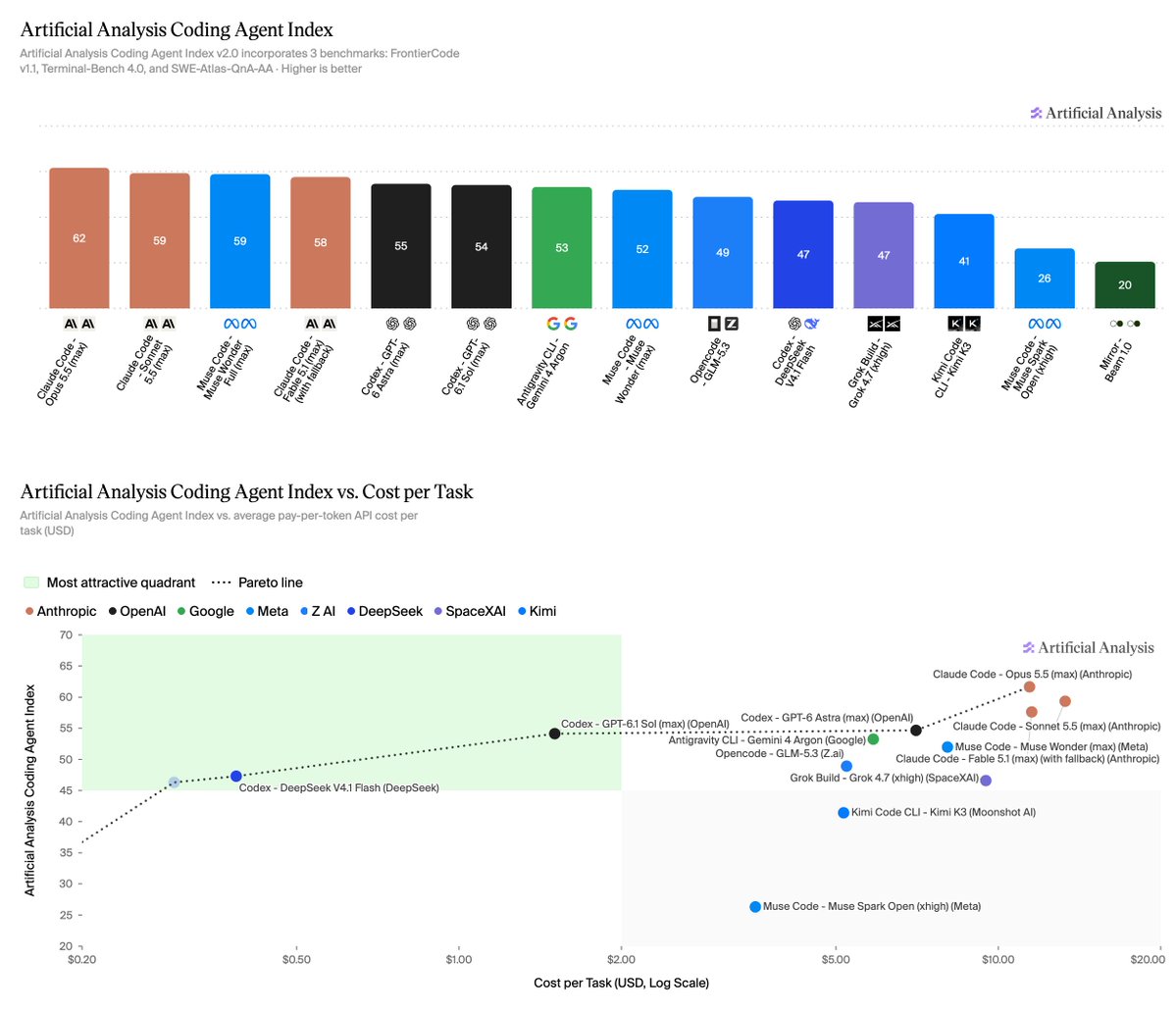
On 2026-10-23 Artificial Analysis launched Coding Agent Index v2.0, which scores model-plus-harness combinations across 290 tasks with three equally weighted benchmarks: FrontierCode v1.1 from Cognition (100 tasks on real open-source repos, graded on whether a maintainer would merge the change) replaces DeepSWE v1.1, SWE-Atlas-QnA becomes the stricter SWE-Atlas-QnA-AA, and Terminal-Bench 4.0 is unchanged. Claude Code with Claude Opus 5.5 (max) leads at 61.7, ahead of Sonnet 5.5 at 59.3 and Muse Wonder Full at 58.9. Scores fall across the board: the 21 configurations measured on both versions drop from a mean of 54.8 to 47.4.

Artificial Analysis launches Coding Agent Index v2.0: FrontierCode from Cognition replaces DeepSWE, and Claude Code with Opus 5.5 leads at 61.7

Key Takeaways

  • Top of the index: Claude Code with Claude Opus 5.5 (max) 61.7, Claude Sonnet 5.5 (max) 59.3, Muse Code with Muse Wonder Full (max) 58.9, Claude Fable 5.1 (max with fallback) 57.6 (Artificial Analysis figures)
  • On FrontierCode v1.1, Opus 5.5 scores 56.0%, ahead of Codex with DeepSeek V4.1 Flash at 52.6%; 15 of 24 configurations sit between 43% and 49%
  • Version shift: 21 configurations average 54.8 on v1.5 and 47.4 on v2.0, with 20 of 21 moving down; the same set averages 45.1% on FrontierCode versus 65.6% on DeepSWE
  • Four points on the cost frontier: DeepSeek V4.1 Flash 47.3 at $0.39 per task, GPT-6.1 Sol 54.1 at $1.50, GPT-6 Astra 54.7 at $7.04, Opus 5.5 61.7 at $11.42 (pay-per-token API costs, not subscriptions)
  • SWE-Atlas-QnA-AA rewords 127 of 1,306 rubric criteria and uses GPT-6 Luna (xhigh) as judge with five votes per criterion; dataset and judge config are on Hugging Face
Read full story

DeepSeek ships V4.1-Flash-1017: MIT open weights, live on web, app and API at unchanged prices, DeepSWE 77.0 (vendor-reported), plus public Search/Fetch APIs

On Oct 17 DeepSeek upgraded V4.1 Flash to V4.1-Flash-1017 across web, app and API (deepseek-flash, same call and price) and published MIT-licensed weights on Hugging Face and ModelScope. Vendor-reported DeepSWE v1.1 rises from 74.2 to 77.0 and Terminal-Bench 4.0 from 31.2 to 42.3, with shorter runtimes and outputs. It also opened Search/Fetch APIs backed by its in-house search engine at $0.75 per 1,000 calls.

DeepSeek ships V4.1-Flash-1017: MIT open weights, live on web, app and API at unchanged prices, DeepSWE 77.0 (vendor-reported), plus public Search/Fetch APIs

Key Takeaways

  • Vendor-reported DeepSWE v1.1 77.0 (prev. 74.2), above Claude Opus 5 (74.0) and GPT-5.6 Sol (73.0) in DeepSeek's table
  • Terminal-Bench 4.0 31.2 → 42.3 and ProgramBench 20.3 → 29.1, still behind Opus 5 (51.8 / 37.0); HLE w/o tools 42.6 vs Opus 5's 56.3
  • Pricing unchanged: deepseek-flash peak $0.30 input (cache miss) / $1.20 output per 1M tokens, off-peak half; 1M context, 384K max output
  • Search / Fetch APIs at $0.75 per 1,000 calls each; server-side calls via DeepSeek Harness, Claude Code and Codex are free until Oct 31, 2026 16:00 UTC
  • MIT weights on Hugging Face in FP8 (FP4 experts); no Jinja template — use the bundled encoding.py or deepseek-recipe
Read full story

AutoEnvScaling: Microsoft and Stanford Automate RL Environment Design via Terminal Agents, Unlocking 25x Data Flywheel

Microsoft Research and Stanford University have unveiled AutoEnvScaling, an automated data flywheel that frames RL environment creation itself as a terminal execution task. A proposer agent builds diverse environments directly from solver rollouts, slashing cost per valid environment by 75% while achieving a 25x higher valid environment yield over prompt-only baselines. Crucially, unifying environment design and solving within a single model enables Recursive Self-Improvement (RSI), yielding +12.2 points on Terminal-Bench 2.1 and doubling scores on Terminal-Bench 4.0.

AutoEnvScaling: Microsoft and Stanford Automate RL Environment Design via Terminal Agents, Unlocking 25x Data Flywheel

Key Takeaways

  • Environment design as a terminal task: shifts RL environment synthesis from manual curation to automated terminal execution, boosting valid yield by 25x
  • Unlocks Recursive Self-Improvement (RSI): enables a single backbone to co-evolve as both environment architect and task solver without human bottlenecks
  • Broad cross-domain generalization: yields a 12.2-point surge on Terminal-Bench 2.1 and doubles Terminal-Bench 4.0 for Qwen3.6-35B-A3B across kernel coding and OS tasks
Read full story

Anthropic launches Claude Haiku 5.5: $0.10/M input, 72.4% on OSWorld 2.1, about 75% cheaper than Haiku 4.5 on average

On Oct 7 Anthropic shipped Claude Haiku 5.5 (claude-haiku-5-5), completing the Claude 5.5 family. It targets high-volume, cost-sensitive work such as summaries, compaction, classification and coding subagents, and Anthropic calls it its fastest model at standard speed. Prompts up to 100K cost $0.10 input / $0.50 output per million tokens, and it is the first Haiku with effort levels. It scores 72.4% on the OSWorld 2.1 offline subset (Haiku 4.5: 15.7%) and 39.2% on Terminal-Bench 4.0. Sonnet 5.5 cache reads were cut 50% the same day, and Max/Team plans get monthly API credits.

Anthropic launches Claude Haiku 5.5: $0.10/M input, 72.4% on OSWorld 2.1, about 75% cheaper than Haiku 4.5 on average

Key Takeaways

  • Pricing: prompts up to 100K cost $0.10 input / $0.50 output / $0.01 cache reads per million tokens ($0.50 / $2.50 above 100K) vs $1 / $5 for Haiku 4.5; Anthropic says about 75% cheaper on average (announcement)
  • OSWorld 2.1 offline subset: 72.4% vs 15.7% (Haiku 4.5), 48.9% (GPT-6 Luna), 83.9% (Sonnet 5.5)
  • Terminal-Bench 4.0: 39.2% (Haiku 4.5 0.0%, GPT-6 Luna 16.4%); FrontierCode 1.1 Main: 46.4% (Sonnet 5.5 xhigh 52.1%)
  • First Haiku with low/medium/high/xhigh/max effort; Claude Code v2.1.293 makes it the default Haiku on the API with 1M context (release notes)
  • Same day: Sonnet 5.5 cache reads cut from $0.20 to $0.10/M; Max 5x / 20x get $100 / $200 monthly API credits, Team $20 (Standard) / $100 (Premium) per seat pooled up to $500; not valid for interactive Claude Code, no rollover
Read full story

HERMES: Harness Engineering via Modular Executable Dev-Primitives Empowers Software Engineering Agents to Match Frontier Models

Large Language Model (LLM) coding agents equipped with bash terminals frequently collapse when deployed across massive enterprise codebases. Centralized agents struggle to reconstruct project states fragmented across multi-language source trees, build configs, and test suites, precipitating context window exhaustion and catastrophic semantic drift. Researchers from UIUC introduce Dev-Primitives and the HERMES harness engineering framework (arXiv:2610.07832). Dev-Primitives transform passive software components into active agentic nodes by pairing each repository artifact with a resident LLM endowed with natural-language reasoning, inter-component communication channels, and localized self-modification primitives. Coordinated via a dependency-aware dynamic activation scheduler and execution-guided fault localization, HERMES boosts task performance across four standard software engineering benchmarks by 12.4% over baseline harnesses. Crucially, powering HERMES with lightweight Qwen3-8B Dev-Primitives brings performance within 4.5% of homogeneous GPT-5.6 Sol configurations while slashing inference token overhead by 26.2% on Terminal-Bench 4.0.

Key Takeaways

  • UIUC introduces Dev-Primitives and the HERMES framework, transforming passive software code artifacts into active LLM-powered nodes
  • Dependency-aware dynamic activation and execution-guided bug diagnosis eliminate context explosion across multi-thousand-file repositories
  • Outperforms baseline harnesses by 12.4% on average; lightweight Qwen3-8B primitives match GPT-5.6 Sol within 4.5% while cutting costs by 26.2%
Read full story
ADSponsored

InclusionAI Ling-3.1-flash: 560B/25B-active MoE; vendor SWE-Pro 65.39 & CyberGym 87.9; free on Vercel/OpenCode through Oct 13

On 2026-09-30 InclusionAI (Ant Group) announced Ling-3.1-flash: ~560B total / ~25B active MoE hybrid-reasoning model, designed for up to 1M context (trial/gateway routes often expose 256K–262K). Weights are not on Hugging Face yet. Vercel AI Gateway and OpenCode Zen list limited-time free access (~through 2026-10-13). Vendor-reported scores include SWE-Pro 65.39, Terminal-Bench 4.0 40.40, CyberGym 87.90—not independently reproduced.

InclusionAI Ling-3.1-flash: 560B/25B-active MoE; vendor SWE-Pro 65.39 & CyberGym 87.9; free on Vercel/OpenCode through Oct 13

Key Takeaways

  • Scale: ~560B total / 25B active (vs Ling-3.0-flash 124B/5.1B); design target 1M context; trial/gateway often 256K–262K
  • Architecture (vendor summary): 7×KDA : 1×Gated MLA; 512 routed experts pick 8 + 1 shared
  • Vendor benches (unreproduced): SWE-Pro 65.39, TB4.0 40.40, CyberGym 87.90, BrowseComp 91.67
  • Access: Vercel AI Gateway inclusionai/ling-3.1-flash(-free) via Novita free ~to Oct 13; OpenCode Zen ling-3.1-flash-free
  • Caveats: no public weights yet; free routes may use data to improve the model; some scores are environment-qualified
Read full story

Anthropic launches Claude Sonnet 5.5: Terminal-Bench 70.6%, 30%+ faster output, same $2/$10 price with lower task cost

Anthropic released Claude Sonnet 5.5 on 2026-09-28 (API id claude-sonnet-5-5), the second Claude 5.5-family model. Vs Sonnet 5: Terminal-Bench 4.0 70.6% (from 10.3%), CursorBench 4.0 55.5%, GDPval-AA near Opus 5.5; 30%+ faster output and up to ~30% lower task cost at the same $2/$10 pricing. Native 1M context; adaptive thinking on by default — use between_tools to disable up-front thinking.

Anthropic launches Claude Sonnet 5.5: Terminal-Bench 70.6%, 30%+ faster output, same $2/$10 price with lower task cost

Key Takeaways

  • Shipped 2026-09-28 — model id claude-sonnet-5-5 (announcement)
  • Terminal-Bench 4.0 70.6% (vs Sonnet 5 10.3%); CursorBench 4.0 55.5%; GDPval-AA 1844
  • Same $2/$10 pricing; ~30%+ faster output; up to ~30% lower task cost via fewer tokens
  • 1M context / 128K max out; adaptive thinking default; between_tools turns off up-front thinking
  • Migrate via docs; anthropic-sdk-python ≥1.9.0; Claude Code ≥2.1.284 sonnet alias → 5.5
Read full story

Artificial Analysis: StepFun Step 5 Preview scores 44 on Intelligence Index at ~2.8x lower cost than Kimi K3

@ArtificialAnlys evaluated StepFun Step 5 Preview (600B-total / 27B-active MoE): Artificial Analysis Intelligence Index 44, matching Kimi K3 (max) at about $0.72 per Index task (~2.8x cheaper). Pricing is about $1/$2.70 per 1M input/output tokens with $0.05/M cached input; 1M context; open weights planned for October 15. It still lags peers on agentic evals such as GDPval-AA and Terminal-Bench 4.0.

Artificial Analysis: StepFun Step 5 Preview scores 44 on Intelligence Index at ~2.8x lower cost than Kimi K3

Key Takeaways

  • AA Intelligence Index 44, tied with Kimi K3 (max); ~$0.72/task (~2.8x cheaper).
  • Pricing ~$1/$2.70 per 1M in/out with $0.05/M cached input; 600B/27B MoE; 1M context.
  • Open weights planned Oct 15; still trails peers on GDPval-AA and Terminal-Bench 4.0.
Read full story
Linked Models & Agents:
⚡ Stepfun Step 5 Preview⚡ Kimi K3

Vals Live Terminal-Bench 4.0: GPT-6 Astra Leads at 57.1%

Vals AI launched Terminal-Bench 4.0: 66 new end-to-end terminal tasks (ship a service, prove a theorem, train a GPU kernel, write a forensic report, and more). Median expert effort is about 4 hours; grading is strict (full verifier suite or zero), and scores are avg@3. GPT-6 Astra won at 57.1%, 7.6pp ahead of Claude Fable 5.1 (49.5%) and 11.6pp ahead of Claude Opus 5 (45.5%). No other model cleared 30%; fourteen of 27 models scored zero on both hardware and media. Version 4.0 spans seven categories—software, science, ML, operations, hardware, security, and media—with roughly three-quarters of tasks outside traditional software work and no overlap with v2.1.

Key Takeaways

  • Terminal-Bench 4.0: 66 new terminal tasks, ~4h median expert effort, strict verifier + avg@3
  • GPT-6 Astra leads at 57.1% vs Fable 5.1 (49.5%) and Opus 5 (45.5%); no other model cleared 30%
  • Seven categories with ~3/4 tasks outside classic software engineering; no overlap with v2.1
Read full story

Artificial Analysis Intelligence Index v4.3: Terminal-Bench 4.0 + AutomationBench-AA

Artificial Analysis (@ArtificialAnlys) shipped Intelligence Index v4.3: Terminal-Bench upgraded 2.1→4.0 (now mini-SWE-agent harness) and τ³-Banking replaced by AutomationBench-AA (657 private Zapier business workflows). Claude Fable 5.1 and GPT-6 Astra tie at 53; OpenAI holds most of the intelligence-vs-cost frontier across Astra reasoning efforts.

Key Takeaways

  • Benchmarks: Index v4.3 upgrades Terminal-Bench to 4.0 and adds AutomationBench-AA (private set).
  • Weighting: private-task/answer evals rise from 40% to 45%; category weights unchanged.
  • Results: Claude Fable 5.1 and GPT-6 Astra tie at 53; open-weights led by GLM-5.3 / Kimi K3 at 44.
Read full story