AI Coding Live News

X Discussion: Greg Isenberg Says He Talks to His Agents More Than His Human Teammates, Shares a Full Agent-Run Company Stack

On November 3, founder and Late Checkout CEO Greg Isenberg (@gregisenberg) posted a long thread on X saying his team has 50+ people in 12 countries, yet he "talks to my agents more than my human teammates." He listed an agent-driven stack covering ideation, design, build, user testing, bug fixing and data review. Within hours it drew about 1,050 likes, 2,300 bookmarks and 183 replies. This is a personal workflow and opinion, not verified productivity data.

Key Takeaways

  • Engagement: about 1,050 likes, 2,300 bookmarks, 183 replies and 75K views within hours (per the X API); bookmarks far exceed likes, so readers are saving it as a checklist
  • Coverage: ideation, design, build, user testing, bug fixing and data review are all handed to agents; humans handle "creative feedback, relationships and telling the agents what they got wrong"
  • Build: pingdotgg/t3code as the control surface and stablyai/orca to run parallel agents, each in its own git worktree
  • Quality control: every output is scored 1-10 by an LLM judge and anything under 8 goes back; every agent mistake becomes a new skill
  • All of this is self-reported; no verifiable productivity or cost figures were published
Read full story

CrowdStrike Agrees to Acquire Fiddler and Dreadnode and Ships an AI Kill Switch, Bringing Agent Observability, Pre-Deployment AI Security Testing and Agent Termination Into Falcon

At Fal.Con Europe in Barcelona on November 3, CrowdStrike said it signed definitive agreements to acquire AI agent observability company Fiddler AI and automated AI security testing company Dreadnode, and launched an AI Kill Switch in Falcon Guardian that can terminate a misbehaving agent, block it from relaunching and cut its enterprise network access. Both deals are expected to close in CrowdStrike's fiscal Q4 FY27, with the products generally available that quarter. CrowdStrike did not disclose prices; CyberScoop, citing the Wall Street Journal, put Fiddler at about $400 million and Dreadnode at about $95 million.

CrowdStrike Agrees to Acquire Fiddler and Dreadnode and Ships an AI Kill Switch, Bringing Agent Observability, Pre-Deployment AI Security Testing and Agent Termination Into Falcon

Key Takeaways

  • Both acquisitions were announced the same day and are expected to close in CrowdStrike's fiscal Q4 FY27, paid mostly in cash plus some stock subject to vesting conditions.
  • CyberScoop, citing the Wall Street Journal, puts Fiddler at about $400 million and Dreadnode at about $95 million, roughly $495 million combined; CrowdStrike did not disclose the amounts.
  • Fiddler will be sold as Falcon Observe: pre-deployment evaluation, tracing of decisions and tool calls across the agent hierarchy, drift and hallucination detection, and evaluation costs cut by up to 98% using purpose-built models.
  • Dreadnode runs more than 100 known AI attack strategies (jailbreaks, prompt injection, multi-turn and agent-specific attacks) against models, agent reasoning loops, applications and MCP servers, mapping findings to OWASP LLM Top 10, OWASP Agentic ASI01-ASI10, MITRE ATLAS and NIST AI RMF.
  • The AI Kill Switch is available today: an authorized admin triggers it, the agent is stopped first at the Gateway (endpoint enforcement coming soon), blocked from relaunching and cut off from the network, with every action logged.
Read full story

Stanford Retests 50 Well-Known LLM Findings on 20 Models: 44% Have Expired, Median Shelf Life About 15 Months

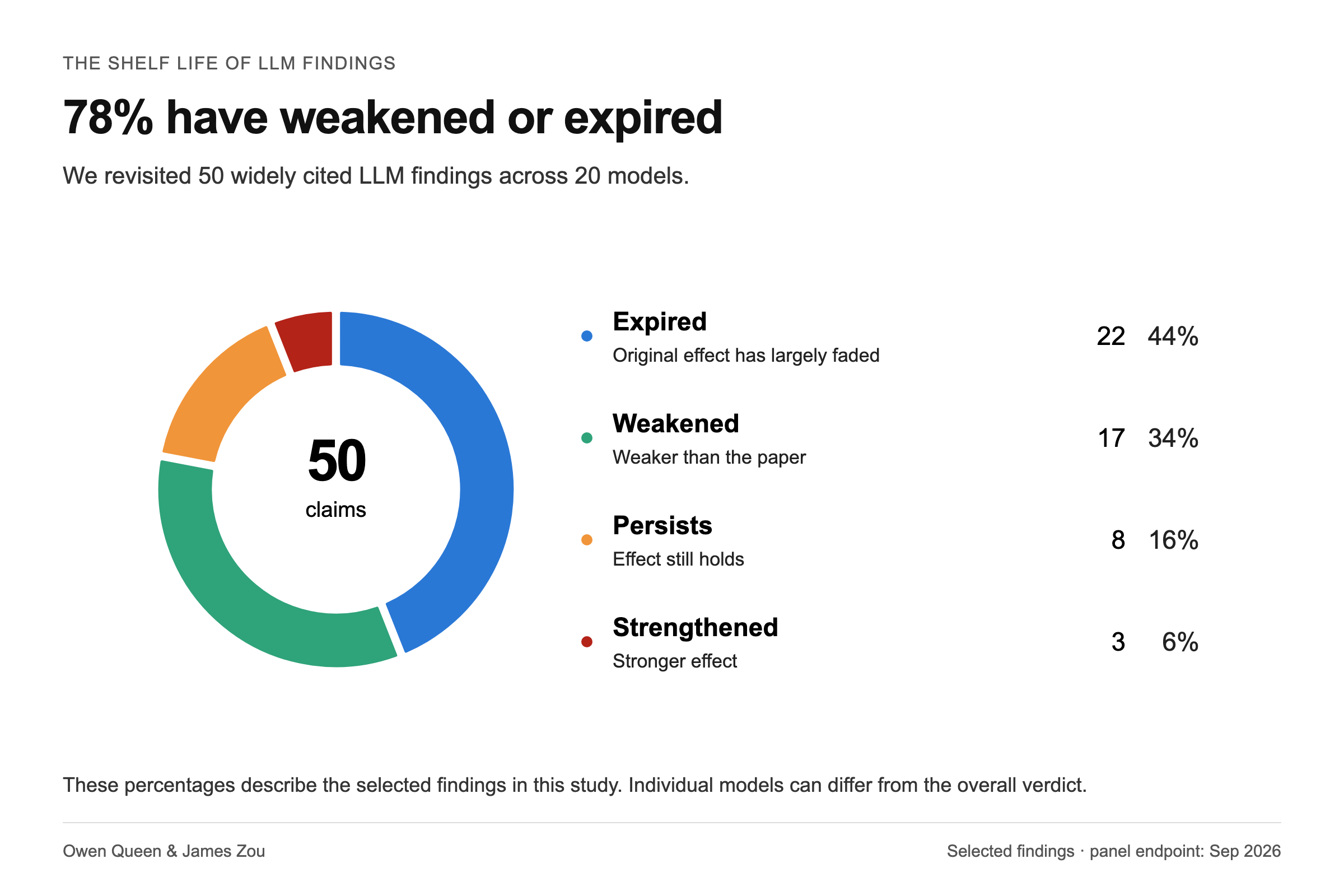
On November 2, Stanford researchers Owen Queen and James Zou published an interactive report, "The shelf life of LLM findings", retesting 50 widely cited claims about LLM behavior on 20 models released from July 2024 to September 2026 by eight developers. Verdict: 22 claims (44%) expired, 17 (34%) weakened, 8 (16%) persist and 3 (6%) strengthened; the median time from publication to expiration for expired claims was 14.7 months. Capability failures such as letter counting, lost-in-the-middle and fabricated citations have largely faded, while preference issues such as sycophancy and judges favoring their own answers persist.

Stanford Retests 50 Well-Known LLM Findings on 20 Models: 44% Have Expired, Median Shelf Life About 15 Months

Key Takeaways

  • 50 claims, 20 models, eight developers; verdicts reflect fitted effects as of September 30, 2026.
  • 44% expired, 34% weakened, 16% persist, 6% strengthened; expired claims had a median lifetime of 14.7 months (mean 15.7).
  • Kaplan-Meier estimates put the expired share at about 4%, 16% and 39% six months, one year and two years after publication.
  • Citation fabrication is expired overall, yet Qwen3.7-Flash still fabricated 69% of references in the same test (about 1% for Sonnet 5.5, 0% for GPT-6.1 Sol).
  • The pipelines were built with Claude Code and Codex; 43 of 48 reproduction checks matched the original papers within tolerance.
Read full story

Apple Intelligence is coming to China: iOS 27.3 developer beta starts Nov 4, public release in December, with Alibaba Qwen inside Siri, Writing Tools and Visual Intelligence

In a press release on its China newsroom, Apple said the first Apple Intelligence features will open for testing in the latest iOS developer beta starting November 4 and reach users in China with the iOS 27.3 release in December. The features run on Apple-built generative models and include Live Translation, Writing Tools, Visual Intelligence, Clean Up, Genmoji, notification and Mail summaries, and Type to Siri; Apple also partnered with Alibaba to bring Qwen into Siri, Writing Tools and Visual Intelligence. The first wave covers iPhone 15 Pro and newer only; Siri AI and the other next-generation features announced at WWDC 2026, plus Image Playground, are not included, and Mac, iPad and other platforms wait on further approvals.

Apple Intelligence is coming to China: iOS 27.3 developer beta starts Nov 4, public release in December, with Alibaba Qwen inside Siri, Writing Tools and Visual Intelligence

Key Takeaways

  • Timeline (Apple): testing in the latest iOS developer beta from November 4, public rollout with iOS 27.3 in December, no exact date given
  • First-wave features include Live Translation (Messages, FaceTime, Phone and AirPods), Writing Tools, Visual Intelligence, Clean Up, Genmoji, natural-language photo search, Priority Mail, notification summaries and Type to Siri
  • Alibaba Qwen is built into Siri, Writing Tools and Visual Intelligence: users can ask about photos, PDFs and presentations and use Qwen to compose original text, signing in with a Qwen account or Sign in with Apple
  • Supported devices: iPhone 16 and later, iPhone Duo, iPhone 15 Pro/Pro Max and iPhone Air, with Siri and device language set to English and Simplified Chinese
  • Siri AI and other next-generation WWDC 2026 features are excluded, MacRumors says Image Playground is also missing, and other platforms follow after the necessary approvals
Read full story
Linked Models & Agents:
⚡ Qwen⚡ Apple Foundation Models🤖 Siri🌐 Apple🌐 Alibaba
ADSponsored

Springer Nature and Google DeepMind partner on an AI peer review assistant built on Gemini and the open-source ADK; a prototype is in testing and human reviewers keep final judgment

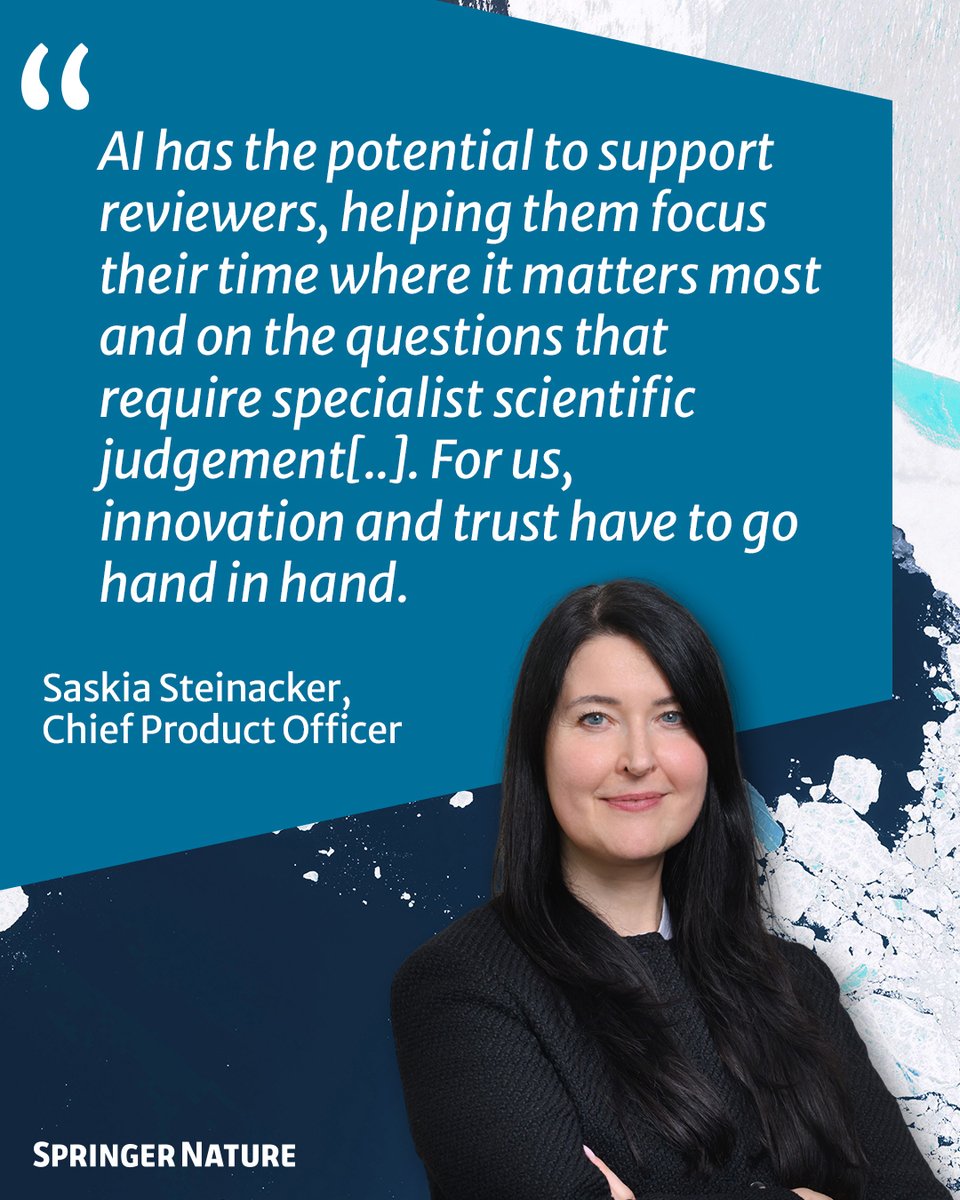
On Oct 26 Springer Nature, one of the world's largest research publishers, announced a research partnership with Google DeepMind to co-design an AI peer review assistant. It uses DeepMind's frontier Gemini models and builds on Google's earlier agentic research tools ScholarPeer and Deep Review to help reviewers navigate manuscripts, analyse large amounts of text, charts and figures, and flag areas that may need closer attention. The system is built with Google's open-source Agent Development Kit (ADK) and runs only inside Springer Nature's private Gemini Enterprise environment, so manuscript content stays in its secure environment. A prototype is being tested; the publisher stresses 'human first, AI second' and has not given a launch date or any performance data.

Springer Nature and Google DeepMind partner on an AI peer review assistant built on Gemini and the open-source ADK; a prototype is in testing and human reviewers keep final judgment

Key Takeaways

  • Partners: Springer Nature (publisher of the largest number of journals and books) and Google DeepMind, announced 2026-10-26 from London, Berlin and New York (press release)
  • Stack: frontier Gemini models plus Google's open-source Agent Development Kit (ADK), building on the ScholarPeer and Deep Review agentic research tools
  • Data isolation: runs only on Springer Nature's private Gemini Enterprise platform, keeping author and reviewer confidentiality
  • Status: prototype in testing; no launch date, journal coverage or accuracy figures have been published
  • Role: helps reviewers find areas needing attention, while final scientific judgment stays with human experts
Read full story

GitHub Next Releases PDD Kit: Provable Specification Enforcement for Coding Agents to Eliminate Edge-Case Regressions

GitHub Next officially released PDD Kit (Property-Driven Development Kit), establishing a formal verification toolkit tailored for autonomous coding agents. Addressing the pervasive reliability gap where agent-generated code passes isolated unit tests but crashes on subtle edge cases, PDD Kit combines property-driven specifications with automated formal solvers. Instead of testing arbitrary sample inputs, PDD Kit mathematically proves that agent code adheres to rigorous invariant specifications across every possible input, preventing regressions and elevating coding agents from probabilistic generation to provable correctness.

GitHub Next Releases PDD Kit: Provable Specification Enforcement for Coding Agents to Eliminate Edge-Case Regressions

Key Takeaways

  • GitHub Next releases PDD Kit to eliminate edge-case flaws in agent-generated code via automated mathematical proofs
  • Pioneers 'proofs for every input', replacing fragile, underspecified unit test samples with comprehensive invariant verification
  • Eliminates deadlocks, boundary index out-of-bounds, and state desynchronization in agentic refactoring workflows
  • Provides an indispensable verification foundation for deploying autonomous coding agents into mission-critical production systems
Read full story

Evolving Agent Interfaces: Empowering Computer-Use Agents to Synthesize Dynamic APIs for 58.58% Success

Researchers introduced 'Evolving Agent Interfaces' alongside the Agent S4 meta-framework in arXiv:2610.28601, removing the fundamental bottleneck of computer-use agents (CUAs). Conventional CUAs are forced to operate through human-designed graphical user interfaces—such as clicking spreadsheet cells one by one—inducing excessive action horizons and high failure rates. The new framework allows meta-agents to inspect live applications in scratch environments, dynamically synthesizing, testing, and evolving programmatic API wrappers and tool repositories on the fly. On OSWorld V2 and ScienceBoard, an open-weights 27B model raised task success from 55.03% to 58.58%, rivaling proprietary frontier models at a fraction of the cost.

Evolving Agent Interfaces: Empowering Computer-Use Agents to Synthesize Dynamic APIs for 58.58% Success

Key Takeaways

  • Evolving Agent Interfaces introduced in arXiv:2610.28601, pioneering dynamic API synthesis for computer-use agents (CUAs)
  • Meta-agents autonomously probe target applications in scratch VMs, writing bespoke programmatic wrappers to replace fragile GUI clicks
  • Elevates task completion rates on OSWorld V2 and ScienceBoard from 55.03% to 58.58% on an open 27B parameter model
  • Significantly compresses action sequences and token budgets, establishing an evolutionary paradigm for OS-level agent autonomy
Read full story
Linked Models & Agents:

LMSYS Arena Enables 14-Day Direct Mode Testing for OpenAI GPT-Image-2.5 Sunburst, Ranked #1 Across All Image Arenas

LMSYS officially announced a 14-day exclusive direct testing window for OpenAI flagship vision generative model GPT-Image-2.5 Sunburst in Direct Mode (active until Nov 2, 8 a.m. PT). Currently holding the undisputed #1 ranking across LMSYS Text-to-Image, Image Edit, and Multi-Image Edit arenas, the model can now be directly chosen from the dropdown menu before returning exclusively to anonymous Battle and Agent Mode.

LMSYS Arena Enables 14-Day Direct Mode Testing for OpenAI GPT-Image-2.5 Sunburst, Ranked #1 Across All Image Arenas

Key Takeaways

  • LMSYS Arena enabled 14-day exclusive Direct Mode testing for OpenAI GPT-Image-2.5 Sunburst until November 2 at 8 a.m. PT
  • The model holds the undisputed #1 ranking across Text-to-Image, Image Edit, and Multi-Image Edit Arenas
  • Demonstrates superior spatial reasoning and ambient lighting consistency across multi-image composition, mitigating visual drift
  • Following Direct Mode, the model will remain anonymously active in Battle and Agent modes to power Elo ratings
Read full story
Linked Models & Agents:

USC, UCLA, and CMU Release Grid-Bench for Multi-Step Spatial Reasoning: 8,928 Executable Instances Reveal Severe State Drift Across 64-Step Trajectories

Can LLMs reliably maintain spatial state representations across sequential operations? USC, UCLA, and CMU introduced Grid-Bench (arXiv:2610.22312, GitHub: grid-bench/Grid-Bench), an executable benchmark with 8,928 instances testing 2D/3D/4D grid state transitions across history lengths up to T=64. Evaluations across 6 frontier models show steep degradation: while GPT-5.6 Sol and Claude 5 Sonnet retain strong cell accuracy, open-weight and mid-tier models collapse to near-zero exact world reconstruction over long trajectories.

USC, UCLA, and CMU Release Grid-Bench for Multi-Step Spatial Reasoning: 8,928 Executable Instances Reveal Severe State Drift Across 64-Step Trajectories

Key Takeaways

  • USC, UCLA, and CMU introduced Grid-Bench (arXiv:2610.22312), an executable spatial tracking benchmark across 2D, 3D, and 4D discrete manifolds
  • Evaluates 8,928 instances across 8 spatial transformation rule families and trajectory lengths up to T=64 steps
  • At intermediate length T=16, GPT-5.6 Sol (98.0% cell accuracy) and Claude 5 Sonnet (96.8%) lead while mid-tier models drop sharply
  • At extreme length T=64, exact world recovery drops to 0 for GLM-5 and Kimi K2.5, demonstrating that long-horizon agents must rely on external state engines
Read full story
Linked Models & Agents:

SpaceXSI launches Grok Voice 3.0: speech-to-speech model tops Artificial Analysis S2S Index at 86.9, price held at $0.08/min

SpaceXSI (SpaceX Super Intelligence, x.ai) released Grok Voice 3.0 on 2026-10-14 17:04 UTC. Per Artificial Analysis testing (Oct 13) cited on the official blog, it scores 86.9 on the Speech-to-Speech Index (Grok Voice 2.0 81.3, GPT-Live-1 Astra 83.2, Gemini 3.8 Live 82.6), 97% on Full Duplex Bench, and 71.6% on τ-Voice — on par with GPT-Live-1 at ~40% lower latency. In the Voice Agent API, grok-voice-latest now aliases grok-voice-3.0 with an unchanged interface at $0.08/min; grok-voice-2.0 is deprecated.

SpaceXSI launches Grok Voice 3.0: speech-to-speech model tops Artificial Analysis S2S Index at 86.9, price held at $0.08/min

Key Takeaways

  • #1 on Artificial Analysis Speech-to-Speech Index at 86.9 (v2.0 81.3, GPT-Live-1 Astra 83.2, Gemini 3.8 Live 82.6)
  • Big Bench Audio 98.5%, Speech Agent Arena Elo 1070, task success 94.8%, Full Duplex Bench 97.0%
  • τ-Voice 71.6%, comparable to GPT-Live-1 (Astra) at ~40% lower latency; top accuracy (74%) on ServiceNow EVA-Bench
  • Same price: $0.08/min ($4.80/hr); grok-voice-latest auto-upgraded to 3.0, grok-voice-2.0 deprecated
  • Production scale (vendor figures): ~20k Starlink support calls/day, ~70% resolved with no human
Read full story
Linked Models & Agents:
⚡ Grok Voice 3.0⚡ Grok Voice 2.0⚡ GPT-Live-1⚡ Gemini 3.8 Live🌐 SpaceXSI🌐 xAI🌐 Artificial Analysis🌐 ServiceNow
ADSponsored

Claude Managed Agents dynamic workflows hit public beta: the lead agent writes an orchestration program running up to 64 concurrent threads and 1,000 agents per run

Anthropic expanded dynamic workflows in Claude Managed Agents to public beta. With workflows enabled in an agent's multiagent block, Claude writes a workflow program that runs many agents in background phases and combines their results, aimed at audits, migrations, deep research and cross-checking.

Key Takeaways

  • Enable with multiagent.type: "multiagent_20261001" and workflows: {"type":"enabled"} under the managed-agents-2026-04-01 beta header
  • Up to 64 threads working at once per run and 1,000 agents over a run's life (thread_limit_error beyond)
  • Runs last 24h by default; 10 open runs per session by default; runs don't nest
  • No separate run price: thread tokens bill at model rates and count toward the session budget, which pauses runs when reached
Read full story
Linked Models & Agents:

Anthropic expands its Cyber Verification Program into three access tiers with Opus 5.5, Sonnet 5.5 and Mythos 5.1; Red Team tier completes 34/50 CyScenarioBench tasks with zero blocks

On 2026-10-06 Anthropic merged Project Glasswing and the original Cyber Verification Program into one three-tier program: Defense Access (SOC, incident response, malware reversing, vuln validation), Red Team Access (authorized pentesting) and Specialized Access (safety-critical systems such as power grids, flight systems and telecom, vetted with the US government). All tiers get Claude Opus 5.5, Sonnet 5.5 and Mythos 5.1 with reduced cyber blocking. On CyScenarioBench, GA models were blocked on the first prompt of every task, Defense tier blocked 46/50 trials, and Red Team tier had zero blocks and completed 34/50 (matching the 67.6% no-safeguard rate). Glasswing partners reported at least 129,000 verified vulnerabilities from April to July 2026.

Anthropic expands its Cyber Verification Program into three access tiers with Opus 5.5, Sonnet 5.5 and Mythos 5.1; Red Team tier completes 34/50 CyScenarioBench tasks with zero blocks

Key Takeaways

  • 3 tiers: Defense (decisions in days), Red Team (weeks, organizations only), Specialized (in-depth review with the US government); Glasswing members move to Specialized automatically (announcement)
  • 3 models in every tier: Claude Opus 5.5, Sonnet 5.5 and Mythos 5.1, plus future models
  • CyScenarioBench (10 tasks x 5 attempts): GA blocked on first prompt; Defense tier blocked 46/50; Red Team tier 0 blocks and 34/50 completed, matching the 67.6% no-safeguard rate
  • Impact: at least 129,000 verified vulns found by Glasswing partners (Apr-Jul 2026) plus 5,500 from Anthropic's own OSS scanning (Apr-Oct), over 33,000 rated critical/high (Project Glasswing)
  • Available on Claude Platform, Vertex AI and Microsoft Foundry; Bedrock only for Enterprise Frontier Safeguards customers; data retention required
Read full story
Linked Models & Agents:

Code2Games: Enabling Coding Agents for Playable 3D Gaming World Generation via Blender-to-UE5 Coordinated Reconstruction

Synthesizing high-fidelity, interactive 3D gaming worlds directly from natural language game concepts requires holistic joint reasoning across scene geometry, spatial topology, gameplay objectives, and executable game mechanics. However, existing LLM coding agents typically generate isolated 3D assets or rudimentary scripts, resulting in broken dependencies and spatial-logical incoherence. To bridge this gap, researchers from Peking University and collaborators introduce Code2Games (arXiv:2610.05033), a dedicated agentic framework that generates structured 3D gaming worlds. Code2Games anchors world generation upon a procedural Blender foundation using a shared scene-gameplay representation that enforces persistent entity correspondence. It then transfers the assets into Unreal Engine 5 (UE5) and deploys an execution-guided reconstruction pipeline driven by compilation diagnostics, runtime traces, and automated playtesting feedback to dynamically rectify engine adaptation discrepancies. Evaluated on the newly introduced GameCode4D benchmark spanning ten tiers of gameplay complexity, Code2Games establishes new state-of-the-art marks in visual quality, interactive fidelity, and complete playable game stability.

Key Takeaways

  • Introduces Code2Games, an agentic framework generating structured, playable 3D gaming worlds bridging Blender foundation to Unreal Engine 5
  • Develops a shared scene-gameplay representation coupled with execution-guided reconstruction resolving engine adaptation defects via diagnostic loops
  • Releases GameCode4D benchmark across ten complex game prompts, surpassing direct agent baselines in visual fidelity and playability
Read full story

SWR: Self-Supervised Scaling of Scientific Terminal Environments for Coding Agents Surges Terminal-Bench 2 to 53.56%

Terminal coding agents are expanding from standard software engineering into scientific domains like bioinformatics, materials science, and physics. However, building training sandboxes requires executable reference behavior and rigorous verifiers capable of distinguishing true semantic correctness from superficial syntactic mimicry—a process that currently requires tedious manual engineering per task. Researchers from Tsinghua University and Tencent introduce Software-in-the-Loop Reconstruction (SWR, arXiv:2610.02710), a self-supervised environment scaling framework. SWR extracts ground-truth outputs and verifiers from existing executable scientific software workflows by perturbing input configurations into public observations and hidden evaluations. Agents synthesize complete, editable programs from input-output schemas without viewing source code, evaluated by hierarchical verifiers testing semantic fidelity, structural integrity, and anti-shortcut compliance. Implemented across 500 workflows and 46 software suites spanning six scientific domains, SWR generates 1,422 verified trajectories. Supervised fine-tuning of Qwen3.8-27B elevates Terminal-Bench 2 average success from 47.94% to 53.56%, establishing a scalable paradigm for scientific terminal agent training.

SWR: Self-Supervised Scaling of Scientific Terminal Environments for Coding Agents Surges Terminal-Bench 2 to 53.56%

Key Takeaways

  • Introduces SWR to bootstrap self-supervised terminal agent training sandboxes from existing scientific software workflows
  • Decouples public observations from hidden evaluations, using hierarchical verifiers to block shortcuts during program reconstruction
  • Drives Qwen3.8-27B performance on Terminal-Bench 2 from 47.94% to 53.56%, eclipsing all token-matched baseline controls
Read full story
T
TesterArmy@tester-army·
👀211
🔥90

TesterArmy's open-source e2e tops GitHub daily trending: natural-language agent steps for web and mobile tests, replayed with zero model calls

e2e (tester-army/e2e), an Apache-2.0 AI end-to-end testing framework, gained 1,430 stars today to top GitHub Trending (3,828 total; 60,933 npm downloads last week). Tests mix natural-language agent.act/agent.assert steps with locator assertions; verified agent steps are recorded and replayed with no model calls until the app changes. v0.17.0 adds Copilot Responses-API models, OpenCode Console sign-in, and a decision-model executor for bounded actions.

TesterArmy's open-source e2e tops GitHub daily trending: natural-language agent steps for web and mobile tests, replayed with zero model calls

Key Takeaways

  • #1 on GitHub daily trending: +1,430 stars today, 3,828 total (Apache-2.0)
  • npm package e2e: 60,933 weekly downloads (Sep 28–Oct 4); latest 0.17.0 released Oct 4
  • Record & replay: verified agent steps rerun with zero model calls until the app changes
  • v0.16.0 cut install footprint from 117 to 29 packages (~36MB to ~31MB)
  • 7 packages: Playwright (Chromium/Firefox/WebKit), iOS/Android, PR reporter, hosted browsers/simulators, decision-model executor
Read full story