
AI Coding Live News

Unsloth ships DeepSeek-V4.1-Flash-1017 dynamic GGUFs: a 250 GB 1-bit quant runs on 128 GB+ RAM, with the Engram table offloaded to SSD

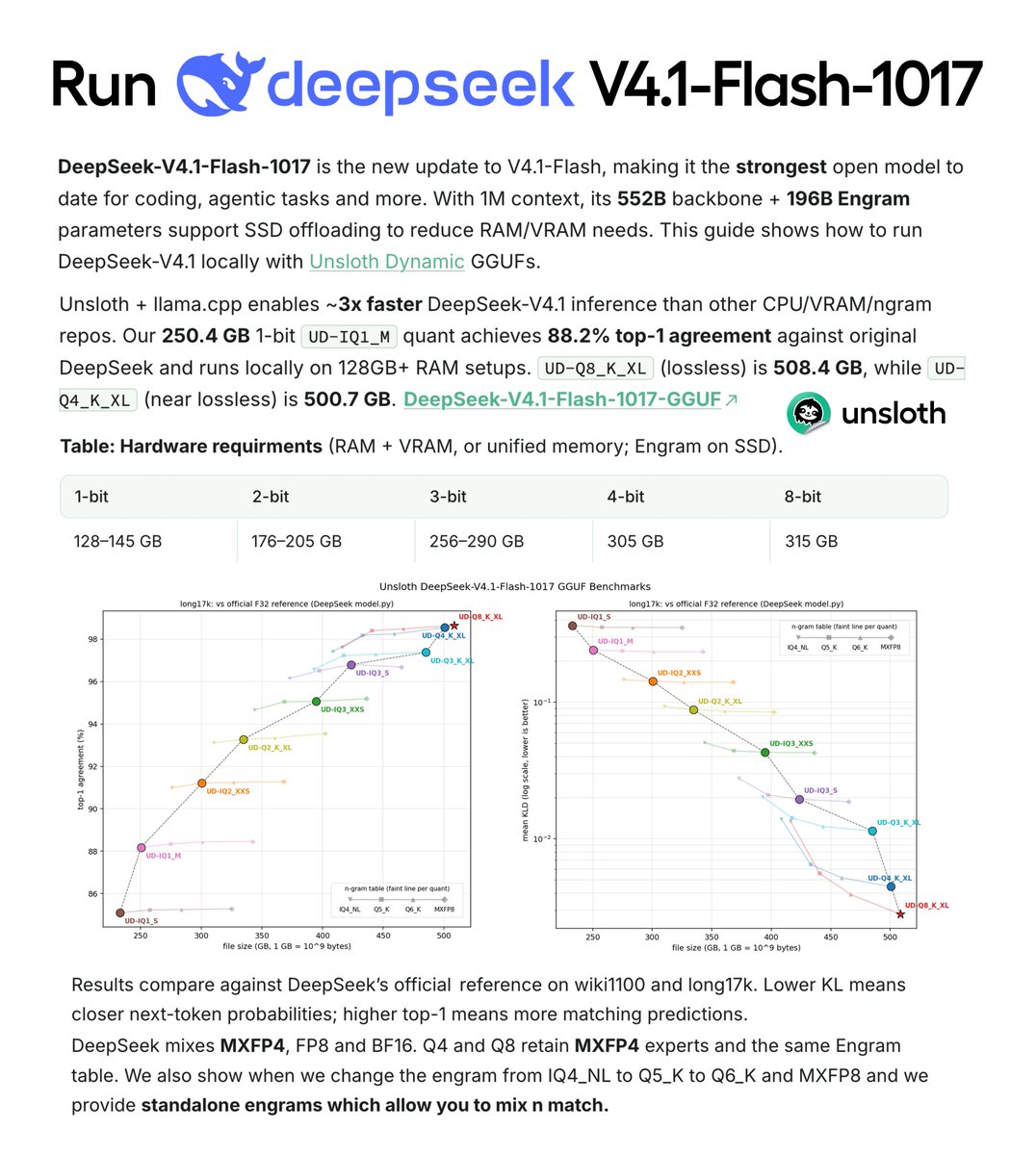
On Oct 19 (UTC) Unsloth released dynamic GGUF quants and a run-locally guide for DeepSeek-V4.1-Flash-1017. Per Unsloth, the 1-bit UD-IQ1_M quant is 250.4 GB (vs 508.4 GB for lossless Q8), keeps 88.2% top-1 agreement with the official weights on long17k, and runs on 128 GB+ RAM machines, because the model's 110.6–202.8 GB Engram n-gram table can stay on SSD via mmap. Running it currently requires Unsloth's llama.cpp PR build or Unsloth Desktop.
Unsloth ships DeepSeek-V4.1-Flash-1017 dynamic GGUFs: a 250 GB 1-bit quant runs on 128 GB+ RAM, with the Engram table offloaded to SSD

Key Takeaways

  • 1-bit UD-IQ1_M is 250.4 GB, about 51% smaller than lossless UD-Q8_K_XL (508.4 GB), with 88.2% top-1 agreement on long17k and 87.1% on wiki1100 (Unsloth-reported)
  • The smallest UD-IQ1_S (233.0 GB) targets 128 GB RAM machines such as a Mac or DGX Spark at 82.8–85.1% agreement; 3-bit UD-IQ3_XXS needs ~256 GB (e.g. Mac Studio) at 94.6–95.1%
  • The model pairs a 552B backbone with 196B Engram parameters; the 110.6–202.8 GB Engram n-gram table can stay on SSD via mmap, saving RAM but not disk
  • Unsloth claims ~3x faster inference than other CPU/VRAM/ngram-focused repos on top of llama.cpp (vendor claim, no independent test yet)
  • The Hugging Face repo is MIT-licensed with 9 quant levels from IQ1_S to Q8_K_XL plus standalone Engram files at different precisions
Read full story
Linked Models & Agents:

Unsloth v0.1.900-beta: local Laya Decision models + Skills editor; ~4.5× LTX-2.3 clips and up to 6.3× faster VAE decode

Unsloth shipped v0.1.900-beta on 2026-09-28 (PyPI unsloth 2026.9.12): Desktop runs Laya Decision models locally via a Jev-compatible /v1/systemone endpoint, adds a Skills CRUD editor and Library viewers for PDF/Office, and improves Apple Silicon with batched serving, structured outputs, and TurboQuant KV. Media pipelines claim ~4.5× LTX-2.3 clips, 1.7–6.3× VAE decode, and up to ~1 minute faster MiniMax-H3 first render with 25–29 GiB lower peak VRAM.

Unsloth v0.1.900-beta: local Laya Decision models + Skills editor; ~4.5× LTX-2.3 clips and up to 6.3× faster VAE decode

Key Takeaways

  • Shipped v0.1.900-beta — local Laya Decision API + Skills editor + Library viewers
  • LTX-2.3 ~4.5×; VAE decode 1.7–6.3×; MiniMax-H3 first render up to ~1 min faster, −25–29 GiB peak VRAM
  • Apple Silicon: batched serving, structured outputs, TurboQuant KV; ModelScope downloads
  • Docs: docs.unsloth.ai
Read full story
Linked Models & Agents:
⚡ Laya⚡ LTX-2.3⚡ MiniMax-H3⚡ Gemma-4🤖 Unsloth-Studio🌐 Unsloth

Unsloth Ships v0.1.815 & Prebuilt CUDA 13 Wheels: Run Qwen-Image-2.1 Locally with Claude-Compatible Agent Skills

Unsloth AI released version v0.1.815-beta alongside official prebuilt Linux x86_64 CUDA 13 wheels for Flash-Attention 2.8.4, Causal-Conv1D 1.7.0, and Mamba-SSM 2.3.2.post1 targeting PyTorch 2.13/2.14 on Python 3.13. The release enables fast local deployment of Alibaba's Qwen-Image-2.1 across both consumer and datacenter GPUs using Fast FP8 and GGUF quantization (defaulting to Q4_K_M) for combined image generation and precise image editing. Crucially, the Unsloth workspace introduces custom Agent Skills compatible with Claude Code and .agents formats, featuring @skill tagging in chat and 2x faster reasoning blocks (boosting UI rendering from 30 FPS to 60 FPS).

Unsloth Ships v0.1.815 & Prebuilt CUDA 13 Wheels: Run Qwen-Image-2.1 Locally with Claude-Compatible Agent Skills

Key Takeaways

  • Official CUDA 13 prebuilt wheels: instant binaries for Flash-Attention 2.8.4 and Mamba-SSM on PyTorch 2.13/2.14, eliminating compilation errors
  • Local Qwen-Image-2.1 execution: Fast FP8 and GGUF Q4_K_M support for both high-fidelity image generation and interactive image editing
  • Claude Code skill interoperability: native support for importing and executing custom skills from .agents and Claude Code folders with @skill
  • 60 FPS reasoning blocks: doubled chain-of-thought rendering performance from 30 FPS to 60 FPS with reworked UX
  • Expanded platform support: in-app Debian upgrades and a dedicated installer for Ubuntu 24.04+ on ARM64 architectures
Read full story
Linked Models & Agents:

RTX 3090 local coding-agent bake-off: Qwen3.8-27B Q4 + llama.cpp ~59 tok/s with reliable tools

@Brjen’s team spent a week comparing local coding-agent stacks on one RTX 3090 (24GB). Winner: Qwen3.8-27B Unsloth UD-Q4_K_XL with llama.cpp (65k context, q8 KV, native MTP depth 2, fully on GPU). Real multi-step coding runs hit ~59 tok/s (~46 tok/s at 45k context) and passed nested tool JSON, fixing a failing test, and a clean unified diff. They rejected Q3 for bad tools, heavier quants for context/MTP tradeoffs, and Flash-Next setups that needed CPU offload.

Key Takeaways

  • Winner: Qwen3.8-27B UD-Q4_K_XL + llama.cpp, 65k context and MTP, fully on a 3090.
  • ~59 tok/s on multi-step coding; passed tool JSON, test-fix, and correct diff gates.
  • Q3, heavier quants, and offloaded Flash-Next were less reliable on 24GB.
Read full story
Linked Models & Agents:
ADSponsored

Unsloth: GLM-5.3-Flash local GGUF inference up to 3.3× faster with MTP

Unsloth says optimized local GGUF decoding makes GLM-5.3-Flash up to ~3.3× faster (typically ~1.6–3.4×), with multi-token prediction (MTP) and faster long-context decoding. 3-bit quants still target ~128GB setups via Unsloth Desktop or llama.cpp; docs and Hugging Face GGUF weights are updated.

Key Takeaways

  • Speed: local GGUF inference up to ~3.3× (typical ~1.6–3.4×).
  • Features: MTP enabled plus faster long-context decoding.
  • Run: 3-bit on ~128GB via Unsloth Desktop / llama.cpp; docs and HF GGUFs live.
Read full story

Alibaba Qwen open-weights Qwen3.8-Flash: 125B/6B multimodal MoE scoring 62.5 on SWE-bench Pro

Alibaba Qwen released open-weight Qwen3.8-Flash, a multimodal Mixture-of-Experts model billed as an early preview of the Qwen4 architecture. The production-scale checkpoint is 125B parameters plus 51B N-gram embeddings, with only 6B activated per token. The new stack combines Gated DeltaNet plus Qwen Sparse Attention, Gated Residual branches, N-gram embeddings that can live in host memory, and a refined Muon optimizer. Qwen said it trained at about one-ninth the cost of Qwen3.7-Plus while beating it across the board, especially on coding and office work: 58.7 on DeepSWE 1.1, 62.5 on SWE-bench Pro, 73.9 on CoWorkBench, 84.5 on AndroidWorld, and 95.7 on MathVision with CI. Native context is 262K tokens, extendable to 1M with YaRN; at 1M context the QSA kernel is up to 7.6x faster in prefill and 4.9x faster in decode. QwenCloud lists roughly $0.15 input / $0.47 output per million tokens, and day-0 runtimes arrived from NVIDIA NeMo, SGLang, Unsloth, OpenRouter, and OpenCode Go.

Key Takeaways

  • 125B/6B MoE hits 62.5 SWE-bench Pro and 58.7 DeepSWE 1.1 at ~1/9 the training cost of Qwen3.7-Plus.
  • QSA hybrid attention is up to 7.6x faster in prefill and 4.9x in decode at 1M context.
  • Open weights plus day-0 support on QwenCloud, OpenRouter, OpenCode, NeMo, SGLang, and Unsloth.
Read full story

Unsloth AI Releases GLM-5.3-Flash 3-Bit GGUF: 320B Multimodal MoE Runs Locally on 128GB RAM

Unsloth released 3-bit GGUF quantization for Z.ai's GLM-5.3-Flash (Ox Alpha), enabling local on-device inference for the 320B-A18B multimodal MoE on 128GB RAM workstations without datacenter GPUs.

Key Takeaways

  • Day-one local offline support for a 320B multimodal coding model on workstation hardware like Mac Studio;
  • Maintains high reasoning and coding fidelity on DeepSWE benchmarks under optimized 3-bit quantization;
  • Weights and deployment guides published on Hugging Face for instant use with llama.cpp and LM Studio.
Read full story
Linked Models & Agents:

Qwen Releases Qwen3.8-Flash-Next Open Weights: Unsloth Single-GPU GGUF Quantization Available

Alibaba Qwen team open-sources Qwen3.8-Flash-Next weights (125B total / 6B active MoE). Partnering with Unsloth, optimized GGUF quantizations run full 262K context on single 24GB GPUs at 85 tokens/sec.

Key Takeaways

  • Qwen team open-sources Qwen3.8-Flash-Next 125B/6B MoE weights;
  • Unsloth GGUF quantizations enable full 262K context on single 24GB GPUs;
  • Local inference throughput reaches 85 tokens/s for air-gapped private development.
Read full story

Qwen3.8-Flash-Next Runs Locally on 75GB RAM with Day-0 Unsloth GGUFs

Alibaba Qwen confirmed that the 125B multimodal MoE Qwen3.8-Flash-Next can now run locally on about 75GB of RAM via Unsloth GGUFs, with N-gram embeddings offloaded to CPU or unified memory for near-VRAM speed. It is the day-0 local path for the Qwen4 architecture preview weights.

Key Takeaways

  • 125B MoE with 6B active parameters plus 51B n-gram embeddings now runs locally on ~75GB RAM without fitting the full model in GPU VRAM
  • Unsloth shipped day-0 GGUFs and a Qwen3.8-Flash-Next guide; CPU RAM / unified-memory setups approach VRAM throughput
  • Official weights remain on Hugging Face and ModelScope, with day-0 vLLM and SGLang serving on NVIDIA and AMD
Read full story