AI Coding Live News

Meta Rolls Out Muse Realtime Avatar in the US Muse App: Speech-Driven Expression and Gesture at ~870ms First-Byte Latency

On November 5 Meta AI (@AIatMeta) said Muse Realtime Avatar, previewed at Connect, is rolling out in the US Muse app, turning Muse Realtime Voice into interactive live avatars. The research blog describes an audio-driven Diffusion Transformer that shares the speech-token stream with voice for lip-sync and expression; a single GB200 session streams 448×768 at 25 fps with about 870 ms from end of user turn to first synchronized audio-video byte, with Meta Video Seal invisible watermarking. Muse is for users 18+; no global schedule or developer API was announced.

Meta Rolls Out Muse Realtime Avatar in the US Muse App: Speech-Driven Expression and Gesture at ~870ms First-Byte Latency

Key Takeaways

  • US Muse app rollout of Realtime Avatar after the Connect preview (@AIatMeta)
  • Shared speech VQ tokens drive audio decode and avatar video; causal chunks with self-forcing distillation cut ~120 teacher NFEs to 2 student NFEs (~60x)
  • Vendor perf: 448×768@25fps, ~870ms first-byte latency; ~8x serving capacity vs BF16 baseline, up to 12 concurrent sessions on one GB200
  • Vendor preference study favored Muse over Runway Characters and HeyGen LiveAvatar on overall and most axes
  • Safety: Video Seal invisible watermark; blog demos are not the full in-app avatar set; no public developer API stated
Read full story
Linked Models & Agents:
⚡ Muse Spark⚡ Muse Presence🤖 Muse🌐 Meta

OpenAI Realtime Lead: GPT-Live Outbound Telephony API Hits GA via Any SIP Trunk, with HD Voice and DTMF

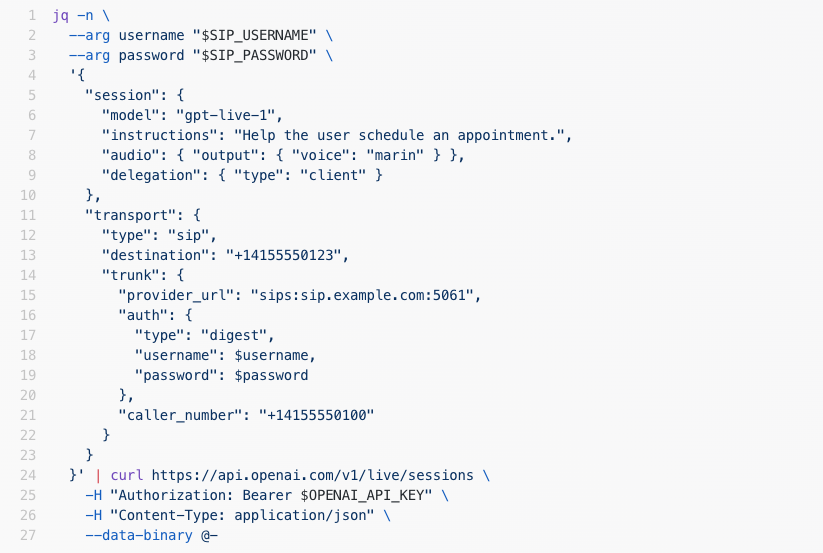
On November 4, Justin Uberti, Head of Realtime AI at OpenAI, said the GPT-Live outbound telephony API is generally available: Live voice agents can dial through any SIP trunk such as Telnyx or Twilio, with HD Voice and bidirectional DTMF. Official docs describe Live API + SIP transport; Greg Brockman amplified the note.

OpenAI Realtime Lead: GPT-Live Outbound Telephony API Hits GA via Any SIP Trunk, with HD Voice and DTMF

Key Takeaways

  • Justin Uberti (Head of Realtime AI, OpenAI): GPT-Live outbound telephony API is GA via any SIP trunk
  • Official docs: Live API POST /v1/live/sessions with transport.type=sip; HD Voice and bidirectional DTMF
  • Trunks need TLS (sips:) signaling and SDES-SRTP; examples cite Telnyx and Twilio
  • Documented limits: ~3 minutes ringing and ~2 hours connected call duration
  • Amplified by Greg Brockman; frame as a first-hand employee note, not an @OpenAI press post
Read full story
Linked Models & Agents:
⚡ OpenAI GPT Live 1🌐 OpenAI

Gemini 3.8 TTS Adds Voice Remixing: Edit Prebuilt or Designed Voices With Natural-Language Instructions Into New Reusable Voice IDs

The official Gemini API changelog released Voice remixing on November 4. Starting from a prebuilt voice, an Extended Voice Library voice or a Voice Design persona, developers describe changes such as accent, pitch, pacing or age in natural language, and POST /v1beta/voices returns a new standalone voice_ ID usable with Gemini 3.8 Flash TTS and Flash-Lite TTS. It is also available interactively in Google AI Studio.

Key Takeaways

  • New Voice remixing feature: apply relative natural-language edits to an existing voice to create a new standalone voice
  • Uses POST /v1beta/voices (type=prompted, store=true, plus a new prompted.base_voice field) and returns a voice_ ID with a 24kHz WAV preview
  • Base voices can be any of 30 prebuilt voices, an Extended Voice Library voice, or a stored custom voice_ voice in the project
  • The resulting voice_ ID works with gemini-3.8-flash-tts and gemini-3.8-flash-lite-tts and can itself be remixed again
  • The original voice is never modified, and deleting it does not affect voices remixed from it
Read full story
Linked Models & Agents:
⚡ Gemini 3.8 Flash TTS⚡ Gemini 3.8 Flash-Lite TTS🌐 Google🌐 Google DeepMind

Google Antigravity v2.29 Brings Remote Agents and a Gemini Live Voice Mode: Agent Sessions Run in a Google-Managed Cloud and Keep Working After You Close Your Laptop, Rolling Out to AI Pro and Ultra

Ivan Leo, who works on developer experience at Google DeepMind, shared the official docs for Antigravity's new Remote Agents feature on X on November 4. Per the docs, Remote Agents run agent sessions and tools in an isolated, Google-managed remote environment, so tasks keep going when you close your laptop or browser or switch between desktop and mobile. Sessions start from the Antigravity App, the Antigravity CLI (1.4.12+, agy --remote-agent) or the web at antigravity.google.com, and remote projects can attach GitHub repositories, Google Drive files and uploads. It is rolling out gradually to Google AI Pro and Ultra subscribers on personal accounts; it is not available on the free plan, AI Plus or business accounts. The official changelog shows this ships in Antigravity v2.29.0 (November 3), which also starts rolling out a voice mode powered by Gemini Live for handing requests to the agent by voice, redesigns the Automations page into Scheduled, Always on and Paused lists, and adds a native Jupyter notebook viewer.

Key Takeaways

  • Remote Agents run in an isolated Google-managed environment with no local machine required; Remote Control instead connects to your own computer or server, and the web sidebar switches between them.
  • Three entry points: a New Remote Project in the Antigravity App, agy --remote-agent in CLI 1.4.12+, or antigravity.google.com in any browser, including mobile.
  • Remote projects can attach GitHub repositories (cloned automatically), Google Drive files and uploads (8 MiB per file, 100 MiB per project, 2 GiB per account).
  • CLI remote sessions default to the always-proceed (turbo) permission preset, so commands run without approval; locally installed MCP servers, plugins and skills are not available remotely yet.
  • Also in v2.29.0 (November 3): a Gemini Live voice mode rolling out gradually, a redesigned Automations page, and native rendering of .ipynb notebooks.
Read full story
ADSponsored

X Discussion: Sam Altman Says People Should Always Control the Future and That This Should Ultimately Constrain AI Progress

At 01:40 UTC on November 4, OpenAI CEO Sam Altman (@sama) posted on X that "people should always be in control of the future," saying OpenAI is against the idea of people being relegated to doing things that "AI systems think makes sense to reward in humans," and that people should not cede control of the future to superintelligence, a requirement that "should ultimately constrain AI progress." Within about 25 minutes it drew roughly 1,360 likes, 337 replies and nearly 100K views; Francois Chollet and others voiced support while many replies pushed back. This is Altman's stated view, not a new OpenAI policy or product announcement.

Key Takeaways

  • Engagement: about 1,360 likes, 337 replies, 89 reposts, 74 quotes and roughly 99K views within about 25 minutes (per the X API); the high reply ratio signals a contested post
  • Three core lines: people should always be in control of the future; OpenAI rejects people being relegated to doing what "AI systems think makes sense to reward in humans"; people should not cede the future to superintelligence, and that requirement "should ultimately constrain AI progress"
  • Support: Francois Chollet (@fchollet) posted "Co-sign," saying the only future worth building is one where AI remains a tool in human hands; Matthew Berman said Altman made the same point in their interview last week
  • Pushback: replies asked "which people?", argued that AI systems "don't think anything," or contrasted the post with Altman's recent comments on RAM and concentrating compute in data centers
  • The post does not say where the quoted phrase comes from and names no concrete policy or timeline; online links to a GPT-6.2 Astra release date are speculation
Read full story
Linked Models & Agents:

Hume Launches Audio Decision API: Ask Plain-Language Questions of Raw Audio in One Call, 70.7% Agreement With a Human Panel per Hume

On November 2 voice AI company Hume launched the Audio Decision API, which it calls the first audio-native model that answers questions about speech and sound. Developers upload raw audio, write each question as a sentence with candidate answers, and get back a probability for each answer, with no transcription step. It supports yes/no, multiple-choice, rating-scale and time-span questions, such as how many speakers there are, whether someone laughs, whether a caller sounds frustrated, or whether a siren is in the background. Per Hume, it was trained on more than 10 million human judgments and in an initial evaluation reached 70.7% agreement with a human panel's average judgment, versus 56.5% for an individual rater. Access is currently by request or waitlist.

Hume Launches Audio Decision API: Ask Plain-Language Questions of Raw Audio in One Call, 70.7% Agreement With a Human Panel per Hume

Key Takeaways

  • Per Hume: 70.7% agreement with a human panel's average judgment in an initial evaluation, versus a 56.5% individual-rater baseline; sample size and languages were not disclosed.
  • Trained on more than 10 million human perceptual judgments (per Hume's X post); the blog cites tens of millions of listener ratings overall.
  • Four question types (yes/no, choice, scale, span); adding a question is one line of JSON, with no labeling or retraining.
  • The endpoint is POST /v0/decisions/file, plus an input-token estimate endpoint, with Python and TypeScript SDKs.
  • Hume says work that used to take 10+ models now takes one call; pricing has not been published.
Read full story
Linked Models & Agents:
⚡ Hume Audio Decision Model🌐 Hume AI

OpenCode team ships Hex 3.0 stable: local voice dictation for Mac, Windows and Linux, built for talking to coding agents

Anomaly, the company behind open-source coding agent OpenCode, shipped Hex 3.0 stable: hold a shortcut, speak, and the text is pasted at your cursor. Recognition runs on-device, local model memory drops from about 900 MB to about 160 MB, and it adds vocabulary hints, a hex CLI and optional OpenCode rewriting.

OpenCode team ships Hex 3.0 stable: local voice dictation for Mac, Windows and Linux, built for talking to coding agents

Key Takeaways

  • Hex v3.0.0 was released on GitHub at 00:38 UTC on Oct 31; it is MIT-licensed, written in Rust, and the repo has about 1,557 stars (release notes)
  • Vendor figures: local model memory drops from about 900 MB to about 160 MB; since 2.3.0 it streams, so a 2-minute dictation finishes about 0.1 s after release on an RTX 5070 Ti
  • Runs on macOS 15+ (Apple silicon), Windows x64/ARM64 and Linux x64/ARM64, with new .deb and .rpm packages on Linux
  • 3.0 does not auto-update from 2.3.1 and starts fresh, so settings, History and models must be set up again; Voice Action and spoken commands are removed
  • The @opencode launch post drew about 2,400 likes, 1,600 bookmarks and 100k+ views (post)
Read full story
Linked Models & Agents:
⚡ Parakeet⚡ Whisper🤖 OpenCode🤖 Hex🌐 Anomaly

Cartesia launches Managed Agents voice agent platform: #1 of 30 on Speech Agent Arena, $0.03 per minute at launch

Voice model company Cartesia launched Managed Agents on Oct 29, an end-to-end voice agent platform for enterprise phone calls that tunes its own speech-to-text and text-to-speech models together with the agent harness, and bundles telephony, knowledge bases, tool calls and outbound batches. Cartesia says it ranks #1 on Artificial Analysis's Speech Agent Arena with a 1115 Elo and scores 87.4% accuracy and 90.7% experience on ServiceNow's EVA-Bench (vendor-reported, with GPT-5.5 as the reasoning model). Launch pricing is 50% off at $0.03 per minute.

Cartesia launches Managed Agents voice agent platform: #1 of 30 on Speech Agent Arena, $0.03 per minute at launch

Key Takeaways

  • On Artificial Analysis's Speech Agent Arena blind preference test, Managed Agents ranks #1 of 30 agents with a 1115 Elo, ahead of Gemini 3.1 Flash Live Minimal (1099), Grok Voice 3.0 (1064) and GPT-Live-1 (1041) (Cartesia blog, as cited by the vendor)
  • First-attempt results on ServiceNow EVA-Bench across 200+ customer service, IT service and HR scenarios: 87.4% accuracy and 90.7% experience, versus 73.7%/71.2% for Grok Voice 3.0 and 59.0%/61.6% for GPT Realtime 2.1 (EVA-Bench)
  • All these benchmark runs use GPT-5.5 as the reasoning model; Cartesia's internal evaluation says 85% of calls had no turn-taking issues, versus 67% for other agents
  • Launch pricing is 50% off at $0.03 per minute; Cartesia says the platform has already handled tens of millions of conversations in finance, retail, hospitality and healthcare
  • It supports 44 languages; English, Spanish, Hindi, French and Japanese can switch mid-call today, with the rest coming soon
Read full story

ChatGPT dots add texting: US Pro users can message their dot over iMessage or RCS, and the dot texts back with proactive updates

On Oct 28 OpenAI announced through @ChatGPT that users can now text their dot, the always-on agent inside ChatGPT. You can hand it a task or something to watch using text, photos or voice notes, and it texts you proactively when there is a relevant update. Texting runs over iMessage or RCS, not plain SMS; only you can text your dot and it can only text you. It is rolling out in beta to a limited number of US Pro users and is not supported in Business or Enterprise workspaces. Texts pass through the third-party provider Linq, and OpenAI says the conversation is not end-to-end encrypted.

ChatGPT dots add texting: US Pro users can message their dot over iMessage or RCS, and the dot texts back with proactive updates

Key Takeaways

  • Scope: a limited beta for US Pro users; not supported in Business or Enterprise workspaces (OpenAI Help Center)
  • Channels: iMessage on iPhone and RCS on Android only; a plain SMS gets an automatic reply asking you to use iMessage, RCS or the app
  • Setup in 3 steps: open the dot's profile and choose Texting, enter your number to get a confirmation text, then enter the code
  • Privacy: texts route through third-party provider Linq, so they are not end-to-end encrypted; Linq keeps no message content after delivery, only metadata such as timestamps and delivery status
  • Context: texting shares the same memory and plugins as the dot in the app; reply STOP or turn it off under Texting to stop
Read full story

Apple ships 27.2 updates: Siri AI adds French, Japanese, Korean, Portuguese and Spanish, and can now recall past conversations

On Oct 26 Apple released iOS, iPadOS, macOS, watchOS and visionOS 27.2, and Siri AI (beta), the assistant rebuilt on Apple Intelligence, now supports French, Japanese, Korean, Portuguese and Spanish in addition to English. Apple says Traditional Chinese, Norwegian, Turkish and Vietnamese will follow by the end of the year. Per the iOS 27.2 release notes, Siri AI can now recall past conversations and draw on more sources such as photos in Messages, Calendar attendees and voicemails. Siri AI is still unavailable in the EU on iOS, iPadOS and watchOS and in mainland China, and server-side features have daily usage limits; Apple says expanded access will be offered for a fee in the future.

Apple ships 27.2 updates: Siri AI adds French, Japanese, Korean, Portuguese and Spanish, and can now recall past conversations

Key Takeaways

  • Languages: Siri AI grows from English-only to 6 languages, adding French, Japanese, Korean, Portuguese and Spanish; Apple says Traditional Chinese, Norwegian, Turkish and Vietnamese arrive by year end
  • 5 platforms: iOS, iPadOS, macOS, watchOS and visionOS 27.2 shipped the same day, with Siri AI still labeled beta
  • New abilities (per iOS 27.2 release notes): recall of past conversations, more sources including photos in Messages, Calendar attendees and voicemails, plus one Excluded Apps setting
  • Limits: unavailable on iOS/iPadOS/watchOS in the EU, for mainland China accounts and for users under 13; server-side features have daily caps, and Apple says paid expanded access is coming
  • Devices: Apple Intelligence hardware such as iPhone 15 Pro and later and M1-or-later iPad and Mac, with device and Siri language set to the same supported language
Read full story
Linked Models & Agents:
⚡ Apple Intelligence⚡ AFM 3🤖 Siri AI🌐 Apple
ADSponsored

Tencent Hunyuan open-sources Hy-SimulMT, a Chinese-English real-time simultaneous interpreting model with ~3s lag and live voice cloning

On Oct 26 Tencent Hunyuan (Tencent Hy) open-sourced Hy-SimulMT, a real-time simultaneous interpreting model for bidirectional Chinese-English speech-to-speech translation. It translates while the speaker talks, outputs both translated text and speech, and can clone the speaker's voice in real time. Six checkpoints landed on Hugging Face (30B-A3B translation-only and source-plus-translation Interleave variants, each in BF16, FP8 and GGUF), with the model card listing Apache-2.0; GitHub ships the SimulInfer serving stack and SimulTrain training tools. Vendor-reported: about 3s StreamLAAL on RealSI long-form audio, the lowest among compared systems.

Tencent Hunyuan open-sources Hy-SimulMT, a Chinese-English real-time simultaneous interpreting model with ~3s lag and live voice cloning

Key Takeaways

  • Size and variants: 30B-A3B MoE (about 3B active), six checkpoints: translation-only and Interleave (source plus translation), each in BF16, FP8 and GGUF (Hugging Face collection)
  • Latency (vendor-reported): about 3s StreamLAAL on RealSI long-form audio, the lowest among compared systems, with a GEMBA quality score above the compared open models and 4 of 5 commercial APIs
  • Short-form (vendor-reported): FLEURS 90.3, CoVoST2 75.5, ACL6060 81.2, RealSI-Sentence 84.7, the last being the top score in the table; Qwen3.8-LiveTranslate scores 88.4/82.1/80.5/84.4 in the same table
  • Human comparison: 18 real Chinese and English recordings of about 6 minutes each against 6 CATTI Level 1/2 interpreters; Tencent says quality was on par with often lower latency, and notes the result only covers this small test
  • Deployment: one SimulInfer deploy.sh command starts vLLM (>=0.31) plus a web/WebSocket service; speech output and voice cloning need a separate TTS service; llama.cpp support is not yet merged upstream (SimulInfer docs)
Read full story
Linked Models & Agents:
⚡ Hy-SimulMT-30B-A3B⚡ Hy-SimulMT-30B-A3B-Interleave⚡ Qwen3.8-LiveTranslate🌐 Tencent

Mistral Releases Voxtral 3 Audio Model Suite and Real-Time Voice-Agent API with Sub-500ms Latency

Mistral AI unveiled Voxtral 3, a production audio intelligence suite paired with a real-time Voice-Agent API. The lineup features the 4B-parameter Mini Transcribe, Small Transcribe 3, and a turn-key voice agent SDK built on LiveKit. Supporting transcription across 50 languages with diarization, multi-lingual TTS with emotional tags across 35+ languages, and 30-minute voice cloning, Voxtral 3 redefines voice AI economics. In Artificial Analysis independent benchmarks, Small Transcribe 3 secured rank #3 globally with a 2.1% error index (outperforming ElevenLabs Scribe v2), while Realtime Transcribe delivers sub-500ms latency at $0.04/min for full voice agent turns.

Mistral Releases Voxtral 3 Audio Model Suite and Real-Time Voice-Agent API with Sub-500ms Latency

Key Takeaways

  • Mistral AI launched the Voxtral 3 suite spanning transcription, emotional TTS, studio-grade voice cloning, and a LiveKit-powered Voice-Agent SDK
  • Artificial Analysis independently verified Small Transcribe 3 at a 2.1% error index, outperforming ElevenLabs Scribe v2 (2.2%) and Grok Voice 2.0 (2.3%)
  • Realtime Transcribe 3 achieves sub-500ms latency, delivering sub-second full conversational voice-agent turns
  • Aggressive pricing: Mini Transcribe starts at $0.0035/min, and managed voice agent sessions cost just $0.04/min paired with Mistral Small 4
Read full story

Hao AI Lab open-sources FastH3 Omni: MiniMax H3 distilled to 8 steps for reference-guided video and audio, with 5.6-11.9x lower end-to-end latency

On Oct 20, the FastVideo team at UCSD's Hao AI Lab open-sourced FastH3 Omni, a distilled version of MiniMax H3's reference-to-video-and-audio (Ref2VA) model that generates video with synchronized stereo audio from text plus up to nine images, video clips and voice references. Sampling drops from 50 steps to eight transformer evaluations, cutting end-to-end latency 5.6-11.9x on eight GB200s by the team's measurements. Training code is open, with NVFP4 weights for DGX Spark and RTX 5090 and ComfyUI support.

Hao AI Lab open-sources FastH3 Omni: MiniMax H3 distilled to 8 steps for reference-guided video and audio, with 5.6-11.9x lower end-to-end latency

Key Takeaways

  • Steps: eight transformer evaluations versus 50 for base MiniMax H3, via PDD plus DMD distillation
  • Speed (team figures): 5.6-11.9x lower end-to-end latency across 27 matched workloads on 8x GB200; a 15-second single-image request drops from 139.69s to 14.14s
  • Inputs: up to nine images, three videos and three audio clips, at most 12 references; output is 24 FPS video with 32 kHz stereo audio
  • Local: NVFP4 QAD weights for DGX Spark (128 GB) and RTX 5090 (32 GB), 480p by default; FP8 weights for RTX 4090
  • License: MiniMax-H3 Community License, not Apache or MIT
Read full story
Linked Models & Agents:

Gradium open-sources Phonon on-device TTS: a 31M-parameter, 64 MB model that starts speaking in 7 ms on a laptop CPU, with the English version under Apache 2.0

On Oct 20, French voice AI company Gradium open-sourced Phonon, a family of on-device text-to-speech models: the English Phonon 31m (64 MB q8 weights, Apache 2.0) and Phonon 40m (single-language English, French, German, Spanish and Portuguese variants plus a five-language model, CC BY-NC non-commercial). Built on Kyutai's Pocket TTS and the Mimi codec, it ships its own runtime for CPU, Metal, CUDA, Vulkan, WebGPU, Core ML and Snapdragon, running offline on phones, browsers and a Raspberry Pi. Gradium reports 7 ms to first audio on a MacBook Air M5 CPU versus 517 ms for Kokoro.

Gradium open-sources Phonon on-device TTS: a 31M-parameter, 64 MB model that starts speaking in 7 ms on a laptop CPU, with the English version under Apache 2.0

Key Takeaways

  • Check the license: only the English Phonon 31m is Apache 2.0 for commercial use; every Phonon 40m variant, including multilingual, is CC BY-NC 4.0 and needs a deal with Gradium for commercial use
  • Size (official): 64 MB q8 weights for 31m and 74.6 MB for 40m; 37 built-in English voices, 102 in the multilingual model, plus voices cloned or designed with Gradium
  • Speed (vendor-measured): 6.9 ms to first audio and 29.9x real time on a MacBook Air M5 CPU with 4 threads, versus 517 ms for Kokoro (which does not stream); 38 ms and 3.7x real time on a Raspberry Pi 5; 7.5 ms on Snapdragon 8 Elite Gen 5
  • Accuracy (vendor-built hard-sentence set, 500 per language, public on HF): English WER of 1.70% for 31m and 2.22% for 40m versus 3.50% for Kokoro and 8.71% for NeuTTS Nano, with text normalization for numbers, dates and version strings
  • Get started with uvx ptts or pip install ptts, the phonon-tts npm package for browsers, or the gradium-ai/xn-ptts runtime on GitHub
Read full story
Linked Models & Agents:
⚡ Phonon 31m⚡ Phonon 40m⚡ Phonon 40m multilingual⚡ Pocket TTS⚡ Kokoro🤖 Pipecat🌐 Gradium🌐 Kyutai🌐 Arm🌐 Qualcomm🌐 Hugging Face

ElevenLabs launches Eleven Realtime v1 Mini and Max speech-to-speech models: Max scores 98.8% on Big Bench Audio, speaks in 0.57s on average, and is OpenAI Realtime API compatible

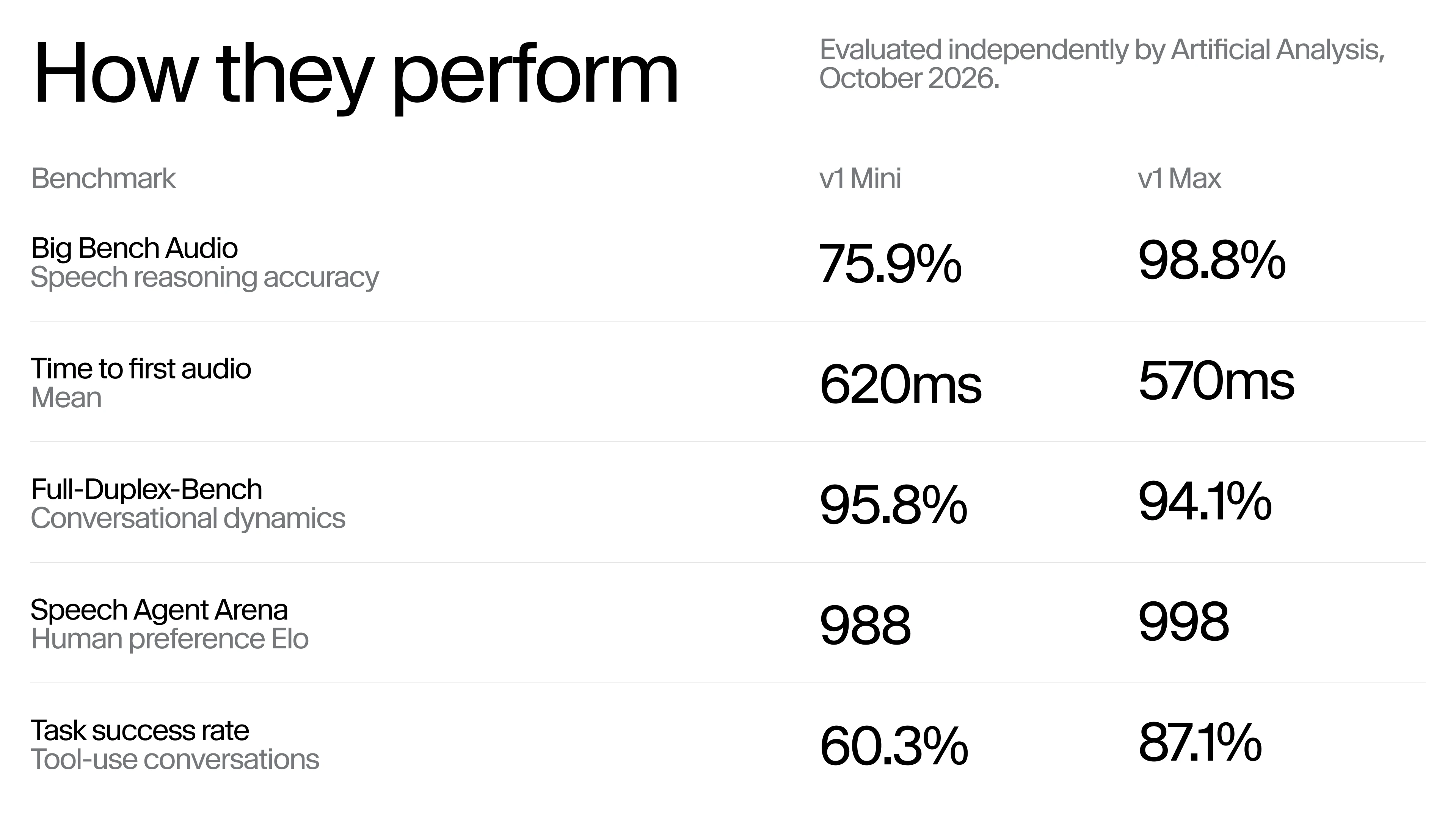
On Oct 20 ElevenLabs released Eleven Realtime, end-to-end speech-to-speech models where each model is a complete voice agent, removing the need to wire up speech recognition, an LLM and text-to-speech yourself. v1 Mini targets low-cost natural conversation and v1 Max targets support and multi-step tool use. Both cover 90+ languages and 17,000+ voices. Citing independent Artificial Analysis evals, Max answers 98.8% of Big Bench Audio correctly and starts speaking in 0.57s on average. The API is OpenAI Realtime compatible, so migrating means changing the endpoint and model name.

ElevenLabs launches Eleven Realtime v1 Mini and Max speech-to-speech models: Max scores 98.8% on Big Bench Audio, speaks in 0.57s on average, and is OpenAI Realtime API compatible

Key Takeaways

  • Speech reasoning (independent Artificial Analysis eval cited by ElevenLabs): on 1,000 Big Bench Audio questions, v1 Max scores 98.8% and v1 Mini 75.9%
  • Speed (vendor-stated): Max starts speaking in 0.57s on average and Mini in 0.62s; the launch post says "half a second", slightly faster than the blog figures
  • Conversation dynamics and preference: Full-Duplex-Bench Mini 95.8%, Max 94.1%; Speech Agent Arena blind tests Max 998, Mini 988
  • Tool-use task completion: Max 87.1% vs Mini 60.3%, which is why ElevenLabs recommends Max for heavy tool calling
  • 90+ languages and 17,000+ voices; the Realtime API is WebSocket-only at wss://api.elevenlabs.io/v1/convai/realtime and works with the OpenAI SDK; pricing was not in the launch post
Read full story
Linked Models & Agents:
⚡ Eleven Realtime v1 Mini⚡ Eleven Realtime v1 Max🤖 ElevenAgents🌐 ElevenLabs🌐 Artificial Analysis