AI Coding Live News

T
Tsinghua University & Z.AI (HarnessPro, arXiv 2610.26770)arxiv.org·
👀22
🔥80

Tsinghua and Z.AI open-source HarnessPro: agents rewrite their own harness, reaching 80.8% on Terminal-Bench 2 at 34% lower cost per task

HarnessPro (arXiv 2610.26770, submitted Oct 19 and revised Oct 20), from Tsinghua University, Z.AI (Zhipu) and collaborators, is a label-free way to improve an agent harness: specialized agents diagnose execution traces, rewrite instructions and runtime policies, score candidates with LLM-generated tests, and keep Lite, Medium and Heavy harnesses along the performance-cost frontier. Per the paper, with GPT-5.5 and Codex the Heavy mode reaches 80.8% on Terminal-Bench 2, 4.5 points above the prior RHO method, while cost per task drops from $1.09 to $0.72. The code is MIT-licensed and drew wider media coverage this week, including from Pandaily.

Tsinghua and Z.AI open-source HarnessPro: agents rewrite their own harness, reaching 80.8% on Terminal-Bench 2 at 34% lower cost per task

Key Takeaways

  • Terminal-Bench 2 (GPT-5.5 with Codex, mean of 3 runs): Heavy reaches 80.8% at $0.72 per task, versus RHO at 76.3% and $1.09, a 33.9% cost cut (paper figures, arXiv)
  • Averaged over three benchmarks: +2.0 points pass rate and -26.1% cost per task versus RHO, across Terminal-Bench 2, SWE-Bench Pro and ProgramBench
  • Holds across models: with GLM-5.2 and Claude Code on Terminal-Bench 2, Heavy hits 81.4% at $0.62, versus vanilla at 74.6% and $0.92 and RHO at 78.0% and $1.00
  • Budget modes: Medium matches RHO at 76.3% on Terminal-Bench 2 for only $0.56 per task; Lite gets 72.9% at $0.43
  • Cheap to train: only 10 training tasks per benchmark and 3 to 4 evolution epochs, tested on 59, 100 and 100 held-out tasks; the three harness tiers are MIT-licensed on GitHub
Read full story

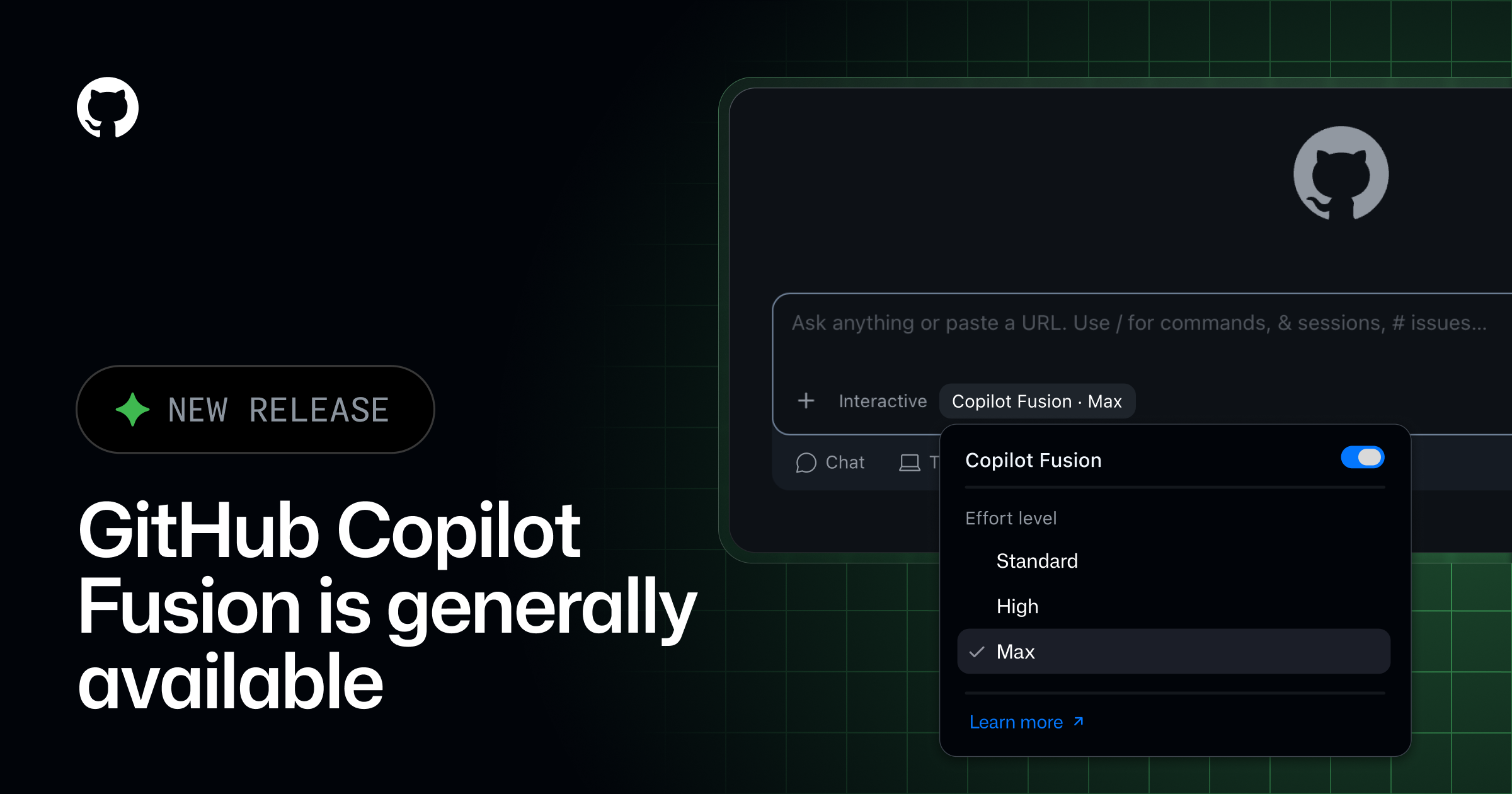
GitHub Universe 2026: Copilot Fusion is generally available, routing and orchestrating models automatically, with Fusion Max scoring 60 on the Artificial Analysis Coding Agent Index at about half the cost of Claude Code with Opus 5.5 Max

At GitHub Universe 2026 on Oct 28, GitHub made Copilot Fusion generally available. It merges the multi-model orchestration of the Project HydraFusion research preview with Copilot auto model selection: users pick Copilot Fusion and an effort level (Standard, High or Max) in the model picker, and the system decides which models to use and whether to run a Single, Cascade or Critique workflow. GitHub says Fusion Max scored 60 on the Artificial Analysis Coding Agent Index, two points below Claude Code with Opus 5.5 Max, at about half the API cost per task, about half the tokens and about 40% less time. Each underlying model is billed at its standard rate, and paid plans get 30% off through Nov 30.

GitHub Universe 2026: Copilot Fusion is generally available, routing and orchestrating models automatically, with Fusion Max scoring 60 on the Artificial Analysis Coding Agent Index at about half the cost of Claude Code with Opus 5.5 Max

Key Takeaways

  • Scores (Artificial Analysis Coding Agent Index v2.0): Fusion Max 60 versus 62 for Claude Code with Opus 5.5 Max; $5.59 per task versus $11.42, while the Devin Fusion pairing scores 62 at $8.00
  • Breakdown: a slight lead on Terminal-Bench 4.0 at 71, third on FrontierCode at 51 (Claude Code 56, Devin Fusion 54), and a weaker 57 on SWE-Atlas-QnA-AA
  • Efficiency: about 7.2M tokens per task, roughly half of Claude Code with Opus 5.5 and 30% fewer than Devin Fusion; GitHub reports about 40% less time per task
  • The pool includes Claude Opus 5.5, Claude Sonnet 5.5, GPT-6 Astra and GPT-6 Sol; admins can disable individual models for Fusion only and set Fusion as the default
  • Availability: all Copilot plans in VS Code, the Copilot app, Copilot CLI and JetBrains IDEs; existing auto, HydraFusion and HydraFusion Max selections migrate to matching effort levels
Read full story

Artificial Analysis launches HealthBench and HealthBench Professional leaderboards: GPT-6 Astra leads clinician conversations at 66.0%, while Claude Opus 5.5 tops the raw score but falls to sixth after the length penalty

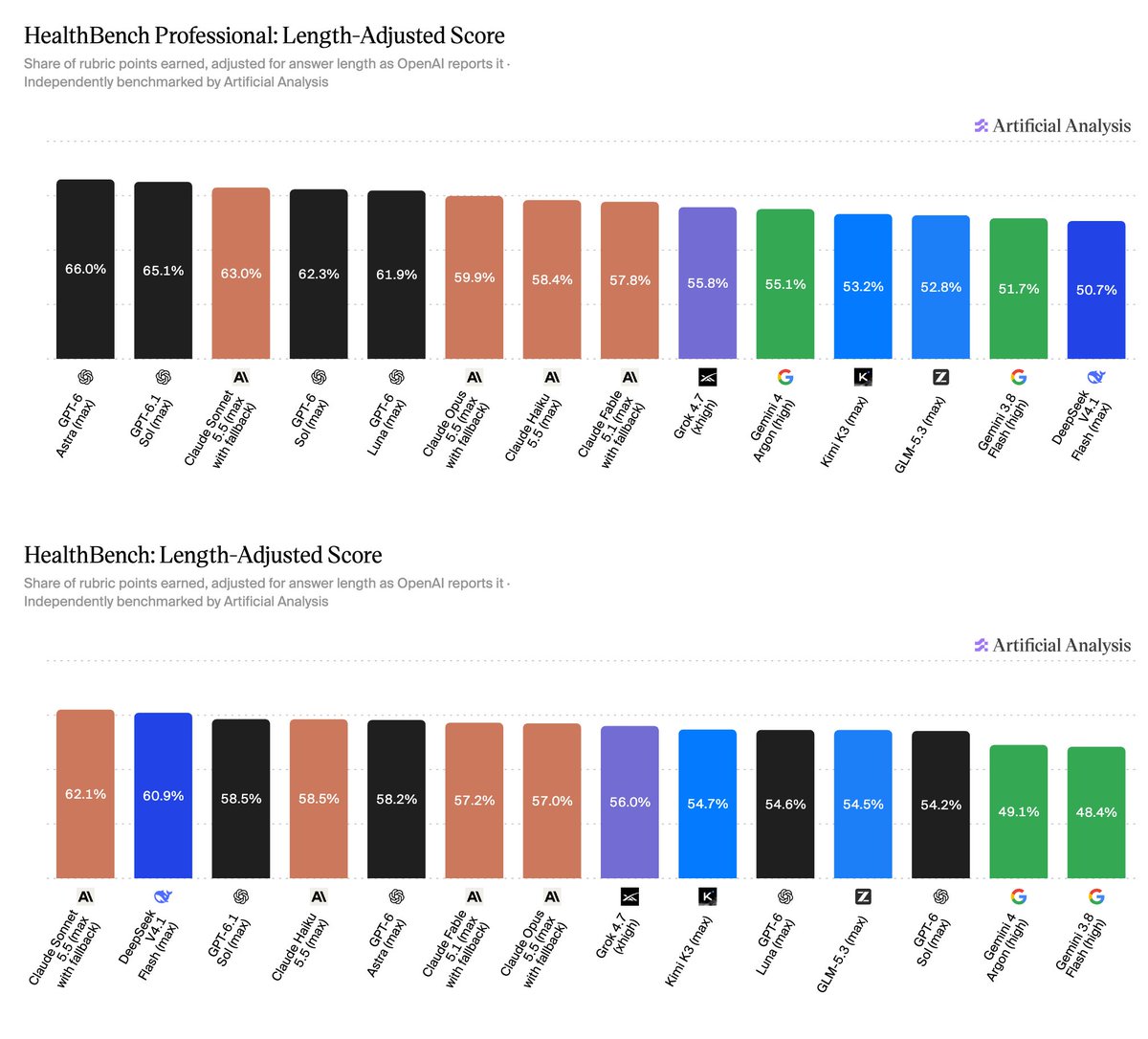
On October 19 independent evaluator Artificial Analysis launched two health-conversation leaderboards built on OpenAI's HealthBench (5,000 realistic health conversations) and HealthBench Professional (525 clinician conversations), graded against physician-written rubrics and reported as both raw and OpenAI-style length-adjusted scores. On Professional, GPT-6 Astra (max) leads at 66.0% length-adjusted, ahead of GPT-6.1 Sol (65.1%) and Claude Sonnet 5.5 (63.0%); Claude Opus 5.5 has the top raw score (71.4%) but drops to sixth (59.9%) because its ~5,900-character answers are penalized. On HealthBench, Claude Sonnet 5.5 leads at 62.1%, with DeepSeek V4.1 Flash close behind at 60.9% for about 1/16 of the cost per task.

Artificial Analysis launches HealthBench and HealthBench Professional leaderboards: GPT-6 Astra leads clinician conversations at 66.0%, while Claude Opus 5.5 tops the raw score but falls to sixth after the length penalty

Key Takeaways

  • HealthBench Professional (length-adjusted): GPT-6 Astra (max) 66.0%, GPT-6.1 Sol (max) 65.1%, Claude Sonnet 5.5 63.0%.
  • Claude Opus 5.5 posts the highest raw score (71.4%) but averages ~5,900 characters per answer, nearly 3x the 2,000-character threshold, and falls to sixth at 59.9%; Claude Fable 5.1 also loses over 11 points.
  • The Professional score-vs-cost Pareto frontier is all OpenAI: GPT-6 Luna (max) scores 61.9% at $0.004 per task, under 2% of GPT-6 Astra's $0.27.
  • HealthBench: Claude Sonnet 5.5 leads at 62.1%, DeepSeek V4.1 Flash 60.9% at $0.005 per task, GPT-6.1 Sol 58.5%.
  • Grading follows OpenAI's original setup: GPT-5.4 (low) grades Professional and GPT-4.1 grades HealthBench.
Read full story

Devin Fusion with an Opus 5.5 lead and GPT-6 Luna sidekick tops the Artificial Analysis Coding Agent Index at 68.1, at what Cognition says is 31% lower cost per task than Claude Code with Opus 5.5

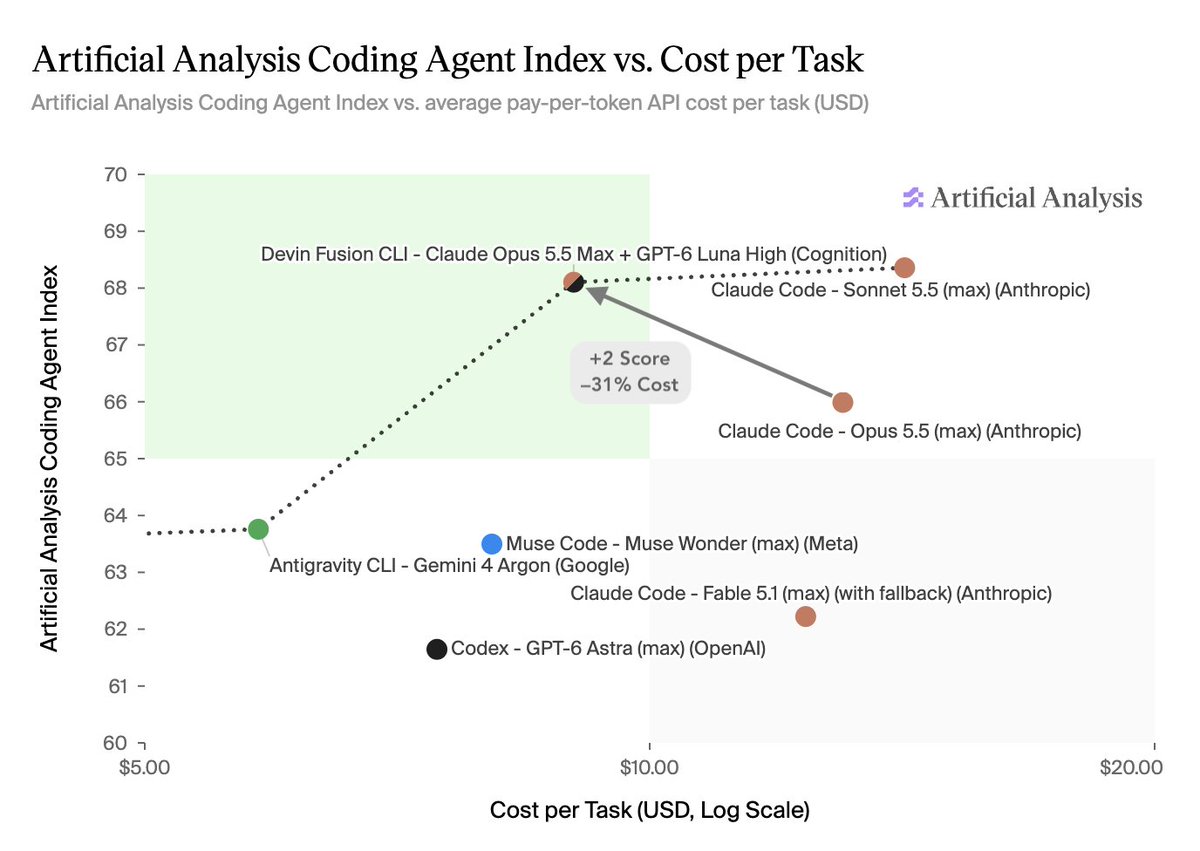
Cognition said on October 19 that Devin Fusion, pairing Claude Opus 5.5 as the lead with GPT-6 Luna as the sidekick, scored 68.1 on the Artificial Analysis Coding Agent Index v1.5. Artificial Analysis's current data puts it first, but only 0.1 ahead of Muse Code with Muse Wonder Full at 68.0, effectively a tie; Antigravity CLI with Gemini 4 Argon is third at 63.8. Cognition says the pairing costs 31% less per task than Claude Code with Opus 5.5 (vendor-reported). Fusion ships in Devin CLI and Desktop.

Devin Fusion with an Opus 5.5 lead and GPT-6 Luna sidekick tops the Artificial Analysis Coding Agent Index at 68.1, at what Cognition says is 31% lower cost per task than Claude Code with Opus 5.5

Key Takeaways

  • 68.1 overall: DeepSWE v1.1 72.6, SWE-Atlas-QnA 69.6, Terminal-Bench v4 62.1, equally weighted (Artificial Analysis data).
  • Just 0.1 ahead of Muse Code with Muse Wonder Full (68.0); Antigravity CLI with Gemini 4 Argon 63.8, Codex with GPT-6.1 Sol (xhigh) 62.9.
  • Cost: Cognition says 31% lower per task than Claude Code with Opus 5.5 (vendor-reported).
  • Earlier, Fusion with Fable 5.1 + SWE-2 cut DeepSWE 1.1 cost per task from $14.63 to $7.88 (-46%) while scoring 63.1 vs 64.3.
  • Recommended pairing is Opus 5.5 + GPT-6 Luna, available by installing Devin CLI.
Read full story
ADSponsored

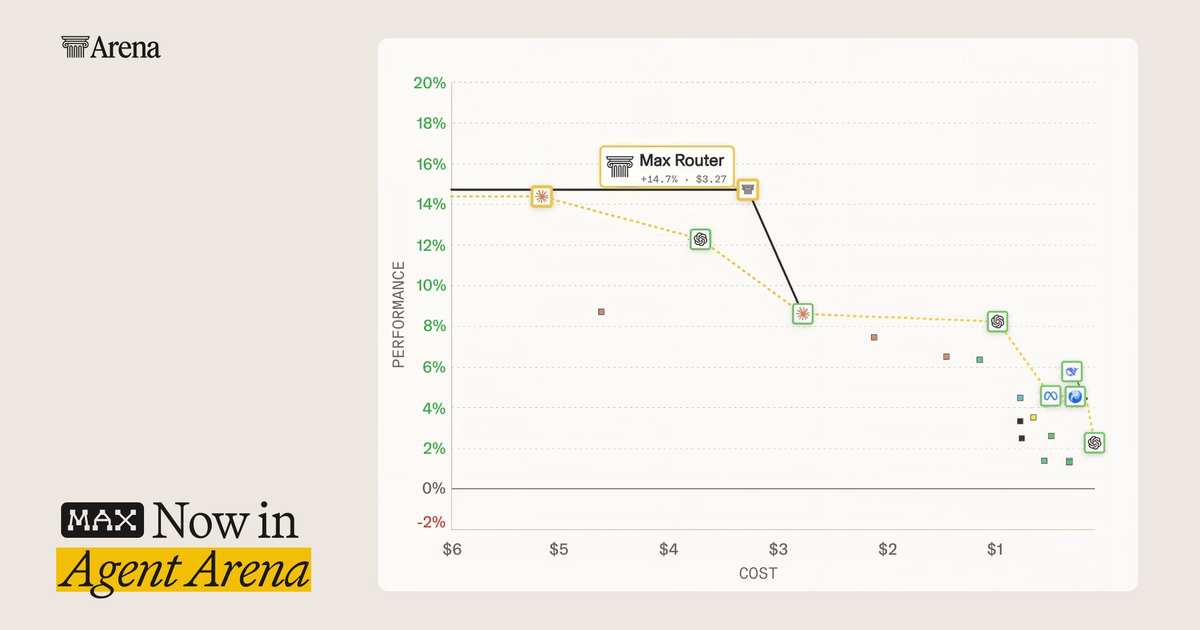
Arena's agentic Max router, trained on 2.5M Agent Arena sessions, tops Agent Arena at a $3.27 median task cost — 37.5% below Fable 5.1 (Max)

Arena released an agentic version of its Max router. Trained on 2.5M+ real Agent Arena sessions, it picks between Fable 5.1 (Max), Astra (Max) and Astra (Medium) per task based on complexity, task type and cost. In a live test it ranked #1 in Agent Arena with a +14.7% score at a $3.27 median cost per task — 0.3% better than the top public model, Fable 5.1 (Max), at 37.5% lower cost — and sent 67% of coding sessions to the cheaper Astra (Medium). It is free to try in Agent Mode for a limited time; API access is via a signup form.

Arena's agentic Max router, trained on 2.5M Agent Arena sessions, tops Agent Arena at a $3.27 median task cost — 37.5% below Fable 5.1 (Max)

Key Takeaways

  • Training data: 2.5M+ real Agent Arena sessions; Arena tested 60+ agentic models over the past 4 months
  • Live test: #1 in Agent Arena with +14.7% score and a $3.27 median cost per task — 0.3% above Fable 5.1 (Max) at 37.5% lower cost
  • Routing mix: code 67% → Astra (Medium); chat Astra (Max) 49% / Fable 5.1 (Max) 42%; work Fable 5.1 (Max) 49% / Astra (Medium) 43%
  • Model-agnostic: an earlier Fable 5 + Kimi K3 router hit +10.7% net at a $1.06 median cost, 0.6 pp above Fable 5 (High) at 54% lower cost
  • Caveats: trained on data collected before Sept 17 (pre-Opus 5.5); Agent Mode only for now, API via signup
Read full story

Pine Computer launches a cloud computer built for AI agents: event-driven perception instead of screenshot polling; GPT-5.6 Luna hits 78.3% SaaS-Bench v1.1 checkpoint score vs 74.3% for Opus 5 + Claude Code at ~$1.02 model cost per task

On Oct 9 Pine AI released Pine Computer in private beta: cloud virtual computers plus a harness and runtime built for AI, driven by an API across browser, files and shell. Instead of repeated screenshots, the OS, browser and apps push change notifications to the model ("epoll for AI perception"). On SaaS-Bench v1.1 (106 tasks, 23 apps) GPT-5.6 Luna on Pine scored 78.3% on checkpoints vs 74.3% for Opus 5 + Claude Code, though its fully-resolved rate (27.4%) trails the latter (31.1%).

Pine Computer launches a cloud computer built for AI agents: event-driven perception instead of screenshot polling; GPT-5.6 Luna hits 78.3% SaaS-Bench v1.1 checkpoint score vs 74.3% for Opus 5 + Claude Code at ~$1.02 model cost per task

Key Takeaways

  • SaaS-Bench v1.1 checkpoint score: Pine + GPT-5.6 Luna 78.3% vs Opus 5 + Claude Code 74.3% vs GPT-5.6 Sol + Codex 71.1%
  • Fully resolved rate trails: 27.4% vs 31.1% (Claude Code) / 29.2% (Codex)
  • Model token cost per task: ~$1.02 vs $26.50 (Opus 5 + Claude Code) / $20.50 (GPT-5.6 Sol + Codex), excluding infrastructure
  • New computer boots in seconds, heavy state restores in ~15 s, paused ones resume in <1 s
  • Launch post: ~99.8K impressions, 250+ likes, 120 reposts; private beta waitlist only
Read full story

Artificial Analysis: Grok 4.7 ranks just behind Anthropic on AA-Briefcase at ~50% Opus 5 cost/task

@ArtificialAnlys published AA-Briefcase results: Grok 4.7 sits behind only Anthropic models, ranking just after Opus 5 at about half the cost per task. Versus Grok 4.6 on public AA-Briefcase-Lite due-diligence decks, Analytical Quality Elo rose 1698 to 1994 while Presentation Elo slipped 1531 to 1499. Example deck API cost: Grok 4.7 (xhigh) about $8 vs Grok 4.6 (xhigh) about $4.40.

Artificial Analysis: Grok 4.7 ranks just behind Anthropic on AA-Briefcase at ~50% Opus 5 cost/task

Key Takeaways

  • AA-Briefcase: Grok 4.7 is behind only Anthropic, just after Opus 5, at ~50% cost/task.
  • Vs 4.6: Analytical Quality Elo 1698→1994; Presentation Elo 1531→1499.
  • Example decks: Grok 4.7 (xhigh) ~$8 vs Grok 4.6 (xhigh) ~$4.40.
Read full story