AI Coding Live News

Anthropic shares early results from Claude in drug development: six partners including BMS, plus its own programs via Mithril Medicine

In an Oct 27 blog post, Anthropic described months of deep research partnerships between its life sciences team and six organizations (BigHat, Bristol Myers Squibb, Divergence Labs, Enveda, Generate Biomedicines and The Column Group), covering hit generation, lead optimization, manufacturing paperwork and clinical trial planning. It also said it acquired the one-person company Mithril Medicine to run its own programs for rare childhood muscular dystrophy. Anthropic stresses the work is mostly preclinical so far.

Anthropic shares early results from Claude in drug development: six partners including BMS, plus its own programs via Mithril Medicine

Key Takeaways

  • Divergence Labs: Claude generated about 35,000 antibody designs in roughly a month, largely autonomously, yielding 3 hits that bind IgE and 20 that dislodge it, 3 of which beat the standard drug at dislodging (vendor-reported)
  • BigHat: about 1,010 variants made and tested in about 10 weeks; the best versions bound over 10x more tightly, the cancer lead stayed in solution 18°C higher, and the other lead clumped over 100x more slowly
  • Enveda: across 1,061 pages of manufacturing documents Claude caught all 11 issues humans found plus 7 they missed, cutting review time 89% (from over 25 hours to under 3)
  • Generate Biomedicines: a CAR-T component designed with Claude Code was about 70% shorter and let immune cells make roughly 10x as many receptors
  • Mithril Medicine acquisition: its founder used Claude to coordinate 11 external labs and went from idea to promising mouse results in under 18 months; human trials could start as soon as late 2028 (official blog)
Read full story

Google previews Gemini API CLI (gemini-api), a zero-dependency Go binary that lets Claude Code, Codex, Cursor and other coding agents generate media, transcribe and run managed agents from the shell

The Google AI Studio team released an experimental preview of the Gemini API CLI (command name gemini-api). It is a stateless, zero-dependency Go binary for macOS, Linux and Windows, open source under Apache 2.0. Any coding agent with shell access and a GEMINI_API_KEY can call text reasoning, image, video, music and speech generation, file and YouTube analysis, audio and video transcription, and managed agents such as Deep Research with one command. Media is written straight to disk and only the file path goes to stdout, so base64 payloads never land in the context window. Google labels it experimental and not a supported Google product.

Google previews Gemini API CLI (gemini-api), a zero-dependency Go binary that lets Claude Code, Codex, Cursor and other coding agents generate media, transcribe and run managed agents from the shell

Key Takeaways

  • Default models (official README): gemini-3.8-flash for generate, analyze and transcribe; gemini-nano-banana-2.1 for image; gemini-omni-1.1-flash for video; lyria-3.5 for music; gemini-3.8-flash-tts for speech
  • Install with a one-line curl script on macOS/Linux, a PowerShell script on Windows, or go install; the latest GitHub release is v0.4.3 (published 2026-10-19)
  • Built for agents: --usage prints the command tree as KDL, --schema prints JSON Schema, --dry-run validates offline with credentials redacted, plus --output-format json/toon and inline --jq
  • Exit codes separate 4 cases: 0 success, 1 runtime/API failure, 2 usage or validation error, 3 auth failure; --agent-mode emits structured JSON errors
  • It also manages sandbox environments, server-side credentials, webhooks and cron triggers for managed agents; files uploaded via the Files API are kept for 48 hours
Read full story
Linked Models & Agents:
⚡ Gemini 3.8 Flash⚡ Gemini Nano Banana 2.1⚡ Gemini Omni 1.1 Flash⚡ Lyria 3.5⚡ Gemini 3.8 Flash TTS🤖 Gemini API CLI🤖 Claude Code🤖 Codex🤖 Cursor🤖 Antigravity🤖 Deep Research🌐 Google

Tencent Hunyuan Releases LifeSearch: The First Real-World Life & Productivity Benchmark for Deep Research Agents, 4,500 Hours of Human Annotation Shows Frontier SOTA at Just 63.4%

While deep research (DR) agents excel on synthetic and academic queries, their reliability in realistic personal life and professional workflows remains uncharted. Tencent Hunyuan introduces LifeSearch, a rigorous benchmark featuring 203 real-user tasks across 7 domains backed by 4,500+ hours of expert annotation and 4,000+ fine-grained rubrics. Evaluating 12 leading DR agents reveals that the strongest frontier agent scores only 63.4%, unmasking persistent bottlenecks in multi-step information synthesis and constraint verification.

Tencent Hunyuan Releases LifeSearch: The First Real-World Life & Productivity Benchmark for Deep Research Agents, 4,500 Hours of Human Annotation Shows Frontier SOTA at Just 63.4%

Key Takeaways

  • Pioneering real-world life & productivity testbed: spans 203 bilingual tasks across 7 realistic domains including travel itinerary synthesis, procurement, and healthcare analysis
  • 4,500 hours and 4,000+ expert rubrics: evaluates both synthesized report depth and concrete attributes (exact values, units, dates, and live URLs) with Spearman rank correlation of 0.89
  • Revealing severe frontier agent limits: the highest-performing deep research agent scores a modest 63.4%, exposing widespread failures in temporal conflict resolution and deep search navigation
Read full story

Web$hell Unifies Agentic Web Access: Bridging Search, Browser Interaction, and File Caching Cuts Deep Research Turns by 66%

As LLM agents are deployed on long-horizon, end-to-end open web tasks such as deep research, multi-vendor comparison, and cross-site navigation, existing web access paradigms suffer severe fragmentation: search-augmented agents discard interactive controls, browser-based agents incur prohibitive context token consumption, and filesystem-based tools (Fetch-then-Explore) lose crucial interaction contexts when selectively grepping text. Researchers from Yonsei University introduce Web$hell (arXiv:2610.13416), a unified interface standardizing web access. Anchored by WebContract (establishing consistent schemas for addresses, values, and associations), WebCompiler (deterministically transforming HTML semantics into operable information and action objects without LLM inference overhead), and WebCache (maintaining persistent, stateful page revision trees), Web$hell unifies passive discovery with active interaction. Evaluated across six benchmarks spanning Web Search (WideSearch, SealQA), Web Navigation (WebArena-Verified, WebWalkerQA), and Deep Research (DeepResearchBench, DeepWeb-Bench), Web$hell achieves state-of-the-art performance across all tasks. Crucially, it slashes Deep Research turns from 52.4 and 30.9 down to 17.6 (-43% to -66%), maintaining flat cost curves even when subjected to 400 injected distractor pages.

Key Takeaways

  • Web$hell unifies web search, interactive navigation, and file caching under a single interface for LLM agents
  • Employs WebContract, deterministic WebCompiler, and stateful WebCache to achieve SOTA across 6 web benchmarks
  • Cuts Deep Research interaction turns from 52.4/30.9 to 17.6 (-66%), demonstrating flat costs under 400 distractor pages
Read full story
ADSponsored

OneSearch-VL: Fudan University Unveils Unified Multimodal Deep Research Agent for Image and Video, Outperforming Qwen3-VL by 20.2 Points

Autonomous deep research agents are expanding beyond text-centric search toward multimodal discovery across high-resolution imagery, complex charts, and long-horizon video. However, existing multimodal models struggle to ground fine-grained visual anchors and bridge perceptual evidence with external search verification. Researchers from Fudan University and collaborating institutions introduce OneSearch-VL (arXiv:2610.12419), a unified multimodal deep research agent for single-image, multi-image, and video environments. OneSearch-VL centers on the Visually Grounded Evidence Graph (VGEG), which explicitly encodes localized visual anchors, entity relationships, source-supported facts, and research operations into a shared dependency topology. Leveraging VGEG, the authors construct OneSearch-VL-SFT-110K and OneSearch-VL-RL-10K datasets alongside an Evidence-aware Visual-Grounded Rubric reward (EVGR) to supervise visual traceability during reinforcement learning. On the newly introduced OneSearch-MI-Bench and OneSearch-Video-Bench, OneSearch-VL-8B outperforms tool-augmented Qwen3-VL-8B by 20.2 and 17.6 percentage points respectively, while setting new state-of-the-art results across seven established image benchmarks and VideoDR, with code fully open-sourced.

Key Takeaways

  • Fudan University releases OneSearch-VL, unifying image and video deep research via Visually Grounded Evidence Graphs (VGEG)
  • Outperforms tool-augmented Qwen3-VL-8B by 20.2 and 17.6 points on multi-image and video benchmarks with 91.8% citation precision
  • Open-sources SFT-110K, RL-10K datasets, and EVGR process rewards, setting an auditable standard for multimodal agents
Read full story
Linked Models & Agents:

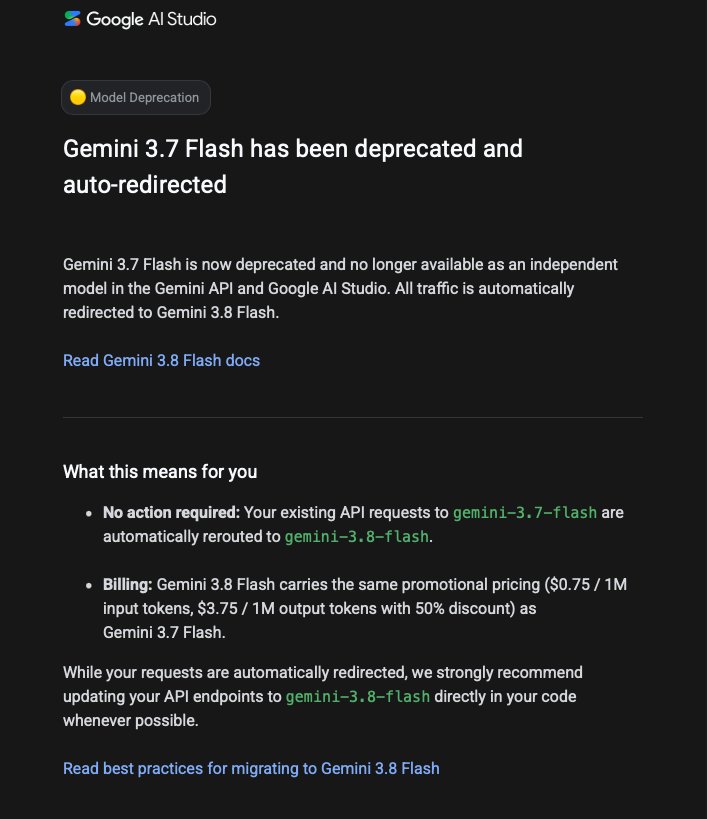
Gemini API deprecates 3.7 Flash and silently routes it to 3.8 Flash; 3.5 Flash moves to 3.6, old Deep Research agent shuts down Oct 23

Google's Gemini API release notes (Oct 8 entry) deprecate gemini-3.7-flash, with all requests now auto-routed to gemini-3.8-flash; gemini-3.5-flash is likewise routed to gemini-3.6-flash. The deep-research-pro-preview-12-2025 agent shuts down on Oct 23 and must migrate to the 04-2026 versions. Developers began receiving email notices on Oct 10.

Gemini API deprecates 3.7 Flash and silently routes it to 3.8 Flash; 3.5 Flash moves to 3.6, old Deep Research agent shuts down Oct 23

Key Takeaways

  • Two model IDs silently re-routed: gemini-3.7-flash → gemini-3.8-flash, gemini-3.5-flash → gemini-3.6-flash
  • Same price: 3.8 Flash paid tier $0.75 in / $3.75 out per 1M tokens through 2026-12-31, then $1.50 / $7.50 from 2027-01-01
  • deep-research-pro-preview-12-2025 shuts down 2026-10-23; migrate to deep-research-preview-04-2026 or deep-research-max-preview-04-2026
  • Deprecations page lists 3.6 Flash with no shutdown date, so 3.7 was replaced before its predecessor
Read full story

Incremental Open-Ended Deep Research (IOEDR): Tsinghua and RUC Introduce Structured Harness for Autonomous Research Agents, Slashing Searches by 61%

Autonomous deep research agents (such as OpenAI Deep Research and Perplexity) represent a powerful leap toward automated knowledge synthesis. However, on open-ended and comprehensive inquiries, existing agents rely primarily on unconstrained search-and-generate loops. This leads to three systemic failures: redundant query loops, conflicting claims across sections, and runaway token expansion. Researchers from Tsinghua University and Renmin University of China unveil IOEDR (arXiv:2610.11566), a framework for Incremental Open-Ended Deep Research with a Structured Harness. IOEDR models the evolving research report as a dynamic hierarchical state graph coupled with a persistent, deduplicated evidence pool. Rather than executing open-ended browsing, the agent uses structured harness constraints to incrementally plan sections, identify specific evidential gaps, and trigger precision queries with dynamic termination conditions. On DeepResearch Bench, IOEDR achieves superior report coherence and verifiable fact density while reducing total token consumption by 33.2% and slashing search API requests by 61.4%.

Key Takeaways

  • Tsinghua and RUC introduce IOEDR, modeling deep research as an evolving hierarchical state graph coupled with a persistent evidence pool
  • Slashes search API queries by 61.4% and token usage by 33.2% on DeepResearch Bench while eliminating cross-section factual drift
  • Implements information-gain gating with a 92.4% noise rejection rate, establishing an efficient architectural pattern for deep research agents
Read full story

Claude Managed Agents dynamic workflows hit public beta: the lead agent writes an orchestration program running up to 64 concurrent threads and 1,000 agents per run

Anthropic expanded dynamic workflows in Claude Managed Agents to public beta. With workflows enabled in an agent's multiagent block, Claude writes a workflow program that runs many agents in background phases and combines their results, aimed at audits, migrations, deep research and cross-checking.

Key Takeaways

  • Enable with multiagent.type: "multiagent_20261001" and workflows: {"type":"enabled"} under the managed-agents-2026-04-01 beta header
  • Up to 64 threads working at once per run and 1,000 agents over a run's life (thread_limit_error beyond)
  • Runs last 24h by default; 10 open runs per session by default; runs don't nest
  • No separate run price: thread tokens bill at model rates and count toward the session budget, which pauses runs when reached
Read full story
Linked Models & Agents:

AREX-2 Advances Self-Improving Agents via Long-Horizon Reflective Tasks: Scoring 81.8 on MLE-bench and 92.2 on GAIA

Test-time self-improvement—the ability of an agent to iteratively refine solutions during inference—relies on high-fidelity reflection to surpass current proposals and long-horizon execution to maintain coherent multi-round exploration. Researchers from Renmin University of China, Microsoft Research, and USTC introduce AREX-2, establishing that these capabilities are domain-agnostic and learnable from verifiable environments. Synthesizing long-horizon reflective trajectories across machine learning and algorithmic programming, an AREX-2 agent built on Qwen3.8-27B achieves 81.8 on MLE-bench Lite and 70.7 on Frontier-CS, transferring seamlessly to deep research with 84.0 on BrowseComp, 92.2 on GAIA, and 93.8 on DeepSearchQA while monotonically scaling with compute budget.

AREX-2 Advances Self-Improving Agents via Long-Horizon Reflective Tasks: Scoring 81.8 on MLE-bench and 92.2 on GAIA

Key Takeaways

  • Identifies reflection and long-horizon execution as domain-agnostic foundations for test-time self-improving agents
  • Achieves 81.8 on MLE-bench Lite and 70.7 on Frontier-CS using an AREX-2 Qwen3.8-27B model
  • Transfers zero-shot to deep research benchmarks, scoring 92.2 on GAIA, 93.8 on DeepSearchQA, and 84.0 on BrowseComp
Read full story

AREX-2 Advances Test-Time Self-Improving Agents via Long-Horizon Reflective Programming: 81.8 on MLE-bench

Endowing LLM agents with test-time self-improvement—the ability to iteratively refine solutions—is a vital milestone for autonomous engineering. Researchers from Renmin University and collaborators present AREX-2, an open-source framework leveraging long-horizon reflective trajectories. Decoupling self-improvement into reflection (generating superior alternatives) and long-horizon execution (sustaining iteration over multiple turns), AREX-2 trains on verified machine learning and algorithmic programming trajectories. Built on Qwen3.8-27B, AREX-2 achieves 81.8 on MLE-bench Lite and 70.7 on Frontier-CS, transferring effectively to deep research with 92.2 on GAIA and 93.8 on DeepSearchQA.

AREX-2 Advances Test-Time Self-Improving Agents via Long-Horizon Reflective Programming: 81.8 on MLE-bench

Key Takeaways

  • Decouples test-time self-improvement into domain-agnostic reflection and long-horizon execution
  • Achieves 81.8 on MLE-bench Lite and 70.7 on Frontier-CS with Qwen3.8-27B, transferring to 92.2 on GAIA
  • Breaks multi-turn degradation bottlenecks, showing monotonic score improvements as iteration budgets increase
Read full story
ADSponsored

CodeGraph: First Open-Taxonomy Code Knowledge Graph Spans 158M Nodes and 1B Edges Across 167M Files

Developed by researchers from Software Heritage and European research universities, CodeGraph introduces the first large-scale open-taxonomy knowledge graph for source code. Scaling across 167 million files in the Stack-Edu corpus, it extracts implicit engineering abstractions—algorithms, architectural paradigms, and design patterns—via a code-specialized LLM and a three-stage Wikidata entity-linking pipeline, materializing 158 million nodes and approximately 1 billion typed edges across 14 languages.

CodeGraph: First Open-Taxonomy Code Knowledge Graph Spans 158M Nodes and 1B Edges Across 167M Files

Key Takeaways

  • Beyond Syntactic AST Parsing: Moves past token and syntax tree representations by explicitly mapping source code implementations to high-level engineering paradigms, design patterns, and algorithmic taxonomy.
  • Massive 158M Node and 1B Edge Scale: Built across 167 million files in Stack-Edu across 14 languages, capturing 145 million file nodes, 63,000 extracted concept entities, and 19,800 grounded Wikidata identifiers.
  • Three-Stage Linking Pipeline: Combines deterministic SPARQL entity linking, a Deep Research Agent for residual long-tail disambiguation, and hierarchy rollup for parent closures, calibrated via human gold sets and LLM judges.
Read full story
Linked Models & Agents:

Grok Bot adds sales-tool integrations

Elon Musk amplified a Grok Bot update for sales teams. Bots can now connect to Salesforce, HubSpot, Gong, Clay, Granola, and other GTM tools to track accounts, complete follow-ups, and run deep research.

Key Takeaways

  • Elon Musk amplified a Grok Bot update for sales teams. Bots can now connect to Salesforce, HubSpot, Gong, Clay, Granola, and other GTM tools to track accounts, complete follow-ups, and run deep research.
Read full story
Linked Models & Agents: