AI Coding Live News

Axion 1.0 Open Agent Foundation Model: Two SFT Stages Plus RL, 35B-A3B Reproduction Checkpoint Under Apache 2.0, Full Recipe Released

arXiv paper 2611.03233 by Yuqi Jia, Yunjie Tian and five co-authors introduces Axion 1.0, an agent foundation model that is open beyond its weights. It uses just two lightweight SFT stages plus reinforcement learning, with no dedicated mid-training, DPO or on-policy distillation, and about 18K SFT trajectories in total. Training code is hosted under the bytedance GitHub organization, and the training data and an Axion 1.0-35B reproduction checkpoint (Qwen3.6-35B-A3B base, 35B total / 3B active, Apache 2.0) are on Hugging Face; weights for the paper's 122B model are listed as coming soon.

Axion 1.0 Open Agent Foundation Model: Two SFT Stages Plus RL, 35B-A3B Reproduction Checkpoint Under Apache 2.0, Full Recipe Released

Key Takeaways

  • A minimal recipe: SFT stage one for self-contained scientific reasoning, stage two for tool use and information seeking, then RL for long-horizon interaction, with 18,363 SFT trajectories and 484 RL tasks
  • The release covers data construction, generation, filtering, verification, prompts and training code (GitHub), not just weights
  • The 35B reproduction checkpoint scores 52.8 on HLE, 60.4 on SEAL-0, 85.0 on FrontierScience Olympiad and 55.0 on FrontierScience Research (HF model card)
  • The paper's 122B model reports 59.0 on HLE with restricted website access and 66.7 on FrontierScience Research; 122B weights are not out yet
  • All scores are self-reported; the HF card lists Claude Opus 5 at 63.6 on HLE, so Axion still trails the strongest closed models
Read full story
Linked Models & Agents:
⚡ Axion 1.0-35B⚡ Axion 1.0-122B⚡ Qwen3.6-35B-A3B🌐 ByteDance🌐 Hugging Face

Liquid AI releases LFM3, six open-weight ~2B models spanning text, vision, audio, omni and decision tasks

On Oct 27 Liquid AI released LFM3, a new generation of foundation models built on a tri-hybrid architecture of gated short convolutions, sliding-window attention and global attention, pre-trained on 22T tokens. The first six models all branch from LFM3-1.7B-Base at around 2B parameters, with weights on Hugging Face under the LFM Open License v1.0. Liquid says the text model LFM3-1.7B needs about 1 GB at 4-bit, supports 256K context and beats models several times its size on several agent benchmarks.

Liquid AI releases LFM3, six open-weight ~2B models spanning text, vision, audio, omni and decision tasks

Key Takeaways

  • Six models: LFM3-1.7B (text), VL-2B (vision/video), Audio-2B, Omni-2B, plus decision models d1-2B and d1-Omni-2B
  • Architecture: of 24 layers, 13 gated short convolutions, 5 sliding-window attention (256-token window) and 6 global attention; 22T pre-training tokens
  • Vendor-reported: LFM3-1.7B scores 43.40 on SWE-bench Verified (OpenCode) vs 41.20 for Qwen3.5-4B and 51.20 for Qwen3.5-9B
  • Vendor-reported: 38.42 on WebArena-Verified and 41.29 on AutomationBench, both above Qwen3.5-9B (28.94 / 15.10)
  • A full 128K context needs about 1.6 GB of KV cache; one B300 with SGLang can produce about 3.6B tokens per day (vendor figure)
Read full story
Linked Models & Agents:
⚡ LFM3-1.7B⚡ LFM3-VL-2B⚡ LFM3-Audio-2B⚡ LFM3-Omni-2B⚡ d1-2B⚡ d1-Omni-2B⚡ Qwen3.5-9B⚡ Gemma 4 E4B🤖 Hermes Agent🤖 OpenClaw🌐 Liquid AI🌐 AMD🌐 Qualcomm🌐 Hugging Face

Cadence launches Maestro, a domain-specialized AI model portfolio for agentic chip and system design built in part on NVIDIA Nemotron, claiming up to 30% better results and 5x token efficiency

EDA leader Cadence announced the Maestro AI Model Portfolio on October 26: domain post-trained LLMs, trained decision models and self-improving agent skills that power its AuraStack, ChipStack, InnoStack and ViraStack AI Super Agents as they drive Cadence EDA and SDA tools. Cadence solvers score outputs against engineering constraints to close a reinforcement learning loop. Initial results per Cadence show up to 30% higher quality and up to 5x token efficiency versus a general-purpose foundation model. NVIDIA contributes Nemotron and OpenShell, and the stack runs on Cadence cloud, public cloud or on-premises. The first models reach select early access customers in Q4 2026.

Key Takeaways

  • Maestro is a portfolio, not one model: domain post-trained LLMs, decision models and self-improving agent skills, mixed with frontier and open-weight models per task
  • Deterministic solvers and EDA tools score outputs against engineering objectives and constraints, feeding a verified reinforcement learning loop
  • Per Cadence: up to 30% higher quality of results and up to 5x token efficiency versus a general-purpose foundation model; no third-party evaluation yet
  • NVIDIA supplies Nemotron models and the OpenShell sandbox reference architecture; customers can post-train on their own designs and run on-premises
  • First models go only to select early access customers in Q4 2026; Socionext expects up to 5x productivity from deploying InnoStack
Read full story

Canva launches Canva Craft, its first in-house image model: plans the layout before rendering, outputs up to 2K, renders text in 55 languages, and is open to all users and the public API

On Oct 22 Canva released Canva Craft, the first image-generation foundation model trained from scratch by its in-house lab, Canva Research. It works in two stages: a planning model writes out the composition (elements, spatial relationships, hierarchy and any text), then a rendering model produces the image at up to 2K across more than 30 aspect ratios. Training leaned heavily on millions of human-made templates from Canva's library, such as posters, social posts, slides and infographics. Canva says it debuted 4th overall on the crowdsourced DesignArena leaderboard and 1st in the People & Portraits and Landscapes & Nature categories. It is available now to all Canva users in Dream Lab and to developers through the Connect API as craft_v1_2k, with Canva MCP access coming soon.

Canva launches Canva Craft, its first in-house image model: plans the layout before rendering, outputs up to 2K, renders text in 55 languages, and is open to all users and the public API

Key Takeaways

  • Two-stage design: a planning model writes the composition (elements, relative scale, hierarchy, text), then a rendering model outputs up to 2K across 30+ aspect ratios (announcement)
  • Vendor-reported ranking: 4th overall on DesignArena, 1st in People & Portraits (of 87 models) and Landscapes & Nature (of 85), 2nd in Abstract & Patterns and 4th in Products
  • Training emphasized millions of human-made Canva templates; designers judged more than 25,000 head-to-head image pairs against leading models
  • For developers: POST /v1/image-generations on the Connect API with model set to craft_v1_2k, which spends the user's AI credits (API docs)
  • Prompts work in any language and in-image text covers 55 languages; the faster, cheaper Craft-fast and Craft-ultrafast variants and MCP access are not out yet
Read full story
Linked Models & Agents:
⚡ Canva Craft⚡ Craft-1 2K🌐 Canva
ADSponsored

NVIDIA Launches Nemotron 3.5 Open Model Family, Cosmos World Models, and 13x Faster BioNeMo RFD4-Proteina

During the GTC Berlin keynote, NVIDIA unleashed a sweeping array of open-weights domain-specific foundation models. The release highlights include the multimodal Nemotron 3.5 Super VL, the lightweight Nemotron 3.5 Bolt series, and the end-to-end Nemotron Retriever suite for embedding, reranking, and document OCR. For physical AI, NVIDIA debuted the Cosmos world models and Alpamayo 2 Edge autonomous driving models. In life sciences, NVIDIA and the Baker Lab released BioNeMo RFD4-Proteina, which establishes state-of-the-art accuracy across more than 10 protein design benchmarks while synthesizing 200-amino-acid binders roughly 13x faster than RFdiffusion3.

NVIDIA Launches Nemotron 3.5 Open Model Family, Cosmos World Models, and 13x Faster BioNeMo RFD4-Proteina

Key Takeaways

  • NVIDIA released an extensive open-weights portfolio at GTC Berlin: Nemotron 3.5 Super VL, Bolt 4GB edge variants, and Cosmos world models
  • Unveils the full Nemotron Retriever suite for embedding, reranking, and multimodal document parsing, boosting enterprise RAG fidelity
  • Co-developed BioNeMo RFD4-Proteina with the Baker Lab, leading on over 10 structural protein design benchmarks
  • Synthesizes 200-amino-acid de novo proteins 13x faster than RFdiffusion3, dramatically shortening computational drug discovery timelines
Read full story
Linked Models & Agents:
⚡ Nemotron 3.5 Super VL⚡ Nemotron 3.5 Bolt⚡ BioNeMo RFD4-Proteina⚡ Cosmos🌐 NVIDIA🌐 Baker Lab

Shanghai AI Lab Releases Sage-A1.5: A 35B MoE Agentic Model Advancing Long-Horizon Software and Scientific Discovery

The Shanghai Artificial Intelligence Laboratory published the technical report for Sage-A1.5 on arXiv:2610.28578, introducing an open-weights 35B Mixture-of-Experts (MoE) foundation model purpose-built for agentic tasks. Building on the Agents-A1 lineage, Sage-A1.5 focuses on scaling the agent execution horizon rather than model parameters through adaptive capability composition. Tailored for complex repository-level software engineering and multi-step scientific hypothesis exploration, Sage-A1.5 consistently outperforms dense 70B+ baselines on long-horizon reasoning benchmarks while maintaining lightweight deployment footprints.

Shanghai AI Lab Releases Sage-A1.5: A 35B MoE Agentic Model Advancing Long-Horizon Software and Scientific Discovery

Key Takeaways

  • Shanghai AI Lab published Sage-A1.5 (arXiv:2610.28578), open-sourcing a 35B MoE agentic foundation model
  • Pioneers horizon scaling over raw parameter expansion, sustaining consistent focus across 100+ execution steps
  • Optimized for repository-level software engineering bug fixes, matching dense 70B+ baselines on complex git issue resolution
  • Features intrinsic scientific exploration and hypothesis generation capabilities, tailored for local on-prem cluster deployment
Read full story
Linked Models & Agents:

MemT-1.0: Towards Memory-Native Evolution Slashing 128K KV Footprint by 66x with Gated DeltaNet-2

Researchers introduced MemT-1.0 (arXiv:2610.26825), a groundbreaking architecture internalizing memory as an intrinsic component of foundation model computation. Moving beyond exploding KV caches and lossy Vector RAG pipelines, MemT-1.0 employs Gated DeltaNet-2 with stable within-turn token-level updates alongside a novel Mixture-of-Storage mechanism. Trained across a two-stage 34B-token pipeline, the released MemT-1.0-Nano model achieves a 1.86x end-to-end inference speedup and a staggering 66x reduction in persistent storage at 128K tokens relative to full-context KV caching, dramatically elevating procedural task execution in autonomous agents.

MemT-1.0: Towards Memory-Native Evolution Slashing 128K KV Footprint by 66x with Gated DeltaNet-2

Key Takeaways

  • MemT-1.0 introduced on arXiv:2610.26825, pioneering memory-native evolution by internalizing memory directly into model computation
  • Combines Gated DeltaNet-2 with stable token-level memory updates and Mixture-of-Storage to scale memory capacity intrinsically
  • At 128K context length, delivers a 1.86x inference speedup and slashes persistent storage by 66x compared to standard KV cache
  • Internalizes procedural operational experience, significantly improving agentic multi-turn task success rates
Read full story
Linked Models & Agents:
⚡ MemT-1.0-Nano⚡ MemT-1.0-Flash

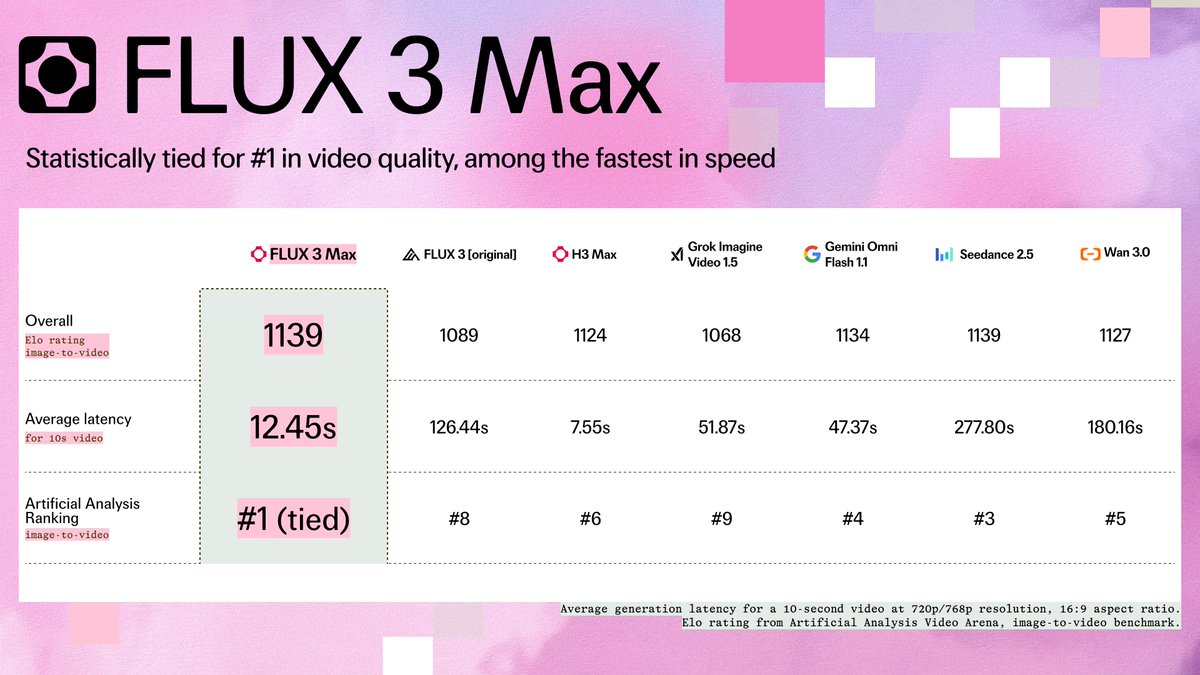
fal and Black Forest Labs launch FLUX 3 Max video model: tied #1 in image-to-video quality, a 10-second clip in about 12 seconds, roughly 22x faster than Seedance 2.5

On Oct 19 (UTC) fal released FLUX 3 Max, a video model built by fal Research with Black Forest Labs through post-training, reinforcement learning and inference optimization on top of the FLUX 3 foundation model. It handles text-to-video, image-to-video and keyframes, up to 20 seconds, at 720p or 1080p, with audio on by default. On Artificial Analysis's preliminary image-to-video arena it scores 1,139 Elo, level with Seedance 2.5 and within the confidence interval of leader MiniMax H3 (1,141), and fal says a 10-second clip takes about 12.45 seconds. A 75% launch discount runs until Nov 7, putting 720p at $0.0425 per second.

fal and Black Forest Labs launch FLUX 3 Max video model: tied #1 in image-to-video quality, a 10-second clip in about 12 seconds, roughly 22x faster than Seedance 2.5

Key Takeaways

  • Artificial Analysis AA-Video-I2V v1.1 (preliminary): FLUX 3 Max at 1,139 Elo, level with Seedance 2.5 and just under MiniMax H3 at 1,141; "tied #1" rests on overlapping confidence intervals
  • Speed (fal-reported, 10-second 16:9 at 720p): FLUX 3 Max 12.45s, Gemini Omni Flash 1.1 47.37s, Seedance 2.5 277.80s; the press release quotes 10.95s instead
  • Versus the original FLUX 3: Elo up from 1,089 to 1,139 (+50) and a 10-second clip down from 126.44s to about 12s (11.5x per the press release, about 10x per the product page)
  • Pricing: promotional $0.0425/s at 720p and $0.0725/s at 1080p until Nov 7, then $0.17/s and $0.29/s, billed per output second
  • API options: 5-20 second duration, multiple aspect ratios, reasoning_level (low/high), generate_audio on by default; model IDs blackforestlabs/flux-3-max/*
Read full story
Linked Models & Agents:
⚡ FLUX 3 Max⚡ FLUX 3⚡ Seedance 2.5⚡ MiniMax H3🌐 fal🌐 Black Forest Labs🌐 Artificial Analysis

Mistral releases Timestral, its first time-series foundation models: four open-weight sizes from 5M to 209M, with the 209M ranked first on GIFT-Eval, TIME and fev-bench among zero-shot models per Mistral, and CPU-only inference

On October 15 Mistral released Timestral, its first family of time-series foundation models, in 5M, 28M, 123M and 209M sizes. Weights are on Hugging Face under a Modified MIT license and the inference code is Apache 2.0. The models produce multivariate probabilistic forecasts with 21 quantiles per step, accept past-only and known-future covariates, and take up to 32,768 steps of context. Mistral says the 209M model ranks first among pretrained zero-shot models on GIFT-Eval, TIME and fev-bench with about two-thirds the parameters of the previous best; on an 8-thread CPU, forecasting one day from three weeks of 15-minute data takes 10 ms with the 5M model and 140 ms with the 209M. These are Mistral's own figures; the technical report is still to come.

Mistral releases Timestral, its first time-series foundation models: four open-weight sizes from 5M to 209M, with the 209M ranked first on GIFT-Eval, TIME and fev-bench among zero-shot models per Mistral, and CPU-only inference

Key Takeaways

  • Four sizes, 5M / 28M / 123M / 209M, with fp32 weights from 21 MB to 837 MB, all downloadable from Hugging Face.
  • Mistral says the 209M ranks first among pretrained zero-shot models on GIFT-Eval, TIME and fev-bench with about two-thirds the parameters of the prior best (vendor-reported).
  • The 28M beats Chronos-2, about 4x larger, on GIFT-Eval and TIME; the 209M beats TimesFM-3 and Falcon-2.0 with fewer parameters (vendor-reported).
  • No GPU needed: a one-day forecast on an 8-thread CPU takes about 10 ms (5M) or 140 ms (209M); the 123M lands within 0.2% of the 209M score at three-quarters of its latency.
  • 32,768-step context, up to 1,024 steps per forward pass, 21 output quantiles; fine-tuning and on-prem deployment via Mistral Forge.
Read full story
Linked Models & Agents:
⚡ Timestral-209M⚡ Timestral-123M⚡ Timestral-28M⚡ Timestral-5M⚡ Chronos-2⚡ TimesFM-3🌐 Mistral AI🌐 Hugging Face

Ex-NVIDIA team Dream Labs exits stealth with a $90M seed and Dream-1, a robot foundation model that zero-shot controls unseen bimanual robots via a public API from $3/hour

On October 19 Dream Labs came out of stealth with a $90M seed round and opened a public API for Dream-1. Dream-1 is a World Action Model (WAM) that learns to predict video and actions together. The company says it can zero-shot control bimanual parallel-gripper robots without any demonstrations from that robot, and it ran 27 unseen robots in simulation, including the 18-year-old PR2. Pricing is $3/hour for Dream-1 and $2/hour for Dream-1-flash. In an independent Robocurve evaluation, Dream-1 scored 59 on RoboDojo-RC Tier 1 versus 48 for the previous best. The company stresses it is a research beta not validated for safety-critical use.

Ex-NVIDIA team Dream Labs exits stealth with a $90M seed and Dream-1, a robot foundation model that zero-shot controls unseen bimanual robots via a public API from $3/hour

Key Takeaways

  • Funding and team: $90M seed; the founders introduced World Action Models in the DreamZero paper in February 2026 while at NVIDIA.
  • Pricing: $3/hour for Dream-1, $2/hour for Dream-1-flash; each call returns 1.6 seconds of actions, about 2,250 calls per hour, roughly $0.0013 per call (company figures).
  • Generalization: zero-shot control of 27 unseen bimanual robots in simulation (including PR2); beta testers at 12 sites in 8 countries ran real-robot tasks.
  • Benchmark: Robocurve's independent eval gives 59 on RoboDojo-RC Tier 1 (previous best 48), 16x lower cost per attempt than Gemini 4 Argon and 1.7x faster than GPT-6 Astra; all 120 runs are public.
  • Limits: it predicts end-effector poses and relies on each robot's IK solver; robots far from its training can be adapted with the FaaS fine-tuning service using a little of their own data.
Read full story
Linked Models & Agents:
⚡ Dream-1⚡ Dream-1-flash⚡ DreamZero🌐 Dream Labs🌐 Robocurve🌐 NVIDIA
ADSponsored

Viggle releases JST-2, a physics-native world foundation model: 3D scenes in about one second and animation-ready characters from a single image

Viggle released JST-2 on October 19. Instead of learning in pixel or video space, it represents the world as persistent "atoms" in 3D space (Physics-Native Tokens) and uses one architecture to generate scenes, characters and motion. Viggle says a 3D scene takes about one second on an NVIDIA B200 at under $0.01 of inference, with up to 64 input views kept as spatial context, and characters animate without a separate rigging step. It is free to try in the PINOC browser app and is also available via API and MCP.

Viggle releases JST-2, a physics-native world foundation model: 3D scenes in about one second and animation-ready characters from a single image

Key Takeaways

  • Scene generation: about 1 second per scene (NVIDIA B200, excluding network latency) at under $0.01 inference cost; Viggle cites about 5–6 minutes for Marble (vendor figures).
  • Spatial context: up to 64 input views, expandable one view at a time in real time, output as 3D Gaussian splats rendered locally in the browser.
  • Character blind tests (run by Viggle): Average Score 58.4% vs Meshy 7.1 and 73.2% vs Tripo H3.1; face quality 63.0% and 82.0% (50% means parity).
  • Motion blind tests (run by Viggle): text-to-motion 74.8% vs Cartwheel Swing and 80.0% vs HY-Motion-1.0; video-to-motion 89.1% vs DeepMotion Animate 3D.
  • Access: free in the PINOC browser app, plus API and MCP for agents such as Codex and Claude Code; JST-3 aims to replace rule-based collisions and object interactions with learned physics.
Read full story
Linked Models & Agents:

Tongji University & Tencent Introduce GeoState: View-Decoupled 3D World Modeling Prevents Camera Scale Drift Across Waymo and KITTI Rollouts

Modern 3D world models typically use view-dependent features from geometry foundation models (GFMs) as predictive states, entangling camera-induced variations with physical scene dynamics. Tongji University and Tencent introduced GeoState (arXiv:2610.22343). By aggregating multi-view GFM features into a view-decoupled 3D scene state, GeoState models physical scene evolution independently of camera viewpoints, maintaining a single context-derived scale throughout rollouts without per-frame scale realignment.

Tongji University & Tencent Introduce GeoState: View-Decoupled 3D World Modeling Prevents Camera Scale Drift Across Waymo and KITTI Rollouts

Key Takeaways

  • Tongji University and Tencent introduced GeoState (arXiv:2610.22343) for view-decoupled 3D world modeling
  • Separates physical scene evolution from camera-dependent observations via a dedicated scene tokenizer and ray-based geometry decoder
  • Maintains a single context-derived scale throughout multi-second rollouts on Waymo without per-frame scale alignment, outperforming VGGT-World and FR3D
  • Demonstrates robust zero-shot cross-sensor generalization across KITTI and nuScenes datasets
Read full story
Linked Models & Agents:

IFM and Inception42 launch Jais 3: six open Arabic-native agentic models (0.9B–375B) plus Jais Speech, 512K context on Hugging Face

On 2026-10-15, MBZUAI’s Institute of Foundation Models (IFM) and Inception42 released Jais 3—the first language adaptation of the open K2 Horizon fleet. Six open-weight sizes run from a 0.9B dense phone model to a 375B-A23B sparse MoE (≈23B active), plus Jais Speech for Arabic ASR. Models share one training recipe and agent stack, with up to 512K context (128K on 0.9B), Apache-2.0 weights and stage checkpoints on Hugging Face, and day-0 vLLM support.

IFM and Inception42 launch Jais 3: six open Arabic-native agentic models (0.9B–375B) plus Jais Speech, 512K context on Hugging Face

Key Takeaways

  • Sizes: 0.9B / 3.7B / 7B / 32B dense + 36B-A4B (MoE+MoVA, ~4B active) + 375B-A23B (~23B active); flagship needs ~8×H200 BF16 (model card)
  • Vendor Arabic average: 375B leads open peers at 84.0 (Qwen3.5-397B 82.0); 7B scores 79.4 vs K2 Horizon base 56.4→79.6 (tech blog)
  • Agents: 3.7B/7B lead their size class by ~20 points; 375B agentic average 60.2 with SWE-Bench Verified 70.2 and Terminal-Bench 2.1 73.8 (same-harness vendor runs)
  • Speech: Jais Speech macro-average WER/CER 22.85/8.37 across six public ASR sets, ahead of Audar, Cohere Transcribe Arabic, omniASR (Jais page)
  • Ship: Apache-2.0; HF collection IFM/jais-3; vLLM≥0.30 / SGLang≥0.5.20 recipes; k2_horizon parsers; companion github.com/ifm-ai/JaisVoice
Read full story
Linked Models & Agents:

GreenWAM: Universal Robotics World Foundation Model Controls Real Humanoids Across 20 Embodiment Families

Robotics research typically separates world models (predicting scene transitions) from control policies (generating actions), fragmented by proprietary robot-specific kinematic formats. Sber AI researchers introduced GreenWAM, a foundational world model for robotics. GreenWAM unifies 20 robot embodiment families (from bimanual arms to dexterous humanoids) under a common joint coordinate space, co-training across visual, action-conditioned, and world-action objectives with specialized action-expert heads. GreenWAM achieves top-tier 3D trajectory and depth accuracy on WorldArena 1.0, establishes state-of-the-art policy benchmark scores on RoboTwin 2.0 and LIBERO-plus, and successfully drives real-world humanoid robots outperforming Cosmos 3 Edge and pi_0.5.

GreenWAM: Universal Robotics World Foundation Model Controls Real Humanoids Across 20 Embodiment Families

Key Takeaways

  • Unified anatomical action space: standardizes joint coordinates across 20 diverse robot families, breaking down proprietary kinematic data silos
  • Dual world model and policy capability: unifies visual scene generation with real-time policy execution via action-conditioned multi-task pretraining
  • Real humanoid deployment: tops WorldArena 1.0 3D trajectory benchmarks and outperforms Cosmos 3 Edge and pi_0.5 on physical humanoid manipulation
Read full story
Linked Models & Agents:
N
NEURA Robotics@neura-robotics·
👀115
🔥88

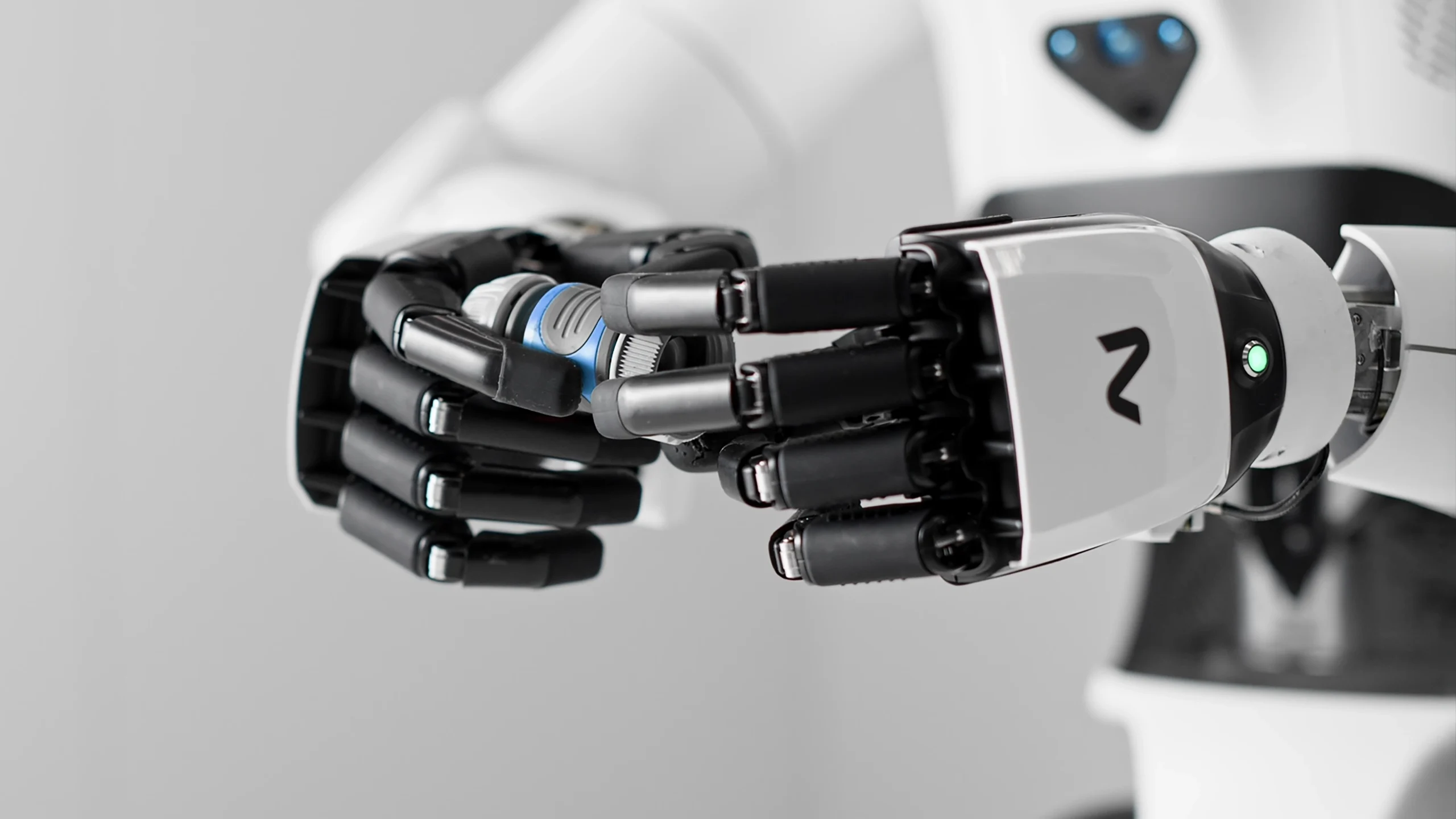
NEURA Robotics launches Neuron AI, a Perception-Language-Action foundation model that fuses 3D vision, touch, audio and memory across five robot embodiments

On 2026-10-14 NEURA Robotics launched Neuron AI, a Physical AI foundation model built on a Perception-Language-Action (PLA) architecture that aligns 3D vision, touch and force, audio, robot state and language in one space, adds memory, and runs on the robot itself across five NEURA embodiments. No quantitative benchmarks were published. Customers fine-tune skills and roll them out to fleets via Neuraverse; a fully autonomous 11-minute laundry task will be demoed at NVIDIA GTC Berlin on October 20–22.

NEURA Robotics launches Neuron AI, a Perception-Language-Action foundation model that fuses 3D vision, touch, audio and memory across five robot embodiments

Key Takeaways

  • Neuron AI takes 5 modalities (3D vision, touch/force, audio, robot state, language) and outputs one action stream
  • One model across 5 NEURA embodiments, including 4NE-1 Gen 3, Gen 4, a wheeled 4NE-1 and two bimanual platforms
  • Trained on 3 data pillars: real robot data from NEURA Gyms, simulation-amplified data, and human demos from sensor suits; Schaeffler and Bosch are data partners
  • Runs locally with no cloud dependency; no quantitative benchmarks published, Time-to-Skill is the headline metric (no figures given)
  • Live demo at NVIDIA GTC Berlin, Oct 20–22 (Hall 3, Booth #3031): 4NE1 completes an 11-minute laundry task autonomously
Read full story