AI Coding Live News

OpenAI Agents API ships Auto Review, async compaction, experimental time awareness and mid-session tool updates

The OpenAI Developers account shared a post by Steve (@stevendcoffey), who works on the API at OpenAI, listing five Agents API updates this week: Codex-style Auto Review of commands before execution, compaction that runs in the background, an experimental time-awareness feature, updating a session's tools at any time, and automatic caching of system prompts across all sessions. As of writing, the official API changelog does not list these items yet.

Key Takeaways

  • Five updates: Auto Review, async compaction, time awareness (experimental), updating session tools at any time, and automatic cross-session system prompt caching
  • Auto Review mirrors the Codex mechanism and evaluates commands for potential bad behavior before they run
  • Time awareness lets the model act on time-boxed instructions such as "timebox CI fixes to 10 minutes"
  • The Agents API entered public beta on September 10, and this is another round of features within 7 weeks (after computer use on Sep 29, sandbox prewarming on Oct 9 and Ultrafast mode on Oct 16)
  • OpenAI has published no latency or cost-saving numbers, and the changelog has not listed these items yet
Read full story

Cursor launches Agent SDK: agents as code with Markdown prompts, TypeScript tools, built-in evals, and hosted or self-run deployment

On Oct 26 Cursor announced that its Agent SDK is generally available. An agent's system prompt is written in Markdown and its tools in TypeScript; agents can be deployed on Cursor's hosted infrastructure or run on your own machines, and built-in evals measure every change. Cursor's docs say it uses the same Cursor SDK harness that powers Bugbot, Security Review, Approval Bot and Rollouts, can be triggered from source-control events, issue trackers, Slack or schedules, and is managed under Deployed Agents after deployment. Cursor has not published pricing or benchmarks.

Cursor launches Agent SDK: agents as code with Markdown prompts, TypeScript tools, built-in evals, and hosted or self-run deployment

Key Takeaways

  • Same harness: Cursor's docs say Agent SDK runs on the harness behind four of its own agents: Bugbot, Security Review, Approval Bot and Rollouts
  • Project layout: bot/instructions.md is the required always-on system prompt, each bot/tools/*.ts file is one typed tool, with folders for skills, MCP connections, subagents, channels, hooks and schedules, and evals live in evals/*.eval.ts
  • Triggers and deployment: runs can be triggered from source control, issue trackers, Slack, webhooks or schedules; deploy on Cursor-managed hosting or self-host, then manage under Deployed Agents
  • CLI: agent-sdk validate, run and eval check the project, run a real turn and run evals; Cursor says only run and eval need a Cursor credential
  • Cursor has not published pricing or benchmarks
Read full story
Linked Models & Agents:

Anthropic guide: fold most subagents back into one main agent loop with on-demand skills and tools; one customer ran about 2x faster

On 2026-10-22, Anthropic's Applied AI team published "Building agents: When to fold subagents into your main agent loop" on claude.com, along with an open-source reference implementation, anthropics/single-agent-loop-kit. The article says that across several enterprise deployments, a single agent with skills frequently beat both the one-big-prompt design and the subagent design on quality, often at lower cost and latency per task; one customer that swapped its multi-agent harness for a single loop saw roughly 2x faster runtime. Anthropic also says it cut Claude Code's system prompt for more advanced models by over 80%. Subagents still make sense in three cases: measurable context bloat, parallel tasks with disposable context, or trouble selecting tools and conflicting instructions. The piece has drawn wide discussion on X over the past two days.

Anthropic guide: fold most subagents back into one main agent loop with on-demand skills and tools; one customer ran about 2x faster

Key Takeaways

  • Original article: Building agents: When to fold subagents into your main agent loop, dated 2026-10-22 on the page
  • Customer result (vendor-reported): one customer comparing its multi-agent harness with a single agent loop saw roughly 2x faster runtime with the single loop
  • Anthropic says it cut Claude Code's system prompt for more advanced models by over 80%, partly by progressively disclosing skills and tools
  • Keep subagents in only 3 cases: measurable degradation from context bloat, parallel tasks with disposable fresh context, or difficulty choosing tools and conflicting system-prompt instructions
  • Companion open-source single-agent-loop-kit migrates in three steps (measure, combine, fold); Anthropic suggests starting with an end-to-end eval of as few as 10 golden examples
Read full story

Source Preference in the Wild: Auditing 12 LLM Agents Reveals Bias Towards Specific Sources Overriding User Requirements 66.7% of the Time

As autonomous LLM agents are entrusted with consequential real-world user decisions—such as selecting software packages, citing research literature, and booking travel accommodations—the neutrality and reliability of their autonomous choices remain an unverified assumption. Researchers from Seoul National University and NAVER AI Lab present the first comprehensive audit on 'Source Preference in the Wild' (arXiv:2610.03195). Evaluating 12 leading agent models across three practical domains with strictly controlled positional and feature parity, the study unveils a pervasive and statistically uniform source bias. Alarmingly, this brand/source preference frequently overrides strict user constraints: when an option meeting one fewer requirement originates from a favored source while the fully compliant alternative comes from a disfavored source, agents choose the objectively inferior option approximately two-thirds (~66.7%) of the time. The authors demonstrate that source tags trigger cognitive shortcuts when specifications are incomplete, and prove that providing structured information and injecting anti-preconception system prompts effectively suppresses this bias.

Source Preference in the Wild: Auditing 12 LLM Agents Reveals Bias Towards Specific Sources Overriding User Requirements 66.7% of the Time

Key Takeaways

  • Audits 12 frontier LLM agent architectures across three domains, revealing pervasive source preference biases
  • Discovers that brand preference overrides user constraints: inferior items are chosen ~66.7% of the time if from favored sources
  • Demonstrates that providing complete structured attributes and anti-preconception prompts cuts source bias by over 50%
Read full story
ADSponsored

KVCMAS: Low-Rank Online KV Cache Correction for Multi-Agent Systems Cuts TTFT by 2x and Peak VRAM by 3.7x

In collaborative multi-agent systems sharing a common foundation model, distinct system prefixes cause KV cache representations for the shared context to diverge, forcing each agent to redundantly re-prefill the entire conversation history. Researchers from Seoul National University and KAIST introduced KVCMAS, an online KV cache correction framework. By parameterizing cross-agent cache deviations as compact low-rank states and chaining corrections along agent pipelines without external reference prefills, KVCMAS accelerates TTFT by 2.0x while reducing peak GPU memory by up to 3.7x.

KVCMAS: Low-Rank Online KV Cache Correction for Multi-Agent Systems Cuts TTFT by 2x and Peak VRAM by 3.7x

Key Takeaways

  • Resolving Multi-Agent Prefix Divergence: Addresses the fundamental impasse where distinct agent system prompts contaminate downstream KV representations for shared dialogue histories, defeating naive cache reuse.
  • Low-Rank Chained Delta Corrections: Represents inter-agent cache deviations using compact low-rank projections, chaining updates dynamically along the agent pipeline without incurring out-of-band reference prefill overhead.
  • 2.0x TTFT Acceleration & 3.7x Memory Reduction: Achieves a 2.0x time-to-first-token speedup over non-shared multi-agent serving traces while slashing peak VRAM by up to 3.7x compared to state-of-the-art correction methods.
  • Full Preservation of Output Fidelity: Maintains exact numerical cache states for the leading agent while preserving zero downstream accuracy degradation across complex multimodal and text agent suites.
Read full story
Linked Models & Agents:

Cursor cuts agent token costs 7% via harness: ~66% shorter system prompt, dynamic tools, cache breakpoints

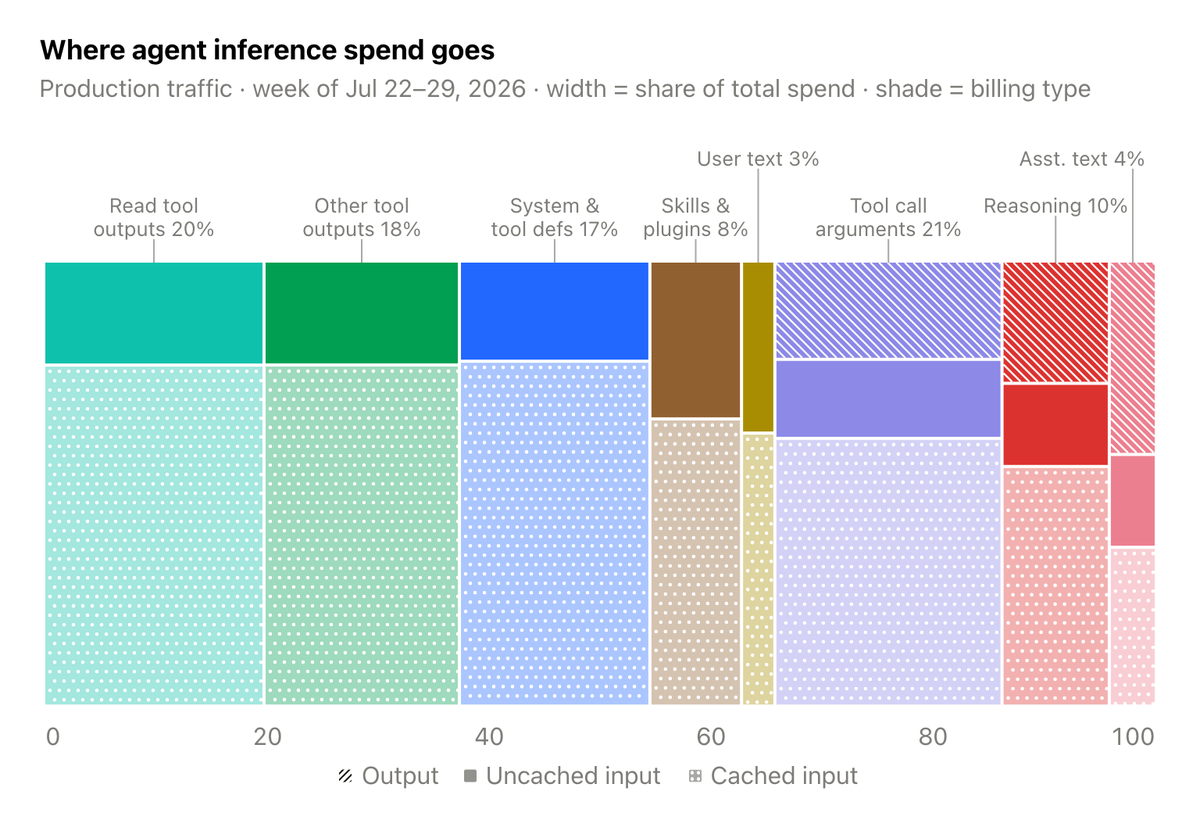
Cursor (@cursor_ai) shipped agent-harness efficiency work that cut user token costs ~7% with no quality drop: trimming the system prompt ~66%, loading built-in tools on demand (prior MCP dynamic context saved 46.9% tokens in sessions that called MCP tools), explicit cache breakpoints that cut cold-cache misses 20%, and numbering only every 10th line on file reads (−1.6% cache-read tokens).

Cursor cuts agent token costs 7% via harness: ~66% shorter system prompt, dynamic tools, cache breakpoints

Key Takeaways

  • Harness changes cut user token costs ~7% without reducing agent quality.
  • System prompt trimmed ~66% as stronger models need fewer DO NOT/Important guardrails.
  • Built-in tools load on demand; earlier MCP dynamic context saved 46.9% tokens on MCP-calling sessions.
  • Explicit cache breakpoints cut cold-cache misses 20%; Read numbers every 10th line (−1.6% cache-read tokens).
Read full story

Motion MCP: coding agents generate animation and launch video via standard MCP tools

Prasenjit Sarkar (@stretchcloud) covered Motion MCP: coding agents call Motion animation and video tools over standard MCP. In the demo, Codex produced a launch video from a system prompt for about $5 in about 10 minutes—so the same agent that ships code can also produce launch creatives without designer round-trips.

Key Takeaways

  • Motion ships an MCP server so coding agents can generate animation and video.
  • Demo: Codex built a launch video from a system prompt for about $5 in about 10 minutes.
  • Creative production can fold into the engineering agent workflow.
Read full story
Linked Models & Agents:

DeepSeek unveils API Prompt Caching rates dropping cached input pricing to ¥0.1 per 1M tokens

DeepSeek introduced automatic API Prompt Caching across its developer platform. When re-sending system prompts, large repository contexts, or multi-turn chat history, cached input tokens are billed at just ¥0.1 per million tokens (~$0.014/M), reducing operating expenses for autonomous coding agents by up to 85%.

Key Takeaways

  • Cached input tokens cost only ¥0.1 (~$0.014) per million tokens with automated 64k prefix reuse.
  • Zero manual cache key configuration: gateway automatically handles prefix hash caching.
  • Dramatically lowers API costs for terminal agents (Aider, Cline, OpenHands) loading full repos.
Read full story