AI Coding Live News

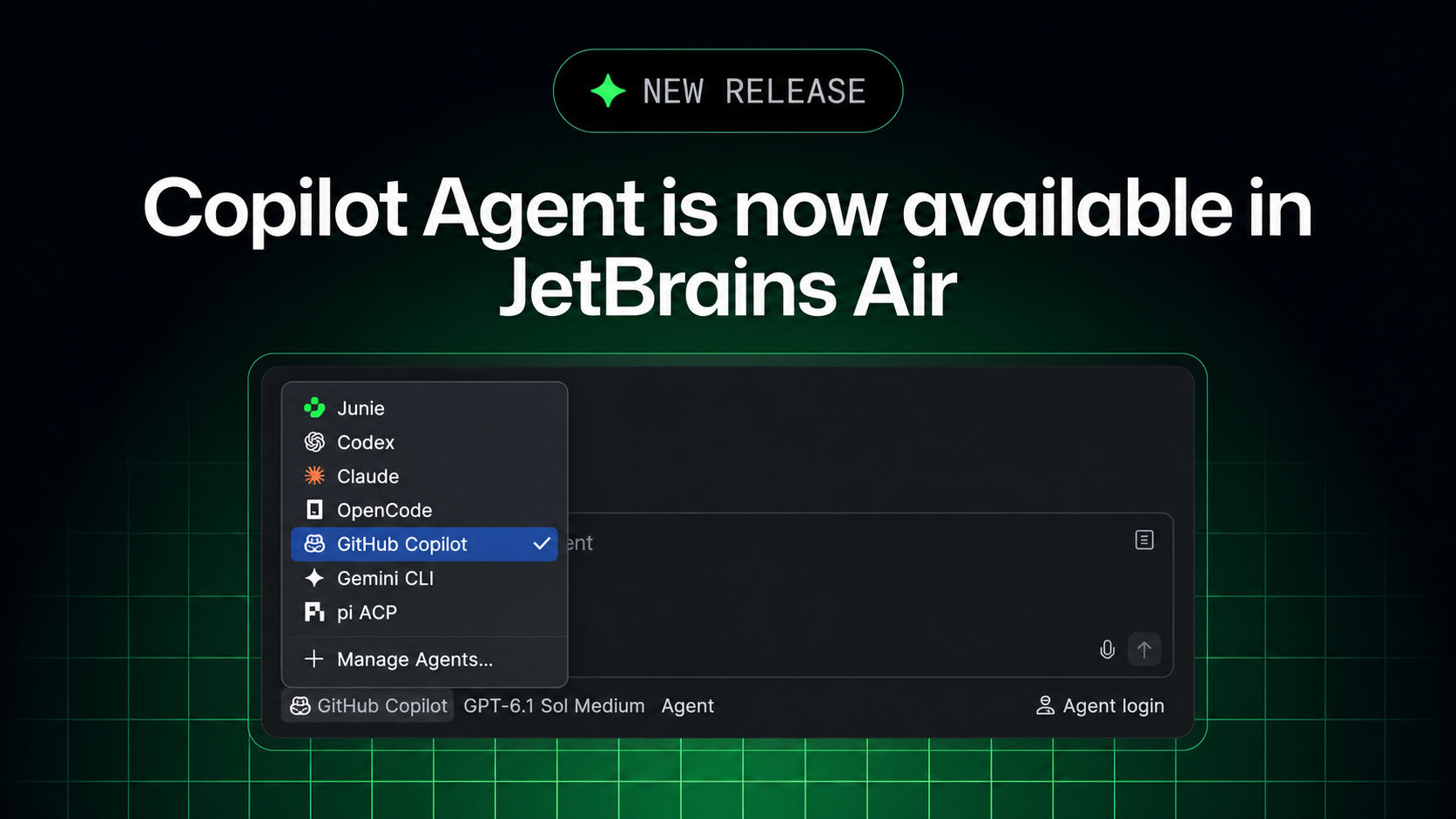
GitHub Copilot Comes to JetBrains Air: Run Coding Tasks Locally in the IDE or in Isolated Cloud Environments via ACP, Billed to Your Copilot Subscription

On November 3 GitHub announced on its official changelog that GitHub Copilot is now available in JetBrains Air. The integration is built on the Agent Client Protocol (ACP): developers pick Copilot in Air's agent picker, delegate coding tasks, track several sessions in parallel and review changes next to their code. Tasks can run locally in a JetBrains IDE or in isolated cloud environments through Air Teams, and they draw on the Copilot subscription rather than JetBrains AI credits.
GitHub Copilot Comes to JetBrains Air: Run Coding Tasks Locally in the IDE or in Isolated Cloud Environments via ACP, Billed to Your Copilot Subscription

Key Takeaways

  • Copilot now appears in JetBrains Air's agent picker and works with an existing Copilot account
  • The integration uses the Agent Client Protocol (ACP) and can be used alongside the existing GitHub Copilot plugin
  • Developers can track multiple agent sessions in parallel and review changes next to their code using project context and IDE tools
  • Cloud tasks run through Air Teams, each in a Docker container on a fresh virtual machine, with traffic through a proxy and no state kept between tasks
  • Cloud tasks use the Copilot plan rather than JetBrains AI credits, but Air analytics do not include Copilot usage and admins cannot set Copilot spending limits inside Air
Read full story

GitHub Copilot Comes to Xcode's Built-In Coding Assistant in Public Preview With Xcode 27.3 Beta, Supported on All Copilot Plans

GitHub's official changelog says Copilot now works directly in Xcode's built-in coding assistant, in public preview starting with Xcode 27.3 beta. It needs macOS Tahoe 26.6 or later, is set up under Xcode > Settings > Intelligence, and supports all Copilot plans; the existing Copilot for Xcode extension stays available.

Key Takeaways

  • Copilot joins Xcode's native coding assistant in public preview, starting with Xcode 27.3 beta
  • Requires macOS Tahoe 26.6 or later
  • Set it up under Xcode > Settings > Intelligence; all Copilot plans are supported
  • The existing GitHub Copilot for Xcode extension remains a separate option
  • Apple's Xcode 27.3 beta 1 release notes list it under Coding Intelligence
Read full story

Microsoft Research and UC Berkeley open-source TokenEconomizer, a plugin that cuts Claude Code and Codex costs by 18.4–30.9% on SWE-Bench without changing the agent

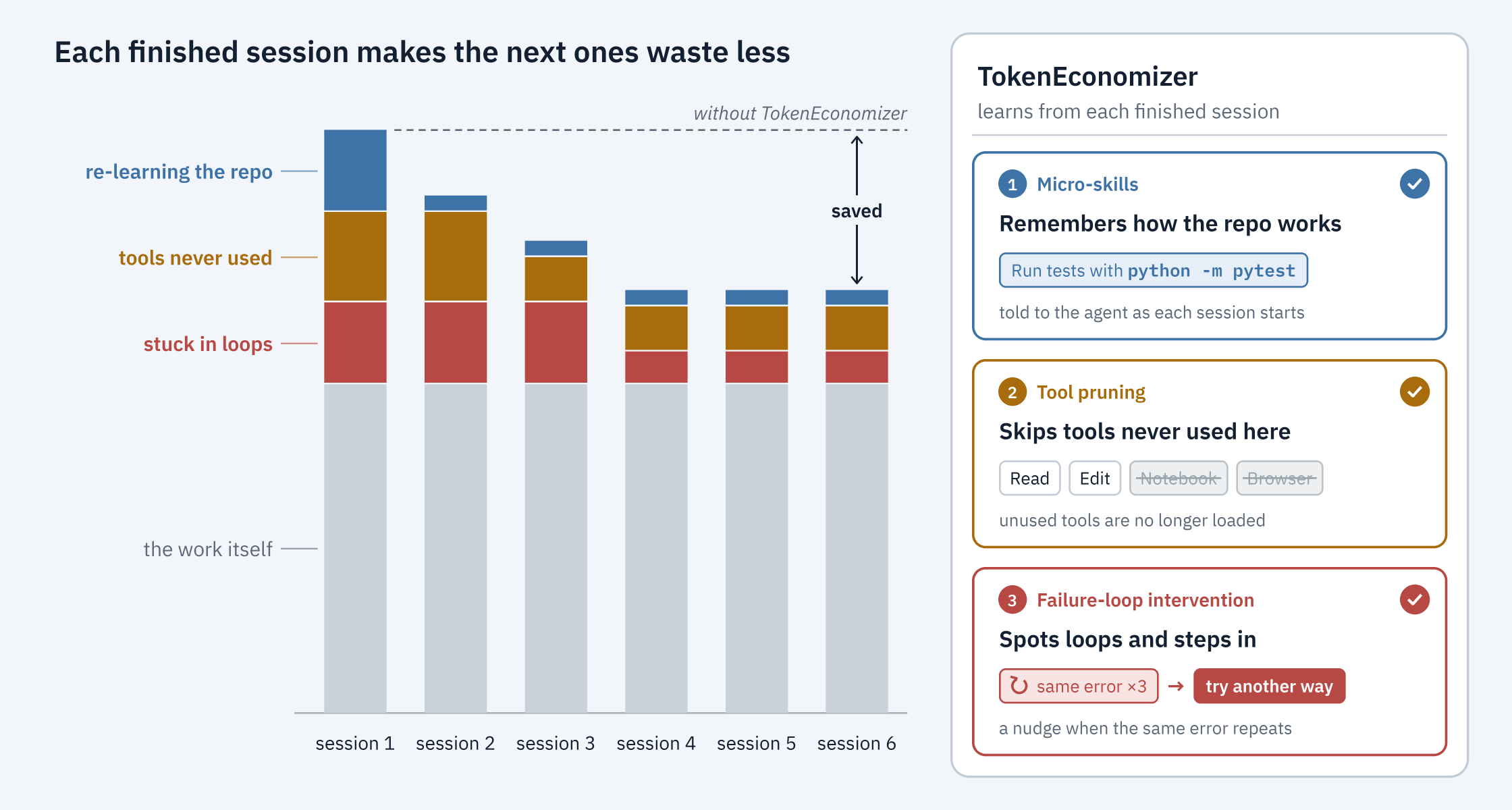
Microsoft Research, Microsoft Security and UC Berkeley open-sourced TokenEconomizer on GitHub (Apache 2.0, v0.1.0 released October 26), a plugin for Claude Code, Codex, GitHub Copilot CLI and Pi, with experimental opencode support. It learns from earlier sessions in the same repository: micro-skills remember repo facts, tool pruning drops tool definitions that go unused, and a loop guard nudges an agent that is stuck. The paper reports 18.4–30.9% lower mean cost across five agent and model combinations on 277 SWE-Bench tasks (paper figures).

Microsoft Research and UC Berkeley open-source TokenEconomizer, a plugin that cuts Claude Code and Codex costs by 18.4–30.9% on SWE-Bench without changing the agent

Key Takeaways

  • Cost: on 277 SWE-Bench tasks across 6 repositories and 5 agent and model combinations, mean cost fell 18.4–30.9%, and all 30 repository-by-combination cells got cheaper (paper figures, including the plugin's own model calls)
  • Success rate: Pass@1 rose in 4 of 5 combinations, e.g. Copilot CLI with Sonnet 5 cost 18.4% less with Pass@1 +2.6, while Claude Code with Opus 4.8 cost 30.9% less with Pass@1 -1.0
  • Three mechanisms: micro-skills (repo facts stated only after three sessions confirm them), tool pruning (by default a tool unused over 10 prompts across 2 sessions is left out), and a failure-loop guard (one redirect when a judge is at least 0.7 confident, never stopping a turn itself)
  • Generalization: 16–21% lower cost on Web-Bench and 6–20% lower on two security-auditing benchmarks where every task is a new repository
  • Deployment: Apache 2.0, Python 3.10+, no API key of its own, and learned experience stays local in ~/.tokeneconomizer
Read full story

GitHub Copilot Automations go team-wide: repo-owned shared automations, 24 new triggers, 20 new tools and AI credit limits

At GitHub Universe on Oct 28, GitHub shipped a batch of Copilot Automations updates. Shared automations now belong to the repository, act as Copilot, bill AI credits to the repo owner and keep running after their creator leaves. Automations gain 24 new GitHub event triggers, REST API triggers from external systems and chaining, plus 20 new tools and custom MCP servers. Teams can cap AI credits per run, day, week or month, automations can propose improvements to their own prompts from real outcomes, and VS Code 1.144 can run them in the cloud.

GitHub Copilot Automations go team-wide: repo-owned shared automations, 24 new triggers, 20 new tools and AI credit limits

Key Takeaways

  • Shared automations belong to the repository: anyone with read access can view them, anyone with write access can edit, actions are attributed to Copilot and AI credits bill to the repo owner
  • 24 new triggers across issues, pull requests, discussions and security alerts, plus REST API triggers from systems like Jira, Sentry and PagerDuty
  • 20 new GitHub tools (merge PRs, retry workflow runs, upload screenshots and more) and support for custom MCP servers
  • AI credit limits can be set per run, day, week or month; org repos need an admin to enable the "Allow use of Copilot cloud agent billed to the organization" policy
  • Rolling out to Copilot Pro, Pro+, Max, Business and Enterprise; VS Code 1.144 runs them in the cloud with chat.automations.cloud.enabled
Read full story
ADSponsored

GitHub Octoverse 2026: agents start over 40% of pull requests, pushes hit 17.9 billion, and Copilot users tapped 47 models

On Oct 28 GitHub published its Octoverse 2026 report: developers pushed code 17.9 billion times in the past 12 months, more than 2024 and 2025 combined, with 34.3 billion commits and 1.3 billion merged pull requests (3.5 million a day). By September more than 40% of pull requests started with an agent draft, up from 17% in March; 55% of Copilot monthly active users use agentic features, and paid Copilot users used 47 distinct models in September.

GitHub Octoverse 2026: agents start over 40% of pull requests, pushes hit 17.9 billion, and Copilot users tapped 47 models

Key Takeaways

  • 17.9 billion pushes, 34.3 billion commits and 1.3 billion merged pull requests in the past 12 months, about 3.5 million merges a day (GitHub figures)
  • More than 40% of pull requests started with an agent draft by September 2026, up from 17% in March; that was 110 million in September alone, about 6x March
  • 55% of Copilot monthly active users now use agentic features, up from 35% a year ago, and Copilot cloud agent grew 230% year over year
  • Paid Copilot users used 29 distinct models in May and 47 in September, with no model above 25% of requests; 61% of users who pick models mix more than one
  • GitHub now serves more than 225 million developers; the US has 38.3 million and India 32 million, each adding over 10 million this year
Read full story

Microsoft opens the GitHub-built Copilot harness in Foundry Agent Service: public preview, 20+ frontier models plus BYOK, billing from Dec 1

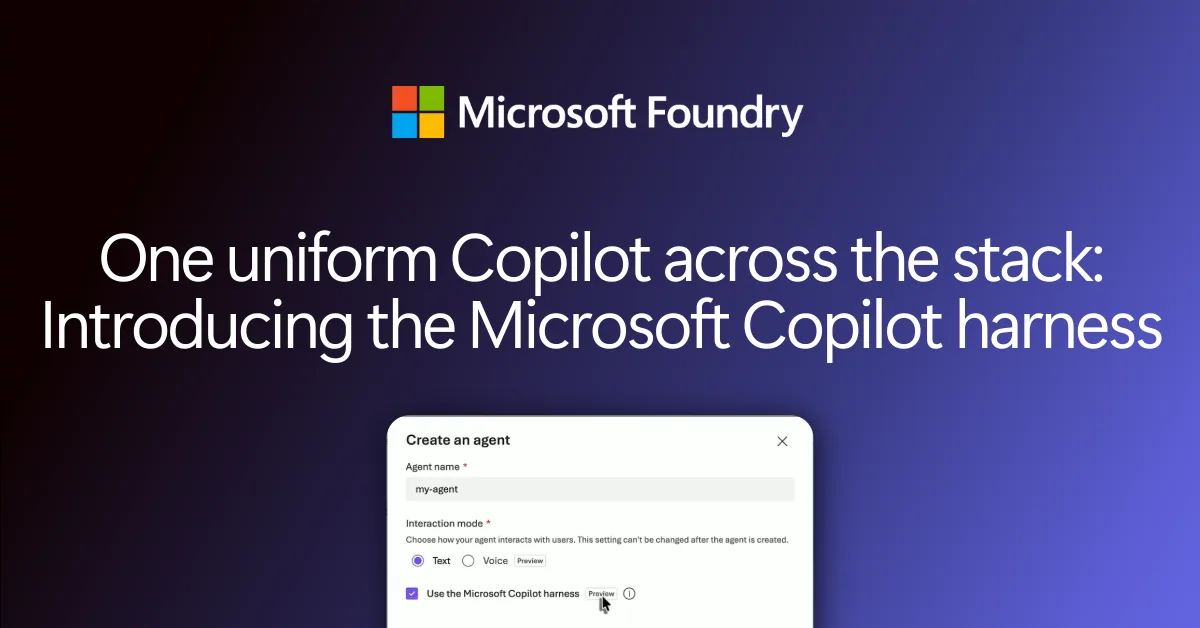
During GitHub Universe on Oct 28, Microsoft put the Microsoft Copilot harness, the shared agent execution layer behind Copilot Code, Copilot Studio, the GitHub Copilot app, the CLI and VS Code, into Foundry Agent Service as a public preview. Microsoft runs the agent loop and sandbox while developers supply instructions, skills, tools and model choice; Microsoft says it works across 20+ frontier models plus bring-your-own-key. Long-running resilience for hosted agents also reached GA. Harness runtime usage is free until Dec 1.

Microsoft opens the GitHub-built Copilot harness in Foundry Agent Service: public preview, 20+ frontier models plus BYOK, billing from Dec 1

Key Takeaways

  • Microsoft says the harness spans 20+ frontier models plus bring-your-own-key, so you can swap models without rewriting orchestration (official blog)
  • Preview building blocks: reusable skills, Foundry and MCP tools with explicit auth and approvals, file and code execution with built-in subagent delegation, and source-controlled agent definitions
  • Pricing: harness runtime is free until Dec 1; after that sandbox compute is USD 0.0994 per vCPU-hour and 0.0118 per GiB-hour, with model inference billed separately (Foundry blog)
  • Long-running resilience for hosted agents went GA the same week: interrupted work restarts with its original input, and your app saves checkpoints
  • Limits: you pick the harness only when creating a new agent; existing agents are unchanged and switching later is not supported yet
Read full story

Microsoft FY27 Q1: Azure growth accelerates to 48%, Foundry revenue more than triples, and Agent 365 now governs 50M agents

On Oct 28, Microsoft reported results for its fiscal Q1 2027, the quarter ended Sep 30: revenue of $92.3B (+19%), Microsoft Cloud revenue of $63.9B (+30%), Azure growth accelerating from 42% last quarter to 48%, and commercial remaining performance obligation of $677B (+73%). CEO Satya Nadella added AI figures on X: Foundry revenue more than tripled year over year, revenue from open source models grew 10x, Copilot daily users grew nearly 50% quarter over quarter, and Agent 365 now holds over 50M agents. Separately, TechCrunch, citing Microsoft's regulatory filing, reports $10B of revenue from OpenAI-related commercial arrangements this quarter.

Microsoft FY27 Q1: Azure growth accelerates to 48%, Foundry revenue more than triples, and Agent 365 now governs 50M agents

Key Takeaways

  • Revenue of $92.3B (+19%) and operating income of $45.9B (+21%); Microsoft Cloud reached $63.9B (+30%) (earnings release)
  • Azure grew 48%, accelerating from 42% in FY26 Q4; commercial RPO reached $677B (+73%) (official investor metrics)
  • Foundry revenue more than tripled YoY, customers building with multiple models grew 5x, and open source model revenue grew 10x (per Satya Nadella on X)
  • Copilot daily users grew nearly 50% QoQ and more than 5x YoY; Agent 365 holds over 50M agents, up 30% QoQ
  • Per TechCrunch citing the 10-Q, OpenAI-related revenue was $10B, about 11% of the total; OpenAI investments added $207M to GAAP net income
Read full story

GitHub Enterprise now includes Copilot: $0 seat charge for Enterprise Cloud users, $10 a month Copilot Standalone for others, with AI usage metered from the first request

At Universe 2026 on Oct 28, GitHub announced a new Copilot access billing model: users with a GitHub Enterprise Cloud license pay no Copilot seat charge, and users without one can get Copilot Standalone at $10 per user per month. Both get the same features and models as Copilot Enterprise but no monthly per-seat AI credits; all usage is metered against the enterprise budget from the first request. It is available now only to Enterprise Cloud customers working with a GitHub or Microsoft account team, opens to self-serve customers in stages, and Copilot Business and Enterprise stay on sale.

Key Takeaways

  • Seat charge: $0 for users with a GitHub Enterprise Cloud license; users without one get Copilot Standalone at $10 per user per month
  • Versus the old plans: Copilot Business is $19 per user per month with 1,900 pooled AI credits and Copilot Enterprise is $39 with 3,900; the new model includes no credits and meters usage from the first request
  • When the budget runs out: code completion and next edit suggestions keep working, while Copilot Chat, Copilot code review and Copilot in the cloud need available budget
  • Availability: from Oct 28 only for Enterprise Cloud customers working with a GitHub or Microsoft account team; self-serve opens in stages, and GitHub Free and Team are not eligible
  • Switching is voluntary, but the billing model applies to the whole enterprise, cannot be mixed with Copilot Business or Enterprise seats, and admins still have to assign seats
Read full story

GitHub Agentic Workflows is generally available: write automation in Markdown, compile it to Actions YAML, run Copilot or your own coding agent, now with ARC self-hosting and micro-VM isolation

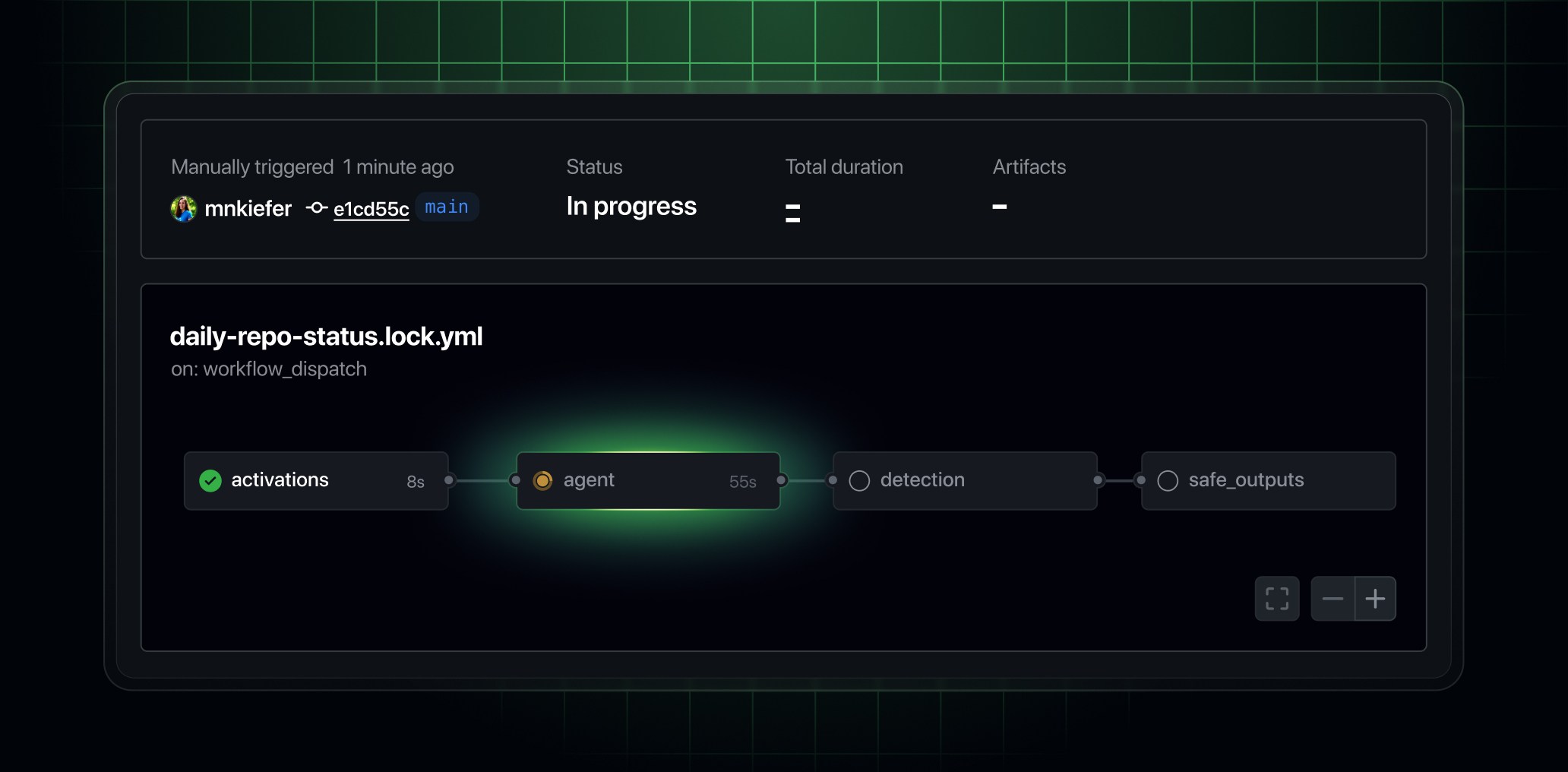
At Universe 2026 on Oct 28, GitHub made GitHub Agentic Workflows, an open source GitHub Next project, generally available on GitHub Free, Team and Enterprise. Developers describe tasks such as issue triage, CI failure analysis, documentation updates and test writing in natural-language Markdown, and gh aw compiles them into standard Actions YAML run by Copilot or a coding agent of their choice. GA adds self-hosted ARC runners with Docker-in-Docker, a non-experimental gh aw forecast cost estimate, per-workflow model providers and model routing, and Cloud Hypervisor or NVX micro-VM isolation.

GitHub Agentic Workflows is generally available: write automation in Markdown, compile it to Actions YAML, run Copilot or your own coding agent, now with ARC self-hosting and micro-VM isolation

Key Takeaways

  • Availability: GitHub Free, Team and Enterprise on github.com; using the default Copilot CLI engine requires a Copilot license
  • How it works: requirements in Markdown, compiled to standard Actions YAML that reuses existing runner groups and policies; run with Copilot or your own coding agent
  • Safe defaults: read-only permissions, a sandboxed container behind the Agent Workflow Firewall, safe-outputs validation, and a threat detection job before changes are applied
  • New at GA: self-hosted ARC runners with Docker-in-Docker, gh aw forecast out of experimental (with threat detection credits and monthly ranges), per-workflow model providers, model routing, micro-VM isolation and cross-repo enclaves
  • Customer story (Accenture's figures): one lead saved about 29 hours a week, AI authors 91% of the team's commits, and production errors fell from about 11,000 a day to under 1,000
Read full story

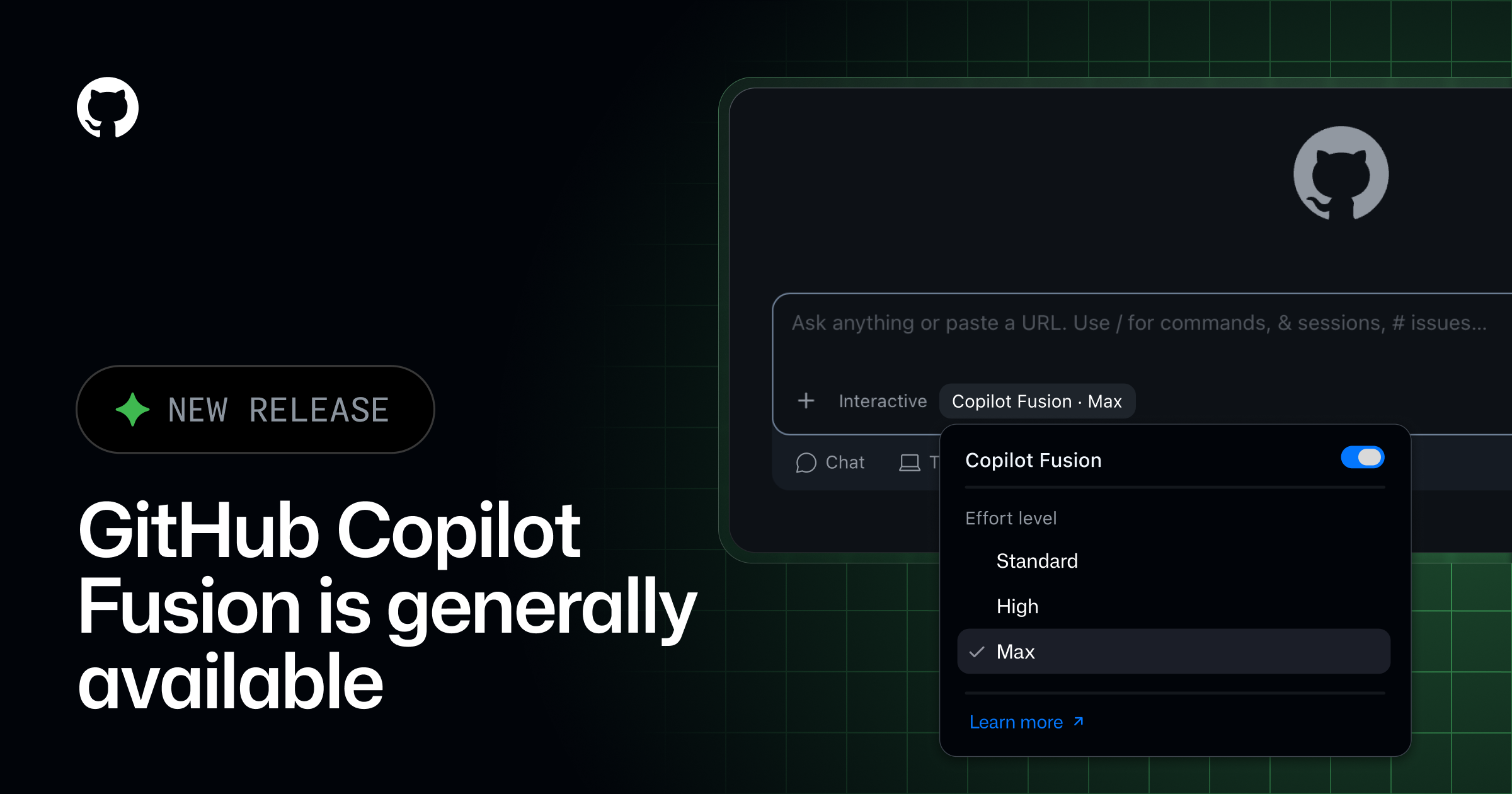
GitHub Universe 2026: Copilot Fusion is generally available, routing and orchestrating models automatically, with Fusion Max scoring 60 on the Artificial Analysis Coding Agent Index at about half the cost of Claude Code with Opus 5.5 Max

At GitHub Universe 2026 on Oct 28, GitHub made Copilot Fusion generally available. It merges the multi-model orchestration of the Project HydraFusion research preview with Copilot auto model selection: users pick Copilot Fusion and an effort level (Standard, High or Max) in the model picker, and the system decides which models to use and whether to run a Single, Cascade or Critique workflow. GitHub says Fusion Max scored 60 on the Artificial Analysis Coding Agent Index, two points below Claude Code with Opus 5.5 Max, at about half the API cost per task, about half the tokens and about 40% less time. Each underlying model is billed at its standard rate, and paid plans get 30% off through Nov 30.

GitHub Universe 2026: Copilot Fusion is generally available, routing and orchestrating models automatically, with Fusion Max scoring 60 on the Artificial Analysis Coding Agent Index at about half the cost of Claude Code with Opus 5.5 Max

Key Takeaways

  • Scores (Artificial Analysis Coding Agent Index v2.0): Fusion Max 60 versus 62 for Claude Code with Opus 5.5 Max; $5.59 per task versus $11.42, while the Devin Fusion pairing scores 62 at $8.00
  • Breakdown: a slight lead on Terminal-Bench 4.0 at 71, third on FrontierCode at 51 (Claude Code 56, Devin Fusion 54), and a weaker 57 on SWE-Atlas-QnA-AA
  • Efficiency: about 7.2M tokens per task, roughly half of Claude Code with Opus 5.5 and 30% fewer than Devin Fusion; GitHub reports about 40% less time per task
  • The pool includes Claude Opus 5.5, Claude Sonnet 5.5, GPT-6 Astra and GPT-6 Sol; admins can disable individual models for Fusion only and set Fusion as the default
  • Availability: all Copilot plans in VS Code, the Copilot app, Copilot CLI and JetBrains IDEs; existing auto, HydraFusion and HydraFusion Max selections migrate to matching effort levels
Read full story
ADSponsored

Anthropic donates the Agent Skills open standard to the Linux Foundation’s Agentic AI Foundation, after 70+ agent platforms adopted it with 1M skills published and nearly 280M installs

On 2026-10-22 Anthropic said it is donating Agent Skills, the open standard that teaches agents a task through a folder with a SKILL.md file, to the Agentic AI Foundation (AAIF) under the Linux Foundation, the same neutral home it gave MCP. The donation covers the Agent Skills name and logo, the GitHub organization and the agentskills.io domain. Anthropic says more than 70 agent platforms, including ChatGPT, Cursor, GitHub Copilot and VS Code, have integrated the standard since December 2025, with 1 million skills published and nearly 280 million installs. Engineers from Anthropic, Google, OpenAI and others will maintain it as individuals.

Anthropic donates the Agent Skills open standard to the Linux Foundation’s Agentic AI Foundation, after 70+ agent platforms adopted it with 1M skills published and nearly 280M installs

Key Takeaways

  • Official figure: 70+ agent platforms have integrated Agent Skills, including ChatGPT, Cursor, GitHub Copilot and VS Code
  • 1 million skills published and nearly 280 million installs so far (Anthropic figures)
  • Donated: the Agent Skills name and logo, the GitHub organization and the agentskills.io domain; you can keep using or contributing without joining AAIF
  • Lead Maintainers are David Soria Parra and Mahesh Murag, with engineers from Anthropic, Google, OpenAI and others maintaining it as individuals
  • Proposed first roadmap: versioned releases, a formal proposal process and security guidance for people who write and install skills
Read full story

VS Code 1.143 makes the Copilot SDK-based harness the default, adds multi-model comparison and on-device MAI Code 1.1 Flash

Microsoft shipped Visual Studio Code 1.143. The Copilot harness, built on the Copilot SDK, is now the default for new sessions and works across the editor and Agents window. A Compare Models preview runs several models on one task with an optional Judge model, an experimental mode runs MAI Code 1.1 Flash on a local NVIDIA GPU, and large chats open much faster.

VS Code 1.143 makes the Copilot SDK-based harness the default, adds multi-model comparison and on-device MAI Code 1.1 Flash

Key Takeaways

  • Default harness: new sessions use the Copilot harness built on the Copilot SDK, which can run in the background and move between the editor and the Agents window
  • Compare Models (Preview): one prompt runs 2 or more models in parallel, mixing Copilot, Claude and Codex harnesses, with an optional Judge model scoring time and token use and a Synthesize step
  • On-device models (Experimental): download MAI Code 1.1 Flash to run locally, labeled On-device with no AI credits used; needs an NVIDIA GPU with 96 GB+ memory
  • Performance (vendor figures): cold-opening a ~1,150-request chat dropped from 35.6 s to 9.0 s, and window freeze time from 28.3 s to 0.6 s
  • Also: the editor diagnostic highlight limit rises from 500 to 5,000 per file, and the Windows installer can install GitHub Copilot CLI
Read full story

VS Code Preview Introduces Canvases: Shared Workspaces for Developers and Coding Agents

The Microsoft VS Code team announced Canvases in VS Code Preview (v1.142), introducing dedicated shared visual workspaces connecting developers with autonomous coding agents. Addressing the severe UX limitations of cramped sidebar chat windows—where complex multi-file architectural modifications and agent diffs become hard to track—Canvases provides an expansive, interactive infinite-canvas whiteboard. Developers and agents (such as GitHub Copilot, Claude Code, and Cline) can collaboratively organize system flowcharts, live interactive code diffs, execution traces, and unit test rollouts side by side.

VS Code Preview Introduces Canvases: Shared Workspaces for Developers and Coding Agents

Key Takeaways

  • Microsoft VS Code Preview v1.142 introduced Canvases, pioneering a spatial human-agent collaborative interface
  • Transceives beyond claustrophobic sidebar chats to an expansive, pan-and-zoom whiteboard mapping concurrent multi-file agent diffs
  • Embeds code files, architecture diagrams, interactive git diffs, terminal outputs, and test runners as unified interactive cards
  • Natively bridges GitHub Copilot, Claude Code, and third-party coding agent harnesses, accelerating IDE spatial development
Read full story

Perplexity Computer Launches Natively on macOS: Full On-Device Model and Agent Execution Without Cloud Roundtrips

Perplexity officially unveiled that Perplexity Computer now operates 100% locally on macOS through the native desktop application. Breaking away from cloud-dependent computer-use paradigms that ship continuous video feeds across the internet, Perplexity Computer executes both the underlying inference model and the agent orchestration runtime directly on local Mac silicon. By interfacing natively with macOS Accessibility APIs, the system eliminates network latency, guarantees complete screen privacy, and empowers autonomous desktop copilots to orchestrate multi-application workflows entirely offline.

Perplexity Computer Launches Natively on macOS: Full On-Device Model and Agent Execution Without Cloud Roundtrips

Key Takeaways

  • Perplexity launched Perplexity Computer inside the native macOS app, hosting both model inference and agent loops locally
  • Eliminates privacy vulnerabilities of cloud-based GUI agents by keeping all screen frames and keystrokes strictly on-device
  • Achieves near-instantaneous interaction latency leveraging Apple Silicon unified memory and the Neural Engine
  • Seamlessly interfaces with native macOS Accessibility APIs and app sandboxes for cross-application workflow automation
Read full story

GitHub Copilot updates HydraFusion and adds HydraFusion Max, with Claude Opus 5.5 and the GPT-6 family in its model pool

On 2026-10-14 GitHub updated HydraFusion, Copilot's multi-model orchestration feature, and added HydraFusion Max for harder tasks. The pool now includes Claude Opus 5.5, GPT-6 Astra, GPT-6.1 Sol and GPT-6 Luna; effort is tuned per stage (medium for drafts, high for review), Cascade gains a judging step, and Critique now inspects the workspace with tools using parallel critics. Both remain in research preview across VS Code, the Copilot app and Copilot CLI.

Key Takeaways

  • Pool: Claude Opus 5.5, GPT-6 Astra, GPT-6.1 Sol, GPT-6 Luna, chosen per workflow (GitHub Changelog)
  • Per-stage effort: medium for drafts, high for review (previously each model's default)
  • Cascade adds a judge that requests repair only when needed; Critique uses tools on the workspace plus parallel critics
  • Two tiers: HydraFusion (balanced) and HydraFusion Max (deepest reasoning, orchestration still minds tokens)
  • Available in VS Code, Copilot app and Copilot CLI on Pro, Pro+, Business and Enterprise with preview features enabled
Read full story