AI Coding Live News

GitHub Copilot Comes to JetBrains Air: Run Coding Tasks Locally in the IDE or in Isolated Cloud Environments via ACP, Billed to Your Copilot Subscription

On November 3 GitHub announced on its official changelog that GitHub Copilot is now available in JetBrains Air. The integration is built on the Agent Client Protocol (ACP): developers pick Copilot in Air's agent picker, delegate coding tasks, track several sessions in parallel and review changes next to their code. Tasks can run locally in a JetBrains IDE or in isolated cloud environments through Air Teams, and they draw on the Copilot subscription rather than JetBrains AI credits.
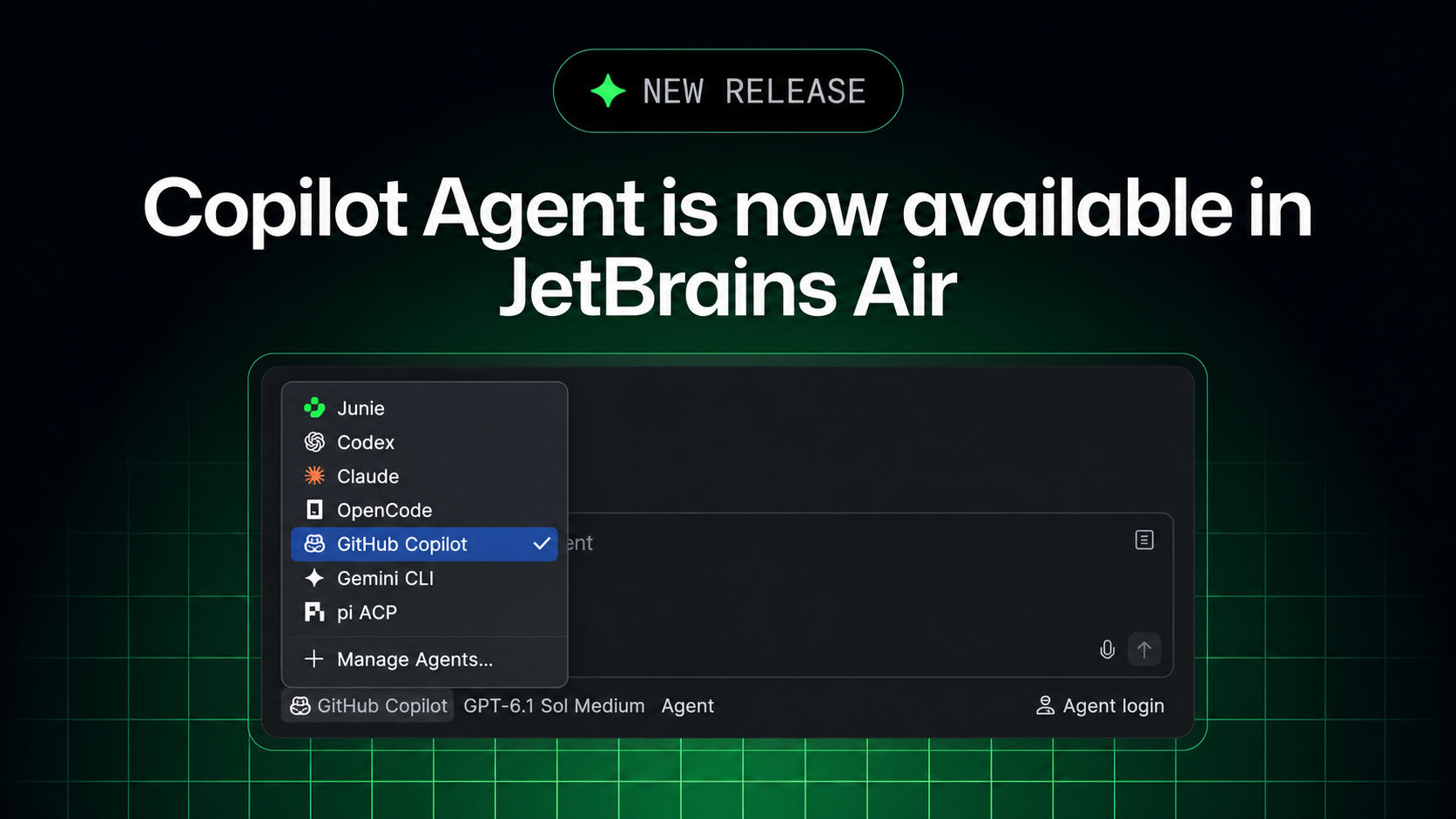
GitHub Copilot Comes to JetBrains Air: Run Coding Tasks Locally in the IDE or in Isolated Cloud Environments via ACP, Billed to Your Copilot Subscription

Key Takeaways

  • Copilot now appears in JetBrains Air's agent picker and works with an existing Copilot account
  • The integration uses the Agent Client Protocol (ACP) and can be used alongside the existing GitHub Copilot plugin
  • Developers can track multiple agent sessions in parallel and review changes next to their code using project context and IDE tools
  • Cloud tasks run through Air Teams, each in a Docker container on a fresh virtual machine, with traffic through a proxy and no state kept between tasks
  • Cloud tasks use the Copilot plan rather than JetBrains AI credits, but Air analytics do not include Copilot usage and admins cannot set Copilot spending limits inside Air
Read full story

OpenAI Details Autonomous Vulnerability Pipeline: An Upcoming Cyber Model Produced Exploits and Patches for 948 Linux Kernel Privilege Escalation Bugs for $1.2M in API Costs

On November 4 OpenAI published "A thousand fewer paths to root." Its autonomous pipeline for vulnerability discovery, validation, exploitation and patching scanned the Linux kernel in mid-October with an upcoming cyber model, reproduced 1,724 vulnerabilities and produced exploits and patches for 948 distinct local privilege escalation (LPE) bugs. The run cost $1,213,430 in API credits, about $1,279 per LPE, and hundreds of reports and patches have already gone to maintainers.

OpenAI Details Autonomous Vulnerability Pipeline: An Upcoming Cyber Model Produced Exploits and Patches for 948 Linux Kernel Privilege Escalation Bugs for $1.2M in API Costs

Key Takeaways

  • Five-stage pipeline: discovery, dynamic validation, exploitability assessment, patch generation, human review
  • Of 2,308 candidate findings, 1,724 were reproduced, yielding 291 info-leak PoCs and 948 distinct LPEs
  • Total cost $1,213,430; historical Pwn2Own and TyphoonPWN bounties imply a hypothetical $18.9M to $66.3M value
  • The newer model found more than 5x the novel LPEs of a July GPT-5.6 Sol run (166)
  • The agents used at least 10 novel Linux exploitation techniques, withheld for safety reasons
Read full story
Linked Models & Agents:

Ricursive Open-Sources Ripple-65B Preview: A 65B Dense Model Pretrained From Scratch, TerminalBench 2.1 80.5, Apache 2.0

Ricursive Intelligence released its first model, Ripple-65B Preview, on November 4 (18:24 UTC), open-sourcing the instruction-tuned model (BF16 and NVFP4) and a base model on Hugging Face under Apache 2.0. The official model card describes a 65B dense Transformer pretrained on 12T tokens with up to 1M context, and self-reports TerminalBench 2.1 80.5, SWE-bench Pro v2.0 Hard 79.1 and DeepSWE 1.1 44.3, ahead of much larger US open-weight models on agentic coding. It fits on local hardware such as the DGX Spark. CEO Anna Goldie says it cost about a tenth of the prior comparable state of the art.

Ricursive Open-Sources Ripple-65B Preview: A 65B Dense Model Pretrained From Scratch, TerminalBench 2.1 80.5, Apache 2.0

Key Takeaways

  • Ripple-65B Preview is a 65B dense model with a thin-and-deep shape (80 layers, d_model 5120), moving from an Olmo 3 baseline to a Gemma 3N-like architecture.
  • It was pretrained on 12T tokens at 8K sequence length, then went through mid-training, long-context training, SFT and mixed-domain RL, with up to 1M context.
  • Self-reported TerminalBench 2.1 is 80.5, above Reflection Beam 501B (80.1) and Muse Spark Open 816B (76.4), but SWE-bench Verified 76.5 and DeepSWE 1.1 44.3 show it does not lead everywhere.
  • Ricursive says the core team grew from one to five people and code compute efficiency improved 16x versus the Olmo 3 ladder; it reaches about 250 tok/s on 2x B200.
  • Hugging Face hosts BF16, NVFP4, base and DFlash2 speculative-decoding checkpoints, all under Apache 2.0.
Read full story
Linked Models & Agents:
⚡ Ripple-65B Preview⚡ Reflection Beam 501B⚡ Muse Spark Open⚡ Nemotron 3 Ultra🌐 Ricursive Intelligence🌐 NVIDIA

webAI Open-Sources TwIL-8B: An 8.8B Reasoning Model With LiveCodeBench 81.6 and MATH-500 98.2, Under a Non-Commercial License

webAI CEO David Stout announced on X on November 4 (17:37 UTC) that the company is open-sourcing TwIL-8B. The official Hugging Face model card says it is post-trained from IBM Granite 4.2 8B with full-parameter SFT, GRPO/DAPO reinforcement learning and a length-aware RL stage, and ships in balanced and verbose variants. Self-reported scores include LiveCodeBench 81.6 (verbose), MATH-500 98.2 and IFBench 74.4, about 93% and 92% of the best frontier score, while GPQA Diamond is only 70.2. A 4.98 GiB Q4_K_M GGUF runs locally; the license is the webAI Non-Commercial License.

webAI Open-Sources TwIL-8B: An 8.8B Reasoning Model With LiveCodeBench 81.6 and MATH-500 98.2, Under a Non-Commercial License

Key Takeaways

  • TwIL-8B has 8.79B parameters, is built on IBM's ibm-granite/granite-4.2-8b, has a 131,072-token context window and is English-only, text to text.
  • Self-reported scores: MATH-500 98.2, AIME 2025 88.3, LiveCodeBench 81.6 (verbose) and IFBench 74.4 (verbose); GPQA Diamond at 70.2 trails Qwen3.5-9B (81.7) clearly.
  • The balanced variant averages about 19.5k output tokens per AIME 2026 problem, about 38% fewer than Qwen3.5-9B's 31.2k, but still roughly 4x GPT-5.5.
  • All scores are webAI internal evaluations; competitor figures are quoted from public sources and were not re-run. SWE-bench, tool use and agentic tasks were not evaluated.
  • The license is the webAI Non-Commercial License 1.0, so it cannot be used commercially as is; the Q4_K_M GGUF is about 4.98 GiB and runs with llama.cpp.
Read full story
Linked Models & Agents:
⚡ TwIL-8B⚡ Granite 4.2 8B⚡ Qwen3.5-9B⚡ Gemma 4 31B🌐 webAI🌐 IBM
ADSponsored

Conductor Is Joining Meta: The Multi-Agent Coding Tool Team Moves to MSL, Conductor Cloud Shuts Down on November 20

Charlie Holtz of Conductor announced on X on November 4 (18:18 UTC) that Conductor is joining Meta, where the team will build "the next interface" with Nat Friedman and Alexandr Wang at Meta Superintelligence Labs (MSL). The official announcement sets a timeline: from November 4 there are no new sign-ups and Pro features are free for existing users; on November 13 Conductor Cloud goes read-only and active subscribers get refunds; on November 20 Cloud shuts down and cloud data deletion begins; the local app keeps getting new models and critical fixes until early 2027. Terms were not disclosed.

Conductor Is Joining Meta: The Multi-Agent Coding Tool Team Moves to MSL, Conductor Cloud Shuts Down on November 20

Key Takeaways

  • Conductor launched in July 2025 as a tool for running a team of coding agents at once (it runs first-party agents such as Claude Code, Codex, Cursor and OpenCode under the hood), and its site claims 100k+ builders.
  • The team joins Meta Superintelligence Labs to work with Nat Friedman and Alexandr Wang; the official word on the new product is only "early next year", with no details.
  • Key dates: sign-ups and downloads stop on Nov 4, Cloud goes read-only with refunds on Nov 13, Cloud shuts down and data deletion starts on Nov 20, and the local app is maintained until early 2027.
  • To migrate, right-click a cloud workspace and choose Transfer to local, or export everything via Settings, Account, Export data.
  • Terms were not disclosed; on the same day HumanLayer announced it is joining Factory, a sign the coding-agent tooling market is consolidating quickly.
Read full story

Axiom Formalizes the Entire Stacks Project in Lean With AI Agent Swarms: About 16 Million Lines, Billed as the Largest Reusable Formal Math Library Yet

Axiom released a Lean formalization of the entire Stacks Project on November 4 (official X post at 17:13 UTC, with over 2 million views). The roughly 7,500-page open-source algebraic geometry reference, started by Johan de Jong in 2005, becomes about 16 million lines of code, which Axiom calls the largest integrated, reusable formal math library ever built. Hierarchically coordinated AI agent swarms did the work and surfaced dozens of statements in the original that needed local fixes, with counterexamples. The library is open source and browsable side by side with the original text at stacks.axiommath.ai.

Axiom Formalizes the Entire Stacks Project in Lean With AI Agent Swarms: About 16 Million Lines, Billed as the Largest Reusable Formal Math Library Yet

Key Takeaways

  • Scale: about 7,500 pages of source text and roughly 16 million lines of Lean, which Axiom calls the largest integrated reusable formal math library (vendor claim).
  • Method: hierarchical AI agent swarms translate statements, search Mathlib for existing abstractions and build proofs in parallel, with multi-agent auditing and semantic cross-checks against the source to keep statements faithful.
  • Findings: the system surfaced dozens of statements needing local refinement, including missing hypotheses and edge cases in positive characteristic, and built explicit counterexamples where claims failed.
  • The permanent Stacks tag structure is preserved so every Lean declaration links back to the original text; stacks.axiommath.ai offers side-by-side reading and a dependency graph.
  • This follows Axiom's October 27 formalization of the Classification of Finite Simple Groups (CFSG); per de Jong's request, corrections are kept in Axiom's own repository rather than sent upstream.
Read full story
Linked Models & Agents:

X Discussion: Vercel CEO Guillermo Rauch Says "Own Your Intelligence," Urging Local Models to Keep Spreading and Developers to Own Their Agent Harness and Data

Vercel CEO Guillermo Rauch posted on X on November 1: "Own your intelligence. Anyone that opposes this has something to sell you (perhaps your own intelligence back to you.)" He argued that local models need to keep proliferating; since the biggest models may be out of reach locally for now, the best option is to keep your options open: own your harness, data, connections and runtime, meaning your agents, and embrace open source. Within about 12 hours the post drew about 2,500 likes, 128K views and over 100 quote posts, with debate centered on how to balance local and cloud AI.

Key Takeaways

  • This is Rauch's personal opinion post, not an official Vercel announcement or product release.
  • The original post (2026-11-01 21:08 UTC) had about 2,533 likes, 255 reposts, 266 replies, 107 quotes, 128K views and 581 bookmarks at fetch time.
  • Core claim: local models should keep spreading; until the biggest models can run locally, keep your options open by owning your harness, data, connections, runtime and agents, and embrace open source.
  • Mark (@marksuman), co-founder and CEO of Maple AI, replied in a quote post that it will be hybrid: cloud will always be more powerful, so local-first AI should be paired with private cloud.
  • Engineer Shantanu Goel (@shantanugoel) quoted it saying "Guillermo says the truth that most others won't!", drawing about 37 likes.
Read full story
Linked Models & Agents:

Google DeepMind expands Gemini-built PlanAssist to 15 English councils after pilots cut planning assessment time by up to 58%

On October 31, Google DeepMind said PlanAssist, a Gemini-built planning tool developed with the UK government, Google Cloud and Faculty, will be made available to 12 more local planning authorities in England, bringing the total to 15 for a 12-month Beta on live applications. In early pilots at Barnet, Camden and Dorset, DeepMind says the average officer time on householder assessment tasks fell by 58%, and more than 70% of the drafted reports were approved with no edits. Planning officers keep the final decision.

Google DeepMind expands Gemini-built PlanAssist to 15 English councils after pilots cut planning assessment time by up to 58%

Key Takeaways

  • Scale: from 3 pilot councils to 15; the 12 new ones join in three cohorts for a 12-month Beta (DeepMind blog)
  • Efficiency: average officer time on householder assessment tasks fell 58% in pilots (vendor-reported; DeepMind's X post says "up to 58%")
  • Quality: more than 70% of AI-drafted reports were approved by officers with no edits (vendor-reported)
  • The UK government says, together with new rules, routine householder processing can halve from eight weeks to four, and it aims to offer the tool to every council in England in 2027 (GOV.UK)
Read full story

OpenCode team ships Hex 3.0 stable: local voice dictation for Mac, Windows and Linux, built for talking to coding agents

Anomaly, the company behind open-source coding agent OpenCode, shipped Hex 3.0 stable: hold a shortcut, speak, and the text is pasted at your cursor. Recognition runs on-device, local model memory drops from about 900 MB to about 160 MB, and it adds vocabulary hints, a hex CLI and optional OpenCode rewriting.

OpenCode team ships Hex 3.0 stable: local voice dictation for Mac, Windows and Linux, built for talking to coding agents

Key Takeaways

  • Hex v3.0.0 was released on GitHub at 00:38 UTC on Oct 31; it is MIT-licensed, written in Rust, and the repo has about 1,557 stars (release notes)
  • Vendor figures: local model memory drops from about 900 MB to about 160 MB; since 2.3.0 it streams, so a 2-minute dictation finishes about 0.1 s after release on an RTX 5070 Ti
  • Runs on macOS 15+ (Apple silicon), Windows x64/ARM64 and Linux x64/ARM64, with new .deb and .rpm packages on Linux
  • 3.0 does not auto-update from 2.3.1 and starts fresh, so settings, History and models must be set up again; Voice Action and spoken commands are removed
  • The @opencode launch post drew about 2,400 likes, 1,600 bookmarks and 100k+ views (post)
Read full story
Linked Models & Agents:
⚡ Parakeet⚡ Whisper🤖 OpenCode🤖 Hex🌐 Anomaly

X discussion: Sam Altman calls DRAM sitting in personal PCs "quite terrible", and local-inference fans push back

On the Cheeky Pint podcast with Stripe co-founder John Collison, published October 29, Sam Altman discussed the memory shortage. He said many people assume open-source models and local inference solve the compute crunch, but from a global allocation perspective it is "quite terrible" for everyone to have scarce DRAM sitting in their own computer and being used about 5% of the time, and that a supply-constrained world wants maximum utilization in the cloud. A pubity post quoting him drew more than 26,000 likes and over 8 million views, and many users pushed back that PC memory is not only for AI and that local models matter for privacy and offline use. This is a summary of an X discussion, not a verified conclusion.

X discussion: Sam Altman calls DRAM sitting in personal PCs "quite terrible", and local-inference fans push back

Key Takeaways

  • Source: Sam Altman on the Cheeky Pint podcast, published October 29, with an official transcript that includes "being used 5% of the time"
  • Altman's argument: with DRAM supply tight, memory in personal computers sits mostly idle, while cloud data centers can serve many users continuously, so utilization should be maximized there
  • Engagement (X API, read Oct 31 13:06 SGT): the pubity post had 26,124 likes, 8,557 quotes, 5,210 replies and about 8.06 million views
  • Main pushback: PC memory also runs the OS, browsers and games; local models keep data on the device; some note the view matches OpenAI's cloud business model
  • Altman did not explain the 5% figure, and coverage suggests treating it as a rough estimate, not a measurement
Read full story
Linked Models & Agents:
ADSponsored

Epoch AI: open-weight GLM 5.3 autonomously exploited the patch gap in six Firefox releases for about $1,000 each

Epoch AI reported on Oct 29 that, in a deliberately basic setup emulating an unsophisticated attacker, Z.ai's open-weight GLM 5.3 read security fixes that were public but not yet shipped and autonomously built exploit chains for all six Firefox releases from Sep 17 to Oct 26, letting a single webpage visit read local files. Marginal cost was about $1,000 per version and the fastest run took 12 hours. Mozilla patched a previously undisclosed bug the model also used in Firefox 159.0 on Oct 27.

Epoch AI: open-weight GLM 5.3 autonomously exploited the patch gap in six Firefox releases for about $1,000 each

Key Takeaways

  • 6 of 6: every Firefox release from Sep 17 to Oct 26 was compromised using only information public at each release (Epoch report)
  • About $1,000 marginal cost per version, with a 48-hour budget and the fastest run at 12 hours; total Firefox research spend exceeded $100,000 including setup
  • The model also rediscovered an unpublished bug on each attempt, which Mozilla fixed in Firefox 159.0 on Oct 27
  • No refusals or safeguards triggered through first-party or third-party APIs
  • Roughly $100,000 of attempts against Chrome failed so far, which Epoch says is not strong evidence Chrome is safe
Read full story

OpenCode 2.2.3 adds a built-in Claude Agent provider that runs Claude models through your own Claude Code login, subscriptions included

OpenCode, the open-source coding agent, shipped v2.2.3 at 09:55 UTC on Oct 30 with a built-in "Claude Agent" provider. After installing Claude Code and running claude auth login, users pick Claude Agent in /connect and can call Claude models through their own Claude Code login, whether that is a subscription, an API key or a cloud account. It runs the user's local claude program through Anthropic's public Claude Agent SDK, but turns off Claude Code's built-in tools and uses OpenCode's own tools and permission system instead. Hours earlier, OpenCode team member dax (@thdxr) teased on X "what if you could use your claude subscription in opencode", drawing about 2,300 likes.

Key Takeaways

  • v2.2.3 shipped at 09:55 UTC on Oct 30; its first highlight is "Use Claude Code in OpenCode", from PR #58782 (release notes)
  • Setup is three steps: install Claude Code, run claude auth login, and pick Claude Agent in /connect; OPENCODE_CLAUDE_PATH overrides the claude binary
  • The design spec says it uses only the public SDK, never reads Claude Code's saved login and never intercepts or changes its requests; subscription, API key and cloud logins all work (spec)
  • Claude Code's built-in tools, CLAUDE.md, hooks, MCP servers, skills, auto compaction and auto memory are all off; OpenCode's tools, permissions and compaction apply, with one claude process per session that stops after 5 idle minutes
  • dax's (@thdxr) teaser post drew about 2,300 likes and 280 replies (post); no performance comparison has been published
Read full story

LM Studio Bionic 1.1.10 adds the oMLX engine, bringing RAM-plus-SSD KV caching and MLX speculative decoding to local models on Macs

LM Studio posted on X at 15:32 UTC on Oct 29 that users can now download a new oMLX engine inside LM Studio and run it with MLX models they already have. The official changelog lists it in Bionic 1.1.10, alongside speculative decoding for MLX models and an in-app terminal. oMLX is an open-source Apple Silicon inference server maintained by developer jundot (Apache 2.0, about 23,000 GitHub stars) built around continuous batching and a two-tier RAM and SSD KV cache. LM Studio has not published speed comparisons for the engine.

LM Studio Bionic 1.1.10 adds the oMLX engine, bringing RAM-plus-SSD KV caching and MLX speculative decoding to local models on Macs

Key Takeaways

  • LM Studio says the oMLX engine can now be downloaded inside the app and used with existing MLX models; the post has about 540 likes (post)
  • The Bionic 1.1.10 changelog (Oct 29) also lists speculative decoding for MLX models, a public in-app terminal and llama.cpp 2.66.0 extension packs (changelog)
  • oMLX is Apache 2.0 open source with about 23,000 GitHub stars and needs macOS 15+ on Apple Silicon M1 to M5 (GitHub)
  • Its core is a two-tier KV cache: hot blocks stay in RAM, overflow is written to SSD as safetensors, and matching prefixes are restored from disk even after a restart
  • LM Studio has published no speed comparison with its existing MLX engine; one user reported that restart-to-update failed after launch and LM Studio is investigating
Read full story

Kimi launches 3D Make: K3.1 Pro drives Blender, CAD tools and Unreal, Unity and Godot to build models, scenes and games

Moonshot AI's official Kimi account announced 3D Make at 03:14 UTC on Oct 30, saying Kimi connects to tools such as Blender and CAD software to create models, assemble scenes and develop games, available now on kimi.ai and Kimi Work. The companion 3D guide says K3.1 Pro was specifically trained to drive 3D software through Python scripts, so specialized tools without MCP support can join the workflow, while meshes such as people and animals are handed to diffusion services like Tripo. Plugins that need locally installed software work only in Kimi Work.

Kimi launches 3D Make: K3.1 Pro drives Blender, CAD tools and Unreal, Unity and Godot to build models, scenes and games

Key Takeaways

  • Availability: 3D Make is live on kimi.ai and Kimi Work; plugins that need locally installed software are Kimi Work only
  • Two modeling routes: parametric models (furniture, mechanical parts, buildings) via Python scripts written by K3.1 Pro, and meshes via services such as Tripo, Meshy and Hyper3D
  • Engines: Kimi says it is adapted to Unreal Engine, Unity and Godot to import models, assemble scenes and build gameplay step by step
  • Showcase: the celestial palace in the K3.1 Pro launch video was built in Unreal Engine 5.8 from source models totaling 36 million triangles, rendered with Nanite and Lumen
  • Benchmarks: no 3D benchmarks were published; the guide admits some tasks need several rounds, and rigging and complex materials remain weak spots
Read full story

Alibaba Cloud opens a Netherlands region at its first international Apsara Conference, plans agentic AI services, and JetBrains explores Qwen for Junie

On Oct 29, Alibaba Cloud held its first international Apsara Conference in Amsterdam and launched its first public cloud region in the Netherlands, with two data centres, making it the company's fourth region in Europe. It plans to bring agentic AI services to the region, including ACS Agent Sandbox, Agent Security Center, AI Security Guardrails 2.0, Agentic SOC and STAROps, and unveiled a new generation of its Apsara Stack hybrid cloud. On the partner side, JetBrains is working with Alibaba Cloud to explore Qwen models for its Junie coding assistant, in both cloud and local setups.

Alibaba Cloud opens a Netherlands region at its first international Apsara Conference, plans agentic AI services, and JetBrains explores Qwen for Junie

Key Takeaways

  • The Netherlands region has 2 data centres and is Alibaba Cloud's 4th in Europe after Frankfurt, London and Paris; the global footprint is now 32 regions and 109 availability zones (company figures)
  • Five agentic AI services are planned for the region: ACS Agent Sandbox (hardware-level isolation), Agent Security Center, AI Security Guardrails 2.0, Agentic SOC and STAROps
  • The new Apsara Stack offers 80+ cloud and AI products; Alibaba says AI-driven operations reach 92.5% accuracy and a 70% automation rate
  • JetBrains is exploring Qwen models for Junie, running either in-region in the cloud or fully local; orq.ai, Monks, Magnific and Idea.ai also integrate Alibaba models
  • Over the next 12 months Alibaba plans its first region in Finland and more data centre capacity in Germany and France, as part of its previously announced US$53B AI and cloud investment
Read full story
Linked Models & Agents: