AI Coding Live News

JetBrains 2026.3 Ships Air Natively: Run Claude Agent, Codex, Copilot, Junie in-IDE; BYO Subscriptions Locally; Junie Lite Free

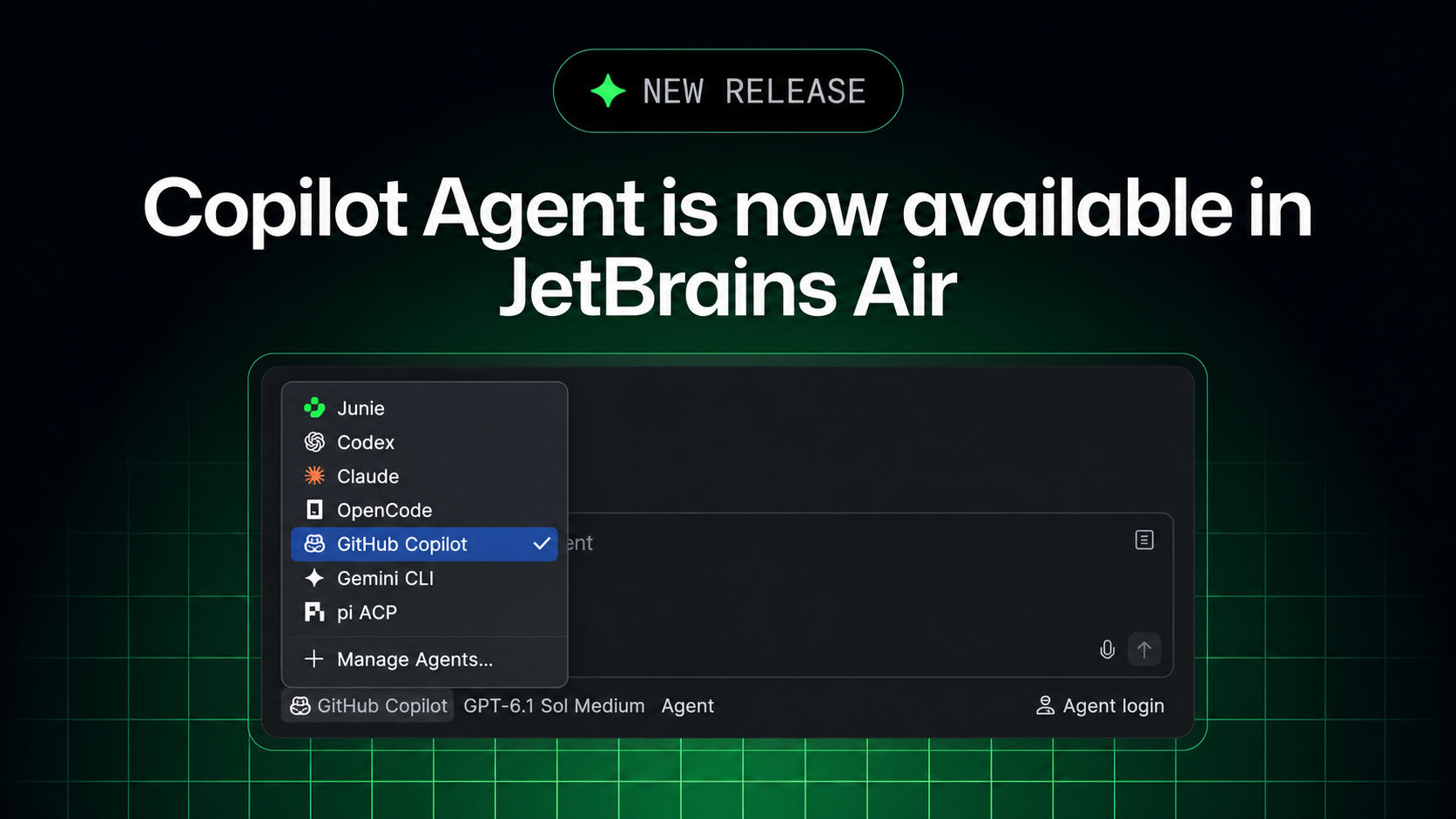
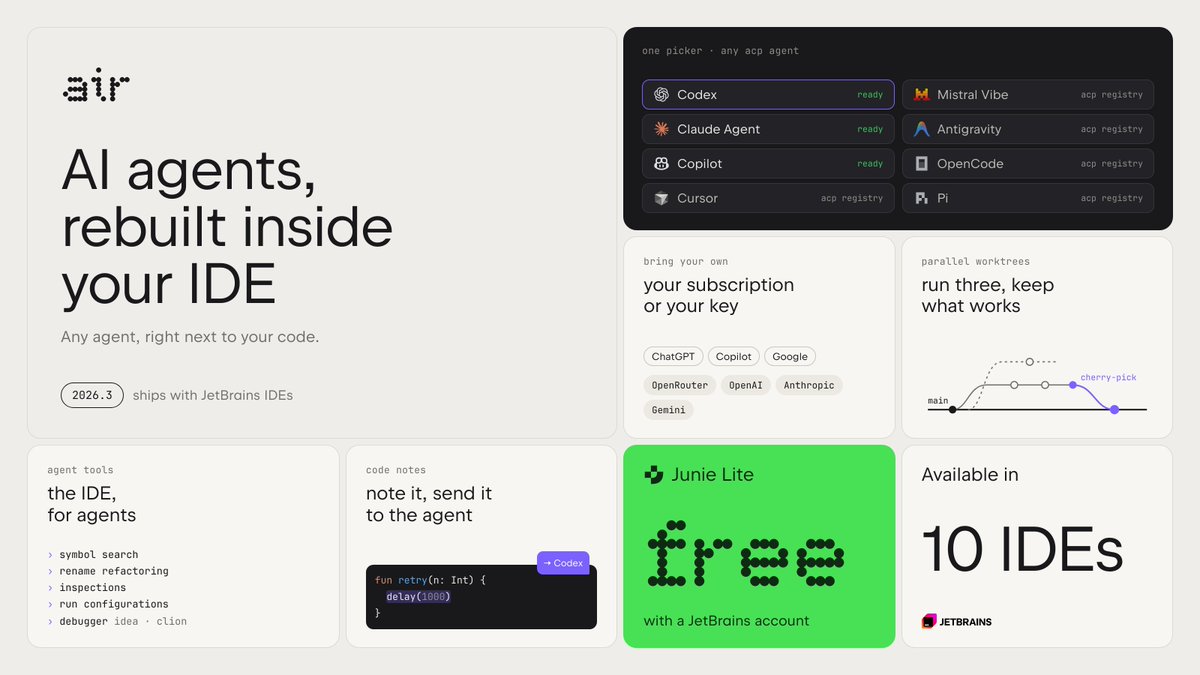
On 2026-11-06, JetBrains (@jetbrains) amplified Head of AI in IDE Denis Shiryaev: starting with 2026.3, Air ships with all JetBrains IDEs. Connect Claude Agent, Codex, GitHub Copilot, and Junie in-IDE, and add Gemini CLI, OpenCode, and more via the ACP registry; local sessions need no JetBrains AI subscription, and Junie Lite is free with a JetBrains Account. Official 2026.3 blogs (IntelliJ / CLion / PyCharm, ~2026-11-05) and jetbrains.com/air/ides match.
JetBrains 2026.3 Ships Air Natively: Run Claude Agent, Codex, Copilot, Junie in-IDE; BYO Subscriptions Locally; Junie Lite Free

Key Takeaways

  • Source: @jetbrains amplify on 2026-11-06 of @literallydenis (JetBrains Head of AI in IDE); CLion/IntelliJ 2026.3 blogs ~2026-11-05
  • Ship: Air ships natively with all JetBrains IDEs from 2026.3 (follow-on to October EAP)
  • Agents: Claude Agent / Codex / Copilot / Junie out of the box; Gemini CLI, OpenCode, Antigravity, Pi via ACP registry
  • Billing: local BYO ChatGPT/Copilot/Google/Claude subscriptions or API keys—no JetBrains AI required; Junie Lite free with a JetBrains Account
  • Capabilities: parallel Git worktrees, line comments on diffs, MCP/Skills, IDE symbol search/refactor/inspections/run configs; debugger in IDEA/CLion
Read full story

Moonshot Ships Kimi Hosted Agents GA: Harness as a Service, Cloud Sandbox About ¥0.072/hour, 140+ Skills and kha CLI

On 2026-11-05 Moonshot officially launched Kimi Hosted Agents, selling the agent runtime harness as a cloud service: isolated sandboxes, persistent sessions, failure recovery, and audit export, billed as sandbox hours + model tokens + plugin calls. Official docs list 140+ Skills and 30+ plugins, plus kha CLI, console, and REST API (kimi-api-version: 2026-09-01-beta). Self-hosted sandboxes are enterprise-verified only.

Moonshot Ships Kimi Hosted Agents GA: Harness as a Service, Cloud Sandbox About ¥0.072/hour, 140+ Skills and kha CLI

Key Takeaways

  • Official: GA on 2026-11-05 as Harness as a Service—no self-built sandbox/session/retry stack required
  • Billing (official pricing): total = sandbox hours × ¥0.072/hour + model inference + Σ(plugin calls × unit price)
  • Bundle: vendor says 140+ Skills and 30+ plugins; product overview lists 12 official templates (finance/game/SRE/community)
  • Start: platform.kimi.com; recommended path is kha CLI install + kha login, or REST/SSE
  • Limits: self-hosted environments and Inference Hook are enterprise-verified only; API still tagged 2026-09-01-beta
Read full story

OpenAI Codex CLI 0.167.0: Agent Command Center with Unread Marks, Backend Switching that Keeps Drafts, Vertex AI Setup Wizard

On 2026-11-06 OpenAI shipped Codex CLI 0.167.0 on GitHub and the ChatGPT/Codex changelog. Open the agent command center with codex agents --no-daemon (unread results marked); switch connected backends in the terminal session picker while keeping drafts; preview local images; expand patches during approval prompts; optionally enable a Google Cloud Vertex AI setup wizard.

Key Takeaways

  • Official: GitHub rust-v0.167.0 (2026-11-06T01:40Z) and same-day ChatGPT/Codex changelog entry
  • Command center: codex agents --no-daemon; unread results marked in the center and session picker
  • Multi-backend: switch connected backends from the terminal session picker while keeping drafts
  • UX: local image previews in supported terminals; expand patch details while an approval prompt is open; network approval prompts close when requests end and serialize per endpoint
  • Auth: enable gcp_setup_wizard for Vertex AI under Sign in another way (ADC or credential file); opt into macOS/Windows system proxies from /experimental
Read full story
Linked Models & Agents:

Hugging Face ML Intern Available as Installable Slack Bot for Workspace ML Tasks

On 2026-11-05 Hugging Face said its open-source ML Intern is available as a Slack bot you can install in your own workspace. Mention @ML Intern to evaluate models, build datasets, and fine-tune using your own Hugging Face account; each thread is a session with an approved compute budget and optional HuggingChat MCP servers.

Hugging Face ML Intern Available as Installable Slack Bot for Workspace ML Tasks

Key Takeaways

  • Official: @huggingface 2026-11-05; docs ML Intern in Slack; install at huggingface.co/chat/slack/install
  • Form: Slack bot running the same agent as HuggingChat, billed and publishing under each user's HF account
  • Capabilities: evaluate models, build datasets, fine-tune; connect data/files and HuggingChat-enabled MCP servers
  • Sessions: each thread is its own session (up to 200 messages, 10 attachments); Jobs/sandboxes need an approved compute budget (starts at $0)
  • Limits: Marketplace-only workspaces cannot install; Enterprise Grid needs per-workspace installs
Read full story
ADSponsored

DigitalOcean Launches Cuttlefish: iPhone App to Approve, Steer, and Pause Managed Agents

On 2026-11-05 DigitalOcean launched Cuttlefish, a native iPhone app for Managed Agents (Public Preview): follow live sessions and tool calls, approve or deny full commands or diffs, require Face ID/passcode for high-risk actions, and steer, pause, checkpoint, or roll back. Sessions run in cloud microVMs that keep going when the phone is locked or offline. With Box as launch partner, Box Mount (Private Preview) syncs a Box folder into the agent sandbox under Box permissions and version history.

DigitalOcean Launches Cuttlefish: iPhone App to Approve, Steer, and Pause Managed Agents

Key Takeaways

  • Official: @digitalocean post 2026-11-05 14:11 UTC; blog introducing-cuttlefish; App Store, Public Preview
  • Live sessions/reasoning/tool calls; approve full command, path, or diff; Face ID/passcode for high-risk; steer, pause, resume, stop
  • In-app previews of sites/docs; browse workspace files; checkpoints with fork/rollback
  • Supervises harnesses including Claude Code, Codex CLI, OpenCode, OpenHands, Hermes, LangGraph, CrewAI
  • Box Mount (Private Preview): sync a Box folder into the sandbox; edits/deletes write back with Box permissions and version history
Read full story

Nous Research Ships Hermes Agent v0.23.0 “The Hearth”: Browser Webapp Desktop, Unified Gateway Sessions, Plugin Catalog Past 1,050

On 2026-11-05 Nous Research released Hermes Agent v0.23.0 (The Hearth). Your gateway can serve the full Desktop in a browser; CLI/TUI/Desktop/editors/bots/cron share one session authority; the plugin catalog grew from ~600 to 1,050+; plus conversation rewind, inline terminal images, and paid-MCP spend limits. Official: ~1,950 merged PRs and 666 contributors.

Nous Research Ships Hermes Agent v0.23.0 “The Hearth”: Browser Webapp Desktop, Unified Gateway Sessions, Plugin Catalog Past 1,050

Key Takeaways

  • Official GitHub release: Hermes Agent v0.23.0 (2026-11-05), codename The Hearth
  • Webapp: gateway serves full Desktop in a browser (off by default; webapp.enabled)
  • Unified sessions: one gateway owns chats so surfaces stop double-writing
  • Plugin catalog ~600→1,050+ with a Verified tier; paid MCP tools can declare cost + chat spend caps
  • Since v0.22.0 (vendor): ~10,080 commits / ~1,950 PRs / 666 contributors
Read full story
Linked Models & Agents:

AWS Kiro Crew Ships Bots GA: Named Long-Running Agents with Own Memory and Parallel Sessions — Delegate Processes, Not Tasks

On November 5 Kiro (@kirodotdev) announced Kiro bots GA in open-source multi-agent Kiro Crew. Each bot has persistent Notes, its own workspace and Dashboard; it launches parallel workers, redirects drift, consolidates results, and asks approval when needed — with schedules and per-role minimal tool permissions.

AWS Kiro Crew Ships Bots GA: Named Long-Running Agents with Own Memory and Parallel Sessions — Delegate Processes, Not Tasks

Key Takeaways

  • Primary: @kirodotdev 2026-11-05 post + official blog Introducing bots in Kiro Crew
  • Shape: named long-running bot = Notes memory + parallel workers + one ongoing chat
  • Capabilities: monitor/redirect/consolidate; schedules; Dashboards
  • Permissions: tools scoped per role; expansion needs approval; Notes editable
  • Start: Kiro Crew sidebar Bots → Add a bot (default or custom agent)
Read full story

Meta Rolls Out Muse Realtime Avatar in the US Muse App: Speech-Driven Expression and Gesture at ~870ms First-Byte Latency

On November 5 Meta AI (@AIatMeta) said Muse Realtime Avatar, previewed at Connect, is rolling out in the US Muse app, turning Muse Realtime Voice into interactive live avatars. The research blog describes an audio-driven Diffusion Transformer that shares the speech-token stream with voice for lip-sync and expression; a single GB200 session streams 448×768 at 25 fps with about 870 ms from end of user turn to first synchronized audio-video byte, with Meta Video Seal invisible watermarking. Muse is for users 18+; no global schedule or developer API was announced.

Meta Rolls Out Muse Realtime Avatar in the US Muse App: Speech-Driven Expression and Gesture at ~870ms First-Byte Latency

Key Takeaways

  • US Muse app rollout of Realtime Avatar after the Connect preview (@AIatMeta)
  • Shared speech VQ tokens drive audio decode and avatar video; causal chunks with self-forcing distillation cut ~120 teacher NFEs to 2 student NFEs (~60x)
  • Vendor perf: 448×768@25fps, ~870ms first-byte latency; ~8x serving capacity vs BF16 baseline, up to 12 concurrent sessions on one GB200
  • Vendor preference study favored Muse over Runway Characters and HeyGen LiveAvatar on overall and most axes
  • Safety: Video Seal invisible watermark; blog demos are not the full in-app avatar set; no public developer API stated
Read full story
Linked Models & Agents:
⚡ Muse Spark⚡ Muse Presence🤖 Muse🌐 Meta

GitHub Copilot Comes to JetBrains Air: Run Coding Tasks Locally in the IDE or in Isolated Cloud Environments via ACP, Billed to Your Copilot Subscription

On November 3 GitHub announced on its official changelog that GitHub Copilot is now available in JetBrains Air. The integration is built on the Agent Client Protocol (ACP): developers pick Copilot in Air's agent picker, delegate coding tasks, track several sessions in parallel and review changes next to their code. Tasks can run locally in a JetBrains IDE or in isolated cloud environments through Air Teams, and they draw on the Copilot subscription rather than JetBrains AI credits.

GitHub Copilot Comes to JetBrains Air: Run Coding Tasks Locally in the IDE or in Isolated Cloud Environments via ACP, Billed to Your Copilot Subscription

Key Takeaways

  • Copilot now appears in JetBrains Air's agent picker and works with an existing Copilot account
  • The integration uses the Agent Client Protocol (ACP) and can be used alongside the existing GitHub Copilot plugin
  • Developers can track multiple agent sessions in parallel and review changes next to their code using project context and IDE tools
  • Cloud tasks run through Air Teams, each in a Docker container on a fresh virtual machine, with traffic through a proxy and no state kept between tasks
  • Cloud tasks use the Copilot plan rather than JetBrains AI credits, but Air analytics do not include Copilot usage and admins cannot set Copilot spending limits inside Air
Read full story

Claude Code Background Subagent Status Lines Now Written by Haiku 5.5: About 99% Cheaper per Update, About 6% More Prompts per Limit

On November 4 ClaudeDevs, Anthropic's official developer account, said the status line that a background subagent in Claude Code refreshes every 30 seconds used to re-read its whole conversation each time, and is now written by Haiku 5.5 from short notes, so each update costs about 99% less. Anthropic says sessions with background subagents used about 5% less of the limit, giving about 6% more prompts on the same limit. It is live for most Pro, Max and Ultra users and everyone on Team and Enterprise, on v2.1.316 or later.

Key Takeaways

  • A background subagent refreshes its status line every 30 seconds, and each refresh used to re-read the subagent's whole conversation
  • Haiku 5.5 now writes the status line from short notes, which Anthropic says makes each update about 99% cheaper
  • The subagent itself keeps its own model; only the status line is written by Haiku 5.5
  • Anthropic says sessions with background subagents used about 5% less of the limit, so the same limit gives about 6% more prompts
  • It is live for most Pro, Max and Ultra users and everyone on Team and Enterprise; update to v2.1.316 or later
Read full story
ADSponsored

Google Antigravity v2.29 Brings Remote Agents and a Gemini Live Voice Mode: Agent Sessions Run in a Google-Managed Cloud and Keep Working After You Close Your Laptop, Rolling Out to AI Pro and Ultra

Ivan Leo, who works on developer experience at Google DeepMind, shared the official docs for Antigravity's new Remote Agents feature on X on November 4. Per the docs, Remote Agents run agent sessions and tools in an isolated, Google-managed remote environment, so tasks keep going when you close your laptop or browser or switch between desktop and mobile. Sessions start from the Antigravity App, the Antigravity CLI (1.4.12+, agy --remote-agent) or the web at antigravity.google.com, and remote projects can attach GitHub repositories, Google Drive files and uploads. It is rolling out gradually to Google AI Pro and Ultra subscribers on personal accounts; it is not available on the free plan, AI Plus or business accounts. The official changelog shows this ships in Antigravity v2.29.0 (November 3), which also starts rolling out a voice mode powered by Gemini Live for handing requests to the agent by voice, redesigns the Automations page into Scheduled, Always on and Paused lists, and adds a native Jupyter notebook viewer.

Key Takeaways

  • Remote Agents run in an isolated Google-managed environment with no local machine required; Remote Control instead connects to your own computer or server, and the web sidebar switches between them.
  • Three entry points: a New Remote Project in the Antigravity App, agy --remote-agent in CLI 1.4.12+, or antigravity.google.com in any browser, including mobile.
  • Remote projects can attach GitHub repositories (cloned automatically), Google Drive files and uploads (8 MiB per file, 100 MiB per project, 2 GiB per account).
  • CLI remote sessions default to the always-proceed (turbo) permission preset, so commands run without approval; locally installed MCP servers, plugins and skills are not available remotely yet.
  • Also in v2.29.0 (November 3): a Gemini Live voice mode rolling out gradually, a redesigned Automations page, and native rendering of .ipynb notebooks.
Read full story

SenseTime Ships SenseNova 6.8 Flash: An Office Agent Model With Long-Term Memory and Proactive Interaction That Builds Animated Slides, Motion Posters and Editable Blender 3D Projects

On the evening of November 2, SenseTime released the official version of SenseNova 6.8 Flash, a multimodal agent model with two main upgrades. First, long-term memory and proactive interaction: it keeps user goals and constraints across tasks and sessions and flags affected items when information changes. Second, design generation across Web, SVG, Three.js, Blender, animated PPT and motion posters, with Figma integration. It is live in SenseNova Studio, the Raccoon assistant and the SenseNova Token Plan; the official X account says the Token Plan offers a free trial of 1,500 API requests every 5 hours. SenseTime says it beats some international frontier models on agent collaboration, data analysis and presentation generation, but the announcement lists no specific scores.

SenseTime Ships SenseNova 6.8 Flash: An Office Agent Model With Long-Term Memory and Proactive Interaction That Builds Animated Slides, Motion Posters and Editable Blender 3D Projects

Key Takeaways

  • The official release landed on the evening of November 2, positioned as a multimodal agent model for office collaboration and design delivery
  • Long-term memory plus proactive interaction: it remembers goals, constraints and preferences across sessions and suggests changes when related information shifts (demos ran on an internal Raccoon build)
  • Design output spans Web, SVG, Three.js, Blender, animated PPT and motion posters, producing editable PPTX files and Blender projects, with Figma integration
  • Available in SenseNova Studio, the Raccoon assistant and the SenseNova Token Plan; the official X post cites 1,500 free API requests every 5 hours
  • SenseTime only says it beats some international frontier models on agent collaboration, data analysis and presentation generation; no scores were published and there is no independent evaluation yet
Read full story
Linked Models & Agents:
⚡ SenseNova 6.8 Flash⚡ SenseNova Loop-9B-Preview🤖 Raccoon🌐 SenseTime

Parameter discloses a ChatGPT share-link flaw that let one opened link read private chats; OpenAI fixed it Oct 26 and rated it P1

Security firm Parameter published an exploit chain in which an attacker publishes a malicious conversation through ChatGPT's normal sharing feature; when a signed-in victim opens the /share/ link, the payload runs as chatgpt.com in their session, lists conversations, reads a private chat that was never shared, and sends data out. Parameter reported it through OpenAI's bug bounty on October 18; OpenAI raised it from P2 to P1, fixed it on October 26 and paid a $5,000 bounty. Parameter reports no real-world use, and users do not need to do anything.

Parameter discloses a ChatGPT share-link flaw that let one opened link read private chats; OpenAI fixed it Oct 26 and rated it P1

Key Takeaways

  • Timeline: reported Oct 18; OpenAI reproduced it Oct 21 and raised it from P2 to P1; both web frontends fixed by Oct 26; published Oct 28 (Parameter writeup)
  • Very low bar: no app install, project join or pasted code; in the auto-preview variant, opening the link was the only action, firing after about 4.5 seconds (per Parameter)
  • Three root causes: MathLive did not check the message sender, the message could carry raw HTML as keyboard-layout data, and that HTML could create an unsandboxed iframe with the chatgpt.com identity; YouTube JSONP was only the final CSP bypass
  • Bounty was $5,000; Simon Willison called it "a bit cheap" for a flaw this serious (blog)
  • MathLive 0.111.2 (Oct 31) now defaults to same-origin validation and blocks cross-window custom HTML layouts (changelog)
Read full story

DeepSeek Harness team open-sources dsh-superagent, a proactive coding agent prototype for a single GitHub repo, alongside its Super-agent architecture article

On Oct 31, deepseek-ai open-sourced dsh-superagent-prototype on GitHub under the MIT license: a proactive coding agent that runs as a DeepSeek Harness bundle, lives on one GitHub repository and can optionally listen to Feishu. When an allowed person asks for work, it opens a work item, works in its own session and directory, and answers in the original conversation, for example with a pull request. The README states it is a research prototype, not an official DeepSeek product. The companion article, Exploring Super-agent Design, proposes a two-layer Router-Worker architecture; the team test, as reproduced by media, reports a p95 completion time of 15.7 minutes versus 29.5 minutes for a single-session setup.

Key Takeaways

  • Open source: deepseek-ai/dsh-superagent-prototype went public on Oct 31 under MIT, written in TypeScript, with about 1,800 stars at the time of writing
  • Scope: each deployment serves 1 GitHub repository, with optional Feishu; it acts only when an allowed person addresses it or a team-written rule allows it
  • Delivery: by default it only allows auto-merge for an approved pull request opened for a ticket with fewer than 200 changed lines, and never enables auto-merge as the agent account
  • Team test (as reproduced by media, vendor-reported): in a simulation with about 300 messages and 20 requests, p50 / p95 completion was 12.4 / 15.7 minutes versus 20.4 / 29.5 for a single session with a subagent tool
  • Risk: worker sessions run commands without approval as the operator's OS user, and the README asks users to review and adapt the code first
Read full story

Microsoft Research and UC Berkeley open-source TokenEconomizer, a plugin that cuts Claude Code and Codex costs by 18.4–30.9% on SWE-Bench without changing the agent

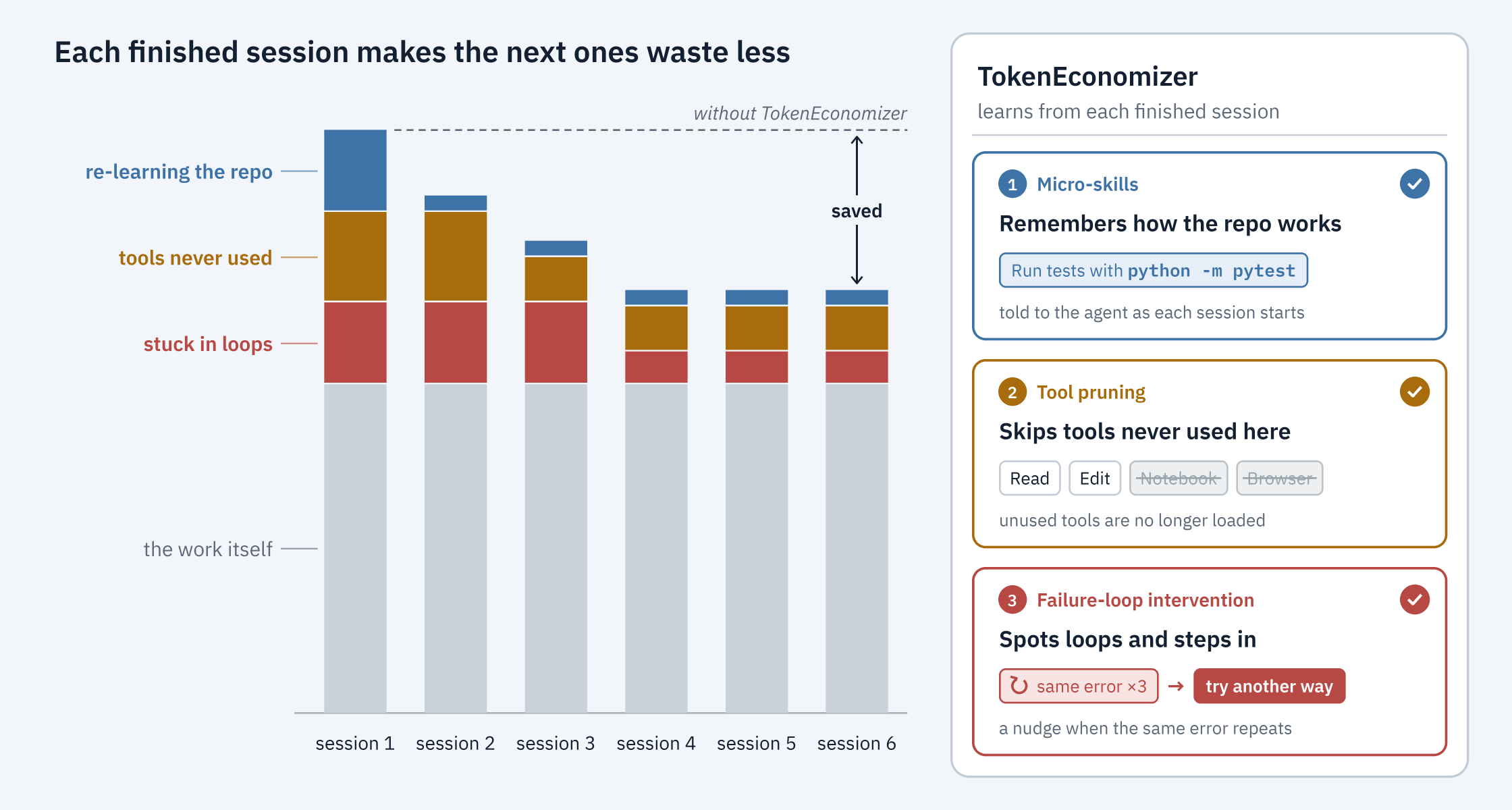
Microsoft Research, Microsoft Security and UC Berkeley open-sourced TokenEconomizer on GitHub (Apache 2.0, v0.1.0 released October 26), a plugin for Claude Code, Codex, GitHub Copilot CLI and Pi, with experimental opencode support. It learns from earlier sessions in the same repository: micro-skills remember repo facts, tool pruning drops tool definitions that go unused, and a loop guard nudges an agent that is stuck. The paper reports 18.4–30.9% lower mean cost across five agent and model combinations on 277 SWE-Bench tasks (paper figures).

Microsoft Research and UC Berkeley open-source TokenEconomizer, a plugin that cuts Claude Code and Codex costs by 18.4–30.9% on SWE-Bench without changing the agent

Key Takeaways

  • Cost: on 277 SWE-Bench tasks across 6 repositories and 5 agent and model combinations, mean cost fell 18.4–30.9%, and all 30 repository-by-combination cells got cheaper (paper figures, including the plugin's own model calls)
  • Success rate: Pass@1 rose in 4 of 5 combinations, e.g. Copilot CLI with Sonnet 5 cost 18.4% less with Pass@1 +2.6, while Claude Code with Opus 4.8 cost 30.9% less with Pass@1 -1.0
  • Three mechanisms: micro-skills (repo facts stated only after three sessions confirm them), tool pruning (by default a tool unused over 10 prompts across 2 sessions is left out), and a failure-loop guard (one redirect when a judge is at least 0.7 confident, never stopping a turn itself)
  • Generalization: 16–21% lower cost on Web-Bench and 6–20% lower on two security-auditing benchmarks where every task is a new repository
  • Deployment: Apache 2.0, Python 3.10+, no API key of its own, and learned experience stays local in ~/.tokeneconomizer
Read full story