AI Coding Live News

Meta Rolls Out Muse Realtime Avatar in the US Muse App: Speech-Driven Expression and Gesture at ~870ms First-Byte Latency

On November 5 Meta AI (@AIatMeta) said Muse Realtime Avatar, previewed at Connect, is rolling out in the US Muse app, turning Muse Realtime Voice into interactive live avatars. The research blog describes an audio-driven Diffusion Transformer that shares the speech-token stream with voice for lip-sync and expression; a single GB200 session streams 448×768 at 25 fps with about 870 ms from end of user turn to first synchronized audio-video byte, with Meta Video Seal invisible watermarking. Muse is for users 18+; no global schedule or developer API was announced.

Meta Rolls Out Muse Realtime Avatar in the US Muse App: Speech-Driven Expression and Gesture at ~870ms First-Byte Latency

Key Takeaways

  • US Muse app rollout of Realtime Avatar after the Connect preview (@AIatMeta)
  • Shared speech VQ tokens drive audio decode and avatar video; causal chunks with self-forcing distillation cut ~120 teacher NFEs to 2 student NFEs (~60x)
  • Vendor perf: 448×768@25fps, ~870ms first-byte latency; ~8x serving capacity vs BF16 baseline, up to 12 concurrent sessions on one GB200
  • Vendor preference study favored Muse over Runway Characters and HeyGen LiveAvatar on overall and most axes
  • Safety: Video Seal invisible watermark; blog demos are not the full in-app avatar set; no public developer API stated

Read full story
Linked Models & Agents:
⚡ Muse Spark⚡ Muse Presence🤖 Muse🌐 Meta
x
xAIdocs.x.ai·
👀67
🔥82

xAI will add an invisible watermark to Grok API text by default from Nov 7, covering grok-4.7 and six other models, with per-model admin opt-out

On Oct 31, xAI (signed as SpaceXSI in its docs) added an "Output Watermarking" page to its API docs: starting November 7, 2026, text generated by grok-4.7, grok-4.6, grok-4.5, grok-4.3, and the reasoning, non-reasoning, and multi-agent versions of grok-4.20 will carry an invisible watermark by default, to comply with the EU AI Act. It covers ordinary text, structured outputs, and tool call arguments on both the Responses and Chat Completions APIs, and works by slightly shaping token choice without adding any characters. Developers can read the x-watermark response header to check; team admins can opt out per model in the Console, but must confirm a legal exception applies, and some models may be locked on.

Key Takeaways

  • Timing: on by default from November 7, 2026, with no code change and no request parameter (xAI docs)
  • Scope: 7 model IDs (grok-4.7, 4.6, 4.5, 4.3, and grok-4.20 reasoning, non-reasoning, and multi-agent) on the global and regional endpoints, across both Responses and Chat Completions
  • Coverage: ordinary text, structured outputs, and tool call arguments; the response header x-watermark: true marks a watermarked output
  • Opt-out: team admins switch it off per model, effective for new requests within 5 minutes and logged in the audit log; admins must confirm a legal exception applies, and some models are locked on
  • xAI's position: no effect on quality or speed; detection is statistical with three outcomes (watermarked, not watermarked, uncertain), and the detection API is by application
Read full story
A
Anthropic (Claude Help Center)support.claude.com·
👀22
🔥82

Anthropic extends Claude text watermarking to older models including Mythos 5, Opus 4.7/4.6 and Sonnet 4.6, reportedly from November 3

Anthropics help center article "How Claude marks AI-generated content" (updated Oct 28) now lists older models released before Aug 2, 2026, including Claude Mythos 5, Opus 4.7, Opus 4.6, Opus 4.5, Sonnet 4.6 and Sonnet 4.5, as carrying text watermarks on first-party surfaces, and says Anthropic is adding watermarks to these models to meet EU AI Act Article 50 transparency duties. According to a customer email screenshot reported by outlets such as MACCUS, the legacy rollout starts Nov 3, with Amazon Bedrock possibly a few days later; Anthropics public pages do not state that date. The watermark follows Google DeepMinds SynthID-Text approach, adds no hidden characters or extra tokens, and detection is in private preview only for regulators, media, researchers and similarly obligated organizations, which has drawn complaints on X that users cannot check their own text.

Anthropic extends Claude text watermarking to older models including Mythos 5, Opus 4.7/4.6 and Sonnet 4.6, reportedly from November 3

Key Takeaways

  • Scope: in the official support table, older models such as Mythos 5, Opus 4.7/4.6/4.5 and Sonnet 4.6/4.5 are ticked only for first-party text watermarks; cloud-partner watermarks and C2PA file credentials remain limited to models launched after Aug 2 (see the help center)
  • Timing: a customer email reported by media puts the start at Nov 3, with Bedrock possibly a few days later (MACCUS); Anthropics public pages give no date
  • Cost and quality: Anthropic says the watermark adds no characters, no extra tokens and no extra cost, using a variant of SynthID-Text (see Anthropics explainer)
  • Detection: the detection API is in private preview for regulators, law enforcement, media, fact-checkers, researchers and obligated enterprises; ordinary users cannot check text yet
  • Reach: watermarks apply worldwide across Claude, the Claude Platform API, Claude Code, Cowork and Tag, because Anthropic says it has no durable way to scope them by region yet
Read full story

OpenAI details textGrain text watermarking for the EU AI Act: invisible watermarks coming to ChatGPT and Codex output in the EU, opt-in for API customers worldwide

On Oct 5 OpenAI described its response to the EU AI Act's machine-readable text requirement: API customers worldwide can now opt in to text watermarking for select models (off by default), and in the coming weeks eligible ChatGPT and Codex text output in the EU will carry an invisible watermark across all plans. The technique, textGrain, embeds a statistical signal in word choices; OpenAI says it matched or beat SynthID for text and plans to open-source it. The detector is limited to approved researchers. At 1% false-positive rate, detection is ~80% on 200-token and ~95% on 400-token passages, falling to 17% after 25% synonym replacement; Astra benchmarks show no meaningful quality change.

OpenAI details textGrain text watermarking for the EU AI Act: invisible watermarks coming to ChatGPT and Codex output in the EU, opt-in for API customers worldwide

Key Takeaways

  • Scope: invisible watermarks on eligible ChatGPT and Codex text in the EU in coming weeks (all plans); API opt-in worldwide, off by default
  • Detection at 1% FPR: ~80% on 200-token passages, ~95% on 400-token; much lower for math-style text
  • Robustness: 10% synonym replacement drops detection ~92%→66%; 25% drops it to 17%
  • Quality: Astra (max) DeepSWE v1.1 72.80% vs 71.68%, Terminal-Bench 4.0 53.90% vs 56.06%, GPQA Diamond 94.44% vs 93.94% (unwatermarked vs watermarked)
  • Openness: textGrain technical report published, open-source release planned; detector limited to approved researchers
Read full story
ADSponsored

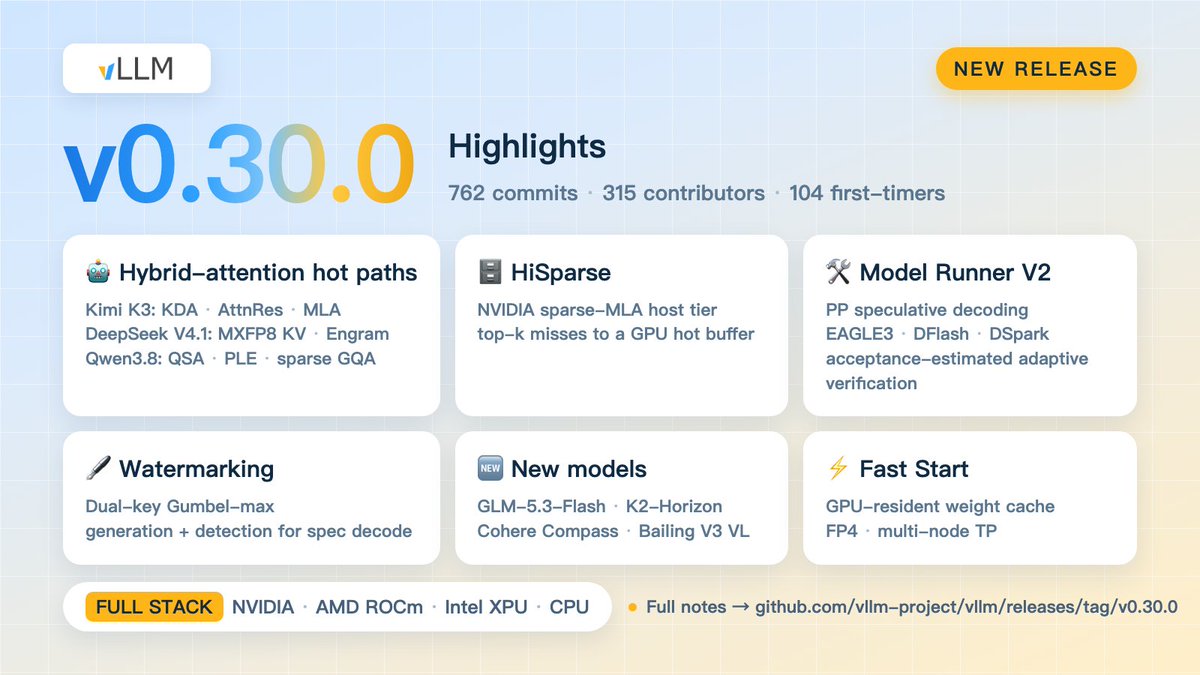
vLLM v0.30.0 ships 762 commits with hot paths for Kimi K3, DeepSeek-V4.1-Flash, Qwen3.8-Flash-Next

The vLLM project (@vllm_project) released v0.30.0 with 762 commits from 315 contributors. Highlights include hybrid-attention hot paths for Kimi K3 (KDA/AttnRes/MLA), DeepSeek-V4.1-Flash (MXFP8 KV and async Engram), and Qwen3.8-Flash-Next (QSA/PLE, lower sparse-GQA overhead); plus HiSparse host-tier decode, Model Runner V2 EAGLE3 pipeline parallelism with adaptive verification, dual-key Gumbel-max watermarking, Fast Start CUDA IPC weight cache, and new models such as GLM-5.3-Flash, K2-Horizon, Cohere Compass, and Bailing V3 VL.

vLLM v0.30.0 ships 762 commits with hot paths for Kimi K3, DeepSeek-V4.1-Flash, Qwen3.8-Flash-Next

Key Takeaways

  • Hybrid-attention hot paths cover Kimi K3, DeepSeek-V4.1-Flash, and Qwen3.8-Flash-Next.
  • Model Runner V2 brings EAGLE3-style drafts to pipeline parallelism with online acceptance estimation.
  • Fast Start maps post-quantized TP-sharded weights over CUDA IPC for faster restarts.
Read full story

NSA, CISA, and FBI Issue Joint Security Advisory on Industrial-Scale AI Model Distillation

In response to campaigns aimed at extracting proprietary capabilities from frontier models, the NSA, CISA, and FBI published a joint cybersecurity advisory. It mandates real-time semantic fingerprint watermarking, synthetic prompt topology filtering, and anti-distillation rate limiting on enterprise API gateways.

Key Takeaways

  • First multi-agency advisory addressing industrial-scale capability theft via API distillation
  • Recommends dynamic imperceptible watermarking and query entropy anomaly detection
  • Elevates model weight protection and synthetic data exfiltration to national cybersecurity priority
Read full story
Linked Models & Agents: